Most Popular Thai Dishes
An important (mostly unconscious) principle of Thai food is a balance of five flavors – spicy, salty, sweet, sour and bitter. The one indispensable ingredient which is used in seasoning many Thai dishes is fish sauce. Fish sauce is considered an essential ingredient in Thai cooking in much the same way as soy sauce is important to Chinese cooking. Thai food is eaten either as a single dish or with rice. Steamed rice is the staple food although sticky rice is more popular in the north and northeast of Thailand where special rice varieties are produced for their sticky starch qualities.
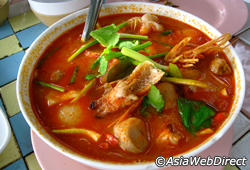
Tom Yam Goong (Sour & Spicy Lemongrass Shrimp Soup)
No other dishes can defeat this renowned Tom Yam Goong as the optimal representative of Thai gourmet. Tom Yam Goong is truly one of a kind with its fierce spiciness and sourness and a blatant use of fragrant herbs including galangal, lemon grass, kaffir lime leaves, shallot, tamarind and chili pepper.
There are two styles of Tom Yam; the clear spicy soup and thick spicy soup. The latter is cooked by adding coconut milk or milk to the broth in order to thicken the stock and give the dish a milder flavor. Tom Yam is very versatile and can be made with prawns, chicken, fish and mix of seafood, and mushroom. Tom Yam Goong is the most popular variety of Tom Yam since Spicy Shrimp Soup is the original. Though not very surprising, Tom Yam Goong is definitely a signature dish of Thailand.
Literally, the words "tom yum" are derived from two Tai words: "tom" and "yam". "Tom" refers to boiling process (soup, in this case). "Yam" refers to a kind of Lao and Thai spicy and sour salad. Thus, "tom yum" is a Lao and Thai hot and sour soup. Indeed, tom yum is characterised by its distinct hot and sour flavours, with fragrant herbs generously used in the broth. The basic broth is made of stock and fresh ingredients such as lemon grass, kaffir lime leaves, galangal, lime juice, fish sauce and crushed chili peppers.
Recipe for Tom Yam Goong
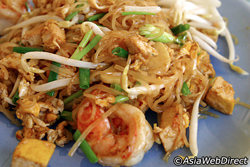
Pad Thai (Fried Noodle)
This national dish prides itself for its long history traced back in previous centuries. Pad Thai flaunts the authenticity of Thai culinary arts in using only fresh and best ingredients and the well-balancing of the five fundamental flavors. The stir-fried noodle has become popular because it tastes yummy and is served with a variety of seasonings to suit your tastes.
Through history, Pad Thai has evolved into two different styles: the classic and the variation. The classic Pad Thai is a stir-fried noodle with eggs, fish sauce, tamarind juice, red chili pepper plus bean sprouts, shrimp and tofu and garnished with crushed peanuts and coriander while another style is relatively dry and lightly-flavored. The latter is easily found in street vendors and dominant in Thai restaurants in the West but having classic Pad Thai freshly cooked in country of origin is the way to go.
Kuay Tiaw (rice noodles) Pad Thai
*Chez Pim's Pad Thai for Beginners
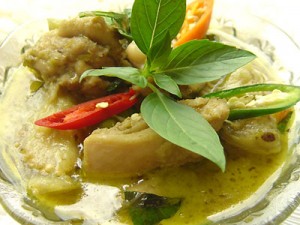
Kang Keaw Wan Gai (Green Chicken Curry)
"Gai" is the Thai word for chicken. Chicken is on of the popular meats used in Thai cuisine; it is usually available in most curries and soups. Kang Kiew Wan, literally translated as "Sweet Green Curry", is nicely sweet and slightly spicy and tastes very delightful with a proper blend of the spiciness from green curry chili paste, blandness from coconut milk, sweetness of sugar and saltiness of fish sauce. It is usually eaten with steamed rice or served as a sauce to rice noodle known as "œKanom Jeen"- a more 'spaghetti-like' noodle.
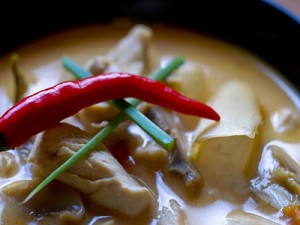
Tom Kha Gai (Chicken in Coconut Milk Soup)
Possibly the world's most refreshing soup, tom kha gai (boiled galangal chicken) combines coconut milk with lemongrass, galangal (ginger's Asian sister) and chicken. It's a sweet, tame twist on tom yam goong. Similar to Tom Yam Kai, the broth is prepared with many types of Thai herbs with the special addition of coconut milk that makes this soup unique. Though the soup is seasoned with chili, lime and fish sauce just like Tom Kha Kai, thanks to the coconut milk, the broth is milder and less spicy. This is probably more preferred by non-spicy eaters.
On a table filled with delectable Thai dishes, tom kaa gai stands out; your spoon will return to this bowl time and again.
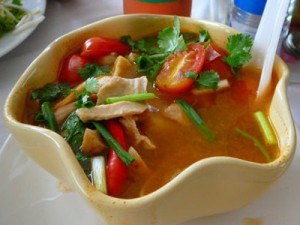
Tom Yam Gai (Spicy Chicken Soup)
Chicken soup is very good to eat when you have a cold but Tom Yam Gai or spicy chicken soup is a yummy treat that you will fall in love with just in a first sip. Tom Yam Kai is a clear chicken soup seasoned with a blend of chili, lime and fish sauce. The broth is simmered with Thai herbs as lemon grass, shallot and galangal which give it a unique and satiating aroma.
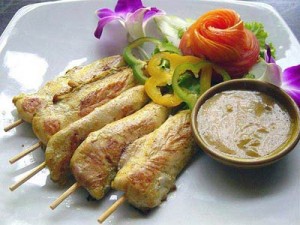
Moo Sa-Te (Grilled Pork Sticks with Turmeric)
This tantalizing sweet-flavored grilled pork sticks are refined with rich, juicy sauce made of turmeric and curry powder. Moo Sa-Te makes a savory hors d'oeuvres that will appease any taste buds. These juicy grilled pork sticks are usually served with two saucy dips – one is a mildly spicy thick sauce with ground peanuts, coconut milk and curry powder and another one is a sweet and sour vinegar sauce with chopped shallot, pepper and cucumber to mitigate its oiliness. Also made with chicken.
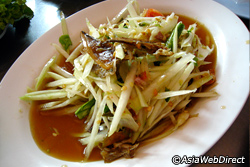
Som Tam (Spicy Papaya Salad)
Som Tam is one of the most popular foods among Thai people for its fiercely spicy and sour flavors. Som Tam, which literally means "Sour Pounded", is a spicy salad made from a mix of fresh vegetables including shredded unripened papaya, yardlong beans and tomato. Som Tam is unique that the spicy dressing and salad vegetables are pounded and mixed in the mortar using a pestle. Som tam is usually served with grilled chicken and sticky rice. Som Tam is good for your health that it contains no fat, low calorie and high vitamins. This is a truly authentic Thai dish that will make a great impression. Just say "Mai phed" (not spicy) to your waiter if you want less chili pepper.
Despite the use of papaya, which one may think of as sweet, this salad is actually savory. When not yet ripe, papaya has a slightly tangy flavor. The texture is crisp and firm, sometimes to the point of crunchiness. It is this that allows the fruit to withstand being beaten in the mortar.
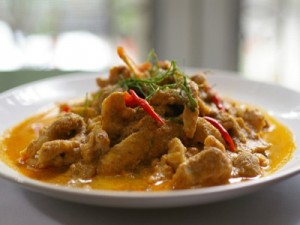
Panaeng (Meat in Spicy Coconut Cream)
Panaeng can be cooked using either pork, chicken or beef. Panaeng tastes like Thai red curry but the coconut milk sauce is thicker and richer. Compared to Thai red curry, Panaeng is mildly spicy and sweet. Paneang is best served with warm steamed rice. There is nothing to dislike about Panaeng expect the fact that it can be too meaty for some people that prefer vegetables with their dishes.
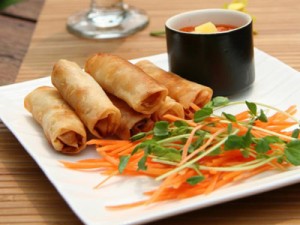
Por Pia Tord (Fried Spring Roll)
Fried spring roll is one of the most popular appetizers for foreigners because it is not spicy and comes with sweet and sour dip. Spring rolls are crispy pastries with fried vegetable fillings. Though spring rolls are commonplace in many Southeast Asian countries, Thai Por Pia is different in flavors with a special dip prepared from Japanese apricot.
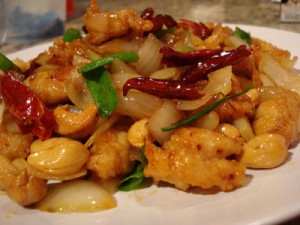
Gai Pad Met Mamuang (Stir-Fried Chicken with Cashew Nuts)
Even though Gai Pad Met Mamuang does not represent the overview of Thai food but it is a very nice treat to your taste buds. Since it is by no means spicy or hot, this slightly sweet and salty chicken fried with crunchy cashew nuts is aptly satiating for children or beginners who are not used to spices.
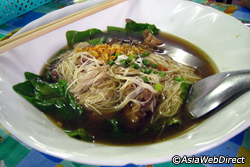
Kuay Tiew (Noodle Soup)
Brush up on your chopstick skills and get your slurping muscles ready, noodle soup is a quick-and-easy staple of the Thai eating experience. Variations in ingredients mean ten different vendors could serve it ten different ways ' making it nearly deserving of its own top ten list. Noodles ' usually thin, occasionally broad ' are served up in a broth with just about any edible meat: pork, chicken, beef, duck, and seafood being the most popular. One sample and you may not stop until you've tried them all.
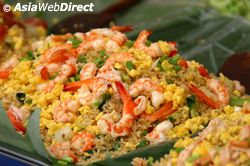
Kao Phad (Fried Rice)
Ah, good old fried rice. On first sight, kao phad appears to be little more than a big heap of rice; you call that a meal? But try it. Augmented with your choice of meat ' shrimp and chicken being the most popular ' and egg, onion, cilantro, garlic, and tomotoes, this is rice with hidden secrets. Spice to taste with chili sauce and enjoy.
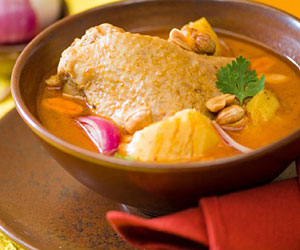
Massaman Curry
Mussaman (Thai word for "Muslim"), is the origin of this popular Thai curry, made from coconut milk, potatoes, roasted peanuts, bay leaves, palm sugar, cinnamon, fish sauce and tamarind sauce and a rich combination of various exotic spices.
Served with steamed rice, the meat of choice is often mutton, beef, or chicken, but Buddhists also use pork in their version. The potatoes help to thicken the curry and the roasted peanuts add a very tasty and crunchy effect. Known as the "King of Curries", gaeng mussaman is renowned as a very complex and time-consuming dish to prepare. However, when ready, it offers a heady combination, predominantly spicy, with a strong coconut, sweet, sour and savory combination of sublime flavours that make all the preparation well worth waiting for.
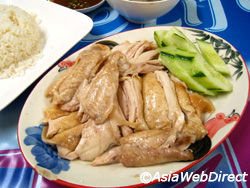
Khao man gai (Chicken and rice)
Khao Man Gai, one of the most common street foods in Thailand, is, in short, a mutation, albeit controlled, of Hainanese chicken and rice. This ubiquitous meal is served mostly during the daytime (while stocks last) at special khao man gai dedicated stalls and restaurants. The chicken is gently boiled until it is tender then the water is used in boiling the rice. Served with a chicken broth and a delicious piquant sauce of ginger, garlic, chillies, and soy, it's the perfect midday snack.
Slices of steamed or boiled capon meat are placed over a mound of rice. Cucumber slices and fresh cilantro leaves serve as a quintessential garnish. The chicken-rice plate is then accompanied by a bowl of piping hot chicken consommé with a few pieces of Chinese winter gourd swimming in it to be drunk between eating pieces of the chicken and rice.
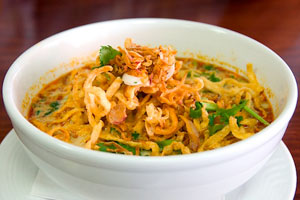
Khao Soi
Khao Soi is a curry noodle dish from the northern part of Thailand. It is often made with chicken, served over Chinese Bah-mi egg noodle, and garnished with fried noodles, shallots, cilantro, pickled mustard greens, fried whole chillis and a squeeze of lime juice. The dish is a seeming cacophony of taste, each strong and distinct yet they blend into one beautifully harmonious bowl and delicious bowl.
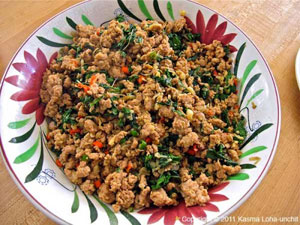
Gkai Pad Gkaprow (Thai Chicken w/ Basil)
This is a good and easy stir-fried dish and one of the favorites among Thai people. It is served over rice as a one-dish meal – for breakfast or for lunch, often topped with a crispy fried egg. Of course, it also appears frequently as one of the courses in a shared family-style meal.
If you are not able to find fresh holy basil, this recipe can be substituted with any fresh basil. The smaller the chicken is cut, the greater the surface area to coat with the flavors of the aromatic herbs and sauces, and the more flavorful the stir-fry will be. In Thailand, this dish is often made with chopped pork, or bird meat, especially in fast-food, curry-rice shops (rahn kao gkaeng), where an enormous variety of dishes are prepared ahead of time and served over steaming white rice to order.
Some of the best pad gka-prow can be had at rice shops in small towns, inconspicuous, no-frills, open-air places. They are made particularly spicy to help preserve the meat, as the dishes are prepared early in the morning and served throughout the day until they are sold out. A particular favorite is made with ground pork and lots of Thai chillies. For pork, make sure you use holy basil (Bai Gkaprow), as it goes especially well with pork. Try substituting fresh seafood (in this case, no need to chop) – shrimps, scallops, mussels, clams, crab and firm-flesh fish, such as fresh halibut and salmon.
Thai Chicken w/ Basil (Gkai Pad Gkaprow)
