Thai Curries
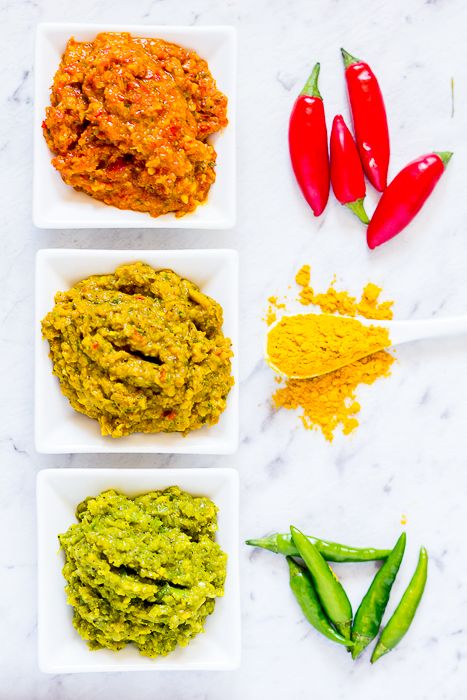
From top: red (red Thai bird chilis), yellow (turmeric),
and green (green Thai bird chilis) curry pastes
Curry is a favorite dish in Thai restaurants throughout the world and for good reason. Based on a delicious paste of fresh and dried herbs and spices, curry is unique and unlike any dish in Western cuisine. The endless combinations and fresh taste make curry a popular dish. But what exactly is curry?
Favored throughout Asia in many different forms, curry can be defined as a savory, stew-like dish flavored with herbs and/or spices. Curry is considered to be native to India, Pakistan, Sri Lanka and South East Asia. This method of cooking was brought to South East Asia by Indian immigrants over the past several centuries.
In Thailand, curry is usually a soupy dish consisting of coconut milk or water, curry paste and meat. Thai curries tend to be more soup-like compared to their thicker Indian cousins. Curries are the richest dish of Thai cuisine, being based on spicy herb and spice pastes, i.e. curry pastes. There are dozens of different types of curries in Thailand varying by the use of various types of curry pastes, the addition of coconut or water and different combinations of meats, herbs, vegetables and fruits.
Curry is a staple dish of Thailand and in many Thai homes it is eaten on a daily basis. Using ingredients commonly found growing around the home and very little meat, curry is an economical and healthy part of the Thai diet. High in vitamins and rich in protein, it is easily digested when eaten with rice as part of a Thai meal.
Note: You can make your own curry paste, but cooks and chefs often use ready-made curry paste. Of the different brands out there, Mae Ploy seems to be the favorite. My friend from work, Chakapope (Chuck) Sirirathasuk uses Mae Ploy. Thai Kitchen’s (a McKormick brand that is made in Thailand) red curry paste rated very low at https://hot-thai-kitchen.com/.
Types of Thai Curry
In Thailand there are basically two broad categories of curry: water-based and coconut milk-based.
Water-based Curries: The most typical water-based curry is sour curry (gaeng sohm plah) often prepared with fish. Typically the sourness comes from tamarind or other types of sour fruits such as lime. Jungle curry (gaeng pah) is another delicious water-based vegetable curry cooked with or without meat, which is usually very spicy. The spiciest curries in Thailand in general are the water-based curries, as there is no coconut fat to alleviate the heat. Unlike coconut-based curries where the paste is almost always sautéed, with water-based curries the paste is often added to the boiling water or stock and simmered to cook the herbs and allow the flavors to infuse.
Coconut milk-based Curries: Thai coconut-based curries are numerous and more well known in the West with red, green, yellow, panang and masamam being the most well known curries. In Thailand these curries are known as gaeng phet (red), gaeng kiow wahn (green curry), gaeng leuang (yellow), gaeng phanaeng (panang) and gaeng massaman (masamam). The most popular curry in Thailand is either gaeng phet (red curry) or gaeng kiow wahn (green curry) depending on which region of the country you are in.
Terminology of Curry
Curry is called gaeng phet in Thai. In Thai gaeng means liquid and refers to both soups and curries and phet means hot in the incendiary sense. When searching for a Thai curry recipe, note that often times the water-based curries are categorized with soups, because not all gaeng are spicy curries. Gaeng also encompasses mild flavored soups called gaeng joot i.e. clear Thai soups.
The various gaeng phet dishes are based on blends of fresh and dried herbs and popularly known as curry paste, or in Thai kreung gaeng or nam prik gaeng.
What is Curry Paste?
A marvelous aromatic mixture of freshly ground herbs and spices. Thai curry paste is not a dry spice powder blend as used in Northern Indian curries, but rather a wet paste made up of mainly fresh herbs and spices. In fact dry aromatic spices, prominent in Indian curries are used sparingly in Thai cuisine.
Curry pastes are the basis of curries throughout South East Asia. Thai, Indonesian, Malay, Cambodian and Vietnamese curry pastes are intense, thick moist blends of aromatic herbal ingredients and spices. Often times a ready-made curry powder is blended into the wet ingredients in Malay and Vietnamese curries, unlike Thai pastes.
The key ingredients in the majority of Thai curry pastes are mostly wet and fragrant: fresh chilies, lemon grass, galangal, garlic, shallot, kaffir lime, cilantro roots, and shrimp paste (kapee). These herbs and spices are appreciated not only for their taste, but also for their medicinal qualities (yah samun phrai).
Curry paste not only forms the basis of curry dishes in Thailand but also can be used in several other dishes, such as stir-fries.
Curry pastes form the basis of almost all Thai dishes – the exceptions are soups and vegetable stir-fries.”
The Art of Curry Paste
By varying the few herbs and spices making up the curry paste, the palette of flavors of the various pastes is amazing. As cooking instructor and cookbook author Kasma Loha-unchit notes, “After you have tried out recipes for several different kinds of curry pastes you will notice that many of the same ingredients are used, yet the resulting pastes are far from similar, varying the proportions of ingredients, prepping them differently (e.g. roasting or not roasting beforehand [spices, shrimp paste, garlic, etc]), deleting an ingredient, adding a new one or introducing a new twist somewhere in the process. All of these variations can produce entirely different curries unlike anything a comparison of ingredients may suggest” (Kasma Loha-unchit, It Rains Fishes: Legends, Traditions and the Joys of Thai Cooking © 1995).
The texture of the different Thai curry pastes also varies: “some kreung gaeng (curry pastes) run to the consistency of fresh clay, while others are as soft as cornmeal dough.” (Joe Cummings, Lonely Planet World Food Thailand, © 2000). With all this variety it's no wonder that curry is part of the daily repast for many Thai people!
Serving Curry
The curry dishes of Thailand have no direct equivalent in Western food, making it hard to translate exactly how to serve and eat curry. Curries are eaten spooned over plain steamed jasmine rice or kanom jeen (round rice noodles). This helps to cut the heat and the intensity of the flavors. To eat curry as we normally eat soup in the West is inappropriate because curries are packed full of intense spices, herbs and hot chilies. Diners normally share a bowl of curry which is accompanied by dishes with mild, salty, bitter and sweet tastes.
Once cooked, the curry is removed from the heat and usually allowed to cool while the other dishes of the meal are prepared. Curry can be served at room temperature over hot steaming rice. Or it can be served hot over room temperature rice, which helps to alleviate the heat.
More things to consider when serving a curry is to plan what dishes you pair your curry with - in Thailand the cooling factors are bland and salty - an example of a bland dish being gaeng joot (mild soup) and a salty dish is often fried salty fish.
Some Like it Hot!
Breaking into a sweat while eating curry is, for many, highly desirable. It is a sort of addiction once you eat curries on a daily basis for about a month. Gradually your tolerance for spicy food increases to an incredible level you never dreamed possible!
Reputedly there are many health benefits from eating chili peppers, including high Vitamin C content and increased metabolism rate.
If you like milder curry, simply omit the fresh whole chiles and/or add less curry paste. Another excellent hint is to first cook the rice and allow it to cool to room temperature, making it easier to eat spicy foods. The plain rice also offsets the spiciness of the curry.
Also consider which dishes to pair the curry with - in Thailand the cooling factors are bland, bitter and salty, so serve with a bland gaeng joot (mild soup), fried green vegetables (slightly bitter) and fried salty fish over room temperature jasmine rice. Most Thai meals aim towards a balance of the five flavors (sweet, salty, spicy, bland and bitter)with spicy being just one in a palette of tastes.
Comparing Thai and Indian Curries
Thai curry is not the same as Indian curry. Thais cook their curry dishes for a much shorter time and use more fresh herbs and garlic and fewer dry spices then in Indian curry. Thai curries in general also tend to be more soupy then Indian curries. The only two curry dishes in Thailand that are based mainly on dried herbs and spices, rather then fresh ones, are Massaman and Panang curry.
"A few Thai curries do resemble the Indian version, in which case the name kari is used, but the more usual term in Thailand is gaeng phet" (Vatcharin Bhumichitr, The Big Book of Thai Curries, © 2007).
Like Masala (a spice mix) used to prepare Indian curries, the following four spices are included in the majority of Thai curry pastes: hot chili peppers, cumin seeds, coriander seeds, and turmeric. In India other dried spices are added such as fenugreek, black pepper, asafetida, allspice, cardamom, cinnamon and nutmeg. But in Thailand fresh wet herbs are predominant including lemon grass, galangal, kaffir lime (leaf or peel) and grachai.
In both Indian and Thai cuisine fresh herbs like garlic are combined with dried spices to make the various curry pastes. In India this style is more prevalent in the southern part of the country, hence Thai curry has more in common with the curries of Southern India, where fresh spices and "other ingredients [are] ground with water, lime juice, vinegar or coconut milk to make a wet masala or paste" (Jennifer Brennan, Cuisines of Asia, © 1989).
In Thailand, curry paste does not normally include oil, water, lime or vinegar (unlike chili pastes which are used for other dishes). These elements can be added to the curry dish itself but are not blended into the curry paste. A typical basic curry paste in Thailand would consist of dried red chilies, cumin seeds, coriander seeds, lemon grass, garlic, coarse sea salt and shrimp paste.
Thai Curry by Region
There are numerous types of curries and curry pastes coming from the four distinct geographical regions of Thailand including different versions of the same basic curry pastes, such as red and green:
Central (Bangkok) - Green Curry is especially popular in this region
North (Chiang Mai) – Khao Soy and Hang Lay are two famous curry dishes (recipe for Chicken Khao Soi)
South – reputation for being the spiciest curries including Gaeng Tai Plah (spicy fish stomach curry), Gaeng Leung (yellow curry) and Masaman
North-East (Issan) – shrimp paste is not used in this landlocked region of Thailand; curries are simple peasant style and include Gaeng Aom.
Making Curry Paste
Traditionally Thai curry paste was prepared as needed in a heavy granite stone mortar and pestle. Today many Thais buy their pastes in the outdoor markets ready made with a large grinding machine. Though these pastes are a compromise, they are still fresher then those purchased in a can or otherwise, as these pastes are often made on a daily basis by a local merchant.
But nothing compares to curry paste prepared with the old fashioned mortar & pestle which is still the most efficient means of crushing fibrous herbs and aromatic roots to release their essential oils. To quicken the task, small stone mortar and pestle sets can be used in the modern kitchen to pulverize small quantities of dry seeds like coriander and cumin with better results than an electric coffee grinder. A mortar and pestle gives greater depth and breadth of flavor compared to processing herbs in a food processor. With a mortar and pestle, lemongrass, galangal and kaffir lime peel reduce to a moist paste and meld into one flavor when pounded.
The easiest approach to prepare homemade curry paste for an inexperienced Western cook is to start with the dry ingredients first, pulverizing in either a small mortar and pestle or an electric coffee grinder (used exclusively for spices). Mash all the other wet ingredients in the mortar and then mix the dried powdered spices with the wet spices. Note that whole spices are preferred over already ground spices in most cases, because the oils are retained that make them so flavorful.
Cooking with Curry Paste
Curry paste is most often blended into water or coconut milk to make a gaeng. In Bangkok the usual way of preparing coconut curry is to first bring the thick part of the coconut milk (i.e. coconut cream) to a rolling boil over high heat to reduce its volume and separate out the oil, which takes about 3-5 minutes. The curry paste is then added to the cream and the paste is fried in the cream until it is aromatic. The other ingredients follow.
If the curry paste is not fried first, the meat is boiled in the curried coconut milk or water and then the ingredients that take less time to cook are added - this is the more typical method in the South.
The curry is always brought to a rapid rolling boil, not simmered, unlike Western cooking. When cooking curries the pot is never covered, as this can cause the coconut milk to curdle.
At the end, be sure to add fish sauce and palm sugar to taste. You will need almost equal portions of both to really enhance the flavours. Fresh herbs like basil are added last to preserve their color and flavor.
Curry paste can also be stir-fried with other ingredients to make the dish paht peht, including pork, chicken or beef. Another popular spicy soup like dish is jungle curry (gaeng pah). Curries are eaten by spooning them over plain steamed jasmine rice, which helps to alleviate the spiciness and counter balances the multitude of flavors acting like a blank canvas. Soupy noodle curries like Khao Soy from Chiang Mai are also popular.
Curry by Color
A common way to categorize Thai curry is by the color of the curry paste used to make the curry dish.
Green and red curry paste are the most typical curry pastes in Thailand. Yellow and sour curries (also sometimes known as orange curry, gaeng sohm) are also well known and each has its own particular combination of herbs and spices to make up the curry paste that makes it unique. Panang and masaman curry are probably the most popular Thai curries in the West, because of their rich tastes.
Green Curry
Green curry paste (kreung gaeng keo wahn) is a blend of fresh green chilies and herbs and is used mainly to make Green Curry. This type of paste usually includes fresh green chilies, shallots, lemongrass, white pepper, coriander root, garlic, kaffir lime rind, shrimp paste and sea salt. Sweet basil leaves, round green eggplant and kaffir lime leaves add to the overall lovely green hue in the final curry dish.
Green curry is often considered to be the most popular curry in Thailand with Green Curry with Beef or Chicken (Gaeng Keow Wahn Neau reu Gy) or with fish dumplings being two common combinations. Green curry is “perhaps the most Thai in the sense that it is so different from the curries of other countries” (Kasma Loha-Unchit, It Rains Fishes: Legends, Traditions and the Joys of Thai Cooking © 1995). Some say this is the hottest curry in Thailand but this is not always true, as this depends on many factors, especially the palate of the cook. Nowadays green curry paste has become part of fusion food and features in recipes for salmon, spaghetti, pizza and whatever else the creative cook can think up.
Thai Green Curry Paste
Thai Green Coconut Curry Chicken
Thai Green Curry Mussels
Red Curry
Red curry paste (kreung gaeng phet daeng), with a ruddy hue, is the most versatile of the curry pastes, being used in the widest range of dishes, including coconut milk-based Red Curry Chicken with Bamboo (Gaeng Phet Naw My Gy). Red curry paste can be made with dried long red chilies (prik chee fah), cilantro root, coriander, cumin, garlic, shallots, kaffir lime rind, white peppercorn, lemongrass, shrimp paste, sea salt and galangal. It is prepared with chicken, duck, beef, pork, shrimp, stir-fries and haw mohk (Thai Curried Fish Mousse in Banana Leaf Cups).
The basic ingredients in a simple red curry paste are dried red chili peppers, whole cloves of garlic, sea salt, fresh lemon grass, fresh turmeric for color, and shrimp paste (ka-pee). You will find most published curry paste recipes with many more ingredients added to this basic recipe, but you can make a delicious curry with just these few staples.
Thai Red Curry Paste
Mussels Thai Style - Red Curry
Chakapope's Thai Red Curry Chicken
The main difference between the red and green curries is the type and color of chilies used in its preparation. Dried red chilies are used for red curry (and red curry paste). The same function is done with fresh, green chilies for green curry. Green curry also gets its color from additional ingredients like coriander and other vegetable additives. The two chilies have their own distinct flavor and taste characteristics. In Thai, red curry is called gaeng phed. The words literally translate as “spicy soup.” The green curry is translated as gaeng keow wahn or “sweet green curry.” In comparison, red curry is spicier and more savory compared to green curry. Red curries are loaded with bold depths of flavor. Meanwhile, green curry is milder and more on the sweet side. It gives a bright and sharp flavor.
Yellow Curry
Yellow curry (gaeng leung or gaeng karee ) is a Thai version of Indian yellow curry, including some dried spices in the curry paste. Yellow curry paste (nam prik gaeng karee) is a mellow sweet-spicy paste blend based on turmeric and curry powder pounded together with coriander, cumin, lemongrass, galangal, shrimp paste, dried red chilies, sea salt, ginger, garlic and shallots. This mild paste is usually used in fish stews or combined with coconut milk, chicken, onions and potatoes for Yellow Chicken Curry.
Recipe for Thai Yellow Curry Paste
Spicy Curry Noodle Soup With Chicken And Sweet Potato
(Orange) Sour Curry
Sour curry paste (kreuang gaeng sohm) is the simplest of the curry pastes and usually forms a water based curry with fish or pork. It is made up of just five ingredients: dried red chilies, shallots, sea salt, turmeric and shrimp paste. Sour curry is especially popular combined with fish. The sour element comes from the addition of sour tamarind (fresh or dried pulp), sour pineapple or other sour tropical fruits.
More Colorful Curries
Other popular types of curry pastes include:
Panang, which is named for the island off Malaysia’s West coast and is the basis for a richer, sweeter and drier curry. Using less coconut milk then red or green curry, Panang curry is topped with thick coconut cream and usually served on a plate. Panang curry paste can include dried red long chilies, shallots, garlic, galangal, lemongrass, kaffir lime rind, coriander root, white pepper, salt and shrimp paste. Peanuts are also sometimes added to the curry paste, making this curry especially popular with foreigners. It is most often prepared with beef in Thailand and preferred to be fiery hot.
Masaman curry includes Persian influenced, dried spices and is therefore rather unique amongst Thai curries. Originating in the deep South of Thailand on the border with Malaysia, where the population is largely Muslim, it is most often prepared with lamb or beef as the Islamic religion forbids the consumption of pork. Masaman curry paste combines dried red chilies, shallots, garlic, galangal, lemongrass, coriander, cumin, cloves, white pepper, salt and shrimp paste. The curry dish itself includes peanuts and whole spices such as cinnamon, white cardamom and nutmeg, which is unusual for a Thai curry. It is a thick stew-like curry, mild in taste, and slightly sweet with the taste of roasted spices. Here in the West Masaman Curry Chicken is a favorite dish.
Recipe for Massaman Curry
Jungle curry: similar to green curry, but made with both red and green chilis! It is spicy as ever - the most spicy of all. It is usually a chunkier paste and really is loaded with chili more than anything else. What also makes this curry dish hotter than others is that it is water-based, rather than coconut milk-based. Without the creamy, fatty and sweet coconut milk to cool and counteract the firey chilis, this curry can blow your head off if you are not used to it!
