Difference Between Thai and Vietnamese Food
Vietnamese Food
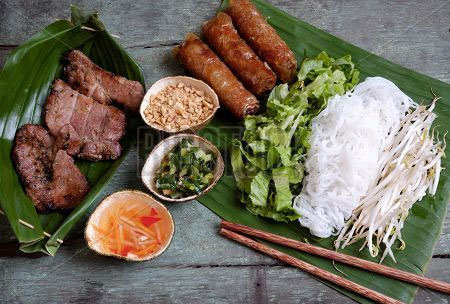
Springs rolls with condiments, dipping sauce (nuoc mam cham) & grilled meat
It's hard to talk about Vietnamese food without mentioning French colonization, which began with missionaries arriving in the 18th century and not ending until 1954. Clearly it had a lasting effect on the country, the people, the architecture, the land, and the flavors. Most obvious might be the banh mi, with its crusty French baguette as the foundation. But the Vietnamese have taken this sandwich and made it entirely their own with grilled pork, fish patties, sardines, cilantro, chili-spiked pickled carrots and other fillings.
Pho (pronounced fuh, like "fun" without the "n") is another example of French colonialism leaving its mark—the soup is a blend of Vietnamese rice noodles and French-minded meat broths. One theory contends that pho is a phonetic imitation of the French word "feu" (fire), as in pot-au-feu. Due to the French influence, the Vietnamese use a greater variety of sausages and patés.
There is an additional Southern Chinese influence in Vietnamese cuisine - both make similar use of noodles of various types and rice, and both use lots of soups. There are more soup based (egg or rice) noodle dishes in Vietnamese cooking than in Thai. The French and Southern Chinese influence on Vietnamese cuisine manifests itself in lighter or clearer soups and sauces, in which the tastes of principal ingredients is showcased. You don't see stone pot, pho and other entree soups, vermacelli bowls, grilled meats in Thai cusine. They are really big on noodle dishes.
The biggest difference is the use of raw herbs and leaf vegetable. Everyone stir fries, boils, fries them -- but only the Vietnamese eat them raw, as a main course. The herbs used are different as well. Thai cuisine tend to stay with basil, mint, and lemon grass. Vietnamese use perilla, basil, mint, polygonum, sawtooth, rice patty, fish mint, to name a few. Lots of galangal in Thai cuisine.
Vietnamese food differs from Chinese food in a major way. In most types of Chinese cooking, the food comes to the table as it should be eaten. Vietnamese food is almost always expected to be customized by the person eating the food. You can make the food as spicy as you want, but don't expect the dishes to come out of the kitchen to make it necessarily that way.
A bowl of pho tai (rare beef noodle soup) is typical. Pho is usually some thinly sliced beef, rice noodles, and broth. When you order it, you will typically get a plate of raw bean sprouts, lemon/lime, hot peppers, mint, and basil. At your table, you will probably have hoisin sauce as well as two or three types of chili pastes. You add whichever condiments and/or veggies based on how you would like it to taste.
Let's take a simple dish of egg rolls (Cha Gio). If you were to eat in a restaurant, they would come with a separate plate of lettuce or mustard greens, herbs, pickled carrots and daikon, cucumber and dipping sauce (nuoc mam cham).
You would take the lettuce/ mustard leaf and add the egg roll then add whatever herbs and vegetable you wanted and dip into the nuoc mam cham sauce. The lettuce adds texture; herbs add aroma and bitterness; pickled vegetables add sour and texture; the crunchiness and savoriness from the egg roll, finished with the balance of sweet, sour, salty, umami from the dipping sauce. Therefore the perfect balanced customized bite.
As in many of the neighboring countries, a Vietnamese meal is rarely divided into courses. All the food is served at once and shared from common dishes. Meals are anchored by a starch, usually rice and sometimes noodles (especially in the north where grain is more prevalent than rice). The Vietnamese prefer long-grain rice to the glutinous short grain varieties preferred by northern Thai and Japanese palates. Most meals include a soup, a stir-fry, and another main dish. Often, a light salad with shrimp or beef and vegetables will accompany the meal.
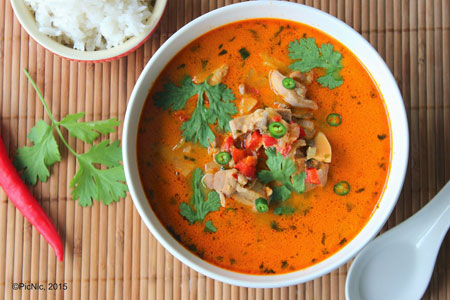
Thai Red Curry
Thai Food
Thai cuisine has more of an Indian and Malay influence, and there are more curry based dishes. Thai focuses a lot on curries, stir-fries and coconut-based sauces/soups. A lot of lemongrass, galangal (type of ginger), basil, mint, and yes, it's spicy! Here's a typical dish: wok fried tender juicy beef, with fried basil, red peppers, some spice, over white rice and the salty jus from the cooking process.
Rice is basically the most important element in nearly every Thai meal. When they say "let's have a meal", they actually say " let's have a rice". You will eat rice with everything in Thailand (sometime even with noodle!) and most of the meal reflected that by manifesting themselves as something to be eaten with rice (like in varieties of curry or paste with intense flavour to be diluted with rice). Thai dishes, while including excellent meats, seafoods and vegetables, strike more of a balance between featuring the main ingredients and emphasizing the sauce or broth.
Vietnamese tend to eat rice product more in place of an actual bowl of rice. Noodles are obviously much more widely consumed as well as other rice paper, rice cake, and rice dumpling. Vietnamese tend to be a bit less picky about their rice in pure, unprocess form. Vietnamese rice in general are kind of like Chinese - that's they lack most of the characters Thai would required to be in their quality rice bowl; namely the bready, pandanly aroma, natural starch which keep the grain smooth and a little sticky, and the perfect shape that retain their density and texture even when well cooked. Vietnamese/Chinese is just soft pluffy (of course they don't always serve that in 20 bht a dish eateries). As for the noodles, only rice noodles are traditionally Vietnamese. Egg noodles and wonton noodles are Chinese import.
Bread is obviouly much more common in Vietnam. Thailand's term for bread is "kanom pan" and literally mean "pan dessert". And just liken its name, it is typically eat as either dessert or snack (hence, many Thai who went to have European food tend to fill unfulfilled because they feel like having snack for a main dish). Vietnam eat bread very commonly as a main dish and has a lot of bread-compatible product like meat loaf, and sausage which is also like-wise more commonly eaten. Thailand sausage are typically meant to be eaten with sticky rice and is eaten more as regional cuisine.
Flavour Profile
In essence, Thai food encompasses various types of dishes including noodles, rices, salads, soups and grilled delicacies. The most significant difference is that the Thais use significant amounts of ferociously spicy chili peppers, both overall and in any given dish, while the Vietnamese use hot chilies sparingly.
The most common flavour in Thai cuisine is sweet, acidity, and heat. Vietnamese food in general, even the more bold southern varieties tend to be at most hot and sweet but not seem to value acidity as much as Thai. Vietnamese cuisine seeks to have the right balance of salty, sweet, sour, umami (savory), and bitter. Hence the liberal use of herbs and condiments to help create that balance. Also texture is very important. In Thai cuisine, the fish sauce is nowhere near as pungent, fishy, smoky and fragrant as Vietnamese nước mắm, which probably benefits from more extended fermentation.
Thai cooking has a character of its own, much of it based on the country’s location and the land’s warm climate and abundant fresh herbs and spices. Brilliant taste, texture and color come from the fresh vegetables and fruits, the rich combinations of flavorings such as chilies, garlic and onions, curry mixtures, coriander, coconut cream, basil, lemon grass, mint, kaffir lime, tamarind and fish sauce. It accepts and incorporates the influences of its neighbors, China, Laos, Cambodia, Burma, and India for a varied and zestful cuisine. Thai food is all about combining five flavor sensations: sweet, sour, salty, hot and bitter. Thai food also has more Indian & Malay influences.
Vietnamese cooking is generally not as rich or heavy as the coconut milk curries, of, say, Thailand or India. All that coastline means that fish and seafood are central to the diet. Other meats -- pork, beef, and chicken -- are also common, but in smaller quantities. Vegetables are often left raw, especially in the south, to act as a fresh contrast to the spicy cooked meat. The distinct flavors of Vietnamese food come primarily from: mint leaves, coriander, lemon grass, shrimp, fish sauces (nuoc nam and nuoc cham), star anise, ginger, black pepper, garlic, basil, rice vinegar, sugar, and green onions. Many flavorful marinades are made by some combination of these flavorings. Marinated meat or fish is quickly sautéed in the wok and served with an array of raw vegetables and herbs. All this may be eaten over rice or rolled in a rice-paper wrapper or lettuce leaf (or both), then dipped into a pungent sauce.
Eating Utensils
The Thai typically use a fork and large spoon as their cutlery. The Vietnamese typically eat with chopsticks. In Southeast Asia, only the Vietnamese eat with chopsticks.
