Toasted Sugar (granulated caramel)
from https://www.seriouseats.com/, Stella Parks
Granulated caramel that can be used in any recipe as a one-to-one substitution for plain sugar. Gentle heat allows caramelization without harming sugar's crystalline nature, letting slow-toasted sugar behave exactly like plain granulated sugar.
That opens up a world of possibility, as it works flawlessly in recipes for buttercream, mousse, or cheesecake, which can accommodate only a small amount of caramel sauce before turning soupy or soft. It's also ideal for desserts that would be ruined by caramel syrup, which is by nature too hot for fragile angel food cake and too viscous for soft candies like marshmallows or nougat. For example, sugar cookies made with granulated caramel stay crisp at the edges, and oatmeal cookies spread like they should. And compared to caramel powder (made from liquid caramel, cooled and ground), it won't compact into a solid lump over time. Stella's recipe for Speculaas uses toasted sugar.
With the right technique, we can caramelize sugar without liquefying it at all. Caramelization and liquefaction only go hand in hand with high-heat techniques, which speed thermal decomposition. But in the gentle heat of a 300°F (149°C) oven, the process is drawn out, revealing myriad stages of caramelization in a crystalline state.
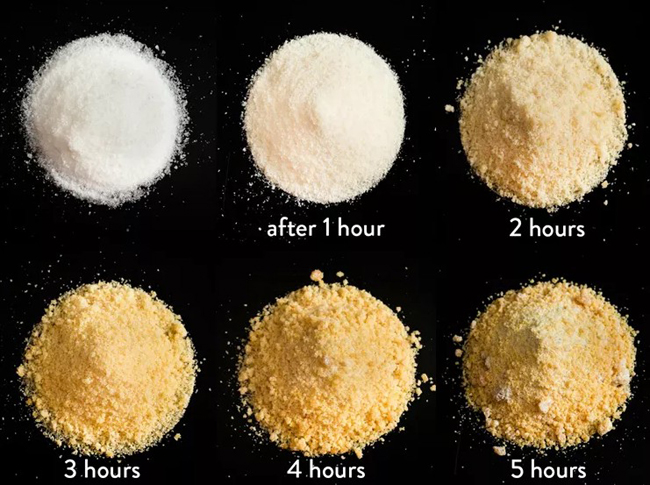
Despite a modest progression of color, the sugar goes through extreme changes in flavor every step of the way. With only one hour of toasting, it mellows with a complexity totally unlike plain sugar. After another hour, it's evocative of caramel the same way unrefined sugar hints of molasses, surely but subtly.
Within three hours, thermal decomposition liberates enough water that the sugar begins to clump as stronger caramel notes develop, changes that intensify into hour four. At five hours, the clumping effect makes granulated caramel visually identical to light brown sugar but with a unique flavor of its own. Though undeniably caramel, it lacks the bitter notes synonymous with high-heat techniques, giving it a lighter profile. Beyond that point, thermal decomposition will finally liquefy the sugar.
Because water is a by-product of caramelization, and relatively low "roasting" temperatures prevent it from being driven off as steam, deeply caramelized sugar is super clumpy. Stirring from time to time helps release entrapped moisture, but not enough to stop it from cooling into hard, lava rock–like pieces. As long as thermal decomposition halts before anything liquefies, granulated caramel behaves like sugar, so there are no caveats on its use.
Fortunately, these chunks are highly porous and easily demolished in a food processor, where they can be ground until powdery and fine. This free-flowing granulated caramel behaves like white sugar in terms of shelf life, and it never needs to be ground again so long as it's kept in an airtight container.
A single hour of toasting won't develop any discernible caramel flavor, but it tames the intensity of marshmallows, angel food cake, and fudge—recipes that rely on sugar for structure, but have a reputation for tooth-aching sweetness.
Ingredients:
4 pounds (9 cups; 1.8 kg) granulated white sugar (see notes)
Note: You can also toast even smaller quantities in just 30 minutes at 350°F (177°C). To quickly toast smaller quantities, use a heavy 10- or 12-inch skillet, and limit the sugar to a quarter-inch-thick layer, so it toasts evenly without requiring any stirring. It's important to stop before the sugar looks damp, a change that signals liquefaction is imminent—when you're dealing with small quantities of sugar in a metal skillet inside a 350°F oven, there's only a brief window of time between dry and wet, which will make the sugar lumpy and hard. Toast the sugar until it has a strong caramel aroma, but exhibits a rather subtle color change.
Adjust oven rack to center position and preheat oven to 300°F (150°C). Pour sugar into a 9- by 13-inch glass or ceramic baking dish (not metal, which will not keep an even heat). Toast until the sugar turns ivory, about 1 hour. Stir thoroughly and continue roasting, pausing to stir every 30 minutes. The sugar will produce steam as a byproduct of toasting, so it must be stirred well to allow that moisture to escape. Stirring should also help move hot sugar from the edges toward the center, and cool sugar from the center toward the edges, for even toasting. Continue toasting and stirring every 30 minutes until the sugar has darkened to the desired degree, from a light beige to the color of traditional brown sugar, between 2 and 4 hours more.
When the sugar has finished toasting, set aside and cool to room temperature, stirring from time to time to speed the process and allow for continued evaporation of steam. Alternatively, the cooling process can be sped along by pouring the sugar into a large, heat safe container. Once fully cool, transfer to an airtight container and store as you would plain white sugar. It can be used interchangeably, by weight or volume, in any recipe that calls for white sugar.
Troubleshooting: In an oven that runs hot, or when using a different volume of sugar, or a different size baking dish, or a metal dish, the sugar will heat more rapidly, and may begin to liquefy much sooner than expected. If this happens, immediately pour the dry sugar into a large stainless steel bowl, leaving the melted caramel behind. If the sugar is not stirred thoroughly throughout the toasting process, it may clump severely along the way and as it cools; should this happen, grind the cooled sugar in a food processor until powdery and fine.
Makes 9 cups
