Mahogany
Cake
from https://www.thekitchn.com/
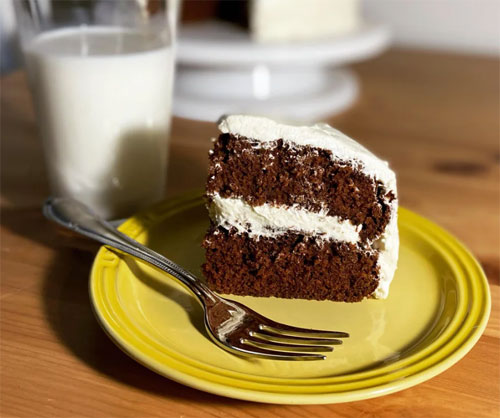
Velvet cakes, without the coloring, are older than Fannie Farmer. Cooks in the 1800s used almond flour, cocoa or cornstarch to soften the protein in flour and make finer-textured cakes that were then, with a Victorian flair, named velvet.
All of this led to the mahogany cake, with its mix of buttermilk, vinegar, cocoa powder and coffee, and its cousin, the devil’s food cake. Mahogany cake dates back to the late 1800s in America appearing in major cookbooks of the day such as Sarah Tyson Rorer’s The Philadelphia Cookbook, published in 1886. As it happens, Mahogany cake is also an awesome study in the subject of baking chemistry — and the alchemy of the ingredients creating not only a lofty rise, but also a phenomenal texture and a beautiful, unique reddish-brown color as well. In many ways, Mahogany cake was the gateway cake to the technicolor Red Velvet.
Let’s start by examining one of the most winning qualities of Mahogany cake: It’s got a fantastically soft and fine crumb, created by the unique combination of vinegar or buttermilk and baking soda. This combination of ingredients was a late Victorian-era technique for creating “velvet cakes,” in reference to their super-soft, velvety interiors — a grand departure from the heavier, denser cakes that had previously defined the era.
Towards the end of the 19th century in America, the concept of the velvet cake was given the addition of a few spoonfuls of natural cocoa powder or squares of unsweetened chocolate. In the early days of cocoa manufacturing, products weren’t alkalized, and therefore were quite acidic. When natural cocoa meets the combination of vinegar and soda, the bright-red pigments in cacao known as anthocyanin are released. So with this serendipitous marriage of ingredients, the velvet cake took on a reddish-brown hue along with a whisper of chocolate flavor — and the magic of Mahogany cake was born.
The original Mahogany cake was most often paired with a white ermine frosting, also known as “flour frosting,” “boiled milk frosting,” or (my personal favorite) “cloudburst frosting.” Whatever your grandmother or great-grandmother called it, it’s an impossibly light, whipped buttercream so named for its silky, luxurious quality, thanks to a pudding-like base made with flour, milk, and granulated sugar. Ermine was the American cake icing of choice before confectioners’ sugar became a widely available bakers’ staple, and a clever way to frost cakes while not blowing through expensive (and later rationed) ingredients like sugar and butter. It has the mouthfeel, not-too-sweet flavor, and gloriously swoop-able quality of a meringue-based buttercream with a fraction of the effort, making it truly deserving of its own prominent place in your cake recipe arsenal.
The earliest versions of red velvet cakes (and indeed, even some current recipes) are essentially Mahogany cake recipes with either beet juice or food coloring added. This also explains why the first versions of red velvet cakes don’t call for cream cheese frosting (which didn’t really trend until the 1960s), but rather the aforementioned ermine frosting that was classically paired with Mahogany cake. Archivists at Kraft Foods, which owns the Philadelphia Cream Cheese brand, say their first record of cream cheese frosting is in a corporate recipe cookbook in the late 1940s.
Mahogany cake is better than the shockingly scarlet red velvet cake you’ve been eating. This cake is subtly sweet with a mere suggestion of cocoa flavor and a crumb so tender no wonder its offspring is called velvet.
Mahogany Cake Recipe
For the cake:
Cooking spray
2 cups cake flour, spooned and leveled
3 tablespoons natural cocoa powder
1 1/4 teaspoons kosher salt
1 teaspoon baking soda
1 1/2 sticks (6 ounces) unsalted butter, at room temperature
1 1/2 cups granulated sugar
1 teaspoon vanilla extract
3 large eggs, at room temperature
1 cup well-shaken buttermilk, at room temperature
1 teaspoon distilled white or apple cider vinegar
For the ermine frosting (makes about 4 1/2 cups):
1 1/2 cups granulated sugar
6 tablespoons unbleached all-purpose flour
1/2 teaspoon kosher salt
1 1/2 cups whole milk
3 sticks (12 ounces) unsalted butter, at room temperature
1 1/2 teaspoons vanilla extract
1/2 teaspoon almond extract
Make the cake: Arrange a rack in the middle of the oven and heat to 350°F. Coat 2 (8-inch) round cake pans with cooking spray and line the bottom of each pan with a parchment paper round; set aside.
Place the cake flour, cocoa powder, salt, and baking soda in a medium bowl and whisk to combine; set aside.
Beat the butter in the bowl of an electric mixer fitted with the paddle attachment on medium-high speed until creamy, 30 seconds to 1 minute. Add the sugar and vanilla and beat until very light and fluffy, about 5 minutes. Stop and scrape down the sides of the bowl with a rubber spatula.
With the mixer on low speed, add the eggs one at a time. Once fully incorporated, stop the mixer and scrape down the sides of the bowl.
Whisk the buttermilk and vinegar together in the measuring cup or small bowl. Add 1/3 of the flour mixture to the mixer and combine on low speed. Add 1/2 of the buttermilk mixture and incorporate on low speed. Add another 1/3 of the flour mixture to the mixer and combine. Add the remaining buttermilk mixture and combine. Add the remaining flour mixture and combine. Stop to scrape down the mixture as needed. Use a large flexible spatula to fold the batter gently several times to ensure it’s well-blended. Divide the batter evenly among the prepared pans, about 1 1/4 pounds of batter per pan.
Bake until the cakes just begin to pull away from the sides of the pans and a toothpick comes out with a few moist crumbs, about 30 minutes. Cool completely in the pans set on a wire rack.
Make the frosting: In a medium (2-to 2 1/2-quart) saucepan, whisk together the sugar, flour, and salt. Whisk in the milk.
Place the pan over medium heat, and whisk occasionally until the mixture comes to a full rolling boil. Cook for 1 minute, whisking constantly, until pudding-like. Remove the pan from the heat. Let cool completely at room temperature, or to speed up cooling, scrape the mixture into a clean bowl, cover the surface with parchment paper, and chill thoroughly in the refrigerator, at least 1 hour.
In the bowl of an electric mixer fitted with the whisk attachment, whip the butter with the vanilla and almond extracts on high speed for 2 minutes. Scrape down the bowl and add the cooled flour mixture. Beat until the frosting on medium-high speed until it is very fluffy, mousse-like in texture, and noticeably lighter in color, about 5 minutes. Use immediately.
Assemble the cake: Remove the cake layers from the pans, discarding the parchment paper. If the top of the cake layers are domed, use a serrated knife to shave the top, mounded portion off. This leaves you with flat, even cake layers. Place one cake layer on a cake plate, serving platter, or cake round.
Spread about 1 cup of the ermine frosting onto the layer into an even layer. Top with the second layer. Scoop the remaining frosting on top of the cake and use a spatula to work it down the sides until the whole cake is completely frosted. Smoothing the top and sides as much as possible.
YIELD Serves 8 to 10
