Early Fruit Desserts: Cobblers, Buckles, Grunts, Brown Bettys & Slumps
First cousins of pies, all have fruit fillings and are baked in either shallow or deep dishes and are similar to each other in that they are basically a layer of fruit baked with a layer of dough either under or on top of them.. They have been and are still called by various names such as cobbler, tart, pie, torte, pandowdy, grunt, slump, buckles, crisp, croustade, bird's nest pudding or crow's nest pudding. They are all simple variations of cobblers, and they are all based on seasonal fruits and berries, in other words, whatever fresh ingredients are readily at hand. They are all homemade and simple to make and rely more on taste than fancy pastry preparation.
Fruit desserts are truly part of our American heritage. Fruit cobblers go far back into the history of American cooking. Many are based on a sweet, baking-powder-biscuit type of dough that's cooked on top of or under a layer of fresh fruit. It's a very English type of cooking that stems from early Colonial times. In truth, these old-fashioned, fruit-based desserts are our true American heritage.
In Colonial times, settlers were very good at improvising. When they arrived here, they looked around for ingredients to make their favorite dishes, and if they didn't find them, they used whatever was available. That's how we ended up with so many traditional American dishes with such unusual names. The names of the dishes often described how they looked or even how they sounded when they were served or cooked.
Although these rustic desserts aren't going to win any beauty contests, they're a great, easy way to showcase ripe fruit and serve a lot of people. The combination of warm summer fruit and pastry trumps all. Add a scoop of ice cream and you're in heaven.
Fool
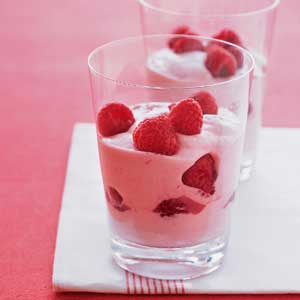
Raspberry Fool
Fool, which dates back to the 16th century, is a simple combination of fresh fruit and cream or whipped cream. Berries are crushed with a fork and sweetened before being folded into thick whipped cream. Fresh strawberries and raspberries are perfect for this, but acidic gooseberries should be simmered in a little sugar and water before crushing.
The name of this dessert comes from the French word foulé meaning pressed or crushed, and refers to the combination of crushed fruits and thick cream. It has origins in England, where it was probably made with gooseberries. When it was made in the United States, however, it was made with blueberries or blackberries.
Recipe for Rhubarb Fool.
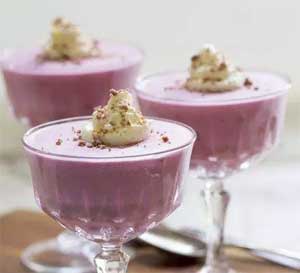
Flummery
Flummery - Flummery is a starch-based sweet soft dessert pudding known to have been popular in Britain and Ireland from the seventeenth to nineteenth centuries. The pudding is made from stewed fruit, most often berries, thickened with cornstarch or oatmeal, sometimes with milk or cream.
Another version uses bread as a thickener. Berries or other fruit(s) are simmered together, sweetened and then poured into a rectangular mold lined with slices of bread. There are even recipes that use gelatin for a thickener.
Flummeries can be made with almost any fruit.
Vintage Strawberry Flummery
Recipe from Sunset Magazine, July 1972
2 1/2 cups strawberries and/or other berries, such as raspberries, blueberries and blackberries, divided
2 cups plus 3 tablespoons water
About 1 cup sugar
1/2 teaspoon salt
3 tablespoons cornstarch
1 cup heavy cream
Set aside 1/2 cup whole berries for garnish. In a saucepan, combine remaining 2 cups berries, 2 cups water, sugar and salt in a saucepan. Bring to a boil, reduce heat and simmer 5 minutes.
In a small bowl, blend cornstarch and 3 tablespoons water to a smooth paste; stir into cooked mixture. Cook, stirring, until mixture thickens and sauce is clear, about 3 minutes. Cool to room temperature.
Using an electric mixer on high speed, whip cream until stiff. Fold into fruit. Transfer to a serving bowl. Garnish with whole berries, cover and refrigerate until ready to serve.
— From Sunset Magazine, July 1972, contributed by Brenda McHenry
Serves 6 to 8
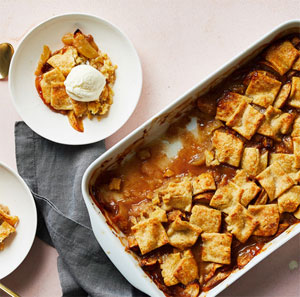
Apple Pandowdy
Pandowdy
An old-fashioned favorite, Pandowdy is a deep-dish dessert that can be made with a variety of fruit, but is most commonly made with apples sweetened with molasses or brown sugar and topped with a pie pastry. The name refers to the act of “dowdying” the crust — that is, breaking it up with a knife and pressing it into the bubbling juices — midway through baking. While it’s not the prettiest of pastries, what it lacks in streamlined good looks it more than makes up for in rich flavor.
Pandowdy was first served on New England farms as a breakfast dish. It was served warm with milk or cream.
Recipe for Apple Pandowdy.
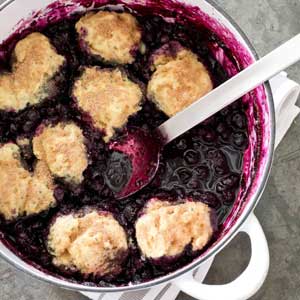
Blueberry Grunt
Slumps, Brambles and Grunts
Slumps, brambles and grunts are all old-fashioned New England desserts, usually made with berries and topped with a type of sweet dumpling mixture. They are early attempts to adapt the English steamed pudding to the primitive cooking equipment available to the Colonists in New England.
Usually cooked on top of the stove. In Massachusetts, they were known as a grunt (thought to be a description of the sound the berries make as they stew). In Vermont, Maine, and Rhode Island, the dessert was referred to as a slump.
There are several regional variations of these same dishes. In the Boston area, slumps are made by dropping dumplings into simmering fruit, covering the pot and steaming the mixture on top of the range. In other parts of New England, brambles and grunts are baked with the dumplings on top so that they crisp up. In some parts of New England, a grunt isn't a type of cobbler at all; it is a steamed pudding with berries.
Recipe for Blueberry Grunt.
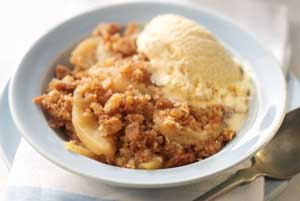
Apple Brown Betty
Brown Betty
Betty - Brown Betty is a name given to an early era baked pudding dessert made by those who came to America during the 1600's. It's made by layering spiced fruit with buttered bread crumbs and its consistency is like bread pudding. All sorts of fruit can be used, but apples are the most common. Apple Brown Betty is made with brown sugar and sliced apples.
Recipe for Apple Brown Betty.
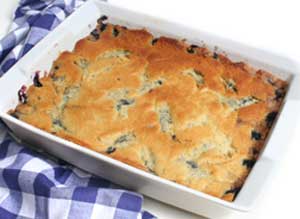
Blueberry Buckle
Buckle or Crumple
Buckle or crumple is a sweet dessert that is made from a cake batter traditionally topped with berries, which is topped with a streusel type topping. The batter rises up as it bakes and the berries and streusel topping sink at uneven intervals, forming a buckled affect in the cake. Originally, buckle was made as a single layer cake topped with blueberries. However, over the years a variety of berries, fruits and toppings have been added to make different versions of this cake dessert.
Recipe for Blueberry Buckle.
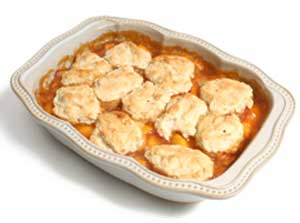
Peach Cobbler
Cobbler
In the North, Cobbler is a deep-dish fruit dessert that is topped with a biscuit crust. This is a very common style, where a biscuit or scone-like dough (either drop biscuits or rolled out dough) is placed on top of the fruit filling. Th dough gives it the appearance of a cobbled road and hence the name. The topping is typically golden and fluffy on the inside, providing a classic, home-style texture that soaks up the peach juices.
It can be made with almost any type of fruit, including peaches, nectarines, plums and blackberries.
In the South, the preferred topping is a batter topping (Cake-style or "Magic Crust. In this Southern style, a thin, cake-like batter is poured into the baking dish, often over melted butter, and the peach mixture is added on top. As it bakes, the batter rises through the fruit, forming a moist, cakey base and a golden crust on top.
A pie crust topping is also often used in the South. The Paschals make this kind in their restaurant for their peach cobbler, which they are well known for. This type uses a traditional flaky pie pastry, either as a single top crust or a double crust (top and bottom) and closely resembles a deep-dish peach pie.
Recipe for Peach Cobbler (Northern style)
Southern Style Peach Cobbler
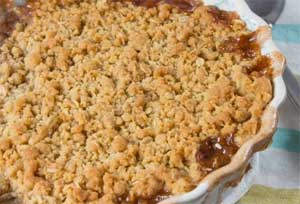
Apple Crumble
Crisps and crumbles
Crisps and crumbles are different from cobblers in that they are made with baked fruit as the bottom layer, which is topped with a crumbly streusel-like topping. A typical recipe combines a variety of ingredients, which include sugar, butter, and flour mixed until crumbly to create a granular topping that is spread over the fruit and baked. The difference between a crumble and a crisp is simply regional. Crisps are the American version of the British crumbles.
The original difference between the two lay in the streusel topping: crisps would contain oats and crumbles would not. In an actual crisp, as in apple crisp or strawberry crisp, the oats in the topping crisp up as it bakes, hence the name. As time has gone by, though, the lines have blurred and the names crumble and crisp are now used interchangeably.
Some recipes add nuts, such as walnuts or almonds, in the streusel topping. A 1944 recipe for peach crisp in the New York Times make their topping using corn flakes mixed with margarine and sugar. Another inventive recipe uses Amaretti cookies, Italian almond macaroons, in place of the oatmeal in the streusel topping.
Recipes for Apple or Peach Crisp
Rhubarb Crisp.
Crunch
Crunch is similar to a crisp and a crumble, but in a crunch, there's a shortbread crust on the bottom as well as on the top. Shortbread is a simple mixture of butter, sugar, flour, and salt. The name “shortbread” comes from the high ratio of butter in the recipe.
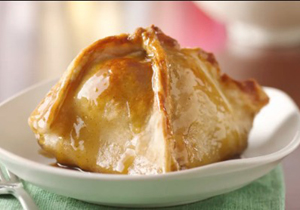
Apple Dumplings
Apple dumplings are a common food in the northeastern United States, especially around Pennsylvania, where they are considered a "cultural staple". A common recipe among the Pennsylvania Dutch, baked Apple Dumplings are often eaten as a breakfast item or dessert. It is sometimes served with cream, whipped cream, or ice cream. Though the first recorded apple dumplings were made in England in the 18th century and can be traced throughout history across many communities in the United States, they’ve really become known as an iconic Pennsylvania food.
Food historians trace this type of apple dumpling back to Hannah Glasse's book, The Art of Cookery Made Plain and Easy, published in 1747 in Longdon in which she has a recipe for Boiled Apple Dumplings. Older traditional recipes call for the dumplings to be boiled instead of baked. They boiled them for a long time and the apples in the middle became something similar to applesauce. This was what the Townsends’ Historical Cooking videos showed. They used Hannah Glasses’ recipe. That method was mostly used before ovens were commonplace in most households.
Here is Hannah Glasse’s recipe:
To Make Apple Dumplings
Make a good puff-paste, pare some large apples, cut them in quarters, and take out the cores very nicely; take a piece of crust, and roll it round enough for one apple; if they are big, they will not look pretty; so roll the crust round each apple, and make them round like a ball, with a little flour in your hand; have a pot of water boiling, take a clean cloth, dip it in the water and shake flour over it; tie each dumpling by itself, and put them in the water boiling, which keep boiling all the time; and if your crust is light and good, and the apples not too large, half an hour will boil them; but if the apples be large, they will take an hour’s boiling; when they are enough, take them up and lay them in a dish; throw fine sugar all over them, and send them to table; have good fresh butter melted in a cup, and fine beaten sugar in a saucer.
--- The Art of Cookery Made Plain & Easy, Hannah Glasse, 1747 & 1796.
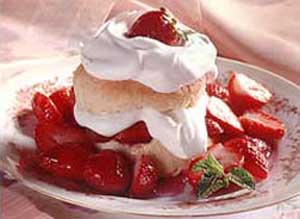
Strawberry Shortcake
Shortcake
Shortcake is a classic American dessert made with a rich biscuit. It's split in two and topped with fruit and whipped cream. Strawberries are traditional, but peaches and apricots are also quite tasty.
Recipe for Strawberry Shortcake.
Plate Cake
Plate Cake - Fruit is topped with rolled biscuit dough and baked. When done, the dessert is flipped, and the biscuit topping becomes the bottom crust. This upside-down cobbler comes by its name because it's turned out directly onto a serving plate. This sounds like an earlier version of a more modern upside-down cake.
Woman's Day has a recipe for Plum Plate Cake, but no picture.
Plum Plate Cake
Nov 17, 2011, https://www.womansday.com/
This tasty cake—which is turned out directly onto a serving plate, hence the name—has a flaky cornmeal cobbler bottom, topped with a sweet nutmeg-spiced plum layer.
Topping
1/2 c. sugar
1/4 tsp. ground nutmeg
3 tbsp. Stick Butter
1 lb. plums (about 6), halved
Lemon-Cornmeal Biscuit
1 c. all-purpose flour
c. cornmeal [amount was missing from recipe]
3 tbsp. sugar
1 tbsp. freshly grated lemon peel
1/4 tsp. baking powder
c. cold stick butter
1/2 c. milk
1 large egg
Heat oven to 400°F. Line bottom of a 9-in. round cake pan with wax paper.
Topping: Mix sugar and nutmeg, then butter in a small bowl. Spread over paper in pan. Arrange plum wedges, a cut side down, in pinwheel fashion on top.
Biscuit: Pulse first 5 ingredients in a food processor to mix. Add butter; pulse just until coarse crumbs form. Add milk and egg; pulse briefly until dough forms. Spoon over plums, spreading to edges of pan to completely cover plums.
Bake 26 to 28 minutes until cake is lightly browned and fruit bubbles up around edge.
Cool in pan on a wire rack 10 minutes. Invert serving plate over pan. Wearing oven mitts, hold plate and pan together and invert cake onto plate. Remove pan and wax paper. Cut cake in wedges; serve warm.This upside-down cobbler comes by its name because it's turned out directly onto a serving plate.
8 servings
Roly-poly
Roly-poly is made by rolling fruit or jam up in a type of pie pastry made with suet, wrapping it in cheesecloth and steaming it. Sailors made this dessert and often called it a duff. Originally, it was boiled in some muslin, but is these days steamed or baked.
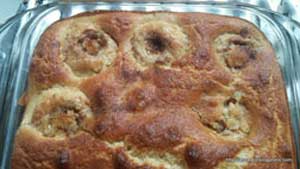
Bird's Nest Pudding
Bird's Nest Pudding - A pudding containing apples whose cores have been replaced by sugar. The apples are nestled in a bowl created by the crust. Also called Crow's Nest Pudding.
Recipe for Bird's Nest Pudding
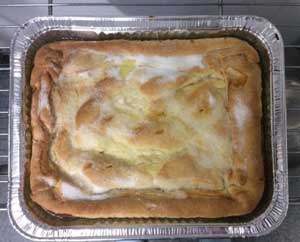
Sonker from Rockford General Store in Dobson, NC
Sonker
Not quite a pie and not quite a cobbler, sonker is a juicy, fruit-filled deep-dish dessert rarely found outside Surry County, North Carolina, in the foothills of the Blue Ridge Mountains. To be exact, the dessert defies definition. Almost any kind of fruit can be used — strawberry, blueberry, blackberry, raspberry, cherry, peach, dewberry — as well as a vegetable, or two: Rhubarb works well, and one of the most popular varieties is sweet potato. There is much debate about which fruit or vegetable should be used to make a sonker.
The debate continues when it comes to the crust. Some sonker recipes call for lining the bottom of a rectangular baking dish with pastry. Others say only to line the sides. Many specify a lattice-work crust on the top. Some have a layer of pastry in the middle. One recipe omits the crust, instead pouring a batter made of flour, sugar, and milk on top to bubble up between the fruit. And then there is the “dip,” a sweet, thickened milk flavored with vanilla extract or spices, such as cinnamon or allspice. It is most often served alongside the sweet potato sonker.
While toppings vary, a subset of sonker recipes dub themselves “lazy” sonkers, in which the fruit is cooked into a sweet stew and topped with a pancake-type batter that bakes into a distinct, lightly crisp layer of cake. The fruit is baked until it bubbles and thickens, then a batter is poured over the filling and returned to the oven. The thick stewed fruit gives the batter a sturdy, level surface on which to bake and the hot filling bakes the batter from underneath, so that it bakes into a tender-yet-crisp raft of cake.
The community of Lowgap at the Edwards-Franklin House, hold an annual Sonker Festival.
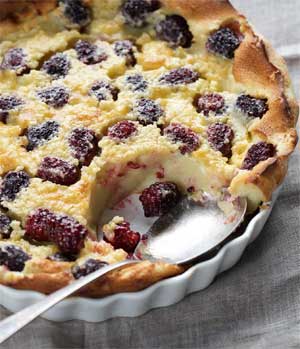
Clafouti
This is a summer dessert that originated in the French countryside. The term clafoutis only first appeared in print around the mid-19th century, defined in the Glossaire du Centre de la France by Count Joubert in 1856. It is a baked dessert of fruit, traditionally black cherries, arranged in a buttered dish and covered with a thick flan-like batter. The clafoutis is dusted with powdered sugar and served lukewarm, sometimes with cream.
A traditional Limousin clafoutis contains pits of the cherries. The pits contain benzaldehyde, the active chemical in almond extract adding a complementary note to its flavor. They also contain a small amount of amygdalin, that create cyanide, but are not toxic in the small amounts.
There are numerous variations using other fruits, including red cherries, plums, prunes, apples, pears, cranberries or blackberries. When other kinds of fruit are used instead of cherries, the dish is properly called a flaugnarde. The dish's name derives from Occitan clafotís, from the verb clafir, meaning "to fill" (implied: "the batter with cherries"). Clafoutis apparently spread throughout France during the 19th century.
Clafouti is often considered a baked pudding.
Cherry Clafouti (flan)
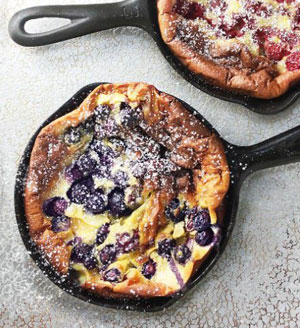
Flaugnarde
Flaugnarde (flow-NYARD) is a sibling of the more familiar, baked fruit dessert called Clafoutis. Resembling a sweet batter pudding or large pancake, the dish is dusted with confectioner's sugar and can be served either warm or cold. The base of the flognarde, like the clafoutis, is a crêpe or flan batter and when baked often has the aspect of a pillowy, puffed crêpe right out of the oven.
While the origine of the dish is unknown, we do know the name comes from the old French Occitan dialect fleugne/fleunhe or flaunhard, meaning soft, gentle, or fluffy. While the clafoutis is a summer dish made most typically with cherries, the flognarde is the autumn version of the dessert made with the season’s apples or pears, or sometimes prunes.
It's just as good for brunch as it is for dessert, served puffed and hot, right out of the oven.
