Auguste Escoffier
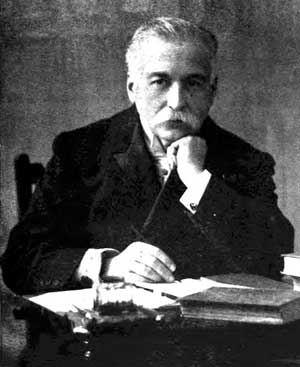
Escoffier, pictured in 1913, simplified
French cuisine in his classic cookbooks.
Victorian chef Auguste Escoffier, 1846-1935, was a culinary pioneer who changed the way we approach food. He was so slight a man that he couldn't even reach the stove. He had platform shoes made and went on to cook his way into culinary history. Born in 1846, Escoffier quickly rose to become known as the Ambassador of French cuisine and eventually was knighted for it.
Escoffier not only was an astonishing chef, but he simplified French food, co-created the Ritz Hotel chain and wrote classic cookbooks (Le Guide Culinaire and Ma Cuisine) that inspired Julia Child and changed the way we look at cooks, cooking and food forever.
Open a jar of tomato sauce for dinner recently? Escoffier was the first to commercially can tomatoes. Is your favorite gravy enriched with fresh mushrooms and bouillon? As a consultant, he helped create both dried soups and the cultivated mushroom industry. Ever dine a la carte? That was Escoffier's idea.
Sauces are the glory of French cuisine, and Escoffier's predecessor, Antonin Carême had previously set forth four grandes sauces as the basis of French cooking: béchamel, espagnole, velouté, and allemande. Escoffier modernized this list with his five mother sauces by dropping allemande sauce, which is a variant of velouté, and adding hollandaise and tomato sauce.
Escoffier radically simplified food service by advocating the use of seasonal ingredients and the abandonment of elaborate garnishes. He was also responsible for simplifying menus, instead of vast arrays of dishes served all at once, Service à la Française (as was the practice), it was Escoffier that wrote them down and served in the order they appeared, Service à la Russe.
But Escoffier not only revolutionised the way food was cooked, he also helped change dining culture. Prior to Escoffier there was not really a dining scene in England. Cooking was done at home. If you saw a woman on her own in a restaurant in Victorian times, she was fair game and she was there for custom.
But Cesar Ritz and Escoffier changed dining conventions by turning the Savoy into a feminine and respectable place. It was somewhere that ladies could go without fear of being bothered or the suggestion that they might be issuing some kind of invitation. Lady de Grey, considered to be a key trendsetter in 19th Century London society, was one of the first women to have a lunch party at the Savoy. Once she'd done it, everyone else had to join in... suddenly the Savoy became incredibly popular for ladies, for couples, people on their own. He changed eaters into diners.
Escoffier created hundreds of dishes named after both the lowly and famous (though not for his own wife), including Peach Melba (for Australian opera star Nellie Melba), Cherries Jubilee (for Queen Victoria's Jubilee) and Dauphine Potatoes (for the French court of the Dauphine, which included Marie Antoinette).
Dauphinoise Potatoes Gratin
The recipe is written in a rapid, shorthand style designed for chefs who had mastered all the techniques, could cook without exact measurements and just needed a "cheat sheet" of sorts to complete the dish. This recipe comes from the 1941 edition of "The Escoffier Cookbook," an English translation of the chef's "Le Guide Culinaire" of 1903.
Finely slice 2 pounds of fair-sized Irish potatoes. Put them in a bowl, and add salt, pepper, grated nutmeg, one beaten egg, one and one-half pints of boiled milk, and 4 ounces of fresh, grated Gruyere cheese.
Thoroughly mix up the whole.
Pour this preparation into earthenware dishes, rubbed with garlic and well-buttered; copiously sprinkle with grated Gruyere cheese; add a few pieces of butter, and cook in a moderate oven from 40 to 45 minutes.
One his most important culinary contributions was the creation of veal stock. When mixed with foods, it imparts natural MSG (monosodium glutamate), which enhances natural flavors and creates what Escoffier named "deliciousness." At the same time the chef was working on his theory of what is now called the flavor of "umami," a Japanese chemist was proving it.
Modern restaurants, where anyone can order food — as opposed to taverns and inns that serviced travelers only — began in 18th-century France. It wasn't a very popular idea; most had no reason to eat anywhere except at home. And so, when Escoffier became a chef, the industry was still in its infancy. Cooks worked in small windowless rooms filled with coal and wood smoke. Wine kept them hydrated. Add sharp knives, stress and shouts over the din of clanging pans, and you can begin to imagine what a brutal place kitchens were.
Escoffier changed that. In his kitchen, no anger or shouting was allowed. His staff drank a malt brew that kept them hydrated and sober. Chaos was lessened by Escoffier's "brigade system." Unlike the old model where chefs cooked everything and then moved to the next order, in the brigade there were stations — fish, meat, sauce, vegetable — and the plate moved from station to station. This newfound system created an assembly line akin to Henry Ford's industrialization of automobile manufacturing. At the Ritz Hotel's lunch service, he could do 500 plates an hour.
Cooking is what brought him fame at an early age. Truffles, foie gras and caviar were his trinity, but he also knew nearly 600 ways to make eggs. "Le Guide Culinaire" includes recipes for 256 of them. While he wanted to be a sculptor and studied with the great Gustave Dore (where he met actress Sarah Bernhardt, a fellow student), he knew that sculptors were often paupers. Food became his medium.
The original Peach Melba was encased in spun gold leaf and served on the back of a swan made of ice. No request was too large or opulent. He once sculpted a table and chair out of shrubs so that a diner could eat in a garden.
Escoffier slept four to five hours a day; he never drank or smoked. When he died in 1935 at age 88, he was working on his memoirs. Despite the fact that he spent decades in England, with many visits to the United States, he never learned English, out of fear that it would cause him to think like the English, and then, unfortunately, cook like them.
His personal life was not without drama. His wife, poet Delphine Daffis, whose hand in marriage he won in a pool game, left him before the birth of their third child. Yet he returned to her after more than 30 years of separation, only to die within days of her passing. His reputed lover Sarah Bernhardt, for whom he cooked a meal of scrambled eggs and Moet until the day she died (according to rumor), could never be his alone.
The best known culinary writings of Escoffier are:
1886 - Le Traite sur L'art de Travailler les Fleurs en Cire
1903 - Le Guide Culinaire
1910 - Les Fleurs en Cire (a new edition)
1911 - Le Carnet d'Epicure
1912 - Le Livre des Menus
1927 - Le Riz
1929 - La Morue
