Homemade Paneer (Indian type of pressed cottage cheese)
from http://indianfood.about.com
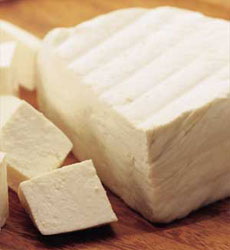 A special favorite with North Indians, paneer with its delicate milky flavour is used all over India to make many dishes. Paneer is used mainly as a star ingredient for many Indian curries. With its fairly mild, milky flavour and dense crumbly texture which doesn’t melt like other cheese, its best when paired with strong and spicy flavours like Shahi Paneer Curry where the word ‘Shahi’ refers to royal in reference to the imperial court. The dish is made by cooking cubes of fresh paneer in a thick and creamy gravy of tomatoes, fresh cream, nuts and carefully selected combination of aromatic spices.
Available at most supermarkets in pressed block form or even as curds, it readily takes on the flavor of the spices in which it is cooked. When used to make desserts it gives a rich and creamy flavour. Paneer can be bought at the supermarket or better still, made at home.
It is made easily at home by curdling heated milk with lemon juice or vinegar and the acidity in the lemon juice or vinegar causes the milk to separate into curds/milk solid and whey. The whey is separated with a help of a strainer lined with cheese cloth to collect the milk sold. This crumbly and moist form is called ‘Chhena’ and is used in making many sweets like rasgulla, ras malai, sandesh etc in Easten India and Bangladesh. When the chhena is pressed to remove excess water by pressing a heavy object on top, we get the solid paneer block which is then cut into cubes and is ready for cooking straight away.
Paneer is similar to Queso blanco, halloumi, and farmer cheese.
This recipe yields enough paneer to serve 2 people, about 6 ounces. Recipe can be doubled.
1 litre full-cream milk (use lean milk for a low-fat version)
½ tsp citric acid/lemon juice
½ cup warm water
Set the milk up to boil.
As the milk is readied, dissolve the citric acid/lemon juice in half a cup of warm water. When the milk comes to a boil, pour the acid-water/lemon juice-water mix into it. Reduce the heat and stir continuously until the milk is completely curdled. If the milk doesn't separate, add a little more citric acid or lemon juice. Boost the heat again and the milk should separate. Stir in a motion that gathers the curds together rather than breaks them up.
Remove from the heat when the separation of the curds and yellowish whey is complete. Strain the mixture through a clean muslin cloth. Hold it under running water for a minute and then press out the excess water.
Hang the muslin for 15-20 minutes so that all the whey is drained out. To make the paneer into a block tie the muslin and place it under something heavy.
The paneer can now be cut into chunks and used as required.
Make Ricotta from the leftover Whey:
You can re-cook the whey to make ricotta cheese. Bring it back to a gentle boil, 200 F, then turn it off and let it cool to 140 F. Stir it occasionally to drive the solids to the bottom. Strain through cheesecloth or a very fine sieve, such as a reusable coffee filter. After two cheese-makings, the whey can be used to make soup stock.
