Homemade Queso Blanco
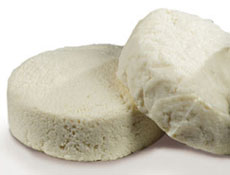
Queso Fresco on the left and
Queso Blanco on the right
The terms queso fresco ("fresh cheese") and queso blanco ("white cheese") are often used interchangeably, and they are both mild, semi-soft, crumbly, unaged cow's milk cheeses made in South America. It is very difficult to distinguish between Queso fresco and Queso blanco in taste and many countries don't bother to distinguish between them at all, but there is a slight difference between the two.
Queso fresco ("fresh cheese") is a crumbly, fresh cheese that is commonly used as a topping for tacos, nachos, and enchiladas. It’s also a popular ingredient in traditional dishes like chile rellenos, and tamales. It can be crumbled over salads or used to top refried beans. It has a mild, slightly tangy flavor. Queso fresco is made with rennet, an enzyme that curdles the milk. The curds get drained and pressed for a few days at the most before the cheese gets packaged for consumption. It's a mild, soft, and crumbly cheese similar to Feta. Other apt comparisons include pot cheese and farmer cheese, as well as Indian paneer and Eastern European quark. Upon being heated it becomes creamy without melting completely.
Queso añejo is the aged version of queso fresco. It adds a similar though more intense flavor, and the texture is drier than the fresh cheese.
Queso blanco ("white cheese"), on the other hand, is a soft, unaged cheese. Since it is so naturally crumbly, queso fresco is often used sprinkled over beans or antojitos, botanas - snacks - as well as on enchiladas and taquitos. It is similar in flavor to queso fresco, but it has a creamier texture. Queso blanco is made from milk that has been curdled with an acid, like lemon juice. Queso blanco does not melt well, but softens and becomes more creamy when heated. Queso blanco is often labeled as a "frying" cheese, or "queso para freir" because it can be sliced and heated without losing its shape. Both cheeses are usually salted. As it is highly perishable, it must be refrigerated or used immediately once the whey has drained out.
Queso Blanco is by far the easiest cheese to make. It can be eaten straight or mixed in with various dishes. Try it in your lasagna recipes instead of Ricotta or in addition to it. This cheese is similar to Paneer, which is often used in Indian cooking and is made with lemon juice, and Halloumi.
1 Gallon Whole Milk (may be pasteurized homogenized , but not ultra pasteurized milk)
1/4 Cup White Vinegar**
- Heat milk to 180 F (82 C) stirring constantly. Be careful not to burn the milk.
- Once the temperature is reached and while mixing with a whisk, slowly add the white vinegar. Add this in 3 equal additions. You will notice the milk begins to curdle. Let rest for 5 min.
- Once the curds begin to form well, gently stir to keep from matting for another 5 minutes.
- Line a colander with a fine cheesecloth.
- Pour the curdled milk through the colander.
- Allow the curds to cool for about 20 minutes.
- Sprinkle the curds with salt, if desired. 1/4 to 1/2 tsp salt. Stir the curds gently to increase whey drainage and mix in the salt.
- Tie the four corners of the cheese cloth together and hang it to drain for about 5 - 7 hours (until it stops dripping).
- (OR) The cloth may be hung for 10-30 minutes. Transfer your curds to an open ended 2 Lb. cheese mold resting on a draining mat and set the follower on top. Begin with 10 lbs of weight for 20 min. and then increase to 25 lbs for 2-5 hours. Your cheese is now ready to enjoy or can be wrapped in waxed paper and refrigerated.
Yield: about 1 1/2 pounds
** The juice of 3-5 lemons or limes may also be used in substitute or addition to the vinegar. The resulting cheese will have a much more tangy flavor.
From another web site: "With the leftover whey, you could make “Requeson”, ricotta cheese. Just heat the drained whey over a low heat and let it simmer until a new set of firm curds forms and drain using the cheese cloth."
If the milk does not curd, "let the milk sit longer to get it to curd. It will also work to bring it back to the stove and warm it up again just before boiling point. Then let it rest for an hour again." "Don't worry, using lime juice or vinegar works fine. Please be patience and wait for the milk to get solid."
