Types of Chicory
Chicories are closely related to lettuces, but heartier and with a bitter edge. Cool weather crops that come into season in late fall (and last in temperate climates through early spring), chicories provide a lot of flavor to seasonal fall and winter meals. They include Belgian endive, curly endive, escarole, and radicchio.
Curly Endive (frisée)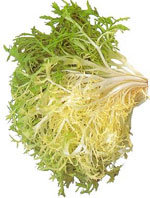 |
Curly endive, or frisée (var crispum). This type has narrow, green, curly outer leaves. Sometimes called chicory in the United States and is called chicorée frisée in French. Curly endive is most commonly used in salads but is tasty when quickly sauteed and drizzled with a bit of strong vinegar, such as sherry or balsamic. *Frisee (Endive) Salad w/ Pears, Blue Cheese, & Port Vinaigrette (Curly endive, radicchio) |
Escarole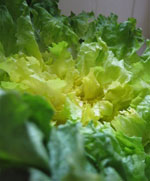 |
Escarole, or broad-leaved endive (var latifolia) has broad, pale green leaves and is less bitter than the other varieties. Varieties or names include broad-leaved endive, Bavarian endive, Batavian endive, grumolo, scarola and scarole. Escarole is great torn into bite-size pieces for a salad and stands up well to bold dressings. Whether in salads or cooked, escarole pairs particularly well with egg. Also try it grilled or broiled for a powerful accompaniment to roasted or grilled meats. Also see Curly endive recipes above |
Radicchio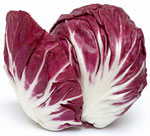 |
Radicchio (pronounced rah-DEEK-eeyo) usually has variegated red or red and green leaves. Some only refer to the white-veined red leaved type as radicchio. Also known as red endive and red chicory. It has a bitter and spicy taste, which mellows when it is grilled or roasted. It can also be used to add color and zest to salads. Radicchio is sometimes sliced and added to salads, like all chicories, but really shines when cooked a bit. Halved and brushed with oil, it's great on the grill. It pairs particularly well with olives, blue cheese, apples, and walnuts. *Holiday Pomegranate Salad (Butterhead lettuce, radicchio, Belgian endive, arugula) |
Belgian Endive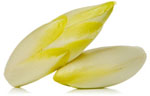 |
Belgian endive is also known as French endive or witloof. It has a small head of cream-coloured, bitter leaves. It is grown completely underground or indoors in the absence of sunlight in order to prevent the leaves from turning green and opening up (etiolation). It is often sold wrapped in blue paper to protect it from light and so preserve its pale colour and delicate flavour. Slightly bitter, the whiter the leaf, the less bitter the taste. The smooth, creamy white leaves may be served stuffed, baked, boiled, cut and cooked in a milk sauce, or simply cut raw. Belgian endive is often chopped and added to salads and separated into leaves and used as serving vessels for dips and spreads. Since they are "forced" to grow in artificial conditions, Belgian endive are available year-round. Their traditional season (when grown in fields and covered with sand to keep out the light), like that of all chicories, is late fall and winter. *Holiday Pomegranate Salad (Butterhead lettuce, radicchio, Belgian endive, arugula) |
Sugarloaf Chicory 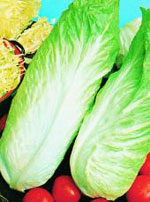 |
Sugarloaf chicory originated in the south of France, Italy, and southern Switzerland and is only cultivated commercially in a few other places. It is harvested from September to the end of November and has a tolerance for light frosts. Although botanically related to the chicory, sugarloaf varieties have more in common with the romaine lettuce or Chinese cabbage as far as appearance is concerned. It generally forms large, firm yellowish green, tightly closed heads that can weigh up to four pounds. |
