Types of Couscous & Recipe Ideas
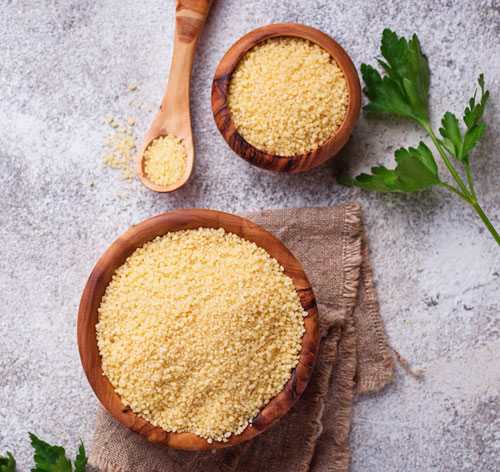
True or Traditional Couscous
True or Traditional Couscous (Moroccan)
Israeli, or pearl, couscous (see below) and true couscous, or Moroccan couscous, are both made with semolina flour and water, but true couscous is much smaller and irregularly shaped.
First eaten by Berber people before the thirteenth century, true couscous is traditionally made at home by sprinkling water over hard-wheat flour, usually semolina. The semolina is sprinkled with water and rolled with the hands to form small pellets, sprinkled with dry flour to keep them separate, and then sieved. Any pellets that are too small to be finished, granules of couscous fall through the sieve and are again rolled and sprinkled with dry semolina and rolled into pellets. This labor-intensive process continues until all the semolina has been formed into tiny couscous granules.
This fresh pasta-like dough is then gently steamed and served with saucy meat and vegetable-based meals. In the traditional method of preparing couscous, groups of people come together to make large batches over several days, which are then dried in the sun and used for several months.
In modern times, couscous production is largely mechanized, and the product is sold worldwide. This couscous can be sauteed before it is cooked in water or another liquid. Properly cooked couscous is light and fluffy, not gummy or gritty.
The couscous that is sold in most Western grocery stores is usually pre-steamed and dried. It is typically prepared by adding 1.5 measures of boiling water or stock to each measure of couscous and then leaving it covered tightly for about five minutes. In Morocco, Algeria, Tunisia, and Libya, it is generally served with vegetables (carrots, potatoes, and turnips) cooked in a spicy or mild broth or stew, usually with some meat (generally, chicken, lamb, or mutton). Moroccan couscous also has some regional variations, with some areas adding additional ingredients like raisins, dates, and almonds to the couscous or the stew.
See What is Couscous & How is it Traditionally Made?
Quick and Easy Couscous
If you've ever had couscous before you know how special the texture can be. When done correctly, each morsel feels light and airy in your mouth. True couscous is often served with a stew spooned on top.
1 cup instant dry couscous
1 1/2 cup low-sodium chicken or vegetable broth (or water plus ½ teaspoon salt)
1/2 teaspoon salt
1 tablespoon unsalted butter
1 tablespoon extra virgin olive oilNote: Toast the couscous in extra virgin olive oil. This is an optional step but can really make a difference in imparting flavor. Heat a little bit of extra virgin olive oil (about 1 to 2 tablespoon) in a non-stick skillet. Add the uncooked couscous and toss around, constantly, using a wooden spoon. You're looking for the couscous to gain a beautiful golden brown color (watch the couscous carefully, this will be quick).
In a medium saucepan, bring broth, salt, butter, and oil to boil over high heat. Remove from heat.
Stir in the couscous, cover tightly with a lid, and let sit for 10 minutes.
You can absolutely serve your couscous plain at this point. Or, feel free to add a little seasoning of your choice and some fresh herbs. A pinch of ground cumin, chopped parsley, dill, and green onions. Perhaps a couple of garlic cloves that have been minced and sauteed in extra virgin olive oil. Add and then fluff.
Use a fork to fluff.
Make 2 - 2 1/2 cups
Recipes:
Couscous with Chicken, Chickpeas, and Caramelized Onions
Golden Couscous (w/ slivered almonds)
Moroccan Couscous (w/ pine nuts & currants)
Italian Couscous
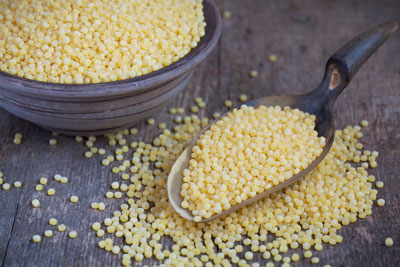
Israeli Pearl Couscous
Israeli couscous is often thought of as a whole grain, but it’s actually a type of pasta made of semolina flour and water, developed in the 1950s by prime minister David Ben-Gurion as a way to feed the influx of immigrants to Israel. It has always been produced by machine.
Balls of Israeli couscous are much larger and round, about the size of tiny pearls or peppercorns. than regular couscous, with a soft, chewy texture. Designed for industrial production, Israeli couscous is perfectly spherical and often pre-toasted for flavor. Israeli couscous has a delightful chewiness that’s ideal as a base for grain salads, pasta sauce, risotto, and more.
What’s the Best Couscous-to-Water Ratio?
The ideal Israeli couscous-to-water ratio is about 1 cup of dry couscous to 1½ cups of water, but you can also cook Israeli couscous like pasta, simply draining off any excess liquid once the couscous is al dente. For even more flavor, sub the same amount of water for chicken broth or vegetable broth.
How to Cook Fluffy Israeli Couscous
Add 1 tablespoon of oil to a pot over medium heat. When the oil is hot, add 1 cup couscous and stir to coat. Cook until lightly toasted and golden brown, about 2 minutes, then simmer couscous with 1½ cups water or broth until liquid is absorbed and the couscous is cooked through, about 10 minutes, then fluff with a fork.
Although dried Israeli couscous is often already lightly pre-toasted, you can add even more flavor by browning your couscous in oil, or by adding aromatics such as sautéed garlic and onions, toasted spices, or hardy herbs such as rosemary or bay leaf.
How to Cook Couscous Like Pasta
Fill a large pot about two-thirds of the way with water, bring to a boil, and then add the couscous. Simmer until al dente, about 8 minutes.
Recipes using Israeli Couscous
Israeli couscous is served as a side dish and works equally well in a room temperature pasta salad or served warm, with pesto or tomato sauce. For a nuttier flavor, try whole-wheat couscous, made with whole-wheat flour.
Recipes:
Israeli Couscous Salad (w/ chickpeas & feta cheese)
1. Israeli couscous salad with cucumber, cherry tomatoes, pine nuts, extra-virgin olive oil, feta cheese, fresh lemon juice, lemon zest, black pepper, and fresh mint.
2. Roasted bell peppers stuffed with Israeli couscous
3. Toasted Israeli couscous with fried eggs
4. Israeli couscous risotto with mushrooms
5. Israeli couscous salad with lentils, quinoa, dried fruits such as cranberries, parsley, sun-dried tomatoes, green onions, and a vinaigrette
6. Pink Israeli couscous with beets
7. Israeli couscous with basil pesto
8. Chicken and vegetable soup with Israeli couscous
