Crisp Slow-Roasted Duck
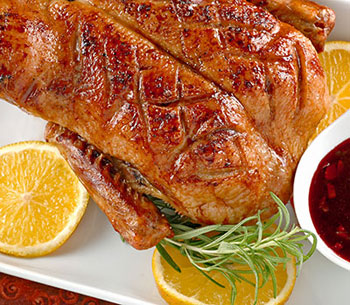
Roast duck is a wonderful choice for a holiday celebration or special occasion. This recipe includes directions for slow-roasting the duck so that the fat is rendered, leaving the skin crispy and golden brown.
By the time the duck is done, at least two cups of fat will have been rendered out. It is a delicious fat, and if you are planning to keep it - to sauté potatoes or for some other use, such as making duck confit - strain it into a glass jar. It will last indefinitely in the refrigerator or the freezer.
A word about the varieties of duck most commonly available: Muscovy very often has a strong flavor that tends toward gamy, while the Pekin, or Long Island, is milder. Whichever bird you choose, it will be a delectable departure from the usual dinner.
5 1/2-pound Long Island duck
Sea salt and freshly ground pepper
Stuffing Suggestion:
3 garlic cloves, chopped [skip for Duck à l'orange]
1 medium bunch of thyme [skip for Duck à l'orange]
1 orange, cut into wedges, for stuffing duck
Orange slices and fresh herbs for garnish
Preheat the oven to 300°F.
Rinse the duck in cold water and pat dry. Cut the fat from the neck and cavity areas and discard. Cut off the wing tips, or you could bend the wing tips under the back.
Season the cavities with salt and pepper. Stuff the duck with the garlic, the thyme and the orange wedges if using. For Duck a l'Orange, use just oranges. See recipe.
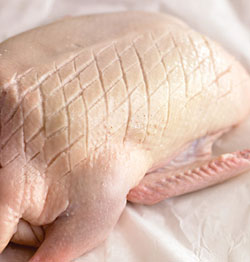
Holding a paring knife angled almost parallel to the duck, pierce the skin all over in dozens of places without cutting into the flesh. Use a light touch with paring knife to gently crosshatch skin's top layer on breast side to facilitate release of fat. Do not cut down through the skin to the flesh.
Set the duck, breast up, on a rack in a large shallow roasting pan. Roast for 1 hour. Remove the rack with the duck and carefully drain the fat from the roasting pan. Turn the duck breast down on the rack, and return to the roasting pan; pierce the skin again. Roast for 3 more hours, draining the fat from the pan and turning the duck every hour. Pierce the skin again, this time focusing only on the areas that appear to be rendering their fat more slowly.
After 4 hours, turn the duck so the breast is up and turn the oven up to 350°F [We have found finishing the duck at 300°F works fine, otherwise the drinppings and grease starts to burn.] Continue roasting for about 1 hour longer, until the skin is very crisp and the duck registers 165 degree on an instantread thermometer. [This may take less time depending on the size of your duck. If making just 1/2 duck, it will be done in 2 1/2 - 3 hours.]
Remove the duck from the oven and let it rest for about 20 minutes. Carve the duck with a sharp knife, arrange the pieces on a warmed platter and serve.
Sauces to serve with duck:
*Duck a l'Orange
Brandied Cherry Sauce
Sweet-Sour Plums
Spiced Pomegranate Sauce
*Hunter's Sauce for Duck (Chasseur Sauce - currant)
4 servings.
