Charcuterie
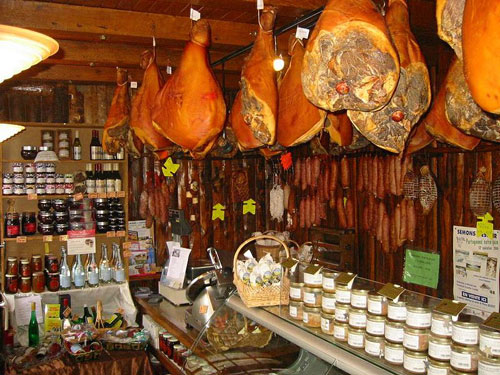
Charcuterie is the art of salting, smoking, brining, or otherwise curing meats, most commonly pork. The term is also used to refer to delicatessens and stores which specialize in prepared meats, and is used in France to distinguish such a store from a butcher shop handling fresh meat. The French have specialized in charcuterie since at least the 15th century, and the skills involved are still highly prized, especially in professional kitchens.
The term is a French word, originating in the Latin caro, for flesh or meat, and coctus, or “cooked.” Charcuterie is often mistranslated as “pork butcher,” but in fact it merely means “cooked meats.” Butchering is a separate although equally valuable art which has to do with handling slaughter and selling fresh meats.
Charcuterie is devoted to preparing meat products such as bacon, ham, sausage, terrines, galantines, pâtés, and confit, primarily from pork. Originally intended as a way to preserve meats before the advent of refrigeration, they are prepared today for their flavors derived from the preservation processes.
Many French restaurants offer a charcuterie plate, with an assortment of cured meats.
History
The Romans may be the first to have regulated the trade of charcuterie as they wrote laws regulating the proper production of pork joints; it was the French though, who raised the skill to an art. In 15th century France, local guilds regulated tradesmen in the food production industry in each city. The guilds that produced charcuterie were those of the charcutiers. The members of this guild produced a traditional range of cooked or salted and dried meats, which varied, sometimes distinctively, from region to region. The only "raw" meat the charcutiers were allowed to sell was unrendered lard. The charcutier prepared numerous items including pâtés, rillettes, sausages, bacon, trotters, and head cheese (brawn). These preservation methods ensured that meats would have a longer shelf-life.
Products Created with Forcemeats
Forcemeat, from the French word farce for stuffing, refers to meat that has been finely ground and combined with other ingredients. It can be made with any type of meat or fish, and may be mixed with spices, bread crumbs, dried fruit, rice or a variety of other ingredients to produce stand alone dishes like terrines, or to stuff other whole meats. For instance, if you use oysters that are very finely ground in your stuffing for a turkey, you’re using forcemeat.
Another use of forcemeat, especially made with ground pork, beef or chicken, is in sausages of various types (charcuterie). You’ll note that certain sausages, like hot dogs are completely smooth inside. They’re usually a mix of different meats, spices and flavorings that have been completely ground, resulting in what appears to be a single meat. Other sausages are more inventive. For instance chicken apple sausage has chopped up chicken, apples, and sweet spices like cinnamon to make delicious tasting forcemeat.
You can use chopped vegetables in forcemeat, to give a dish extra flavor and nutrition. For instance, terrines may be a combination of meat, mushrooms, a few green vegetables and breadcrumbs. Perhaps the most classic of all forcemeats is pâte, liver chopped to a fine paste, to which spices may be added.
In American usage, there are four basic styles of forcemeat.
- Straight forcemeats are produced by progressively grinding equal parts pork and pork fat with a third dominant meat which can be pork or another meat. The proteins are cubed and then seasoned, cured, rested, ground and then placed into desired vessel.
- Country-style forcemeats are a combination of pork, pork fat, often with the addition of pork liver and garnish ingredients. The finished product has a coarse texture.
- The third style is gratin which has a portion of the main protein browned; the French term gratin connotes a "grated" product that is browned.
- The final style is mousseline which are very light in texture utilizing lean cuts of meat usually from veal, poultry, fish, or shellfish. The resulting texture comes from the addition of eggs and cream to this forcemeat.
Sausage
Its name derived through French from the Latin sal, "salt", sausage-making is a technique that involves placing ground or chopped meats along with salt into a tube. The tubes can vary, but the more common animal-derived tubes include sheep, hog, or cattle intestinal linings. Additionally, animal stomachs and bladders, as well as inedible casings produced from collagen, plant cellulose or paper are used. Inedible casings are primarily used to shape, store, and age the sausage. There are two main variants of sausage, fresh and cooked. Fresh sausages involve the production of raw meats placed into casings to be cooked at a later time, whereas cooked sausages are heated during production and are ready to eat at the end of production.
Pâté, terrine, rillettes, galantine, roulade
Pâté and terrines are often cooked in a pastry crust or a earthenware container. Both the earthenware container and the dish itself are called a terrine. Pâté and terrine are very similar: the term pâté often suggests a finer-textured forcemeat utilizing liver, while terrines are more often made of a coarser forcemeat. The meats are chopped or ground, along with heavy seasoning, which may include fat and other proteins. The seasoning is important for pâté and terrine as they will generally be served cold, which mutes the flavors.
The mixture is placed into a lined mold, covered, and cooked in a water bath to control the temperature, which will keep the forcemeat from separating as the water bath slows the heating process of the terrine. Pâté and terrine are generally cooked to 160 degrees, while terrine made of foie gras are generally cooked to an internal temperature of 120 degrees. After the proper temperature is reached the terrine is removed from the oven and placed into a cooling unit topped with a weight to compact the contents of the terrine. Then it is allowed to rest for several days to allow the flavors to blend.
Country-Style Pâté en Terrine served w/ Cumberland Sauce
Chicken Pistachio Terrine
Chicken Liver Pâté
Chicken Liver Mousse
Rillettes is a preparation of meat similar to pâté and is sometimes described as a rustic pâté. Rillettes were traditionally made with fatty pork belly or pork shoulder. The meat was cubed, heavily salted, and cured for twelve hours, cooked slowly over low heat until very tender, then raked into small shreds and blended with the warm cooking fat to form a rustic paste. Rillettes, covered with some of the cooking fat, could be stored in crocks for several days. They are normally used as spread on bread or toast and served at room temperature. Eventually several preparations for seafood rillettes were developed including an anchovy, tuna, and salmon version. Though the fish is not actually cooked in the fat, it is blended with fat to form the characteristic paste-spread. The soft, smooth texture is a deciding factor in determining a good rillette dish.
Galantine is a chilled production of poultry created after the French Revolution by the chef to the Marquis de Brancas. The term galant connotes urbane sophistication. Other origins are suggested: the older French word for chicken géline or galine or the word gelatin. Sources suggest that the spelling of gelatin transformed into the words galentyne, galyntyne, galandyne, and galendine.
The galantine is prepared by skinning and de-boning a chicken or other poultry. The skin is laid flat, with the pounded breast laid on top. A forcemeat is then placed on top of the pounded breast. The galantine is then rolled with the ends of the breast meeting one another. The galantine is then wrapped in cheesecloth and poached in poultry stock until the proper internal temperature is reached.
Roulade is similar to a galantine. There are two major differences, the first difference being that instead of rolling the poultry evenly for the ends of the breasts to meet, the bird is rolled into a pinwheel shape. The second difference is that when the roulade is cooled it is chilled after it has been removed from the poaching liquid.
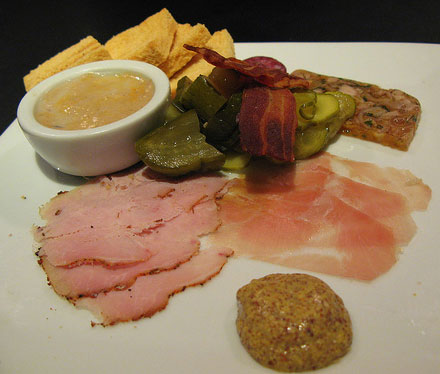
A Charcuterie Plate
Salt-cured and brined products
Salt serves four main purposes in the preservation of food in the charcuterie kitchen. The first is inducing osmosis: this process involves the movement of water outside of the membranes of the cells, which in turn reabsorb the salted water back into the cell; this process assists in the destruction of harmful pathogens. The second is dehydration, which means that the salt pulls excess water from the protein, which aids in the shelf-life of the protein as there is less moisture present for bacteria to thrive in. Fermentation is the third, in which salt assists in halting the fermentation process in meat which would otherwise completely break it down. Finally, salt assists in denaturing proteins, which in essence means that the structure of the proteins is effectively shifted, similar to the effects of cooking.
Before the discovery of nitrates and nitrites by German chemists around 1900, curing was done with unrefined salt and saltpeter. As saltpeter gives inconsistent results, and has been outlawed in the United States for culinary uses since 1975, nitrate and nitrates (in the form of sodium nitrite and sodium nitrate) have increased in popularity for their consistent results. Nitrates take a considerably longer period of time to break down in cured foods than nitrites; because of this, nitrates are the preferred curing salts for lengthy curing and drying periods. Nitrites are often used in foods that require a shorter curing time and are used for any item that will be fully cooked. Eventually a portion of the nitrates will break down into nitrites.
Nitrite has multiple purposes in the curing process. One purpose is flavor, the nitrites giving a sharp, piquant flavor to the meat. Second, the nitrites react with substances in the meat to produce nitric oxide. Nitric oxide prevents iron from breaking down the fat in the meat, thus halting rancidity. The binding also creates the characteristic reddish color found in most cured meats. Finally the nitrite inhibits the growth of botulism-causing organisms that would ordinarily thrive in the oxygen-deprived environment in the sausage casing. German scientists originally named botulism poisoning Wurstvergiftung or "sausage poisoning". The term botulism derives its name from the Latin term for sausage.
Nitrates and nitrites have been noted to react with one another and form nitrosamines which are known to cause cancer. Recent research has proven this risk to be minimal, but regulations in the United States limit residual nitrates and nitrites to 200 parts per million (0.02%) as a precautionary measure.
Curing salt blends
There are two main types of curing salt mixture used by the charcutier. The first is known by multiple names, including "tinted cure mix", "pink cure", "prague powder", or "insta-cure #1". The mixture is 94 percent sodium chloride and 6 percent sodium nitrite. When used, the recommended amount is a ratio of 4oz/113g for each 100 lb/45.36 kg of meat or .25 percent of the total weight of the meat. This blend is colored bright pink to keep the charcutier from confusing the mixture with regular salt.
The second curing salt blend is called "prague powder II" or "insta-cure #2". Also colored pink to differentiate it from table salt, this blend is produced from salt and sodium nitrate. This mixture is used for dry sausages that require a longer drying period which requires the presence of nitrate.
Seasoning and flavoring agents
Sweeteners and other flavoring agents are necessary in the production of many cured products due to the harsh flavors of the curing salts. A number of sweeteners can be used in curing foods, including dextrose, sugar, corn syrup, honey, and maple syrup. Dextrose is seen often in cured meats as it not only mellows the harshness, but it also increases the moisture content of the cured product while not adding a sweet flavor to the cured meat. The sweeteners also assist in stabilizing the colors in meats and it also helps the fermentation process by giving a nutrient to the bacteria.
Numerous spices and herbs are used in the curing process to assist with the flavor of the final product. The sweet spices regularly used include cinnamon, allspice, nutmeg, mace, and cardamom. Other flavoring agents may include dried and fresh chilies, wine, fruit juice, or vinegar.
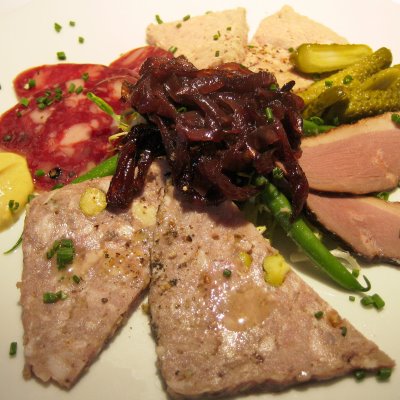
Charcuterie plate, from top left clockwise: Saucisson, a French dry-cured
sausage; pork rillette; thin slices of duck breast; and a country pâté
textured with ham bits. Accompaniments are dijon mustard, tart cornichons
and haricot verts. Crowning the top are caramelized onions.
A Mind-Bogglingly Delicious Charcuterie Plate
Ariane Daguin, owner of the cured-meat purveyor D'Artagnan, envisions the perfect charcuterie platter: "First, I would have a very nice cooked pâté, like a pâté de campagne and some good rillettes [shredded, cooked pork mixed with pork fat]. Then some air-dried meats. That's the part I love, so I need a lot of them. In addition to some good French jambon de bayonne, I'm also excited about duck prosciutto and wild-boar prosciutto. There should be two or three sausages, including some saucisson sec. And a cooked sausage, like a garlic sausage. Finally, good bread, cornichons and hearty red wine."
The Meat Expert's Cheat Sheet
Dry-Cured Meat
FRANCE Jambon de Bayonne, the most well-known French dry-cured ham, is traditionally made in the southwest, near the Pyrenees.
ITALY Prosciutto is probably the most famous cured ham in the world. Coppa, made from pork shoulder, is equally tasty.
SPAIN Spanish dry-cured hams like jamón serrano are rubbed with sea salt, then aged a year or more. Lomo embuchado is cured pork loin.
GERMANY Real Black Forest ham is an air-dried, salt-cured, smoked ham from the forests near Freiburg; it's moister than prosciutto.
Dry-Cured Sausage
FRANCE Saucisson sec is primarily made from pork, seasoned with spices that vary by region.
ITALY Soppressata is a sweet-tasting, coarsely ground sausage; other classic Italian sausages include finocchiona and cacciatorini.
SPAIN Chorizo gets its characteristic tangy flavor from paprika. Fuet, whose name comes from the word for whip, is a long, thin pork sausage.
GERMANY Chewy, jerkylike Landjäger is smoked, as many German sausages are, and seasoned with caraway and garlic.
Cooked Sausage
FRANCE Garlic sausage, or saucisson à l'ail, is delicious by itself, but it's also a key ingredient in cassoulet; also try gently spiced boudin blanc.
ITALY Mortadella is flavored with pistachios, black pepper, wine and sugar, then steamed.
SPAIN Butifarra negra, made with pig's blood, is popular in Barcelona; butifarra blanca, made from pork, is seasoned with nutmeg and white pepper.
