Roasted Turkey
The technique used here called, "to bard," of adding butter or bacon or pork fat, and in this case mixed with herbs under the skin of the turkey, makes the turkey moist and flavorful. This technique, of adding of adding extra fat, developed as a way of keeping faster cooking, lean parts moist and juicy until fattier areas are done. The best turkeys that Brian and I have cooked have been done this way.
If you are planning a big dinner, you can make Make-Ahead Thanksgiving Gravy to save you some time on Thanksgiving or whenever making turkey and want to serve gravy with it. You can add the turkey drippings later.
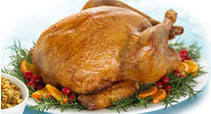 Buying: Allot 1 lb. per person, more if you want leftovers. See chart below to determine the appropriate size turkey for your family gathering.
Thawing: Thaw turkey in unopened wrapper, breast-side up, on a tray in the refrigerator. See chart below for thawing time.
Chart:
| Turkey Size | 8-12 lb. | 12-14 lb. | 14-18 lb. | 18-20 lb. | 20-24 lb. |
| Thawing time |
2-3 days | 3-3½ days | 3½ - 4 days | 4 - 4½ days | 4½ - 5 days |
| Baking time |
2¾ - 3 hours | 3-3¾ hours | 3¾ - 4¼ hours | 4¼ - 4½ hours | 4½ - 5 hours |
| Number of servings | 8-12 | 12-14 | 14-18 | 18-20 | 20-24 |
Preparing:
- Clean the Turkey: Remove neck and excess fat and giblets from chest and neck cavities. Rinse cavity and outside of turkey with cold water. Blot with paper towels.
- Make Broth from Giblets: Place the neck and giblets in a small pan, cover with water, bring to a boil, then simmer on the stovetop while the turkey is roasting. The broth can be added to your gravy for extra flavor.
- Bard the Turkey: Season cavity with salt and pepper. Loosen the skin of the turkey by sliding your fingers under the skin on the breast and thighs, being careful not to tear it. Mix some butter, 4 - 5 Tbsp. for a 12 pound turkey, with fresh herbs such as thyme, sage, rosemary, marjoram and parsley (use the same herbs you use in your stuffing) and stuff under the skin of the turkey. This will keep the turkey breast nice and moist.
- Stuff the Turkey: Just before putting the turkey in the oven, stuff the cavities with your favorite stuffing - Stuffing recipes. Do not stuff any earlier or bacteria could form.
- Roaster Pan: Place turkey in a roaster with a rack.
Roasting:
- Preheat oven to 325°F
- Roast at 325°F for indicated time (see chart above) - with the butter under the turkey skin, basting is unnecessary.
- If the skin is getting too brown, about two thirds of the way through roasting, shield the breast loosely with a sheet of foil to prevent over browning.
- Check for doneness. The quality of the breast meat begins to suffer when rises above 165º, losing some of its juiciness and flavor. This is more so for fresh turkeys or frozen turkeys that haven't been pre-basted or pre-brined. Brining helps poultry remain juicy and moist if it's overcooked a bit, but for the best quality the breast meat shouldn't go over 165º Fahrenheit. However, the meat of the thigh and leg actually improves in quality when it rises above 165º. Dark meat is forgiving, and can reach up to 180º without a loss of quality, and is actually better cooked to the higher temperature, becoming more fall-apart tender and juicier. Still, if it's cooked to 165º it's safe for all to eat. The thigh and drumstick meat should feel soft when pressed, and when the thigh is pierced with a fork the juices should run clear, not pink. Don't forget to use a meat thermometer to be sure that the temperature of the stuffing inside the bird reaches 165°F.
Resting:
- Remove turkey from oven. Place on cutting board or platter. Tent the cooked turkey with foil.
- Let stand for 15-20 min. This resting time allows the juices to saturate the meat evenly for the most tender turkey.
Make Gravy: While the turkey is resting, make the gravy.
- Remove any extra fat from the roasting pan. Fat will look shiny, whereas turkey juices look clear. Add the broth from the giblets and extra water for the desired amount of gravy to the roasting pan and place it on the stove over medium heat.
- Stir the stock and scrape the flavorful bits from the sides and bottom of the roasting pan to deglaze.
- Once deglazed, pour the juices through a strainer into another saucepan to remove any bits that did not dissolve.
- Mix the slurry to be used for the thickener. Mix 1 Tbsp. of flour in cold water for every cup of gravy you are making. For instance, if you have 6 cups of deglazed juices, use 6 tablespoons of flour mixed in about the same amount of cold water. I have a special shaker just for this purpose. The amount of water is not crucial, less is okay; you just want to make sure the flour is completely mixed with the water without any lumps.
- Slowly add flour mixture to the juices in the saucepan and whisk until smooth. Continue to cook, whisking, for 3 to 4 minutes over medium heat.
- As the mixture cooks it will begin to thicken. Bring the gravy to a boil and then turn heat to low and simmer for approximately 5 minutes. Season the gravy with salt and pepper to taste and keep warm until ready to serve.
Carving the Turkey:
| Begin carving by removing the legs. Slice down between the leg and the body. The leg should move easily and the joint connecting the leg to the body may even snap free without cutting, but if it does not, cut through the joint to release the leg from the body. Repeat this for the other leg. | 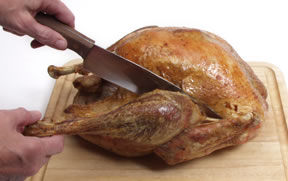 |
| The upper portion of the leg (thigh) can be separated from the lower portion of the leg (drumstick), by cutting through the joint connecting the two portions. | 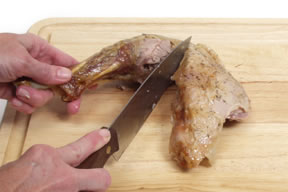 |
| Both the thigh and the drumstick can be left as is or they can be carved further. Holding the thigh with a meat fork, carve even slices that are parallel to the bone. | 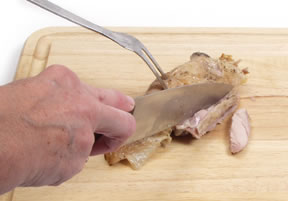 |
| The drumstick can be held on end and slices can be carved up to the bone. | 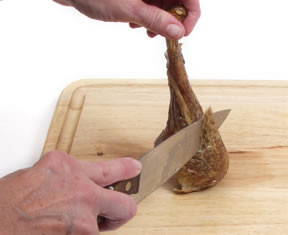 |
| The wing can be removed by pulling it away from the body and cutting into the hollow area between the wing and the breast. When the wing joint (shoulder joint) has been exposed, cut through it while continuing to pull on the wing in order to release it from the body. Repeat this for the other wing. | 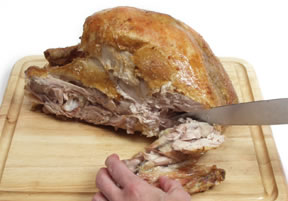 |
| The portion of the wing nearest to the body, known as the drummette, can be cut at the elbow joint. The flat middle section beyond the elbow may be used as one piece. | 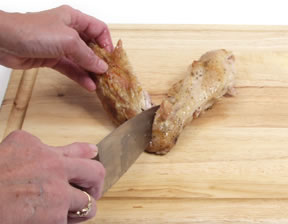 |
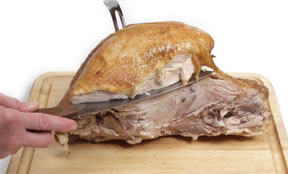
| The first step in removing the breast meat is to make a horizontal cut from near the location of the wing toward the ribs. Cut horizontally as far as possible. |
|
| Make vertical cuts down through the breast meat to the horizontal cut that was made previously. All of the slices will stop at the horizontal cut, allowing for even slices. | 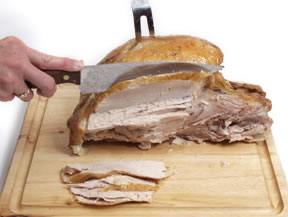 |
| Alternatively, the two breast halves may be removed whole and then placed on a cutting board to carve even slices across the grain of the meat. | 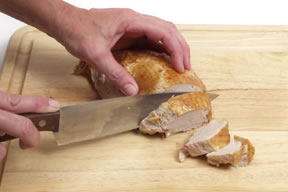 |
Serving: Decorate your platter by placing fresh herbs, such as rosemary and sage, around the turkey. Citrus wedges and whole fresh cranberries are colorful additions to garnish with as well.
For using up all those Thanksgivings leftovers including turkey, see Thanksgiving Leftovers Ideas
