Homemade Orecchiette
from https://www.the-pasta-project.com/
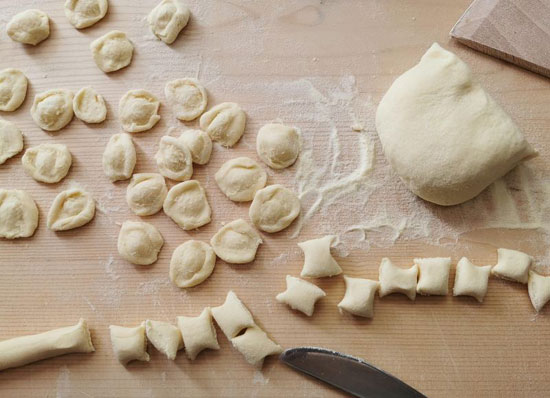
Orecchiette is a really ancient type of pasta from Puglia and Basilicata. The word ‘orecchiette’ means ‘little ears’ and, of course, the name comes from the shape. This pasta became popular in Puglia between the 12th and 13th century. However, some food historians say that originally orecchiette arrived in Southern Italy from Provence during the 13th century with the Angevins, who brought with them a form of pasta called ‘crosets’ . This was very similar to the orecchiette of today.
Orecchiette is made with durum wheat semola flour. Outside of Italy, this flour is often called semolina flour. It is a hard wheat flour that is slightly yellow in colour. It is, also, the flour used in almost all Italian dried pasta as well as most of the traditional pasta shapes from Southern Italy. This pasta, made without eggs, is called pasta di semola di grano duro.
For Northern Italian egg pasta, known as pasta all’uovo, Italians use soft wheat flour. This is because, durum wheat is mostly grown in the South. Also, the dough from durum wheat is quite tough and not suitable for typical Northern pasta types such as ravioli, fettuccine, lasagne or tagliatelle. See Homemade Fresh Pasta for a recipe for northern egg pasta.
Like many Southern Italian pasta shapes, you only need flour, water and salt to make homemade orecchiette. Making and kneading the dough isn’t so difficult. It requires just a little more elbow grease than egg pasta dough. The reason for this is that durum wheat pasta has a higher gluten content than soft wheat pasta.
Once you have made the dough and left it to rest a while, the next step involves rolling pieces of the dough into 10” (25cm) sausages and cutting the sausage into small pieces (1-2cm about 0.4-0.8in) . You can make your orecchiette any size you want. The important thing is that your pasta is more or less the same size.
So far, this is much the same method as making cavatelli or even gnocchi.
There are two ways to shape orecchiette. The first is using a knife. You need to hold the knife at a 45-degree angle to your work surface, then press and roll the piece of dough toward you. When you reach the end of the piece of dough, stop and unfurl it over your thumb in the opposite direction to form a concave shape. Put the ready orecchiette on a baking sheet or tea towel, lightly sprinkled with semolina flour. Repeat with the remaining dough. Some people are able to make homemade orecchiette using just their thumb.
Recipe for Homemade Orecchiette:
300 g hard wheat semolina flour (10.5oz),
Semola di grano duro
160 g
water (5.4floz) tepid
2 pinch salt plus salt for cooking pasta
semolina flour for dusting
Mound the flour on a pastry board or work surface, make a well in the middle and add the salt. Slowly add the water whilst incorporating the flour and water together. You can use a scraper to help keep the flour and water together. (I like to start in a bowl and once I have a dough like mixture, I turn it out onto a board and start kneading)
Work the dough until no dry flour remains. Then knead until smooth and elastic. About 5-10 minutes. Roll the dough into a ball and cover with plastic wrap or a tea towel. Let it rest for about 15-30 minutes.
When you are ready to make the orecchiette, cut off about 1/3-1/4 of the dough and roll it out into a sausage about 10in/25cm in length. Cut the sausage into 1-2 cm (0.4-0.8in) pieces.
Take one piece of dough and a normal dinner knife and hold the knife at a 45-degree angle to your work surface, then press and roll the piece of dough toward you. When you reach the end of the piece of dough, stop and unfurl the dough over your thumb in the opposite direction to form a concave shape. Put the ready orecchiette on a baking sheet or tea towel, lightly sprinkled with semolina flour. Repeat with the remaining dough.
Your homemade orecchiette can be stored at room temperature overnight. So you can make the pasta the day before cooking and serving.
When you cook homemade orecchiette add them to boiling salted water. Once the pasta rises to the surface let it cook for 2 minutes more. Then scoop the orecchiette out of the water with a slotted spoon and add to your sauce. It’s best to try the pasta before removing it to make sure it’s cooked.
