Homemade Fresh Pasta
from http://www.rusticocooking.com/pasta.htm
If you've always wanted to make fresh pasta dough but felt unsure of the correct technique, here's a primer to get you comfortable kneading, rolling out, and cooking your own fresh pasta. This dough can be used to make lasagna noodles, ravioli, fettuccine, linguine,
The raw ingredients for fresh egg pasta are: Unbleached all-purpose flour; sea salt; and eggs.
The standard formula used by most Italian cooks is 3 and 1/2 ounces of flour per egg. However, some recipes call for more or less eggs; no eggs at all; only egg yolks; a hint of white wine; or olive oil to be added to the dough instead. All of these variations yield different lasagna; the fun is in experimenting once you have mastered the basic technique of combining wet and dry ingredients and rolling out and cutting the resulting dough.
Also see: Recipes for making Colored Pasta, Homemade Pappardelle, Homemade Ravioli
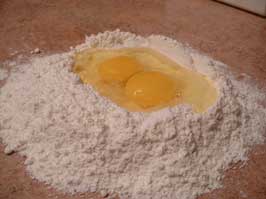
Step 1: Gather Ingredients
To make enough lasagna for 4 people, you will need:
- 1 1/2 cups of unbleached all-purpose flour
- 1/4 teaspoon fine sea salt
- 2 extra-large eggs
Place the flour on a counter and add the salt; combine with a fork.
Make a well in the center and add the eggs to the well.
Step 2: Mix Ingredients
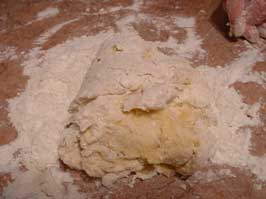
Using a fork at first, draw the flour into the eggs.
When almost all of the flour has been incorporated into the eggs, begin kneading the dough by hand.
Step 3: Knead the dough
Begin to knead the dough with the palms and heels of your hands. If the dough is dry, add a touch of water; if it is moist, add a touch of flour.
Alternately, place the flour in a bowl, mix it with the salt, and stir in the eggs, then turn the resulting dough out onto the counter and knead it as above; this method is easier for beginners.
Knead the dough until it is smooth and supple with your hands; it will take about 5 to 10 minutes.
The aim is not to develop the gluten in the dough, as in bread-making, but rather to produce a dough that is homogenous and workable.
The dough will change from ragged and rough to smooth and elastic as you work it.
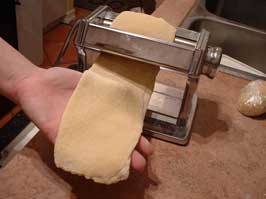
Step 4: First Rolling of the Dough
To roll out and cut using a pasta machine: Cut the dough into 4 equal pieces, keeping the other pieces of dough covered to prevent them from drying out and forming a skin.
Working with 1 piece at a time and keeping the others covered, dust 1 piece with flour, shape it into a flat rectangle, and roll through the machine set on the widest setting.
Step 5: Continue Rolling Dough at Widest Setting
Fold the resulting sheet in thirds, dust with flour, and roll through the machine on the same setting. Repeat one more time, folding the sheet over itself, dusting with flour, and rolling through on the same setting. You will have rolled the rectagle through three times on the widest setting.
This repeated rolling through the widest setting serves to knead the dough and makes it perfectly smooth. Switch to the next-thinner setting; dust the sheet with flour and roll through the machine, without folding the sheet over itself. (From this point on, you will not fold the dough over itself.)
Step 6: Final Rollings of the Dough
Switch to the next-thinner setting; dust the sheet with flour and roll through the machine, without folding the sheet over itself. Repeat the process until you reach the second-to-thinnest setting on your pasta machine. The sheet should be thin enough to be nearly transparent; if needed, roll through on the thinnest setting to obtain a sheet that is sufficiently thin.
The thinner the lasagna sheets, the better they will taste. It is very important that you remember to dust the sheets with flour before rolling through the machine, or they may stick or tear.
Repeat with the remaining 3 pieces of dough.
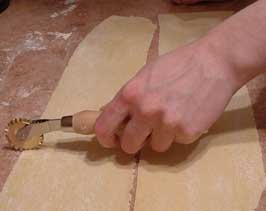
Step 7: Cutting the Pasta:
At this point, the sheets of pasta could be cut by hand or passed through a pasta machine with cutting rollers. Here they are cut for lasagna or cannelloni.
To make other pasta shapes, see:
Cutting and Shaping Pasta by Hand
Cutting Pasta with a Hand-Cranked Roller Machine
When you have rolled out all of the dough, lay the resulting lasagna sheets out on a lightly floured counter and cut into squares using a fluted pastry wheel.
[Note: Lasagne can be cut several different ways. It can be cut into long strips or rectangle shapes. Strips are generally cut 3 to 3 ½ inches wide by 13 inches long. A fluted pastry wheel is used to create a wavy edge, but a knife can be used if a straight edge is desired.
The rectangle lasagne pieces are generally cut to approximately 3 ½ x 5 inches or 4 x 6 inches, using a knife to create a straight edge. When deciding on what size to use, consider the size of the baking dish that you will be using and use a size that will work best for the dish.]
This is the lasagna. It is now ready to boil and top with pesto, tomato sauce, a seafood sauce, or a light white-meat ragu--in short, any sauce that is light yet flavorful, preferably not cream-based.
To dry lasagna and reserve it for future use, lay the squares out on a lightly floured counter in a single layer until thoroughly dry, then stack in an airtight container at room temperature up to 2 weeks.
To freeze lasagna, lay the squares out on lightly floured trays in a single layer and freeze until solid; wrap in wax paper and then in a double thickness of freezer-safe plastic bags. When you are ready to cook frozen lasagna, drop directly into boiling water without defrosting first. Frozen lasagna keeps up to 1 month.
Step 8: Cooking the Pasta
To cook the lasagna, bring a large pot of water to a boil (allow 4 quarts of water for 4 servings).
Add a generous dose of salt and drop in 4 lasagna squares at a time. Cook until al dente, about 1 minute, then remove with a slotted spoon to serving bowls.
Toss each serving of lasagna with room-temperature pesto (see Step 10) as you remove the lasagna from the boiling water, or it will stick together.
Continue to cook and sauce the remaining lasagna in the same manner. Serve the lasagna immediately--do not wait for all servings to be cooked or the lasagna will cool down.
To turn your fresh lasagna into Cannelloni
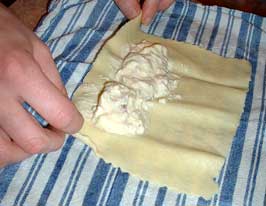
For the cannelloni, you will need eight 5-inch lasagna squares. You can cut fresh lasagna sheets with a fluted pastry wheel for a prettier presentation.
To cook the cannelloni, bring 5 quarts of water to a boil. Add 2 tablespoons of salt. Drop in 4 of the lasagna squares and cook for 2 minutes, or until al dente.
Remove the lasagna squares to a bowl of cool water with a slotted spoon.
Blot the cooked lasagna squares dry on kitchen towels.
Cook the remaining 4 lasagna squares the same way and blot dry as above.
Divide the filling evenly among the lasagna squares. Shape the filling into a log along the bottom of each lasagna square and roll into tight bundles. These are the cannelloni.
Hand-cut pasta (tagliatelle, fettuccine, pappardelle)
Use a rolling pit to thinly roll out one piece of the pasta dough on a floured (or fine semolina-ed) surface. Toss with semolina into little nests and use immediately, or dry it out to use later. Repeat with remaining dough.
Roll up into a loose log and cut it, widthwise, into equal strips of the desired size
- linguine - 5⁄32 in, lay out the strips to dry
- fettuccine - 1/8 inch strips, lay out the strips to dry, pairs best with rich and creamy sauces
- tagliatelle - 1/4 inch, unravel the tagliatelle, loosely wrap 5 or 6 tagliatelle around your hand to form a nest
- pappardelle (‘pap-par-day-lay’) - 3/4 - 1 inch strips, stand the rolls of dough up - perfect companion to a hearty meat or mushroom sauce
Homemade 'penne' (actually garganelli)
Make fresh pasta dough and roll out the dough to very thin sheets by either a pasta maker or rolling pin.
Cut sheets into 1-1/2 inch (4 cm) strips and then into squares
Then place a small dowel or other small wooden stick, such as a chopstick, on one pointed corner and roll up towards the corner that’s diagonally across, pressing slightly at the end to seal.
Note: you can buy a garganelli board fairly inexpensively that will make ridges on the outside of the pasta.
Homemade busiate (spiral pasta)
Busiate are a pasta shape that look like spirals of ribbon. They originate from Sicily but can also be found in Calabria. To make them, you’ll need round-edged chopstick of even thickness or a thick wooden skewer. Here’s how to do it:
Divide pasta dough into small pieces.
Take a piece and use your fingers to roll it out into long, round strands until very thin, approx. the width of a wooden skewer or a thick strand of wool. Cut the single strand into evenly-sized lengths, approx. 10 cm/4 in. long.
Wrap the strand around the skewer in a spiral.
Place on your work surface and roll it for a full rotation, until you have a flattened spiral. You can now gently slip the finished shape off the skewer.
