History of Chowder
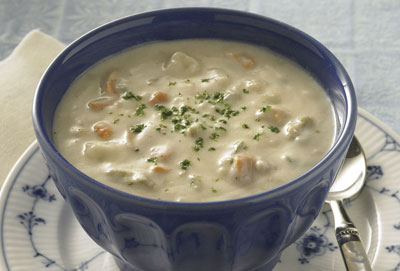
Most clam chowder-lovers have a strong preference: few would admit to liking both. But there's more to the definition of chowder than this cream -versus -tomato rivalry suggests.
A Real Pot-Boiler
Although the origin of the name "chowder" is somewhat mysterious, the history of the soup is a clear, condensed example of culinary evolution. The story begins in the early 17th century on the northwestern coast of France, where preparing seafood in a "chaudiere," or cauldron, was commonplace. Breton sailors who set off for Newfoundland and Nova Scotia kept the tradition alive by preparing cauldrons of fish and salt pork (stew thickened with hardtack). They lived in close proximity to English settlers who adopted the dish, as well as (many believe) the name of the vessel, chaudiere, in which it was prepared. As early as the sixteenth century the words chowder and chowter, dialect version of jowder, meaning a fish-seller were known in Cornwall and Devonshire. And Hannah Glasse's 1763 English cookbook, The Art of Cookery, contained a recipe for "Chowder, a Sea Dish," suggesting that this dish came from seafaring men. Her ingredients are cod, pickled pork, onions, [sea] biscuit, and water. Glasse suggested finishing her chowder with oysters, truffles, morels, or "a glass of hot madeira wine.
"To make Chouder, a Sea Dish.
Take a belly piece of pickled pork, slice off the fatter parts, and lay them at the bottom of the kettle, strew over it onions, and such sweet herbs as you can procure, take a middling large cod, bone and slice it, as for crimping, pepper, salt, all-spice and flour it a little; make a layer with part of the slices, upon that a slight layer of pork again, and on that a layer of biscuit and so on, pursuing the like rule, until the kettle is filled to about four inches cover it with nice paste, pour in about a pint of water, lute [?] down the cover of the kettle, and let the top be supplied with live wood embers. Keep it over a slow fire about four hours.
When you take it up, lay it in the dish, pour in a glass of hot Madeira wine, and a very little India pepper, if you have oysters, or truffles or morels, it is still better, thicken it with butter. Observe before you put this sauce in, to skim the stew, and then lay on the crust, and send it to table reverse as in the kettle, cover it close with the paste, which should be brown." (p. 274-5)
- Hannah Glasse's 1763 English cookbook, The Art of Cookery,
Over the next 200 years the dish made its way into New England. By the end of the 18th century chowder was a staple in the region. At this time the common method of preparation was to layer the ingredients. The bottom of the pot was covered with onions, and then topped with strips of salt pork. Next came a layer of fish, which was seasoned with various herbs, and salt and pepper. Moistened crackers completed the stratification. All was then sometimes covered with a combination of wine and water, and stewed for several hours.
The dish was sufficiently popular in 1751 for a major newspaper, the Boston Evening Post, to run a recipe for "chouder" on September 23rd -- the first on this side of the Atlantic. The recipe is equally remarkable for its literary form as for its culinary content.
Directions for making a Chouder
First lay some Onions to keep the Pork from burning,
Because in Chouder there can be no turning;
Then lay some Pork in Slices very thin,
Thus you in Chouder always must begin.
Next lay some Fish cut crossways very nice
Then season well with Pepper, Salt and Spice;
Parsley, Sweet-Marjoram, Savory and Thyme,
Then Biscuit next which must be soak'd some Time
This your Foundation laid, you will be able
To raise a Chouder, high as Tower of Babel;
For by repeating o're the Same again,
You may make Chowder for a thousand Men.
Last Bottle of Claret, with water eno' to smother 'em
You'l have a Mess which some call Ominium gather 'em.
Early recipes recommend serving boiled potatoes alongside; by the 1840s, the potatoes were included in the pot.
The first American cookbook to give a chowder recipe was the second edition of Amelia Simmons's American Cookery (1800). It called for bass, salt pork crackers, and a side dish of potatoes
Amelia Simmons' recipe:
"Chouder.
Take a bass weighing four pounds, boil half an hour; take six slices raw salt pork, fry them till the lard is nearly extracted, one dozen crackers soaked in cold water five minutes; put the bass into the lard, also the pieces of pork and crackers, cover close, and fry for 20 minutes; serve with potatoes, pickles, apple-sauce or mangoes; garnish with green parsley."
So which came first: milk vs tomato base?
Neither. Oldest chowder recipes suggest they were water-based fish soups of various thickness featuring minimal underground vegetables (onions, carrots, later potatoes). Fish componnent likewise varied. Early chowders were sometimes flavored with wine. Many included some kind of finished bread product (crouton, cracker, stale cubed loaf) for bulk. These recipes decended from the ancient practice of combining grain with protein for maximum results. Think: porridge, stew, gruel & soup. Milk/cream chowder versions were inevitable in regions where dairy products flourished. Tomatoes and sharper spices made sense in warmer climes.
The American colonists were the first to use clams as a main ingredient, due to their easy availability on the Atlantic coast. Clam chowder originated as a working-class one-pot meal among the fishermen of New England. The first printed recipes for clam chowder in America date from the mid-18th century, but chowder has continued to evolve since then.
Boston (New Engalnd) Clam Chowder
The most popular type of chowder in America and the one most people picture when they think of chowder is Boston clam chowder, also called New England clam chowder. Boston chowder is the original form of chowder, with roots in the 18th century. Natives of Maine and Massachusetts invented this dish, and made it with a cream- or milk-based broth, giving it its characteristic white color and thick texture. Traditional Boston clam chowder is made with clams, potatoes, hardtack or crackers, and salt pork or bacon. Today, the layers of hardtack or crackers are generally left out, especially outside of New England, and carrots or celery are often used for extra flavor and color. (Modern Recipe)
Manhattan Clam Chowder
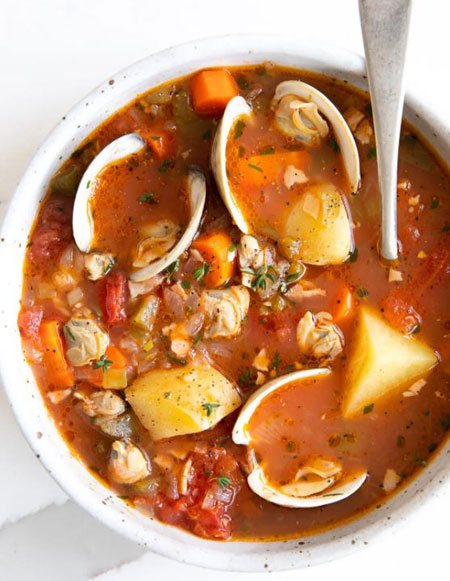 The other main type of clam chowder, though not as popular as the Boston type, is Manhattan clam chowder. Manhattan chowder is immediately distinguishable from the Boston variety by its color since it is made with a tomato base, Manhattan chowder is red, rather resembling cioppino or bouillabaise. This type of chowder may have been introduced by Portuguese immigrants in the 19th century. It never achieved the wide popularity of Boston clam chowder, remaining mainly a regional dish. There is a rivalry between the aficionados of the two types, and most restaurants that serve chowder will serve either Boston or Manhattan, but rarely both. Besides the tomato broth, the ingredients are similar to the Manhattan type, usually including potato, carrot and celery. (Recipe)
Rhode Island Clam Chowder
There is one other type of clam chowder, which is almost exclusively regional to southern Rhode Island. The chowder consists of little more than fresh hard-shell clams (known locally as quahogs) in a clear broth. Any other additions, such as bacon, potatoes, onions, salt, and pepper—are all ingredients that the cook easily could have had on the boat. This type of chowder is loved by locals, but remains virtually unknown outside its native region.
The defining feature of a Rhode Island clam chowder is that there is no milk or cream. This dairy-free chowder is sometimes called a Clear Broth clam chowder. The broth can either be a clam broth or a fish stock. Sometimes herbs are included quite liberally.
Otherwise, the ingredients are almost identical to a New England clam chowder. But it has a completely different character. Without any milk or cream to mellow things out, it has a stronger, saltier flavor of the sea, especially if fresh quahogs and a homemade clam broth are used (as opposed to canned clams).
Thinking Outside the Shell
Much like tomato clam chowder, seafood-free chowders began appearing early in the soup's history. In his book 50 Chowders, Jasper White explains that "farmhouse chowders" featuring vegetables and meat developed naturally in areas of New England where seafood wasn't readily available. During the 19th century Corn Chowder became a well-known variety. It's the only non-seafood chowder included in Fannie Farmer's cookbook.
New England corn chowder and its relatives tended to follow the basic recipe for white chowder, which included, salt pork or bacon, onions, potatoes and cream. Within a short time tomato-based vegetable chowders appeared, along with vegetarian versions that omit the pork. Today the only unifying element among chowders appears to be the potato. But that in itself isn't a firm foundation, as it may be starchy or sweet.
The Clam Scam
While chowder-lovers continue their regional dispute, few realize that New England is actually the birthplace of both the red and white varieties. As early as the 1830s, cooks in Connecticut and Rhode Island were adding tomatoes to their fish chowders, to the dismay of their northern neighbors who preferred a milder tasting, heavier dish. Chowders in Massachusetts and Maine had become thick with crackers, butter, and sometimes milk or cream. By the middle of the century, the entire region finally acquired a taste for the clams that were so abundant along the coast, and began adding them to their chowders in place of fish.
No one knows why tomato-based clam chowder became known as Manhattan-style. As recently as 1896, culinary expert Fannie Farmer included her version of the soup as "Connecticut Clam Chowder" in the first edition of The Boston Cooking-School Cook Book. Nevertheless some historians believe two other events may explain the name change to a degree. By the end of the 1800s, Italian and Portuguese immigrants to the Northeast became partial to the tomato-based clam chowder, which in turn made it more familiar in the large cities where they lived. Then around 1890, two chefs at New York's Delmonico's Restaurant, Alessandro Filippini and Charles Ranhofer, each published a cookbook containing a recipe for tomato clam chowder. Even so, the term "Manhattan Clam Chowder" didn't appear in print until the 1930s. Once it did, however, New England was pleased to end its association with the despised soup (even though Rhode Island is still making its own chowder-proudly including tomatoes.)
While the clam debate continues, less controversial seafood chowders have quietly become popular. Shellfish, particularly lobster, crab and shrimp, are commonly used, as are meatier fish like monkfish and salmon. Tomato-based conch chowder has become a traditional dish in the Bahamas and the Florida Keys.
Condiments and Serving Methods
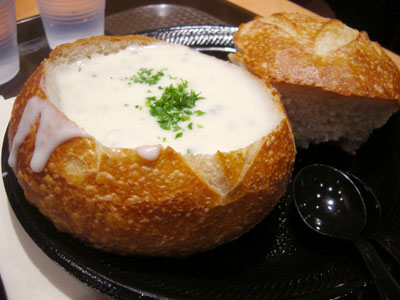 Manhattan and Rhode Island chowders are usually served alongside clamcakes. Boston chowder is often presented in a sourdough bread bowl that soaks up the creamy broth. Many fans of the Boston variety like to spice up their servings with a few drops of Tabasco sauce; though not strictly traditional, this condiment adds a little kick to the cream and complements the clams. Lovers of all three types often like to float a few oyster crackers on top for extra texture. This practice is reminiscent of the old tradition of adding hardtack to the stock during the cooking process.
While the clam debate continues, less controversial seafood chowders have quietly become popular. Shellfish, particularly lobster, crab and shrimp, are commonly used, as are meatier fish like monkfish and salmon. Tomato-based conch chowder has become a traditional dish in the Bahamas and the Florida Keys. Down in New Orleans they make a Tasso and Crawfish Chowder which is stunning. But no matter how it's served, clam chowder is a favorite among seafood lovers. In all its permutations, clam chowder is a classic American comfort food.
Chowder Recipes
*+New England Clam
Chowder
Manhattan Clam Chowder
*Yvonne's Grampa Tingley's Fish Chowder
*Corn Chowder
Uncle Donnie's Fireman's Chowder (made with chicken, for functions at the Fire House)
Lobster Corn Chowder
*Bay Scallop Chowder w/ Parsley Oil
Southwest Seafood Chowder
