Portable/Hand Pies (Edible Pockets)
The practice of making small, stuffed breads and pastries dates back to ancient times. The beauty of these self-contained foods was they were easy to cook, inexpensive, portable and could be consumed anywhere with little mess. Many cultures developed similar foodstuffs though the pastry/bread & fillings differed with region, religion and seasonal availability. In ancient Iraq there was sanbusaq. The Cornish had their pasties, the Spanish their empanadas, the Russians their pirozhki, the Portuguese their rissoles, the Scottish their bridies, the Italians their calzones, and the Eastern Europeans — especially the Eastern European Jews — their knishes. Like dumplings, portable pies are a true universal recipe, spanning all periods and points of the globe.
"There is reason to believe that [sanbusak] is the progenitor of the empanada and calzone. Sanbusak, an Arabic word that comes from the Persian sanbusa, meaning anything triangular, was first described as a stuffed pastry in the early ninth century by Ishaq ibn Ibrahim (d. 851), a well known author from Iraq...In a thirteenth-century Arabic cookery book of al Baghdadi, sanjusaj is described as a stuffed triangular pastry fried in sesame oil...By the thirteenth century, sanbusak appears in Spain, almost as the same recipe, a triangular fried pastry."
---A Mediterranean Feast, Clifford A. Wright [William Morrow:New York] 1999 (p. 573)
These stuffed doughs make great sandwiches to take to work or school for lunch. Small versions of many of these edible pockets make perfect appetizers, served with a dip.
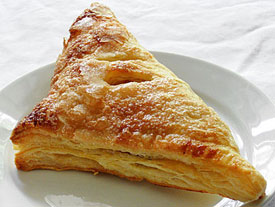
Turnovers
Turnovers are one of the most popular examples of portable pies. Pastry choices range from classic European puff paste to Mediterranean filo.
"A turnover is a sort of small, typically individual pie or pasty, in which the filling is placed on one side of a piece of rolled-out pastry and the other side is then turned over' to cover it, forming a semicircular or tiangular shape. The term is first recorded at the end of the eighteenth century: an old woman preparing her turnovers, commonly called apple-pies' (Sporting Magazine, 1798). It is occasionally used for savoury fillings, such as meat, but a sweet fruit filling is the norm, and, as the above extract suggests, most turnovers are in fact apple turnovers."
---An A-Z of Food and Drink, John Ayto [Oxford University Press:Oxford] 2002 (p. 353)
Apple, Peach, Blueberry or Raspberry Turnovers
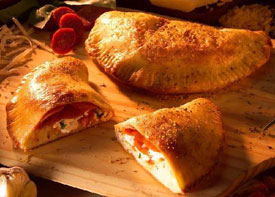
Calzones
A calzone is a turnover that originates from Italy. It is made of ingredients similar to pizza, folded over and shaped like a crescent before being cooked. The typical calzone is stuffed with tomato and mozzarella, and may include other ingredients usually associated with pizza toppings, such as pepperoni.
In the United States, calzone are typically made from pizza dough and stuffed with cheese (usually mozzarella cheese and ricotta, but some varieties contain Parmesan, Provolone, ham or salami, vegetables, or a variety of other stuffings. It is typically served with marinara sauce on the side for dipping, or topped with garlic and parsley-infused olive oil. The dough is folded over, sealed on one edge, salted, then baked in an oven.
In Middletown, Connecticut, several restaurants offer scacciata, which is similar to a calzone, but is filled with either broccoli, spinach, potatoes and onions, and sometimes sausage.
Regarding the origin of calzones there are a couple of theories:
"Calzone means "pant leg" in Italian. Calzone are usually associated with Naples, but are found, famously, throughout southern Italy, sometimes deep-fried. Every town has its own variation...Carol Field, author of several books on Italian food, suggests that calzone may have existed in medieval Latin as early as 1170, according to a reference in Padua, although the historian Luigi Sada, also the author of several Apulian cookbooks, suggests a statute from Bisceglie around 1400 as being the first appearance of the word. Chef Carlo Middione, the author of The Food of Southern Italy, makes the plausible suggestion of a Muslim introduction in medieval Arab times. If this is true, then the calzone, not to mention the empanada, is related to the old fried pastry of the medieval Arab world, sanbusak....Sanbusak, an Arabic word that comes from Persian sanbusa, meaning anything triangular, which was first described as a stuffed pastry in the early ninth century by Ishaq ibn Ibrahim...a well-known author from Iraq."
---A Mediterranean Feast, Clifford A. Wright [Morrow:New York] 1999 (p. 563, 573)
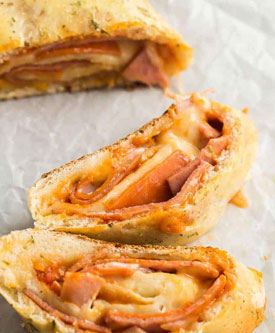
Stombolis
Stromboli is a type of turnover filled with various Italian cheeses (typically mozzarella) and cold cuts (typically Italian meats such as salami, capocollo and bresaola) or vegetables. The dough used is either Italian bread dough or pizza dough. Stromboli was likely invented by Italian-Americans or Italian immigrants in the United States in Philadelphia, though it may have similar counterparts originating in Italy.
A stromboli is somewhat similar to a calzone. A calzone is a baked turnover stuffed with pizza ingredients. A stromboli is usually made by rolling up dough with cheese and meat ingredients and is then baked, but it does not generally contain pizza ingredients aside from cheese and Italian meats. Generally, strombolis do not usually contain tomato sauce, unlike calzones. A calzone is crescent-shaped, and a stromboli is usually shaped like a long cylinder. The distinction between the two is complicated because there is some variation in what constitutes a stromboli.
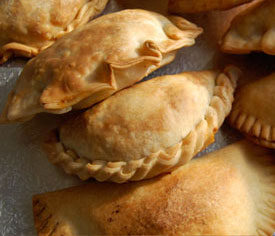
Empanadas
"A Spanish and Latin American savoury turnover. Empanada means 'covered with bread'; and bread dough may be used, but the usual covering is shortcrust pastry. Often the semicircular seam is decorated by twisting it at regular intervals. The pastry may be baked or deep fried. Fillings vary from one country or region to another. In Spain a mixture of minced meats and sausage is common, but in writing about empanadas in Galicia Janet Mendel [Traditional Spanish Cooking, Garnet Publishing, 1996] lists no fewer than 18 examples of fillings, ranging from clams to rabbit, sardines to pigeon, and octopus to ham. In S. And C. America and the southwest of the USA a similarly wide range of fillings are used. Mexican fillings are highly seasoned with chilli peppers."
---Oxford Companion to Food, Alan Davidson [Oxford University Press:Oxford] 1999 (p. 273)
Empanadas are considered part of the gastronomic history of Spanish Galicia. The Empanada Festival is one of this region's major annual events. These portable pies were introduced to the "New World" by Spanish explorers and missionaries.
"Empanadas, meat and fish pies from Galicia, are rarely found elsewhere in Spain. One explanation for the popularity of empanadas in Galicia is that they suit the character of these northern peoples, for the pies hide their contents from public view, just as the Gallegos often remian aloof and secretive. The idea may be a bit farfetched, but there is little doubt that Gallegos make better meat pies than anyone else, using fillings as varied as the produce of Galicia. Most empanadas contain lots of onion and green or red pepper, in combination with meat or fish. The doughs take many different forms, from puff pastry to those made with cornmeal. There are other areas of Spain known for their pies, but these are called pasteles instead of empanadas."
---The Foods and Wines of Spain, Penelope Casas [Alfred A. Knopf:New York] 1982 (p. 52)
[NOTE: Ms. Casas mentions on p. 64 of this book that Empanada de Lomo (pork pie) is the most commonly prepared Galician pie.]
Empanadas - General Information
Empanada Dough
Argentine Beef Empanadas (America's Test Kitchen)
Empanadas Argentinas
Sweet Corn & Bacon Empanadas
Potato & Chorizo Empanadas
Green Chile Chicken & Queso Empanadas
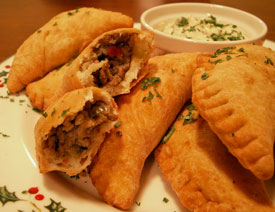
Natchitoches
Personal portable pies, Louisiana-style!
These tasty meat turnovers, along with the Festival of Lights, are native to Natchitoches, Louisiana and are traditionally served on Christmas Eve. They're usually made bigger, more of a hand pie, but also nice as an Hors d'oeurve for holiday parties. Serve with a Creole Mustard Aioli for dipping.
"...the curiously named hot-ta-meat pies of Louisiana that indicate a borrowing from the Spanish...One of the most interesting of all turnovers is the pastry-filled fried food that I dined on in a town in Louisiana called Natchitoches (the name is pronounced Nacky-tosh). These spicy turnovers were once referred to as hot-ta-meat pies, but now they're simply called Natchitoches meat pies. The most famous in town are served at a small restaurant called Lasyones. I am certain these pies are very much related to empanadas and came about through the influence of Spanish settlers in the state. The are decidedly un-French."
---"Turnovers: A Dish With an International Heritage, Craig Claiborne, New York Times, May 5, 1982 (p. C8)
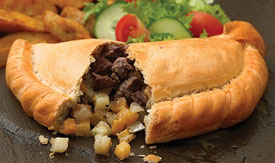
Cornish Pasties
These traditional Welsh meat-filled pies often served as a miner's lunch. When these laborers came to America to work the copper mines, they brought lunch with them. Efficient & portable, easily re-heated & ultimately delicious. Foods like these transcend time and place. If you have the opportunity to taste the real thing NEVER pass it up. After the experience, you will know why.
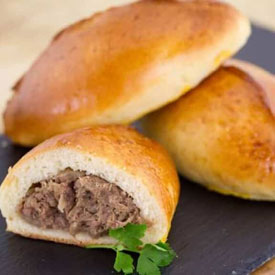
Pirozhki - Polish-Russian pierogi
Pirozhki are Russian and Ukrainian baked or fried yeast-leavened boat-shaped buns with a variety of fillings. Pirozhki are a popular street food and comfort food in Russia and a stereotypical part of Russian culture.
A typical pirozhok is boat- or rarely crescent-shaped, made of yeast-leavened dough, with filling completely enclosed. Pirozhki are either fried or baked. They come in sweet or savory varieties. Common savory fillings include ground meat, mashed potato, mushrooms, boiled egg with scallions, or cabbage. Typical sweet fillings are fruit (apple, cherry, apricot, lemon), jam, or quark.
Russian Pirozhki
Bierocks (German American Sandwich similar to Russian Pirozhki)
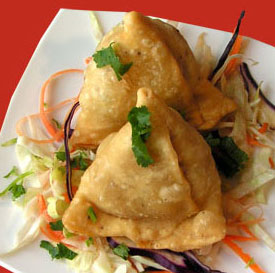
Samosa
"Samosa...are small, crisp, flaky pastries made in India, usually fried but sometimes baked. They are stuffed with a variety of fillings such as cheese, cheese and egg, minced meat with herbs and spices, vegetables such as potatoes, etc. Sweet fillings are also popular. Samosas are usually eaten as a snack, often as a street food.
The Indian version is merely the best known of an entire family of stuffed pastries or dumplings popular from Egypt and Zanzibar to C. Asia and W. China. Arab cookery books of the 10th and 13th centuries refer to these pastries as sanbusak (the pronunciation still current in Egypt, Syria, and Lebanon), sanbusaq, or sanbusaj, all reflecting the early medieval form of this Persian word: sanbosag. Claudia Roden...quotes a poem by Ishiq ibn Ibrahim al-Mausili (9th century) praising sanbusaj.
In the Middle East the traditional shape of sanbusak is a half-moon, usually with edges crimped or marked with the fingernails; but triangular shapes are also used. In India triangular and cone-shaped samosas are popular. In Afghanistan, where the name is sambosa, and in the Turkish-speaking nations, where is its called samsa...it is made both in half-moon shapes and triangles. Sedentary Turkish people such as the Uzbeks and the people of Turkey itself usually bake their samsas, but nomads such as the Kazakhs fry them...These pastries were still made in Iran as late as the 16th century, but they have disappeared from most of the country today..."
---Oxford Companion to Food, Alan Davidson [Oxford University Press:Oxford] 2nd edition, 2007(p. 690)
Aloo Samosas (potato & pea stuffed deep-fried pastry)
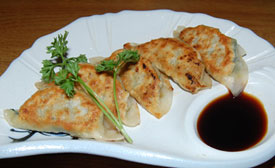
Chinese Pot Stickers
Jiǎozi, or pot sticker is a Chinese dumpling widely spread to Japan, Eastern and Western Asia. Jiaozi typically consist of a ground meat and/or vegetable filling wrapped into a thinly rolled piece of dough, which is then sealed by pressing the edges together or by crimping. Potstickers are steamed and fried dumplings named for their remarkably sticky wrappers, which can adhere to the cooking pan if the dumplings are not handled properly. The term "potsticker" is used mostly in North America, with the Chinese preferring jiaozi.
The construction of a potsticker is very basic. It starts with the dough, which is typically flour-based. The dough is rolled out and cut into a square or a round before being stuffed with a filling made from chopped and seasoned vegetables or meats. Usually the filling is lightly cooked to ensure that it will be fully cooked when the potsticker is cooked, and it can feature a range of ingredients including shallots, pork, garlic, ginger, black beans, tofu, mushrooms, carrots, and cabbage, among many other things. The wrapper is tightly crimped shut to turn the potsticker into a neat package.
Cooking potstickers is a two-step process. First, the dumplings are fried seam side up in a large pan to create a brown crust on the bottom of each dumpling. Then, a shallow water or broth is added to the pan and the pan is covered, allowing the potstickers to steam for 10 to 15 minutes. After the steaming process, the potstickers are done and ready to be served.
Potstickers can be eaten hot or cold, and they are classically served with a sauce. Soy sauce is a common choice, but chili sauces, mustard, fermented black bean sauce, sesame oil, and numerous other garnishes may be offered as well. Classically, potstickers are considered an appetizer, and they may be served with other appetizers like egg rolls and steamed buns. Many dim sum establishments also serve potstickers.
See Types of Chinese Dumplings & Buns
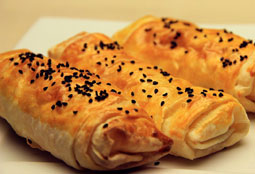
Börek
Börek (also burek and other variants) is a family of baked or fried filled pastries made of a thin flaky dough known as yufka (or phyllo). It can be filled with cheese, often feta, sirene or kaşar; minced meat, or vegetables. Probably invented in Anatolia in the early Ottoman period, it became a popular element of Ottoman cuisine. A börek may be prepared in a large pan and cut into portions after baking, or as individual pastries. The top of the börek is often sprinkled with sesame seeds.
Börek is very popular in the cuisines of the former Ottoman Empire, including North African cuisine. The Northern Slavic cuisines, historically developed by people living in close contact with the Turkic peoples of Asia and Europe, also feature derivatives of the börek. In Israel, börek is part of Mizrahi, Sephardic, and Palestinian traditions.
Spanakopita
Savory Pies: Jamaican Patty, Pyrih, Khachapuri, Karelian Pasties, Pastilla, Bridie, Knish, Hornazo, Gibanica, Meat Doughnut, Fleischkuekle, Öçpoçmaq, quesadillas, knishes, Greek kolokotes
