Christmas Breads Around the World
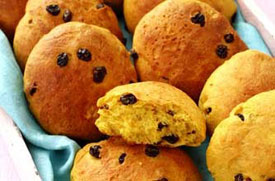
Cornish Saffron Buns
Swedish Saffron Bread
Saffron bread has a long history. In earlier centuries, saffron buns and cakes were made in various parts of England, although they are now regarded as a Cornish speciality. Sir Kenelm Digby (1669) gives an early recipe. It is for a rich yeast bread with butter, milk, sugar, sultanas, currants, and other spices as well as saffron.
Saffron breads are also made in Sweden, especially on 13 December, the feast of Santa Lucia. Enriched and mixed with fruit, candied peel, and almonds, the dough is shaped into plaits, crosses, and buns called Lussekatter, St Lucia's cats.
Swedish Saffron Bread
English Saffron Bread
Traditional Cornish Saffron Buns
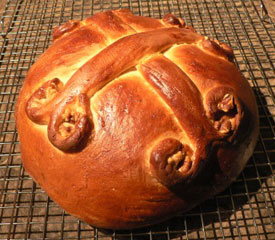
Greek Christopsomo
Literally 'Christ's Bread', this bread forms a significant part of the Greek Orthodox Christmas. Baking it is considered a sacred tradition—the cook crosses himself before beginning, and only the most expensive and pure ingredients are used.
Recipes vary, but Christopsomos may contain pine nuts, red wine, tangerines, anise and myriad dried fruits and nuts. The bread is usually decorated with strips of dough forming a cross, the ends of which coil around cherries or walnuts. Families often further decorate the dough with references to family life—birthdates or names pricked into the crust, or dough animals and people adorning the top of the loaf.
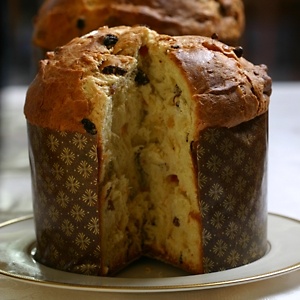
Italian Pannetone
Milanese bread, possibly dating back to the ancient Roman times. Pannetone is baked in a tall round tin and served cut in vertical slices. The bread is rich and fruity.
Panettone is a medieval Italian Christmas yeast bread, filled with candied fruits and raisins. Panettone, a Milanese specialty, is tall, dome-shaped and airy, in contrast to the other famous Christmas bread, panforte, which is is short and dense (although there is a less common, flat version of panettone). The name means "large loaf" in Italian. While the origins of a sweet leavened bread date back to Roman times, and a tall, leavened fruitcake can be seen in a 16th century painting by Pieter Brueghel the Elder, the first known mention of panettone with Christmas is found in the 18th century writings of Pietro Verri, who refers to it as "pane di tono."
The dough is cured for several days (like sourdough), giving the cake its distinctive fluffiness. Raisins, candied orange peel, citron and lemon zest, are added dry; some modern versions add chocolate (which was not available when the recipe originated); others are plain. The classic Panettone accompaniment is a sweet hot beverage or a sweet wine such as spumante or moscato; but any dessert wine will do. Some Italians add a side of crema di mascarpone, a cream made from mascarpone cheese, eggs, and amaretto (or you can substitute zabaglione). The other popular Italian Christmas bread is panforte, a dense fruitcake from Siena Italy dating back to the 13th-century. See Types of Cakes: Fruitcakes
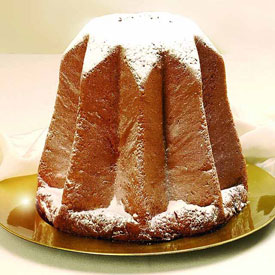
Italian Pandoro
Panettone is however closely related to its Verona counterpart, the palatable and delicate Pandoro. The name of this tall, distinctive cake shaped like a Christmas tree, literally means 'golden bread'. Pandoro is topped with powdered sugar reminiscent of snow, or a twinkling star. And indeed, if cut horizontally each slice of Pandoro is an eight-pointed star. Pandoro which is the conjunction of the Italian words pane and oro, for ‘bread’ and ‘gold,’ is served dusted with vanilla confectioner’s sugar made to resemble the snowy peaks during Christmas. If any is leftover on Christmas morning after the previous nights celebrations, sliced Pandoro is briefly heated in the oven, then dunked in steaming hot cappuccino.
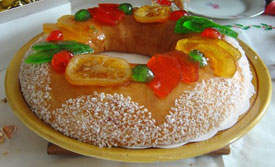
French La Pompe des Rois
This bread hails from France, and is particularly associated with Provence. The dough is flavoured with orange blossom water and studded with candied and glace fruits. It is then formed into a ring and decorated with pearl sugar, more candied fruit and V-shaped slits.
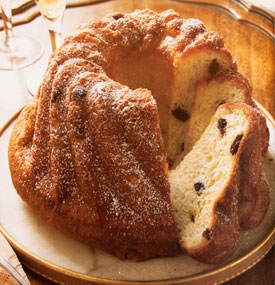
Kugelhopf (French)
One legend claims that Marie Antoinette brought the recipe for Kugelhopf from Austria to France; however, Germany, Hungary and Poland also claim the creation of this fruit-studded Christmas bread.
Kugelhopf is made with a brioche-like dough, baked in a specialty Kugelhopf or 'Turk's head' tin, shaped like a fluted bundt. The baked kugelhopf is then drenched in a buttery rum glaze. Savoury variations of kugelhopf also exist, and are flavoured with ham or bacon.
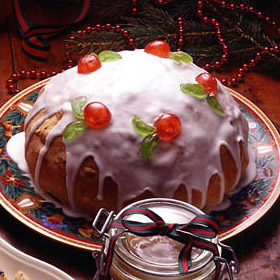
Danish Julekage
A Danish enriched, sweet white bread made with large pieces of candied fruit. Julekage is loaf-shaped, and can either be iced with a sweet white icing or toasted and buttered. Cardamom is a traditional flavouring, but the bread can also be spiced with cinnamon or nutmeg.
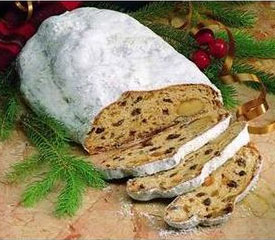
Stollen
This German Christmas bread originated in Dresden sometime before 1474. Its shape, a wide oval folded into unequal halves, represents the infant Christ in his swaddling clothes. A roll of marzipan is hidden inside some Stollens, which are flavoured with cardamom, citrus and dried fruit, and heavily dredged in icing sugar.
The tradition of baking Christmas Stollen in Dresden is very old. Christmas Stollen in Dresden was already baked in the 15th century. This stollen t is different from today's buttery fruited yeast bread. The original stollen was made of flour oats and water. It was served during Advent, a time of fasting. Bakers were not permitted to use butter, and could only bake with oil. Five successive popes were petitioned to rescind the ban of butter. The sixth pope allowed butter and milk to be used in baking stollen, and the recipe evolved. Stollen at that time were baked in loaves weighing 30 pounds. Stollen became such a part of Dresdeners' lives that it was cut and served with special, stollen only utensils.
Some recipes place a log of marzipan inside the rolled dough—a delicious touch. Although there is a basic recipe, every baker and every family have their own "inherited secret recipe." Since 1994 the Dresden 'Stollenfest' is one of the highlights of the Christmas season.
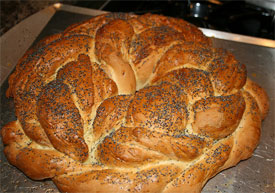
Kolach (Central and Eastern European)
Variations of this bread exist in the Ukraine, Bulgaria and Russia. The name comes from the word kolo, meaning 'circle', and the bread is shaped either as a plain round, a ring or a complicated two-tiered braided ring. Kolach is often topped with poppy seeds.
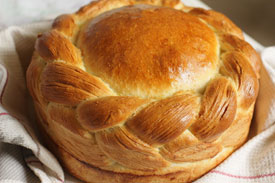
Serbian Christmas Bread (Cesnica)
Česnica, derived from the noun čest, meaning "share," is the ceremonial, round loaf of bread that is an indispensable part of Christmas dinner in Serbian tradition. The preparation of this bread may be accompanied by various rules and rituals. A coin is often put into the dough during the kneading; other small objects may also be inserted. At the beginning of Christmas dinner, the česnica is rotated three times counterclockwise, before being broken among the family members. The person who finds the coin in his piece of the bread will supposedly be exceptionally lucky in the coming year.
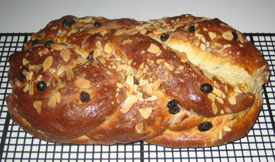
Czechoslovakian Vánočka (Christmas Vánočka/Houska)
This rich, eggy, slightly sweet yeast bread exists in almost every Eastern European culture. Typically, it's braided and can be made with or without raisins. Bohemians and Czechs call it houska. Poles call it chalka, Ashkenazi Jews refer to it as challah. The bread is reminiscent of French brioche and is terrific plain, with butter or toasted. Leftovers are great in bread pudding and makowki (traditional poppy seed bread pudding made from leftover hoska). Houska is braided and has raisins and almonds in it.
When Christmas comes around it is then called Vánočka, although descendants of the Czech emigrants in the U.S. still call it Houska, a name they inherited from their ancestors. Dried fruits and butter are added for a richer product. Come Easter the same dough was used to make a Mazanec - a round bread with a cross on top. The Rohlik was more of a rolled horn either straight or curved with poppyseed or salt poppyseed or salt caraway seed was put on. By housky ("housky" (plural) or "houska" (one piece)), Czechs mean smaller white buns. Housky rolls are intended for immediate consumption. The dough contains almost no fat, so the bread rolls are stiff and dry by the next day. They are braided and are topped with sesame seeds, poppy seeds, or caraway seeds and course salt.
Vanocka ("Christmas bread") has a long history in Czech and Slovakia and without it Christmas is simply just not complete. In the past the Czechs called it pletenice or zemle or ceplik. Before the 18th century it could only be bought at the baker store – people never baked it at home.
Czech Christmas Bread (Vánočka)
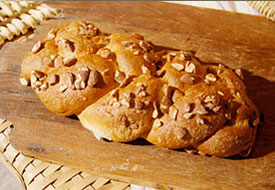
Scandinavian Cardamom Bread
Cardamom bread is a Scandinavian baked good. Cardamom bread is often shaped into a variety of forms before it is baked. For simple, everyday occasions, the bread is often baked in a loaf pan or bundt pan and sliced before serving or the dough may be shaped into individual rolls or buns. Special occasions, especially holidays, tend to have bread that is braided for a more ornate, decorative look.
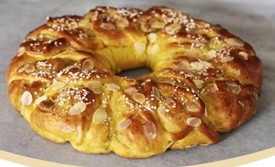
Swedish Saffranskrans
Saffron bread is very popular in Sweden during Advent, a festive, saffron-infused bread shaped like a wreath, often filled with orange marmalade or other sweet fillings. "Saffranskrans" translates to "saffron wreath" in English.
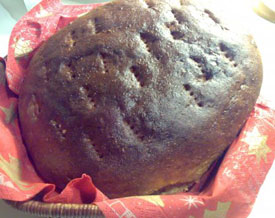
Finnish Joululimppu
Rye flour gives this Finnish Christmas Bread a nutty earthiness with a pleasant tang and a dark, rich color. Joululimppu is brimming with the irresistible flavors of fennel, aniseed, orange and mörk sirup, literally “dark sirup,” a molasses-like ingredient that’s sweet with a touch of bitterness. The breads are formed into rounds and pricked all over with a fork, then basted with molasess during baking. Joululimppu, which translates to “Yule loaf,” is served sliced with butter or festive spreads such as mustard, ham, and cheese.
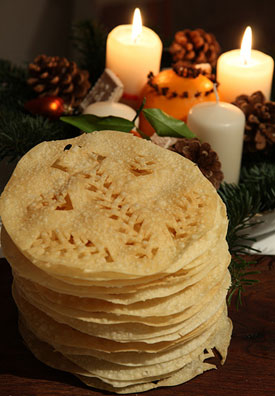
Icelandic Laufabrauð
'Leaf breads' or 'Snowflake breads' are an Icelandic treat, and are among the most distinctive and unusual Christmas breads. Unlike the many fruited-loaf variations, laufabrauð are flat, hard, cracker-like cakes.
A very dense dough made with wheat and sometimes rye is rolled out thinly enough that a newspaper might be read through the dough, before being folded and snipped to create a snowflake pattern (similarly to making a paper snowflake). The breads are then fried in lard. In Iceland, pre-rolled laufabrauð dough is sold ready to be snipped and fried, as a holiday activity for children.
