Types of Cake
Cakes are broadly divided into several categories, based primarily on ingredients and cooking techniques.
| Percentages of Major ingredients in Basic Some Cake Types | |||||
| Cake Type | % Liquid | % Egg | % Flour | % Sugar | % Fat |
| Angel Food (egg whites) | 6 | 47 | 13 | 34 | 0 |
| Sponge | 4 | 45 | 20 | 31 | 0 |
| Biscuit Roulade* (jelly roll cake) | 0 | 59 | 14 | 27 | 0 |
| Chiffon (oil in place of butter) | 14 | 35 | 18 | 24 | 9 |
| Genoise* | 0 | 46 | 23 | 23 | 8 |
| Basic Butter Cake | 24 | 10 | 27 | 27 | 12 |
| Pound Cake | 12 | 22 | 22 | 22 | 22 |
| Pancakes | 52 | 20 | 23 | 0 | 5 |
* without syrup
Fruit Cakes - One of the oldest cakes. Fruitcakes are often served in celebration of weddings and the Christmas holiday.
Yeast Cakes - Until the middle of the Renaissance, European cakes were leavened with yeast and were very similar to yeast breads. Many contain dried fruits and were made for special occasions, and include such pasteries as babka, panettone and stollen.
Cheesecakes - Cheesecakes are also very old, with evidence of honey-sweetened cakes dating back to ancient Greece.
Foam Cakes - By the middle of the 18th century, yeast had fallen into disuse as a raising agent for cakes in favor of beaten eggs. Foam cakes are thought to be the first of the non-yeast-based cakes and rely primarily on trapped air in a protein matrix (generally of beaten eggs) to provide leavening.
Jelly Roll Cake - Cake rolls are typically baked in a jelly roll pan, also known as a sheet pan, which is a large and rectangular pan with shallow rims. The type of cakes used are foam cakes, such as a sponge, which is flexible enough to withstand being rolled without cracking. Fillings for the cake vary widely.
Chiffon Cakes - This fairly recent American creation was invented by a salesman who sold the recipe to General Mills, which spread the recipe through marketing materials in the 1940s and 1950s. Up to this point cakes were either a light sponge cake or a heavier butter or shortening cake. A classic chiffon cake is kind of a cross between the two - it has the richness of a butter cake and the light spring of a sponge cake. Like a sponge cake, the eggs are separated and the whites are beaten to soft peaks before being folded into the batter. And like a butter cake, a chiffon cake contains fat, but it uses vegetable oil instead of butter.
Butter Cakes - The invention of baking powder and other chemical leavening agents during the 19th century substantially increased the flexibility of the traditional pound cake by introducing the possibility of creating lighter, fluffier cakes using the traditional combinations of ingredients, and it is this transformation that brought about the modern butter cake. It was then that cake as we know it today (made with extra refined white flour and baking powder instead of yeast) arrived on the scene.
Charlottes - These molded and very decorative desserts are a variation of the cake in which fillings - hot or cold - are poured into a bowl lined with bread, ladyfingers or pieces of cake, then decorated.
Pudding Cakes - A pudding cake separates into a layer of pudding and a layer of cake when baked.
Fruit Cakes
Fruit cake, one of the oldest cakes, is a cake made with chopped candied fruit and/or dried fruit, nuts, and spices, and soaked in spirits. In the United Kingdom, certain rich versions may be iced and decorated. Fruitcakes are often served in celebration of weddings and the Christmas holiday. The name "fruitcake" can be traced back only as far as the Middle Ages. It is formed from a combination of the Latin fructus, and French frui or frug. And it was only in the 13th century that dried fruits began to arrive in Britain, from Portugal and the E. Mediterranean. The oldest reference that can be found regarding a fruitcake dates back to Roman times. The recipe included pomegranate seeds, pine nuts, and raisins that were mixed into barley mash. Honey (sugar was not prevalent then), spices, and preserved fruits were added during the Middle Ages. Today European countries have their own variations of fruit cake served during the holidays.
See Fruit Cakes (with some historical notes)
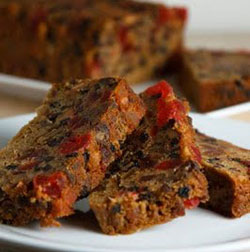
British Style Fruitcake
This is the tradional British-style fruit cake loaded with dried fruits, raisins and nuts, soaked in sherry and left to age. It is also the fruitcake most made in the United States. It contains no leavening and is quite dense due to the amount of fruits and nuts in contrast to the dough.
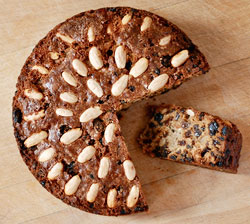
Dundee Cake
A rich, buttery Scottish fruit cake containing sultanas, ground almonds, and candied peel. Before baking, the top is covered with whole blanched almonds.
The name appears to have been first recorded in the late 19th century. According to sources in the city of Dundee, the cake originated as a by-product of the orange marmalade made by Keiller's, the famous and long-established marmalade-makers of that city, who found it convenient to make the cakes during the part of the year when they were not making marmalade (and may well have had citrus peel to spare).
Laura Mason (1999) further observes that the bakers in the city had a gentleman's agreement that only Keiller's should make Dundee cake, a situation which lasted until the company became part of a multinational in the 1970s. The agreement had not, however, extended to other parts of Britain, and the cake was widely copied in the 20th century. Bakers further south also confused it with rich fruit cakes as known in England, and tended to think that it was merely the topping of almonds which distinguished it from the latter.
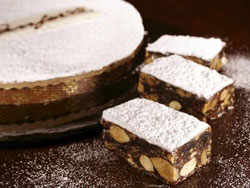
Panforte
Panforte (pronounced pan-FOHR-tay) comes from Siena Italy and also goes by the name Siena Cake. It is a traditional Italian dessert, born in 12th century Siena. Panforte means "strong bread" which refers to the spicy flavour. Panforte is baked in a shallow round form. Bite into a slice of Panforte and you may be surprised to find how chewy it is. This chewy texture comes from mixing the fruit, nuts, spices, and flour (just enough to bind the ingredients), with a boiled syrup made from sugar and honey.
This sugar/honey syrup, along with the addition of melted chocolate and cocoa powder, gives this Christmas cake an almost candy-like texture and flavor which is hard to resist, even for those who hate fruit cake. It was originally called panpepato con miele, peppered (spiced) bread with honey, and was traditionally a Christmas bread baked by nuns. It became panforte and traveled to other parts of Italy, where variations evolved. In the 1400s in Venice it was a custom to enjoy the classic panforte prepared in "the ancient Siena way" for important celebrations; in Genoa's archives it is mentioned as one of the best known desserts of Italy.
In the 1820s the Parenti bakery introduced a chocolate-laced variety; now the most popular varieties are Panforte Nero and Panforte Margherita. Panforte Nero (black panforte), as its name implies, is dark: there is some chocolate, and it has an underlying bitter taste from bitter almonds, along pine nuts, candied citron, lemon rind, flour, sugar, cinnamon, cloves and black pepper. It is preferred by connoisseurs. Panforte Margherita is delicate, made of flour, sugar, honey, almonds, nutmeats, candied citron, candied orange peel and other candied fruit peel, cinnamon, allspice and coriander and topped with a dusting of confectioners’ sugar. The recipe was developed in 1879 by a baker named Enrico Righi and presented to Queen Margherita, who came to see the Palio (the running of the bulls, a major Siena event) with King Umberto every year. Both varieties use a crust of communion wafers.Today’s recipes are lighter and sweeter than the medieval originals, and are served year-round.
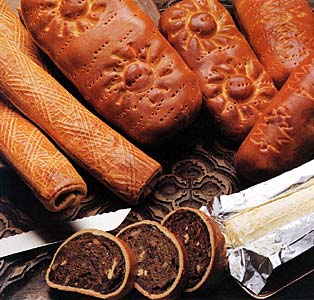
Birnenbrot
This wonderful, spicy and rich peasant's pear and nut bread from Switzerland is made with dried pears, dates, plums and figs, almonds, hazelnuts, walnuts, sultanas, raisins, candied orange and lemon (or zest), thick pear juice (Birnel), "Birnbrot" spices, "Zopf Bread" dough, Kirsch, and many more ingredients.
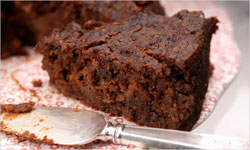
Black Cake
Traditional part of the Christmas time celebration in Trinidad and Tobago. Made predominantly of rum drenched prunes, currants and raisins, it is a staple dinner item between the Christmas season and New Years'.
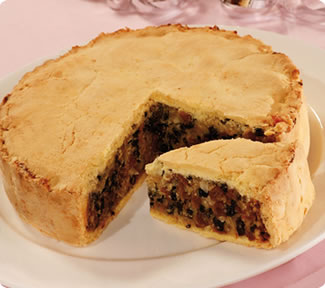
Black Bun
As its alternative name Scotch bun indicates, Black Bun is a Scottish institution, a festive cake eaten at Hogmanay. Originally this cake belonged to Twelfth Night but moved to the secular festival of New Year when religious reformers banned Christmas as a festival.
Although the ‘bun’ has a long and puzzling history, the name ‘black bun’ only came into use in the early part of the 20th century. The recipe for it which was given by Meg Dods (1826) was entitled Scotch Christmas Bun. This was originally made with bread dough enriched with spices, dried fruit, eggs, and brandy and then wrapped in a plain casing of bread dough. Meg Dods said that it was made by all the leading bakers in Edinburgh in the weeks before Christmas and exported in sizes up to 16 lb (8 kg) to other parts of the United Kingdom.
Back in the 18th century the same thing or something very like it appeared as ‘plum cake’. The ‘bun’ term may have been introduced to avoid confusion with the meaning which the Scots had for ‘cake’ as a hard biscuit, as in oat ‘cakes’.
By the late 19th and early 20th centuries it had become so intensely spicy and fruity that the bread dough was abandoned, very little flour was added to the spice and fruit mixture, and the whole mixture was wrapped in short pastry crust. At this stage the bun could almost be described as an English Christmas pudding in a crust. The filling had become so dark as to deserve the epithet ‘black’. It seems to have been after the author R. L. Stevenson described it as ‘a black substance inimical to life’ that the name ‘black bun’ came into use.
The composition of the filling has varied over the centuries. All Scottish bakers who make the bun have their own spice mix, and flavours range from strong peppery versions to milder cinnamon-flavoured ones. Black treacle is a modern addition which did not appear in early recipes, and this of course enhances the blackness.
Size and shape also vary. A black bun may be circular or loaf shaped. In many households there is a strong tradition of serving the bun with Scotch whisky; but the bun may of course be found in households where Scotch whisky is never consumed.
Yeast Cakes
Yeast cakes are the oldest. Until the middle of the Renaissance, European cakes were leavened with yeast and were very similar to yeast breads. Today's yeast-leavened cakes come mostly from continental Europe. Such cakes are often very traditional in form, and include such pastries as babka, savarin and stollen. Also well-known are the Kugelhopf or Gugelhupf, from central Europe, and the panettone from Italy. Some people classify these as yeasted cakes; others call them breads.
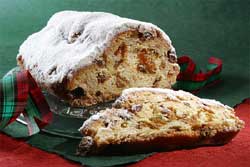
Traditional German fruitcake usually eaten during the Christmas season. It's more like a bread than traditional fruitcake, is loaf-shaped and powdered with icing sugar on the outside. It is usually made with yeast, butter, water, flour, and studded with candied fruit, raisins, and almonds.
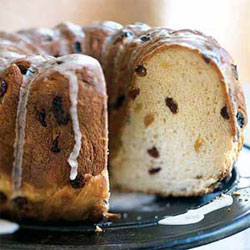
Traditional Babka
Babka developed in the Jewish communities of Central Europe in the early 19th century. Somewhere between a rich coffee cake and a brioche, the name is thought to derive from a popular Easter cake made in Poland called “baba” which means “grandmother” in Polish. The early Eastern European babka looked different to the babka we know today; it was baked in a tall, fluted pan that looked like a grandmother’s skirt. Moist, spongy and bright yellow, babka is a sweet bread commonly served for Easter in Poland, Ukraine, Belarus and other Central and Eastern European countries. According to Polish Heritage Cookery, the term babka covers a wide range of cakes which need to be taller than they are wide, and be narrower at the top than at the bottom.
Traditional babka has some type of fruit filling, especially raisins, and is glazed with a fruit-flavored icing, sometimes with rum added. The name means 'old woman' or 'grandmother' in the Slavic languages.
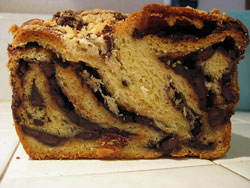
This modern version of babka is associated with the Eastern European Jewish tradition. The chocolate babka was likely a mid-20th century American development. It is made from a doubled and twisted length of yeast dough and is typically baked in a high loaf pan. Instead of a fruit filling the dough contains cinnamon or chocolate and the bread is usually topped with streusel.
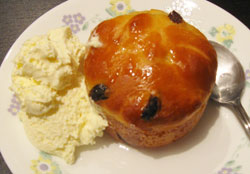
A rum baba or baba au rhum is a small yeast cake saturated in liquor, usually rum, and sometimes filled with whipped cream or pastry cream. It is most typically made in individual servings (about a 2" tall slightly tapered cylinder) but sometimes can be made in larger forms similar to those used for Bundt cakes. The batter for baba is even richer than that for brioche, and includes eggs, milk, and butter. The modern "Baba au Rhum" with dried fruit and soaked in rum, was invented in rue Montorgueil (Paris, France) in 1835 or before.
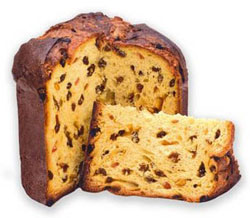
Panettone is a typical bread of Milan, usually prepared and enjoyed for Christmas and New Year in Italy. It has a cupola shape, which extends from a cylindrical base and is usually about 12-15 cm high for a panettone weighing 1 kg. It is made during a long process that involves the curing of the dough, which is acidic, similar to sourdough. The proofing process alone takes several days, giving the cake its distinctive fluffy characteristics. It contains candied orange, citron, and lemon zest, as well as raisins, which are added dry and not soaked. Many other variations are available such as plain or with chocolate . It is served in slices, vertically cut, accompanied with sweet hot beverages or a sweet wine, such as Asti Spumante or Moscato d'Asti.
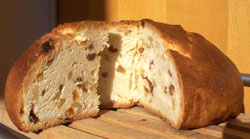
Pandolce
Pandolce [pahn-DOLE-cheh], also called pan di Natale, is a typical Christmas confection from Genoa, Italy. Literally translated, "sweet bread". Pandolce is a Genoese sweet very similar to Milanese Panettone, but denser. Like Panettone, it is a traditional Christmas dessert. The batter for pandolce is made of eggs, butter, sugar and flour, enriched by candied fruit and pine nuts, and perfumed with fennel or anise seeds and orange flower water.
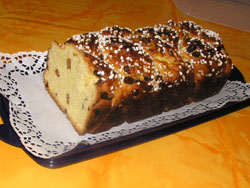
Cozonac
Cozonac [kozoˈnak] is a traditional Bulgarian and Romanian sweet bread. It is usually prepared for Easter in Bulgaria and mostly for every major holiday (Christmas, Easter, New Year) in Romania. Cozonac is a sweet bread, to which milk, sugar, eggs, butter and raisins are added. In Bulgaria lemon zest is also added to the dough mixture. The Italian Panettone is very similar to the basic cozonac, the most visible difference being their shapes.
Cheesecakes
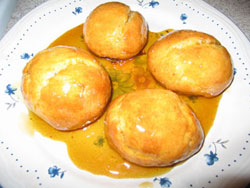
Roman-style cheesecake
Cheesecakes use mostly some form of cheese (often cream cheese, mascarpone, ricotta or the like), and have very little to no flour component (though it sometimes appears in the form of a crust, often sweetened). What makes the cakes rise are the eggs, the whites often beaten and folded in. Cheesecakes are also very old, with evidence of honey-sweetened cakes dating back to ancient Greece.
There are many recipes for cheesecakes in our earliest surviving cookbooks, but one thing these early cheesecakes did not contain was cream cheese, as this is a thoroughly modern invention. American cheesecakes are usually made from cream cheese, which was invented in 1872. After James Kraft invented this type of cheese, it became the top product for making cheesecake in America. In other countries, other cheeses and techniques are used. For instance, Italian cheesecakes are generally made from ricotta cheese or mascarpone. The Germans make a cheesecake that is not baked but uses cream and quark cheese. The Canadians use Maple syrup, while the French make a very light cheesecake with gelatin and Neufchatel cheese.
The one that challenges the taste buds the most is the Roman Style cheesecake, which contains flour, honey, a cheese similar to ricotta, and bay leaves. These ingredients are mixed and rolled into loaves like bread then baked. Modern day Italian version uses sugar instead of honey, ricotta or mascarpone cheese, adds vanilla extract to the mix and small bits of candied fruit, and omits the bay leaves.
See Early Cheesecakes and Types of Cheesecake
Foam Cakes
By the middle of the 18th century, yeast had fallen into disuse as a raising agent for cakes in favor of beaten eggs. Foam cakes are thought to be the first of the non-yeast-based cakes and rely primarily on trapped air in a protein matrix (generally of beaten eggs) to provide leavening, sometimes with a bit of baking powder or other chemical leaven added as insurance. Foam cakes include the Italian/Jewish pan di Spagna and the French Génoise.
Culinary historians believe that sponge cake probably emerged around the early 19th century, because this is when it first started appearing in recipe books. The cake quickly became popular since it was so versatile, and the basic principle of a light, fluffy cake spread across much of the Western world, where various regions developed their own versions. The French Genoise and American chiffon cake are two examples of regional derivatives.
Remove the cake from the oven when it is absolutely done. If not, the fragile batter will collapse. It is ready when the edges shrink from the sides or the pan and it springs back when touched in the center of the batter. (The centers are found around the cake ring). Foam cakes must be turned upside down to cool while still in their pans. The fragile cake structure would collapse if not. Placing it this way allows the warm cake to stretch and set before turning it right-side when cool. Some place the upside-down-pan on four inverted drinking glasses or set in a colander.
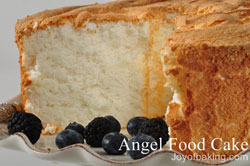
Angel Food Cakes
This type of cake is made with egg whites alone and no yolks. The whites are whipped with sugar until very firm before the flour is gently folded in, resulting in a snowy-white, airy, and delicate cake that marries beautifully with fruit. Most angel food cakes have a spongy, chewy quality derived from their relatively high sugar content and the absence of egg yolks. Baked in ungreased two-piece tube pans, angel food cakes are cooled by being inverted, since this type of cake would collapse if cooled right-side-up in the pan or if removed from the pan while still warm.
Angel Food Cakes are made from a simple meringue, egg whites beaten with sugar. Sometimes cream of tartar is added to the egg whites during beating to help stabilize them. The meringue is then slowly folded together with a relatively small amount of cake flour for stability and texture. Angel food cakes are made without egg yolks or fat of any kind or chemical leavening, such as baking powder and/or baking soda. The beaten egg whites are the leavening and expand in the hot oven, causing the cake to rise to the rim of the 4-inch tall pan, giving it a light, airy texture.
An Angel food cake is one of the most versatile cake choices around. It's a naturally plain cake that tastes as delicious as is or dressed up. Angel food cake batters can be easily flavored with different extracts, such as vanilla, almond, lemon or orange. You can add in other ingredients, such as crushed peppermint candies, finely chopped well-drained maraschino cherries, grated semisweet chocolate or chocolate chips (mini's are the best, if you can find them). A simple garnish of fresh fruit complements any angel food cake.
Angel Food Cake (& variations: Marble, Chocolate, Gold-Silver, Peppermint, Cherry, Chocolate Chip)
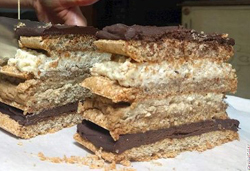
Marjolaine, a type of Dacquoises
Dacquoises
This classic French cake is composed of two layers of a meringue filled with whipped cream or buttercream. Often, the layers are of a meringue "japonais," which means with ground nuts added; you can use blanched almonds or hazelnuts. It is held together with a sour cream ganache: a blend of sour cream and milk and dark chocolates. The combination of hazelnut meringue and sour cream ganache is spectacular! Please use the best chocolates you can find.
The recipe for dacquoise "japonais" can be used in a wide range of desserts, and it can serve as a base for anything from macarons and individual cakes to pavlovas. The cake itself can be filled with pastry cream, buttercream, ganache, whipped cream, fresh fruit, or preserves. The base recipe for dacquoise is incredibly versatile and can be customized by using different types of nut flours, such as pistachio or coconut, and adding different kinds of dried fruits or even chocolate. Some of the most famous combinations are rum and chocolate, lemon and strawberry, and banana and pecan.
While the meringues cannot be made on a humid day, they can be made well ahead and stored airtight at room temperature. This is best served about 2 to 4 hours after completion, when the meringues will still have much of their crispness. Though it can be served for several days after it is made, the meringues will no longer be as crisp. Do not freeze dacquoises.
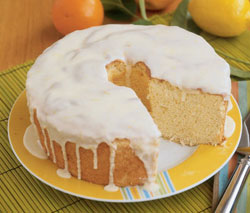
American Sponge Cake
The American Sponge cake has no or little melted butter and more eggs than other sponge cake types. The yolks and whites are beaten separately, providing air as the cake's leavening. This makes for a light and airy (spongy) texture, being the very essence of sponge cake’s dominant characteristic of being. Because these cakes are based on air bubbles, these batters require gentle handling when making so none of the air cells are broken down. When extra yolks are added and their whites are left out, the cake becomes richer, more tender and tighter grained - or less spongy - from the added fat of more yolks. Sponge cake batters must be baked immediately after mixing.
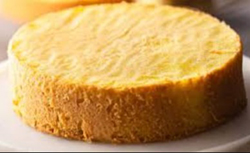
European Sponge Cakes
Genoise or Buttersponge: Genoise is the classic, fine-crumbed French sponge cake. It has been one of the most prized elements in the French chef's repertoire. It is made by beating warm whole eggs with sugar until the mixture more than triples in volume, then folding in the flour and sometimes melted butter too. This type of sponge cake is made with whole eggs rather than just egg whites, which gives it a richer flavor than angel food cake. The eggs are combined with sugar and gently heated over simmering water, then whipped (heating the eggs allows them to be whipped to a greater volume).
Genoise lacks much assertive flavor of its own, but it is often used to construct layered or rolled cakes when a lighter texture than a butter cake is desired. To add flavor and moisture, genoise cake layers are always moistened with a flavored syrup. The right amount of syrup results in soft and tender crumbs, too little can render the cakes dry or tasteless, while too much produces soggy units. Hardcore European versions have liqueur as part of their syrupy additives, resulting in notably enhanced flavors.
They are often sliced into thin horizontal layers and stacked with rich fillings such as buttercream. These layer cakes, common in the coffeehouses of Europe, are called "European-style" to distinguish them from American-style butter layer cakes, which generally have fewer, thicker layers.
The Genoise is different from American sponge cakes in that it has less sugar and sometimes contains clarified butter (butter that has been melted so that the water evaporates and the milk solids drop to the bottom. The milk solids then brown which adds a richer flavor). The butter makes the cake somewhat more moist and flavorful. It tends to be dry and usually some type of syrup or icing is added to the finished cake in order to moisten it. The perfect amount of syrup to use is 3 to 4 tablespoons for every egg used in the recipe. If the cake is several days old and dry, add an extra tablespoon.
Genoise is one of the most useful cakes because it is firm and sturdy. Because of its plain crumb, it makes a great foundation cake for both elaborate or simple concoctions, such as wedding cakes, layer cakes, tortes, ice cream cakes, Baked Alaska, ladyfingers, petits fours and simpler desserts, filled with buttercream or pastry cream and then fruit. It is a great cake to frost with cream frosting, or whipped ganache. Highly decorated sponge cakes with lavish toppings are sometimes called gateau, after the French word for cake.
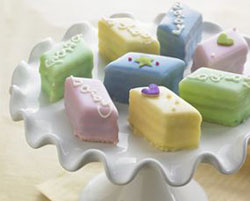
Petits Fours
A genoise is used quite often when making petits fours or small cakes. They usually contain 3 layers of genoise, liberally laced with spirits, and are filled with lemon, hazelnut or raspberry and topped with marzipan. They are then dipped in pastel-colored white chocolate or a fondant glaze.
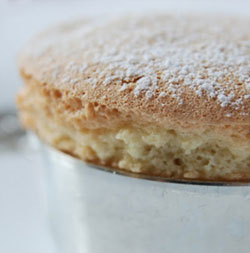
Biscuit (Biscuit de Savoie)
Biscuit (always pronounced the French way as bees-kwee): This type of sponge cake, sort of a cross between angel food and pound cake, contains both egg whites and yolks, but, unlike in genoise, the whites and yolks are whipped separately and then folded back together. In a Genoise the eggs are beaten whole--never separated. This creates a light batter that's drier than a genoise but holds its shape better after mixing. For this reason, it's often used for piped shapes such as ladyfingers. If baked in a tube pan like an angel food cake, it makes a very chewy sponge cake that was popular in the early 20th century but has since fallen out of favor. However, it's still known in a slightly different form as the classic Passover sponge cake, in which the flour is replaced by matzoh cake meal and potato starch.
Biscuit de Savoie (Sponge Cake)
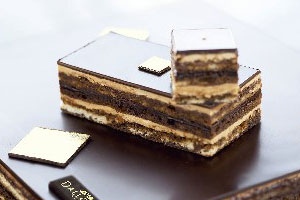
Joconde
An almond sponge cake. This biscuit is named for the Mona Lisa (La Joconda in French). In addition to containing almonds, it differs from other sponge cakes by having whole eggs (rather than just yolks) beaten with sugar and ground almonds before the meringue is folded in. Joconde is baked in thin layers on baking sheets. Joconde is used to make linings for the outsides of charlottes, a traditional French raspberry mousse cake, and other Bavarian mousse cakes.
Almond Sponge Cake (Biscuit Joconde)
Opera Cake (pictured to the left)
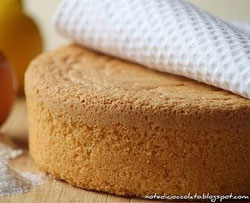
Pan di Spagna
Pan di Spagna means "Bread of Spain," and despite the Spanish sounding name, it's actually Italian. This cake is a simple cake, quite similar to Genoise, that can be eaten plain, dusted with icing sugar, or split in half and layered with jam. Stale Pan di Spagna can be toasted and buttered. It is also used as the basis for many other desserts, including Cassata, Tiramisu, Zuccoto and Zuppa Inglese (English soup). Once cooked, it can absorb almost up to twice its weight in a flavourful liquid.
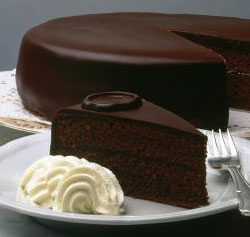
Sachertorte
Sacher Cake is a chocolate cake, invented by Franz Sacher in 1832 for Klemens Wenzel von Metternich in Vienna, Austria. It is one of the most famous Viennese culinary specialties. The Original Sachertorte is only made in Vienna and Salzburg, and is shipped from both locations. The only place where the Original Sacher Torte is available outside of Austria is in the Sacher shop of Bolzano, Italy.
The cake consists of two layers of dense, not overly sweet chocolate cake (traditionally a sponge cake) with a thin layer of apricot jam in the middle and dark chocolate icing on the top and sides. It is traditionally served with whipped cream without any sugar in it, as most Viennese consider the Sachertorte too "dry" to be eaten on its own.
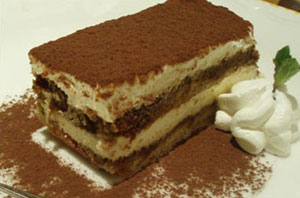
Tiramisú
Classic Italian Cake
These delicious cakes are filled with fresh fruits, sweet ricotta cheese, vanilla cream, chocolate cream, or chocolate, lemon, or raspberry mousse and topped with whipped cream or butter cream frostings.
Classic favorites include:
- Rum Cake, sponge cake lightly soaked with rum and layered with chocolate and vanilla cream and topped with butter cream and chopped roasted peanuts
- Tiramisú with its espresso infused sponge cake and rich and luxurious mascarpone filling.
- Torta al Cappuccino which features cappuccino soaked sponge cake layered with luscious ricotta and topped with whipped cream
- Italian Fruit Cake, a delicious favorite consisting of light, airy sponge cake layered with peaches, strawberries, and whipped cream
- Chocolate Mousse cake, with its layers of rich decadent mousse and dark chocolate cake, is perfect for chocolate lovers. Also available are the Lemon or Raspberry Mousse cakes.
- Gelato Cake (gelato is similar to ice cream)
- Hazelnut and Almond Tortes
- Napoleon Cake
- Traditional Italian Cherry Nut Cake
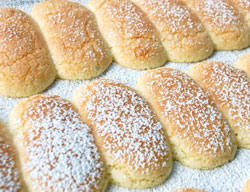
Ladyfingers
Ladyfingers, are light and sweet sponge cakes roughly shaped like a large finger. They are called savoiardi in Italian (meaning "from Savoy"), or in French biscuits à la cuillère or boudoirs. Ladyfingers are a principal ingredient in dessert recipes. Today, their more common usage is in trifles, charlottes, and tiramisu. They are typically soaked in a sugar syrup or liqueur, such as coffee for the tiramisu dessert. Ladyfingers originated in the late 15th century at the court of the Duchy of Savoy, and were created to mark the occasion of a visit of the King of France.
Like other sponge cakes, ladyfingers traditionally contain no chemical leavening agent, and rely on air incorporated into the eggs for their "sponge" texture. The egg whites and egg yolks mixed with sugar are typically beaten separately and folded together with flour. They contain more flour than the average sponge cake. The mixture is piped through a pastry bag in short lines onto sheets, giving the cookies their notable shape. Before baking, powdered sugar is usually sifted over the top to give a soft crust.
Tiramisú - Classic Italian dessert consisting of layers of savoiardi (Lady Fingers) soaked with coffee and brandy or liqueur layered with mascarpone cheese and topped with grated chocolate. It can be made in a trifle bowl, individual goblets, or a springform pan.
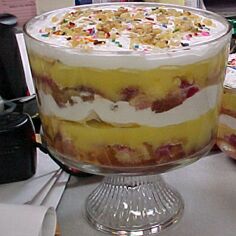
Trifle
Trifle is one of the oldest desserts in the UK having originated somewhere in 16th century. The first trifles were very much like Fools (an old confection of pureed fruit mixed with cream), and the two terms were used almost interchangeably for many years. Many puddings evolved as a way of using up leftovers and trifle originated as a way to use stale cake. The English Trifle is a close cousin of an Italian version called "Zuppa Ingles" (English Soup), and also seems distantly related to a Spanish dessert called "Bizcocho Borracho."
It was in the mid-1700s that cake (or biscuits), alcohol, and custard were combined in the trifle bowl. The recipe for trifle (and many of its now-heirloom glass dishes) came to America via the British who settled in the coastal South. Its popularity remained firm with Southern planters who loved indulgent desserts. Supposedly, it was called Tipsy Parson because it presumably lured many a Sunday-visiting preacher off the wagon. Southern hostesses prided themselves on their elegant table settings and considered a cut-glass trifle bowl to be mandatory.
Jelly Roll Cake
A jelly roll cake (American), also known as a biscuit roulade, roulade (Paupiette) or biscuit recipe (French) or Swiss Roll (English), is used to refer to cakes that when flat, serve as a base to be filled with another ingredient. They are then rolled into a tube-like or log shape and sliced to display the ingredients swirled into the rolled base of food.
Cake rolls are typically baked in a jelly roll pan, also known as a sheet pan, which is a large and rectangular pan with shallow rims. The type of cakes used are foam cakes, such as a sponge, which is flexible enough to withstand being rolled without cracking. Fillings for the cake vary widely and can include pastry cream, buttercream, lemon curd, seedless jam or jelly or chocolate ganache. Right before serving, the roll can be can be simply dusted with powdered sugar or covered with whipped ganache, whipped cream or buttercream. It is sliced into disks, where it shows its pinwheel design when served flat on a plate.
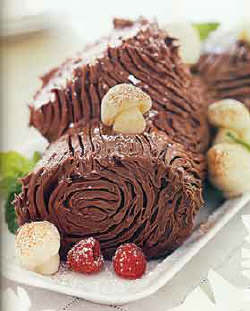
Bûches de Noël
Bûche de Noël type of sweet roulade and is a traditional dessert served near Christmas (as Noel refers to the birth of Christ) in France, Belgium, Canada, Lebanon, Vietnam, and several other francophone countries and former French colonies. As the name indicates, the cake is generally prepared, presented, and garnished so as to look like a log ready for the fire used in the ancient fire-festival of the winter solstice.
The traditional bûche is made from a Génoise or other sponge cake, generally baked in a large, shallow Swiss roll pan, frosted, rolled to form a cylinder, and frosted again on the outside. The most common combination is a basic yellow sponge cake, frosted and filled with chocolate buttercream; however, many variations on the traditional recipe exist, possibly including chocolate cakes, ganache and espresso or otherwise-flavored frostings and fillings. Bûches are often served with a portion of one end of the cake cut off and set on top of the cake or protruding from its side to resemble a chopped off branch, and bark-like texture is often produced in the buttercream for further realism. This is often done by dragging a fork through the icing. These cakes are often decorated with powdered sugar to resemble snow, tree branches, fresh berries, and mushrooms made of meringue.
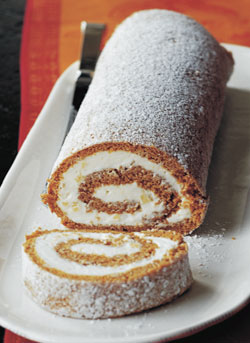
Pumpkin-Walnut Roulade w/ Spiked Cream (jelly roll pan)
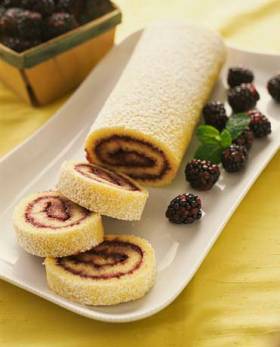
Jelly Rolls
Known since the mid-1800s, jelly rolls are cakes made of a thin sheet of sponge cake, spread with jam or jelly (and sometimes whipped cream or frosting) and rolled up. This type of cake is traditionally sprinkled with confectioners' sugar, rather than being frosted. When cut, jelly rolls have an attractive pinwheel design. The British term for jelly roll is Swiss roll.
Sponge Cake Roll w/ variations
Chiffon Cakes
This fairly recent American creation was invented by a salesman who sold the recipe to General Mills, which spread the recipe through marketing materials in the 1940s and 1950s. Up to this point cakes were either a light sponge cake or a heavier butter or shortening cake. A classic chiffon cake is kind of a cross between the two - it has the richness of a butter cake and the light spring of a sponge cake. Like a sponge cake, the eggs are separated and the whites are beaten to soft peaks before being folded into the batter. And like a butter cake, a chiffon cake contains fat, but it uses vegetable oil instead of butter. Since oil is always liquid at room temperature, a chiffon cake stays soft and moist like a butter cake and thus stays fresher than other foam type cakes. This creates a cake with a tender crumb and rich flavor like an butter cake, but with a lighter texture that's more like a sponge cake. Chiffon cakes can be baked in tube pans like angel food cakes or layered with fillings and frostings.
Historical note: It was in 1948 that Betty Crocker (a brand name and trademark of General Mills) introduced the Chiffon Cake and hailed it as "the cake discovery of the century!" A California insurance salesman turned caterer, Harry Baker, invented the recipe in 1927. He baked his cakes in the Los Angeles area and for Hollywood restaurants, but he never divulged the secret recipe. Harry decided that Betty Crocker should share in his special recipe and he traveled to Minneapolis to finally divulge the secret. At this point the name was changed to “chiffon cake” and was released with a set of 14 recipes and variations in a Betty Crocker pamphlet published in 1948. And the Chiffon Cake was given to cooks across the nation.
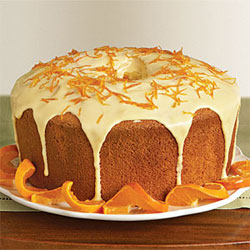
Chiffon Cake
A chiffon cake is a very light cake made with vegetable oil, eggs, sugar, flour, baking powder, and flavorings. It is a combination of both batter and foam type cakes In contrast to butter, the traditional fat used in cake making, it is difficult to beat air into oil, so chiffon cakes, like angel cakes and other foam cakes, achieve a fluffy texture by beating egg whites until stiff, and folding them into the cake batter before baking. Its aeration properties rely on both the quality of the meringue and the chemical leaveners. Its oil-based batter is initially blended before folding into the meringue.
The high oil and egg content creates a very moist cake, and as oil is liquid even at cooler temperatures, chiffon cakes do not tend to harden or dry out as traditional butter cakes might. This makes them better-suited than many cakes to filling or frosting with ingredients that need to be refrigerated or frozen, such as pastry cream or ice cream. Chiffon cakes tend to be lower in saturated fat than butter cakes, potentially making them healthier than their butter-heavy counterparts. The lack of butter, however, means that chiffon cakes lack much of the rich flavor of butter cakes, and hence they are typically served accompanied with flavorful sauces or other accompaniments, such as chocolate or fruit fillings.
Chiffon Cake (& variations: Maple Pecan, Butterscotch, Pineapple, Chocolate Chip, Spice, Orange, Bit O' Walnut, Cherry Nut)
Butter Cakes
The invention of baking powder and other chemical leavening agents during the 19th century substantially increased the flexibility of the traditional pound cake by introducing the possibility of creating lighter, fluffier cakes using the traditional combinations of ingredients, and it is this transformation that brought about the modern butter cake. It was then that cake as we know it today (made with extra refined white flour and baking powder instead of yeast) arrived on the scene.
Typical butter cakes are American butter cakes and Pound cakes. Both have a fine crumb, a tender moist texture and a rich buttery taste, which makes them some of the most popular cakes. Butter cakes tend to be richer than other types of cakes and have a good volume, but Pound cakes are the richest and densest of all Butter cakes.
Butter cakes, including the pound cake and devil's food cake, rely on the combination of butter, eggs, and sometimes baking powder to provide both lift and a moist texture. One of the most important steps is to properly cream the fat with the sugar. This is when air bubbles are formed, which will later expand from the leaveners, and make the cake rise. Recipes will specify room temperature butter and other ingredients, which is very important. Having the ingredients at approximately the same temperatures helps make a consistent creamed mixture which holds air well and incorporates the dry ingredients easily. This helps create a batter that rises evenly.
The test for doneness is when the sides shrink from the pans and when lightly touched in the middle, the cake springs back. Butter cakes can be cooled in their pans or removed and then cooled. When a cake is cooled completely in its pan it should be placed on a wire cake rack. If unmolding, the finished cake should first sit on the rack in the pan for 10 minutes. The cake is then removed and put back on the rack right-side-up to cool completely.
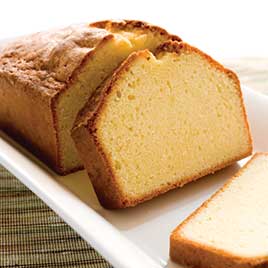
Pound Cake
The Pound Cake is a British creation that dates back to the early 1700s and is the simplest type of butter cake. A classic pound cake is made with a pound each of butter, sugar, eggs, and flour. This produces a dense yet tender texture. Pound cakes are heavier than the types of butter cakes used for constructing layer cakes. They're easy to prepare, with the only trick being that the butter must be quite soft when you begin.
These cakes are usually very lightly flavored with either vanilla or lemon and served plain or topped with a simple glaze or water icing. A pound cake is usually baked in a loaf or Bundt pan. Many coffee cakes, sour cream cakes, and fruit crumb cakes are variations of pound cake. "Sour cream pound cake" is a popular variation in the United States, which involves the substitution of sour cream for some of the butter, which also is intended to produce a more moist cake with a pleasantly tangy flavor. Some of these variations may drastically change the texture and flavor of the pound cake, but the name pound cake is often still used.
Traditional Pound Cake
Buttermilk Pound Cake
Almond Sour Cream Pound Cake
Lemon Pound Cake w/ Lemon Glaze
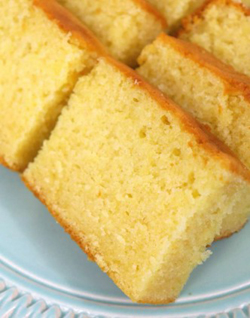
American Butter Cake
The Butter cake, also known as a Shortened cake or Creamed cake, is an American classic. It is thought that the butter cake evolved from the original pound cake recipe as there are a lot of similarities, but the butter cake is lighter in texture. Some favorite butter cakes are Yellow, White or Chocolate cake, lemon, orange, strawberry and marble or chocolate and vanilla swirled together.
An American butter cake is characterized by a rich, buttery flavor and soft texture, relying on butter as a key ingredient for both flavor and structure. It's often used for classic American desserts like layer cakes or simpler coffee cakes. Butter cake batters can be baked in prepared round or square pans, sheet pans or cupcake tins. They can be iced, glazed or dusted with powdered sugar.
Rich White Cake (uses egg whites, no yolks. Can be made into layer cakes, sheet cakes, or cupcakes.)
Mary Lincoln's White Almond Cake (basically a rich white cake with ground almonds added)
Rich Yellow Cake (whole eggs. Can be made into layer cakes, sheet cakes, or cupcakes.)
Gold Cake (eggs yolks, no whites. Can be made into layer cakes, sheet cakes, or cupcakes.)
Marble Cake (white and chocolate cakes batters swirled together. Can be made into layer cakes or sheet cakes.)
Chocolate Chip Cake (white layer cake w/ chocolate chips)
Pink Champagne Cake (layer cake popular in the 1950s)
Chocolate Cake (Can be made into layer cakes, sheet cakes, or cupcakes.)
*Mom's Quick
Chocolate Cake
Devil's Food Cake (There is more cocoa and fat in a Devil's Food Cake than regular chocolate cake, creating a richer and more sinful recipe)
German Chocolate Cake (A layered chocolate buttermilk cake topped and filled with a coconut-pecan frosting. It is an American creation. The original recipe was sent by a homemaker in Dallas in 1957 to a newspaper in Texas which used Baker's German's Sweet Chocolate as an ingredient, developed for Baker's Chocolate Co. in 1852 by Sam German. Hence the cake's name. However, in most recipes and products today, the apostrophe and the "s" have been dropped, fueling the assumption that it's German.)
Black Magic Cake (Rich chocolate mocha cake made with coffee)
Red Velvet Cake (A chocolate butter cake, made with cocoa powder and buttermilk, that has a dark-red color that comes from beets or red food dye and is typically frosted with cream cheese icing. The addition of vinegar to the cake recipe may seem unusual, but it helps with leavening and makes for a very fine, tender cake. It is most popular in the American South.)
Chocolate Mousse Cake
Black Forest Cake (Schwarzwälderkirschtorte - German chocolate layer cake made with Kirsch (cherry liqueur), cherries, whipped cream & chocolate shavings)
Smith Island Cake
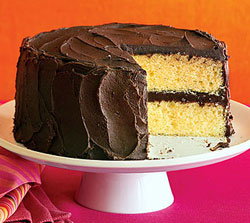
Layer Cakes
Butter cakes can be made into layer cakes with inventive fillings between the layers, such as lemon, raspberry, buttercream icing or nut fillings.
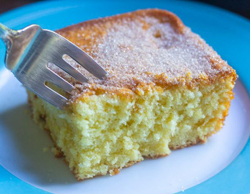
Sweet Cream Cake
Cream Cakes
"The shortening is rich, rich cream [in place of shortening]." (from Betty Crocker's Picture Cookbook, 1950s edition)
Sweet Cream Cake
Whipped Cream Cake
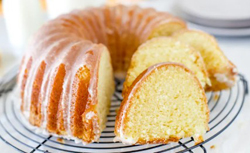
Bundt Cakes
Bundt Cakes are typically made from Butter and Pound cake recipes because they are sturdy, necessary when baking them in intricately decorated pans.
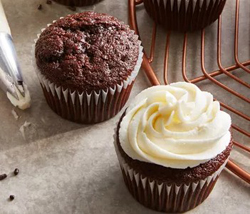
Cupcakes
Miniature butter cakes. You can use the same recipes for larger cakes.
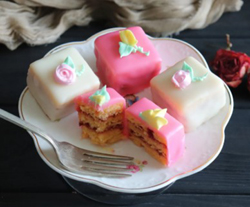
Petitis Fours
Petitis Fours are small, square-cut, frosted and decorated piece of pound cake or sponge cake. They can be made with any flavor cake, though white and chocolate are the most common.
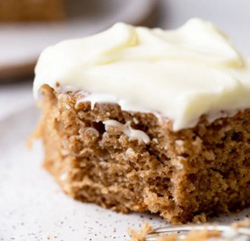
Spice Cakes
More casual cakes heavily accented with allspice, cinnamon and other spices. Oftentimes, frosted with cream cheese frosting.
*Carrot Cake
*Susan's Pineapple-Coconut Carrot Cake
Apple Sauce Cake
*Mom's Gingerbread w/ Lemon Sauce
Pumpkin-Walnut Roulade w/ Spiked Cream (jelly roll pan)
Jam Cake
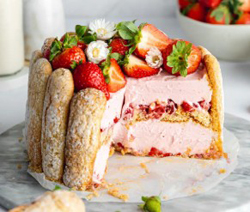
Charlottes
These molded desserts are a variation of the cake in which fillings - hot or cold - are poured into a bowl lined with bread, ladyfingers or pieces of cake, then decorated. The classic version is the Charlotte Russe. Also try such flavors as chocolate, eggnog, strawberry, Bavarian cream.
Charlottes were first popularized by French chef Marie-Antoine Carême, the father of French cuisine, in the early 19th century. Carême claimed to have invented the “charlotte à la Parisienne” at his shop in the early 1800s, a dish with ladyfingers lining a mold, filled with Bavarian cream or a similar filling.
The timeline of the dessert's creation is heavily debated.
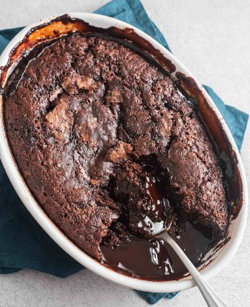
Pudding Cakes
A pudding cake separates into a layer of pudding and a layer of cake when baked. Follow the instructions carefully, then bake until the top of the cake is set. The center of the cake should still be slightly jiggly when you remove it from the oven. Pudding cake, like pudding, is best served cold.
