Yeast Bread Shapes
There are numerous varieties of bread shapes baked in containers or on a flat surface. Some breads are slashed, which not only creates a decorative effect, but provides a means for some of the carbon dioxide gas to escape resulting in a loaf that retains an even shape. Slashing also prevents the bread from splitting and cracking while baking. To ensure proper results, always follow the instructions on the particular bread recipe for the exact requirements for shaping and slashing the dough and for the correct time for the final rising (proofing) period.
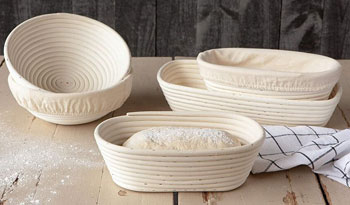
Bannetons: bentwood willow proofing baskets used for sourdough breads and other "country" breads. Proofing baskets can be found in just about every shape and size--round, oval, or long. You can line them with linen for a smooth texture on your bead, or they can be left unlined and the pattern of the basket will imprint on your dough. When ready to bake, turn out of basket and put in the oven immediately to bake.
A banneton is used for round loaves, called boules, and bâtards. A liner usually comes with the basket that can be covered with flour to keep the bread dough from sticking to the basket.
You can improvise with regular wicket baskets, stainless steel or glass mixing bowls, colanders, even bread loaf pans could work for bâtards. Place a cotton kitchen towel or other cotton cloth flat over the top of the container, do not push it in. Dust the cloth with flour, dust the top of the dough, then place your dough in top down. If you push the cloth down in first, all the flour ends up in bottom.
If the dough is stuck to the cloth, spray the cloth or the dough where it is sticking with water.
A couche is typically used for longer loaves, such as baguettes. Couches are flax linen proofing cloths that help shape the long loaves. Placing the dough between folds in the linen helps maintain its shape, absorbs the excess moisture and prevents them from sticking to each other as they increase in size. You can buy special couches designed for this, but using linen or cotton kitchen towels also works.
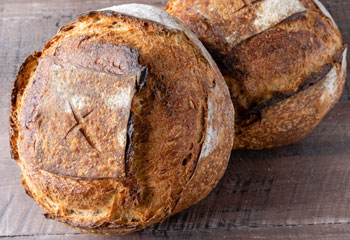
Boule or Round Loaves: French for "ball". Called a "Cob" in Britain. It is a fat, round loaf made from the same ingredients as a baguette or batard and baked on a stone.
To shape a boule, fold the bottom edge of the dough up to about halfway. Fold the left side over to about 3/4 to the right. Fold the right side over to cover left. Stretch top up & away from the center and fold down to about half (you’ll now have a “letter”). Hold the bottom and roll the package over. Using the bench scraper at a 45 degree angle, push into the dough on the right side (if right-handed) then rotate up around the dough and push into the dough at the top to tuck the dough under. Keep going around the dough to shape into a round. In the YouTube channel I got this from, he did not use any flour so there was more tension of the dough on the counter. If using just your hands to do this, push in with the side of the hand on the right side of the dough, then rotate up and push the dough under with your fingers. Dough will tighten up and hold its shape and have a tight skin on top. Use bench scraper to move dough to proofing basket or bowl.
For small rounds, such as for buns, cup you hand over the dough and keep rotating in a circle until the dough forms a nice tight ball. This works best with little or no flour so there is tension between the dough and the work surface. Bringing the sides of the dough under to the underside of the roll and then pinching this together also tightens the skin of the bun. Be sure to fully seal.
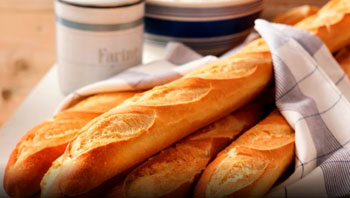
Baguette: The baguette is the shape made famous in Paris, and is thus the ultimate city bread, as opposed to the so-called country loaves, which are more round or oblong. It is a long, thin loaf with diagonal slashes that is often made with nothing more than flour, yeast, salt, and water. The word means "wand" in French and is usually baked free-form on a stone or baking sheet, or in a special U-shaped pan.
The physical length of baguettes will ultimately be determined by the size of your baking stone. 300-gram baguettes roll out to about 14″ in length. Because they're smaller than traditional baguettes, they're more like demi-baguettes. Regardless, shaping baguettes, whether smaller or larger, is almost the same with the only difference being their overall length.
This approach, outlined by Jeffrey Hamelman in his seminal book, Bread, imparts significant structure to the dough and helps keep the shape tight when proofing at room temperature before baking.
- Starting with a preshaped round (or rectangle), first fold the top half down to the middle and seal
- Flip the dough 180° and fold the new top down to the middle again, slightly overlapping the first fold
- Using your left-hand place your thumb horizontally with the middle seam and, using your fingers on the left hand, pick up and curl the top edge of the dough up and over your thumb. At each curl, use your right palm to seal this curl to the middle of the dough. Work your way from the right side of the dough to the left. Note that your right hand is only sealing the dough with the palm, it does nothing else
- Flip the dough 180° and repeat step 3 above, but this time seal the dough to the bottom firmly against the bench
- Using one hand, roll the dough away and toward your body in the middle, then transition to two hands and roll the dough back and forth as evenly as possible until the desired length is achieved. Note that during this rolling it's best to keep your fingertips and palms in contact with the bench at all times. This helps create the consistent taper on each side of the tube.
Another description: To shape, use a bench cutter to divide the dough — usually three or four equal pieces. Smooth-side down, pat the dough down and shape into rectangles — about 10 inches by 8 inches. Like a business letter, fold the dough into thirds, folding the top third down and the bottom third up towards the center. Seal the bread by using the palm of your hand to knock out any large air bubbles and form a tight skin on the top part of the loaf. Fold the dough in half and seal again, striving for a tight skin. Starting with the middle of the dough and working out towards the ends, use a soft hand to roll the dough into a long baguette shape — about 12 to 15 inches in length.
Once rolled out, transfer with two hands to a liberally floured couche for their final proof on the counter.
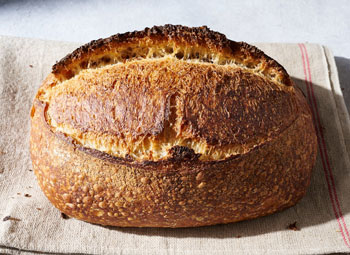
Bâtard: A fat, log-shaped bread, also called Torpedo when with tapered ends due to its shape. It is also slashed diagonally and baked using the same method as the baguette and made with the same ingredients. Starting like the baguette, shape a batard so it tapers off at the ends, but keeps a bit of volume in the center. Other bâtards are not tapered at the ends, but are more rectangular in shape.
A ‘football’ shaped loaf, the batard was one of the last classic shapes the French formed. Here’s a useless piece of bread trivia: The word ‘batard’ is French for ‘bastard’. Originally French bakers only shaped their French dough into baguette and boule (round) shapes. Then in the 19th century a baker came up with the loaf shape. It was a hit. The loaf wasn’t shaped like a baguette or a round, it was something in between. So customers referred to it as a “bastard” hence… batard. Voila! La trivia Francais!
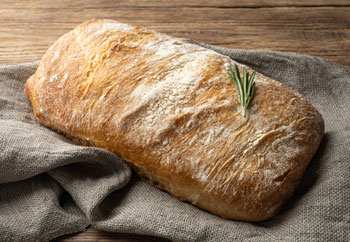
Ciabatta: An Italian flatbread whose shape is said to resemble a Medieval Italian shoe. It has a chewy interior with lots of holes and a floury crust.
Recipe for Ciabatta
Pain Rustique: Pain rustique is a French rustic loaf of bread with a freeform shape. Because it has a rather vague name and is not a traditional variety, the shape and texture varies widely. It can be round, oval, or rectangular. Usually made with unbleached wheat flour, pain rustique can have a soft or coarse texture and an open crumb.
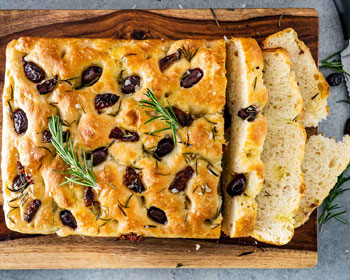
Focaccia: An Italian flatbread that has a dimpled surface. This bread uses olive oil in addition to flour, salt, yeast, and water and can be flavored with herbs and topped with many things.
Recipe for Focaccia
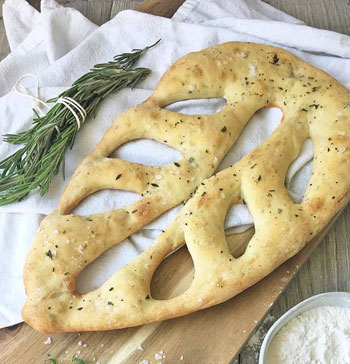
Fougasse: Fougasse (pronounced foo-gaas) is a flat bread from Provence in the south of France, although it can be found (with variations) in other regions of France. Its origin goes back to ancient Rome. Panis focacius was a Roman flat bread which was cooked in the ashes of a wood burning hearth (called a focus). Later, these quick-cooking flat breads became a traditional way to test the temperature of a wood burning oven to tell if it was hot enough to bake the loaves of bread.
Some versions are sculpted or slashed into a pattern resembling a leaf or sheath of wheat, with open areas within the bread. It is often scented with herbs.
The open areas help the bread to bake incredibly quickly. They also make these loaves a crust lover’s best friend because they maximize the surface area of the bread that gets crusty. This crusty crackle and crunch is what makes fougasse distinctly different from its Italian relative, focaccia. But similar to a classic French baguette.
You will typically find fougasse served whole as a part of an appetizer spread, which accents its beautiful form. It also makes a nice accompaniment to a meal.
Provençal Olive Fougasse (French)
Fougasse (Provençal Flat Bread) w/ rosemary & thyme
Title: text
Pain Auvergnat: A bread made from wheat flour, rye flour, yeast, salt, sugar and water. A specialty from Auvergne, this bread has a thick crust, a dense and melting greyish crumb and a hat like a mushroom.
Circle Bread: A traditional German-style bread that is distinguished by its disk shape, notched edges, and circle-patterned, flour-dusted top.
Couronne: A crown (circular) shaped bread that can be made with French, Italian, or country bread dough.
Épi: A baguette-type loaf that's been cut and shaped to resemble a wheat sheaf.
Fendu: Fendu is a French word that means split. Pain Fendu is a French bread that is shaped by splitting the bread down the middle with a dowel to create a "split" in the loaf. In the old days in France, each region had its own style and shape of bread. First, form the risen dough into a ball, sprinkle with some flour, cover it loosely with plastic wrap, and let the dough rest for 15 minutes. Next, elongate the dough ball into a batard, and tighten it up with a bench scraper. After that, press a dowel into the dough to create a deep crevice, and then roll the dowel back and forth to create a thin skin of dough in the middle. Sprinkle some flour into the middle and rub the sides of the crevice with more flour. Roll the sides of the dough together and let the loaf rise for about 30 minutes, split side down, then flip over and continue proofing, split side up, until ready to bake. Then bake them, split side up, for about 30 minutes.
Grissini: Italian breadsticks. They can be as thin as pencils or as thick as your thumb and can be topped with egg wash and sprinkled with seeds or sugar for a sweet bread.
Pain Au Levain: French version of starter-made (sourdough) bread. This artisan bread can be round, shaped like a traditional baguette, or any variety of shapes such as buns, zigzags, twists, or crowns.
Pain de Campagne: A dense country loaf made with a combination of bread flour, whole wheat, and rye flour. It can be baked as a free-form round or in a La Cloche (stoneware baker).
Pain Meteil: Uses a mixture of wheat and rye flours and is baked into a free-form round loaf, traditionally marked with the baker's mark - a kind of monogram used to designate who made the bread.
Pain Ordinaire: The classic French yeast-leavened bread, usually baguette-shaped, with a soft interior and a crisp, thin crust. Best to enjoy it the day it is made.
Pane Allo'Ollio: Everyday Italian bread made with bread flour, yeast, salt, sugar, spring water, and olive oil. Cigar-shaped rolls, crisp on the outside, creamy on the inside, baked on a stone.
Pane Bigio: A round, classic rustic Italian loaf made with bread flour and whole wheat flour.
Panini: Italian rolls that can be made into various shape such as torpedos, globes, or fancy shapes created according to the baker's whim. Also the name of a pressed sandwich.
Petits Pains: Hard rolls from France that are raised four times to produce a bread that is crusty on the outside and soft and creamy on the inside.
Pissaladiere: France's version of pizza made with egg-rich brioche dough then topped with a variety of items.
Pizza: America's favorite flatbread made of bread flour, yeast, salt, and water. Topped with tomato sauces and a variety of cheeses, meats, etc.
Pugliese: Rustic Italian bread similar to Ciabatta, but usually baked in rounds rather than in the shape of a slipper.
Stirato: Italian bread that means "to stretch." The dough for this artisan bread can be stretched up to 36 inches just make sure it will fit in your oven.
Tordu: Twisted baguette that resembles the American donut twists.
