Challah
from Secrets of a Jewish Baker by George Greenstein
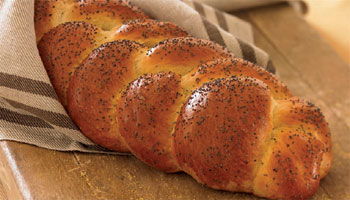
3-Braid Challah with Poppy Seeds
Challah (sounds like "hal-lah" but the "h" at the beginning is made in the back of the throat), or egg bread, is a sweet, egg-rich, festive-looking bread with an elegant mahogany hue. This bread was originally baked by Jewish families to grace the Sabbath or holiday table.
Challah can be made up in different shapes, ranging from a sectioned pan loaf to fancy and intricate braids; braids are traditional for the Sabbath. Another traditional shape, for Rosh Hashana, is the round, turban shaped bread. Challah dough is also used as rich egg roll dough, often shaped into smaller turbans, and is made into many varieties of dinner or sandwich rolls.
Today its use is becoming universal. It is found in ethnic bakeries and food markets of all kinds. Though not quite as rich, it's similar to French brioche. Brioche is made with a high proportion of egg and butter to flour; challah is made with oil and fewer eggs. And, like brioche, it makes wonderful toast and French toast.
The secrets to good challah are simple: Use two coats of egg wash to get that laquer-like crust and don’t overbake it. Joan Nathan, who this recipe is adapted from, adds that three risings always makes for the tastiest loaves, even better if one of them is slowed down in the fridge.
Made into rolls, these are great for sandwiches. See Shaping Turks Caps at the bottom of this page. Ham and cheese with mustard is especially good on these rolls.
1 cup warm water
2 packages active dry yeast (1-1/2 tablespoons)
1 egg, lightly beaten
2 egg yolks, lightly beaten (some recipes use all whole eggs or use the leftover whites for the egg wash. King Arthur Flour uses 2 eggs and 1 egg yolk and uses the extra egg white for the egg wash.)
1/4 cup vegetable oil
1/4 cup plus 1 1/2 teaspoons sugar (some recipes use honey)
4 to 4 1/2 cups bread flour - I only used about 3 3/4 cups of flour total (Note: you can substitute all-purpose flour for bread flour, but the challah will not be as light or tender)
2 teaspoons salt
Vegetable oil, for coating bowl
1 egg beaten with 1 tablespoon water and a pinch of salt, for egg wash
Poppy or sesame seeds, for topping (optional)
Cornmeal, for dusting baking pan
Mixing: In a large bowl, sprinkle the yeast over the warm water and allow to soften. Add the egg, egg yolks, oil, sugar, 4 (3) cups of the flour, and the salt. Stir until the dough comes away from the sides of the bowl. Turn out onto a lightly floured work surface and knead, adding more flour 1/4 cup at a time if the dough is sticky or very soft. Don't add too much flour - when ready, the dough will be springy and moist. It won't stick to your fingers, but it still will be soft and easy to work. Knead until the dough is smooth and elastic and the gluten is well developed (10 to 15 minutes). When you push down, the dough should feel firm and push back.
Rising: Transfer to an oiled bowl, turn to coat, and let rise, covered, until tripled in volume (30 to 40 minutes). When fully risen, an indentation made with a finger pushed down into the center of the dough should remain and not recede. This is a fully aged, or ready, dough. If you have time, punch down and let rise again or put into the refrigerator overnight to further age.
Punch down the dough, cut in half (recipe makes 2 loaves), cover, and allow to rise for 15 minutes.
Shaping & Final Rise:
Punch down again on a very lightly floured work surface.
Shape the breads using one or more of the techniques on this page: Shaping Challah Bread. Or shape into rolls using instructions below.
Give the dough its first egg wash, using care to cover completely, but do not let excess egg drip into the crevices. Then allow it to rise. Place in a warm, draft-free area, preferably enclosed, and allow to rise until doubled in size.
FMM: I made one 1-pound braided loaf and 8 rolls from this recipe.
Baker's Secret: After rising, brush with egg wash a second time. This will give the bread its characteristic shine. While still wet, sprinkle on the poppy or sesame seeds.
Baking: Preheat the oven to 350°F. Bake on the middle shelf of the oven until the loaves have a rich mahogany color and emit a hollow sound when tapped lightly on the bottom with your fingertips (35 minutes). Rolls take only about 25 minutes.
If the top begins to brown excessively and the bottom is raw, cover the bread with a sheet of parchment paper or aluminum foil that has been creased down the center to form a tent. If there is a white line visible between the braids, continue baking until it disappears. To test for doneness, press lightly between the braids on the highest part of the bread; it should be firm. If you feel the creases give when lightly pressed, continue baking until they firm up. Let cool on a wire rack. Challah keeps very well for several days in a plastic bag in a bread box. It can be frozen; defrost slowly, preferably wrapped, overnight in the refrigerator.
Yield: 2 1-pound loaves of bread, or 1 1-pound loaf and 8 decent sized rolls - each about 2 oz. If you want to use the rolls for sandwiches they need to be larger. You could also make the rolls smaller to use as small dinner rolls - I made 32 small rolls from 1 recipe, each about .13 ounces.
To shape Challah Rolls
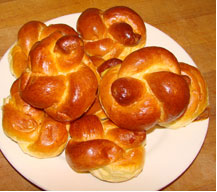
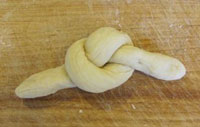
Roll your dough into equal-sized strands that are about 9 inches long.
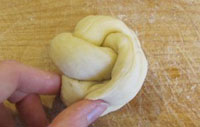
For each strand, start by tying a knot in the dough.
Pinch the two loose ends together to create a roll shape.
Place the seam side down on a greased cookie sheet. Brush with egg wash, top if desired, and allow to rise.
Also see How to Shape Dinner Rolls for other ideas and another way to create these knots - called Turk's Caps