Qunice Paste
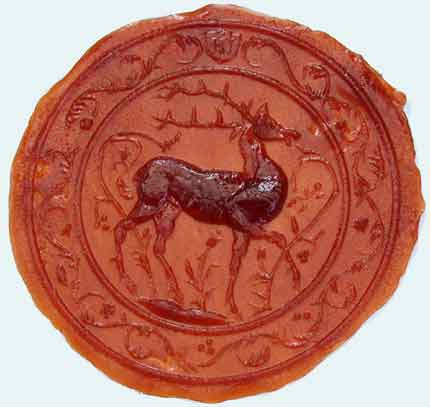
Thi beautiful stag is printed on to a delicious translucent quince paste,
known in the seventeenth century as quiddany or cotoniack, using a wooden mold..
Quince pastes such as this were served during the banquet course.
The fruit most commonly preserved throughout early Europe, including England, was quince, in part because quince was believed to have many health benefits, and in part because its high pectin content made possible all manner of jellied conceits.
Quince is an ancient fruit, found in Roman cooking and grown across Turkey and southeast Asia. It grows on small trees and is closely related to apples and pears, but it lacks their immediate edibility and appeal. The fruit is knobbly and ugly, with an irregular shape and often a gray fuzz — especially when the fruit has been picked underripe. The ripest, nicest quince will have a golden tone and smooth skin. But even ripe quince doesn't taste very good raw.
The first clue that quince hides something special is its aroma. If you leave a quince on a sunny windowsill it will slowly release a delicate fragrance of vanilla, citrus, and apple into your kitchen. It's a heady, perfumed scent that is completely at odds with its appearance. And then, if you peel a quince and hack it up, then cook it, those scents blossom into an indescribably wonderful perfume, and the fruit itself magically turns from yellowed white to a deep rosy pink. When you stew quince in sugar and a little water or wine, it becomes not just edible but delicious — sweet, delicate, fragrant.
Quince paste was known in the seventeenth century as quiddany or cotoniack. The name quiddany normally referred to a translucent pectin-rich jelly, while other quince confections like Genoa paste were opaque thick marmalades. Cotoniacks, quince marmalades and quiddanies were stored in little round wooden boxes.
Medieval English cookery texts give recipes for sweet fruit pastes called chardequince and chardewarden, made from quinces and pears (wardens). However, these were thickened with eggs and were probably designed for immediate consumption. Even more fashionable was the quince preserve called marmalade, which the English initially imported from Portugal, where it was invented (and hence its name, from the Portuguese marmelo, or quince), also Genoa, Spain and France, they don't seem to have been made here at home until the sixteenth century. Other names were cotoniack, quiddany and diasetonia. The last was a term used by the London apothecaries, who prescribed these sweet pastes and jellies for helping the digestion. This was the reason why quince pastes were served after the meal during the banquet course. In 1629, John Parkinson, the Covent Garden based herbarist to James I, wrote,
"There is no fruit growing in this Land that is of so many excellent uses as this, serving as well to make many dishes of meate for the table, as for banquets, and much more for the Physicall vertues".
Like modern quince paste, often called by its Spanish name membrillo, quince marmalade was a smooth, stiff confection that could be picked up with the fingers, not a nubby bread spread. It was sometimes put up in matchwood boxes, to be served in cut pieces, sometimes “printed” in fanciful individual molds, and sometimes squirted in pretzel-like knots. Quince jelly, or quiddany (from the French cotignac), too, was a stiff confection and was often printed. There were also quince “pastes,” quince “cakes,” quince “chips,” and still other types of quince preserves. Wooden 'prints' were used for moulding ornamental marchpanes and gingerbreads, but they were also utilised for printing decorative patterns on quiddany, cotoniack and Genoa paste, the principal quince confections of the early modern period.
By the seventeenth century, all of these conceits had come to be made with innumerable other fruits, including oranges, which were worked up into a marmalade that had the same smooth solidity as its quince forebear. So fond were the English of these sugared fruit delicacies that they devised a specialized implement to consume them: the sucket fork (from succade, candied citrus peel). It had fork tines at one end and a spoon bowl at the other, facilitating both the spearing of solid preserves and the scooping of wet preserves and their ambrosial syrups.
White and red quince pastes were both popular, the latter sometimes being coloured with barberry juice or cochineal. In early Stuart England, both printed and knotted white and red quince marmalades were made. These delicious pastes are totally unlike modern orange marmalades. Many early modern period confectionery texts give recipes for both colours of quince marmalade.
These three recipes are from The Good Huswifes Jewell, 1596 by Thomas Dawson
To make Marmalet of Quinces.
Take very good Quinces, and pare them and cut them in quarters, then coare them cleane, and take heede it be not a stony Quince, and when you haue pared and co- red them, then take two pintes of running water, and put it into a brasse pan, casting away eight spoonefules of one of the pintes, then waigh three pound of fine suger, & beat it, and put it into the water, make your fire where you may haue a good light, not in a chimney, then set on your pan vppon a tree- uet, and when your suger and water begin- neth to boile, you must skimme it cleane, then put in sixe spoonfuls of rosewater, and if there rise any more skumme, take it of and so put in your three pound of quinces, and so let them boile but softly, and if you see the colour waxe somwhat deepe, now & then with a faire slice bee breaking of them, and when your liquour is well consumed away, and the colour of your quinces to growe fai- rer, then be still sturring of it, and when it is enough your shall see it rise from the bottom of your pan in stirring of it, and so box it, and yee shall haue it to bee good marmelet and a verie orient colour, if you will you maye put some muske into it some rosewater, and rub your box withall, it will giue it a prety sent, and it is a very good way.
To make marmelet of Quinces.
Take verie good Quinces and pare them & cut them in quarters, then core them cleane, & take heed it be not a stonie quince, and when you haue pared and cored them, and take two pintes of running water, and put it into a brasse, casting awaye eyght spoonefulls of one of the pintes, the wayght of foure pound of fine suger, & beate it & put it into the water: make your fire where you may haue good light, & not in the chimney, then set ouer your panne vpon a Treuet, and when your suger and water beginneth to boile you must straine it cleane, then put in sixe spoonefuls of rose water, and if there rise any more skumme, take it off and put it into boxes.
To make condomacke of quinces.
Take fiue quarts of running water, and a quart of french wine, put them together, then take quinces and pare them and cutte them till you come at the cores, then weigh ten pounde of the quinces, and put them into your pan of water and wine and boile them ouer a quicke fire till they bee tender, kee- ping your panne verye close couered, then take a peece of tine canuas & put your quin- ces and liquor in it, and when your sirroppe is all runne through, put in so much fine su- ger as will make it sweete, and set it ouer a quicke fire againe, sturring with a sticke til it be so thicke that a drop will stand vpon a dish, then take it from the fire and put it in boxes.
The Good Huswifes Jewell, 1596 by Thomas Dawson
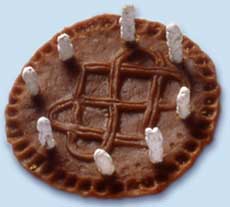
This Genoa paste is flavoured with musk and
'struck' with perfumed ragged comfits. It is based
on one depicted on Dives's banquet table in
Frans Franken's 1603 painting Lazarus and Dives.
Sir Hugh Platt's Quidini of Quinces
Take the kernells out of eight great Quinces, and boile them in a quart of spring water, till it come to a pinte, then put into it a quarter of a pinte of Rosewater, and one pound of fine Sugar, and so let it boile till you see it come to bee of a deepe colour: then take a drop, and drop it on the bottome of a sawcer, then let it run through a gelly bagge into a bason, then set it in your bason upon a chafing dish of coles to keep it warm, then take a spoone, and fill your boxes as full as you please, and when they be colde cover them: and if you please to printe it in moldes, you must have moldes made to the bigness of your boxe, and wet your moldes with Rosewater, and so let it run into your mold, and when it is colde turne it off into your boxes. If you wette your moldes with water, your gelly will fall out of them.
Sir Hugh Platt Delights for Ladies (London: 1600)
To make Paste of Genua, as they doe beyond the Seas
Boile faire yellow Peare-Quinces tender in their skinnes, and so let them stand vntill the next day, till they be colde, then pare them, and scrape all the pulp from the coare, then take as much pulp of yellow Peaches as the pulp of Quinces doth weigh, and dry it vpon a little chafingdish of coales, alwaies stirring it, then boile these pulps in double refined Sugar, and so let it boile, always stirring it vntill it come to a candie height, with as much Rosewater as will melt that Sugar, and put in your pulps, alway stirring it in the boiling, vntill it come from the bottome of the Posnet, then fashion it vpon a pie plate, or a sheete of glasse, some like leaues, some like halfe fruits, and some you may print with moulds, set them into a warme Ouen after the bread is drawne, or into a Stoue, the next day you may turne them, and when the stuffe is through dry, you may box it, and keepe it for all the yeere, but be sure it be through dried before you lay it vp in store.
From John Murrel, A Daily Exercise for Ladies and Gentlewomen, (London: 1617)
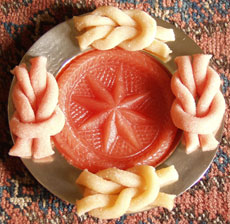
A printed red quince marmalade garnished
with knots of white and red quince paste.
Quince Paste
Let your quinces be full ripe, boil them till they are quite tender, drain and sift them as usual; reduce the marmalade (on the fire) to a paste-consistence, stirring continually, according to the quantity of quince-marmalade; refine a pound of sugar to three quarters of quinces; mix them together on a very flow fire without boiling, put it into what form you please directly, and dry as usual.
Red Quince Paste
To make the paste of a fine red, bake the quinces in the oven a long while, then peel and sift them in a strong hair-sieve; dry the marmalade over a slow fire a little while, to about half the consistency of a paste then to redden it the more, keep it a good while on a slow ashes-fire, stirring some time; and to add to this redness, put a little steeped cochineal, and reduce it on a flow fire, to a thick paste; that is, when it loosens from the Pan; put as much sugar as marmalade, or paste, soak it a little while on the fire and let it cool, just enough to work it well with the hands, and finish directly as usual.
From Borella, The Court and Country Confectioner (London: 1770). Mr Borella was confectioner to the Spanish Ambassador to the English Court in the mid eighteenth century.
To Preserve Quinces
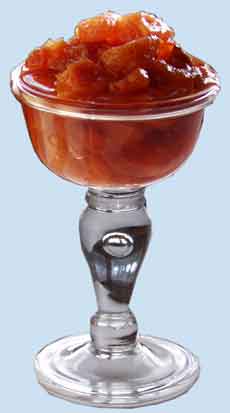
Many early modern period cookery and confectionery books give recipes for preserved quinces, either red or white. That in the sweetmeat glass in the picture was made from the recipe from Archimagirus Anglo-Gallicus.
Take Quinces and weigh them, core and pare them, then take for every pound of Quinces a pound of Sugar; then take Quinces and grate them and strain them; for every pound half a pint as the juyce of the Quinces, and half a pint of fair water; the water, and sugar, and syrrop must be first boyled and clean skimmed, then put in your Quinces and turn them still to keep the colour of them: then let them boyl so till the Quinces be tender, they must seethe very softly, for fear of breaking; and ever as the scumme ariseth, you must take it off with a feather.
From Archimagirus Anglo-Gallicus; Or, Excellent & Approved Receipts and Experiments in Cookery, (London: 1658)
