Great Cities of Mesopotamia
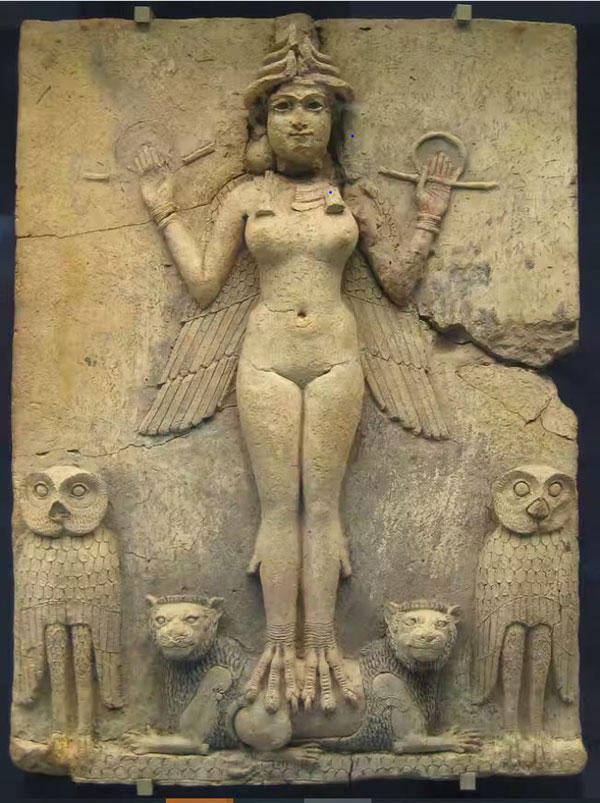
A likely representation of either Ereshkigal or Ishtar.
The Burney Relief (also known as the Queen of the Night relief) is a Mesopotamian terracotta
plaque in high relief of the Isin-Larsa period or Old-Babylonian period, depicting a winged, nude,
goddess-like figure with bird's talons, flanked by owls, and perched upon two lions.
The relief is displayed in the British Museum in London, which has dated it between
1800 and 1750 BCE. It originates from southern Mesopotamia, but the exact find-site is unknown.
The relief is a terracotta (fired clay) plaque, 50 by 37 centimetres (20 in × 15 in) large, 2 to 3 centimetres
(0.79 to 1.18 in) thick, with the head of the figure projecting 4.5 centimetres (1.8 in) from the surface.
Mesopotamia, the land between two rivers, is a historical region of Western Asia situated within the Tigris–Euphrates river system, in the northern part of the Fertile Crescent.
Mesopotamia occupies modern Iraq. The historical region includes also the head of the Persian Gulf and southeast Turkey, west Iran, northeastern Syria and northern Kuwait.
The eighteen recorded Sumerian cities of southern Mesopotamia remained concentrated along the branches and irrigation canals of the Euphrates in a narrow strip of land extending from south of present-day Baghdad to the marches bordering the Gulf. This region was divided between people of two language groups: in the south, Sumerian-speakers, in the north, Semitic speakers, or Akkadians. Each Sumerian city was the center of a small city-state, consisting of the city itself and its surrounding territory – farmlands, gardens and orchards in the irrigated land near the city, grazing land for herds of cattle and flocks of sheep and goats on the arid land further out, between the cities.
What we know of Sumerian history in the Early Dynastic period is one of warfare, between city-states and with foreign invaders. The cities strove to subdue one another, and one city-state after another – Kish, Uruk, Ur, Nipur, Lagash, Umma – achieved a position of dominance over some or all of the other cities of southern Mesopotamia, and beyond.
In this rather tedious power-struggle, certain issues seem to have been at stake. It is clear that some wars were a straightforward conflict over resources – land, water, trade routes. Over and above these, however, there seemed to be two goals that an ambitious king would aim for.
Firstly, domination of Nippur gave the king control over the religious center of Sumer, because it was in this city that the temple of the chief Sumerian god, Enlil, was located. This seems to have been a center of pilgrimage, and possessing it gave a ruler enormous prestige. His patronage of the temple legitimized his status as overlord of other city-states.
Secondly, controlling Kish seems to have been key to controlling the Semitic lands of Akkad, just north of the Sumerian heartlands, which in turn gave a ruler a huge strategic advantage viz-a-viz the other rulers. These two cities therefore figure prominently in the power-struggles of the period.
The civilization of Mesopotamia included distinct phases which are often seen as civilizations in their own right – the Sumerians, the Babylonians, the Assyrians, and the Neo-Babylonians. The Sumerians and Akkadians (including Assyrians and Babylonians) dominated Mesopotamia from the beginning of written history (c. 3100 BC) to the fall of Babylon in 539 BC, when it was conquered by the Achaemenid Empire. See Ancient Mesopotamia: History of a Civilization (6000 BCE - 550 BCE)
Urbanization began in ancient Mesopotamia in the Uruk Period (4300-3100 BCE). The earliest city to rise in the region of Mesopotamia is considered by modern-day scholars to be Uruk, around 4500 BCE, and then that of Ur around 3800 BCE, both of which were then situated in proximity to the banks of the Euphrates River.
To the Sumerians, however, the first city was Eridu which was founded in 5400 BCE but probably was not a `city' in the same way that Uruk or Ur would be defined. Babylonian texts talk of the foundation of Eridu by the god Marduk as the first city, "the holy city, the dwelling of their [the other gods] delight".
Other cities which lay claim to the title of `first city' are Byblos, Jericho, Damascus, Aleppo, Jerusalem, Sidon, Luoyang, Athens, Argos, and Varasani. All of these cities are certainly ancient and are located in regions which have been populated from a very early date. Uruk, however, is the only contender for the title of `oldest city' which has physical evidence and written documentation, in the form of cuneiform texts, dating the activities of the community from the earliest period. Sites such as Jericho, Sidon, and even Eridu, which were no doubt settled before Uruk, lack the same sort of documentation.
Eridu
Eridu was long considered the earliest city in southern Mesopotamia. Located 12 km southwest of Ur, Eridu was the southernmost of a conglomeration of Sumerian cities that grew around temples, almost in sight of one another. These buildings were made of mud brick and built on top of one another. With the temples growing upward and the village growing outward, a larger city was built. In Sumerian mythology, Eridu was originally the home of Enki, later known by the Akkadians as Ea, who was considered to have founded the city. His temple was called E-Abzu, as Enki was believed to live in Abzu, an aquifer from which all life was believed to stem.
Excavation has shown that the city was founded on a virgin sand-dune site with no previous occupation. According to Gwendolyn Leick, Eridu was formed at the confluence of three separate ecosystems, supporting three distinct lifestyles, that came to an agreement about access to fresh water in a desert environment. The oldest agrarian settlement seems to have been based upon intensive subsistence irrigation agriculture derived from the Samarra culture to the north, characterised by the building of canals, and mud-brick buildings. The fisher-hunter cultures of the Arabian littoral were responsible for the extensive middens along the Arabian shoreline, and may have been the original Sumerians. They seem to have dwelt in reed huts. The third culture that contributed to the building of Eridu were the Semitic-speaking nomadic herders of herds of sheep and goats living in tents in semi-desert areas. All three cultures seem implicated in the earliest levels of the city. The urban settlement was centered on a large temple complex built of mudbrick, within a small depression that allowed water to accumulate. By c. 2050 BC the city had declined; there is little evidence of occupation after that date.
Uruk
Uruk, also known as Warka or Warkah, was an ancient city of Sumer* (and later of Babylonia) situated east of the present bed of the Euphrates River on the dried-up ancient channel of the Euphrates 30 km (19 mi) east of modern Samawah, Al-Muthannā, Iraq. According to the Sumerian King List, it was founded by King Enmerkar c. 4500 BCE.
*Sumer is the earliest known civilization in the historical region of southern Mesopotamia (south-central Iraq), emerging during the Chalcolithic and early Bronze Ages between the sixth and fifth millennium BC. It is also one of the first civilizations in the world, along with ancient Egypt, Elam, the Caral-Supe civilization, the Indus Valley civilization, the Minoan civilization, and ancient China. Living along the valleys of the Tigris and Euphrates, Sumerian farmers grew an abundance of grain and other crops, the surplus from which enabled them to form urban settlements. Proto-writing dates back before 3000 BC. The earliest texts come from the cities of Uruk and Jemdet Nasr, and date to between c. 3500 and c. 3000 BC.
Uruk is the type site for the Uruk period. Uruk played a leading role in the early urbanization of Sumer in the mid-4th millennium BC. By the final phase of the Uruk period around 3100 BC, the city may have had 40,000 residents, with 80,000-90,000 people living in its environs, making it the largest urban area in the world at the time. The legendary king Gilgamesh, according to the chronology presented in the Sumerian King List (henceforth SKL), ruled Uruk in the 27th century BC. The city lost its prime importance around 2000 BC in the context of the struggle of Babylonia against Elam, but it remained inhabited throughout the Seleucid (312–63 BC) and Parthian (227 BC to 224 AD) periods until it was finally abandoned shortly before or after the Islamic conquest of 633–638 AD.
In myth and literature, Uruk was famous as the capital city of Gilgamesh, hero of the Epic of Gilgamesh. Scholars identify Uruk as the biblical Erech (Genesis 10:10), the second city founded by Nimrod in Shinar.
In addition to being one of the first cities, Uruk was the main force of urbanization and state formation during the Uruk period, or 'Uruk expansion' (4000–3200 BC). This period of 800 years saw a shift from small, agricultural villages to a larger urban center with a full-time bureaucracy, military, and stratified society. Although other settlements coexisted with Uruk, they were generally about 10 hectares while Uruk was significantly larger and more complex. The Uruk period culture exported by Sumerian traders and colonists had an effect on all surrounding peoples, who gradually evolved their own comparable, competing economies and cultures. Ultimately, Uruk could not maintain long-distance control over colonies such as Tell Brak by military force.
Geographic factors underpin Uruk's unprecedented growth. The city was located in the southern part of Mesopotamia, an ancient site of civilization, on the Euphrates river. Through the gradual and eventual domestication of native grains from the Zagros foothills and extensive irrigation techniques, the area supported a vast variety of edible vegetation. This domestication of grain and its proximity to rivers enabled Uruk's growth into the largest Sumerian settlement, in both population and area, with relative ease.
Uruk's agricultural surplus and large population base facilitated processes such as trade, specialization of crafts and the evolution of writing; writing may have originated in Uruk around 3300 BC. Evidence from excavations such as extensive pottery and the earliest known tablets of writing support these events. Excavation of Uruk is highly complex because older buildings were recycled into newer ones, thus blurring the layers of different historic periods. The topmost layer most likely originated in the Jemdet Nasr period (3100–2900 BC) and is built on structures from earlier periods dating back to the Ubaid period.
Ur
The Sumerian city-state of Ur came into prominence around 2100 BC, after the decline of the Akkadian Empire. The city was propelled to its zenith by two kings, Ur-Namma and Shulgi. Owing to their immense contributions, city’s inhabitants took to deifying them.
Ur-Namma (reign 2047 – 2030 BC) was the one who built the famous Ziggurat of Ur, a shrine of the god Nanna, in the 21st century BC. The Ziggurat of Ur, a pyramid-like structure, can be found in present-day Dhi Qar Province in Iraq.
The city of Ur worshiped Nanna as their patron god. Nanna was also the god of the moon in many Mesopotamian city-states.
During Ur-Namma, the Sumerian city of Ur also witnessed the first known code of law, the Code of Ur-Nammu. It is believed that the code precedes the Code of Hammurabi by a whopping 300-400 years
In the 18th century BC, Ur went into decline, allowing it to be incorporated into the empire of the first dynasty of Babylonia (the Amorites).
Babylon
Walled cities were common throughout Mesopotamia. The most famous and, today, probably the most controversial, city in the ancient world was Babylon, an ancient Akkadian-speaking state and cultural area based in central-southern Mesopotamia. It remains controversial for the same reason as its fame in that the city is featured prominently – and negatively – in so many of the biblical narratives. Far from being a 'city of evil', however, Babylon was a great and prosperous cultural and intellectual centre, being the first, among other achievements, to perfect the art of glass making c. 1500 BCE as well as further developing the arts and sciences known today as astronomy, astrology, early physics, mathematics, law, literature, architecture, and sculpture. During the Akkadian Empire (2335–2154 BC), Babylon seems to have been a minor city or perhaps a large port town on the Euphrates River at the point where it runs closest to the river Tigris.
The known history of Babylon begins with its most famous king: Hammurabi (r.1792-1750 BCE). This obscure Amorite prince ascended to the throne upon the abdication of his father, King Sin-Muballit, and fairly quickly transformed the city into one of the most powerful and influential in all of Mesopotamia.
The great king Hammurabi first encircled Babylon with walls in 1792 BCE and built the first sacred temple complex to the god Marduk (the Esagila) including the ziggurat, a high stepped tower (which may have given rise to the famous biblical account of the Tower of Babel) all centered around the river Euphrates. Babylon reached its height, however, under the reign of Nebuchadnezzar II (who lived 634-562 BCE, reigning from 605-562 BCE) who ringed the city three times around with walls 40 feet high and so thick that chariot races were held atop them. The walls of Babylon, and especially the great Ishtar Gate, appeared on some writer's lists among the Seven Wonders of the Ancient World and were considered a marvel, encircling the city for ten miles. It was in the Neo-Babylonian Period, under Nebuchadnezzar II's reign, that the Hanging Gardens of Babylon are said to have been constructed, as well as the famous Ishtar Gate built.
Walled cities were the centres of life for the ancient Mesopotamians, however, and the population of Babylon (200,000 during the reign of Nebuchadnezzar II) did not differ from the other city-states in their reliance on the walls of the city to separate them from the uncertainty and danger of the outside world. Beyond the walls of the city stretched the long fields for cultivation and the grazing of cattle but also lurked the uncontrollable aspects of nature and the enmity of those hostile to one's city. Although a significant percentage of the populace left the confines of the city every day to tend fields and cattle and engage in trade, the lives of the people unfolded primarily behind the city walls.
The Neo-Babylonian Empire continued after the death of Nebuchadnezzar II and Babylon continued to play an important role in the region under the rule of Nabonidus and his successor Belshazzar (featured in the biblical Book of Daniel). In 539 BCE the empire fell to the Persians under Cyrus the Great at the Battle of Opis. Babylon's walls were impregnable and so the Persians cleverly devised a plan whereby they diverted the course of the Euphrates River so that it fell to a manageable depth.
While the residents of the city were distracted by one of their great religious feast days, the Persian army waded the river and marched under the walls of Babylon unnoticed. It was claimed the city was taken without a fight although documents of the time indicate that repairs had to be made to the walls and some sections of the city and so perhaps the action was not as effortless as the Persian account maintained.
Under Persian rule, Babylon flourished as a center of art and education. Cyrus and his successors held the city in great regard and made it the administrative capital of their empire (although at one point the Persian emperor Xerxes felt obliged to lay siege to the city after another revolt). Babylonian mathematics, cosmology, and astronomy were highly respected and it is thought that Thales of Miletus (known as the first western philosopher) may have studied there and that Pythagoras developed his famous mathematical theorem based upon a Babylonian model.
When, after 200 years, the Persian Empire fell to Alexander the Great in 331 BCE, he also gave great reverence to the city, ordering his men not to damage the buildings nor molest the inhabitants.
After Alexander's death at Babylon in 323 BCE, in the Wars of the Diadochi, his successors fought over his empire generally and the city specifically to the point where the residents fled for their safety (or, according to one ancient report, were relocated). By the time the Parthian Empire ruled the region in 141 BCE, Babylon was deserted and forgotten. The city steadily fell into ruin and, even during a brief revival under the Sassanian Empire, never approached its former greatness.
In the Muslim conquest of the land in 650 CE whatever remained of Babylon was swept away and, in time, was buried beneath the sands. In the 17th and 18th centuries CE European travelers began to explore the area and return home with various artifacts. These cuneiform blocks and statues led to an increased interest in the region and, by the 19th century CE, an interest in biblical archaeology drew men like Robert Koldewey who uncovered the ruins of the once-great city of the Gate of the Gods.
Great Cities of Mesopotamia
Uruk
Uruk was one of the first major cities in the history of the world. Dating back to about 3200 BC, it reached its peak around 2900 BC when it had an estimated population of 50,000 to 80,000 people making it the largest city in the world.
Uruk was located in southern Mesopotamia along the banks of the Euphrates River. It was the center of the Sumerian civilization. It was able to grow so large because of advanced farming and irrigation techniques. The abundance of food made the city rich.
The most famous king of Uruk was Gilgamesh. He was later turned into a mythical hero through the tales of his exploits and superhuman strength in the Epic of Gilgamesh.
Akkad
The city of Akkad was the center of the world's first empire, the Akkadian Empire. The people of Akkad, under the leadership of Sargon the Great, conquered many of the Sumerian city-states and took control of Mesopotamia. It came to greatness starting around 2400 BC. Owing to its multicultural environment and central government structure, Akkad was able to build upon several Sumerian technologies in irrigation, sailing, and literature.
The Akkadian language took the place of Sumerian and continued to be the primary language of the region into the Babylonian and Assyrian Empires.
Archeologists still haven't found the city of Akkad and are unsure where it is located. It was likely located in southern Mesopotamia just east of the Tigris River.
Assur
Located in northern Mesopotamia on the western bank of the river Tigris, Assur became the first capital city of the Assyrian Empire.
Although other cities would later take over as capital of the Assyrian Empire, Assur was always recognized as the religious center of the empire. Assur was named after the primary god of the Assyrians. The city and the god are sometimes called Ashur. It was believed that the god accompanied the Assyrian King Ashurbanipal in all his war campaigns.
Babylon
In some regard, the city-state of Babylon was the greatest city in ancient Mesopotamia. Babylon also became famous due to it being mentioned a number of times in both Christian and Islamic literature.
Babylon was the capital city and center of the Babylonian Empire. During its peak, Babylon was the largest city in the world with populations exceeding 200,000 people. It was home to kings such as Hammurabi and Nebuchadnezzar as well as the fabled Hanging Gardens of Babylon which are one of the Seven Wonders of the Ancient World.
King Hammurabi (reign – 1792 – 1750 BC) was credited with the introduction of the Hammurabi Code (around 1755 BC) – one of the world’s first legal codes that pronounced just punishments on offenders, regardless of gender or social status.
As for Nebuchadnezzar, his story abounds in the Christian Bible. The King was a deeply polytheist ruler who stretched the boundaries of the empire into other parts of the region. Legend has it that the Hanging Gardens of Babylon, which was filled with all sorts of trees and flowers, was built as a gift for the Nebuchadnezzar’s wife, Amytis of Media.
Babylon is located in central Mesopotamia along the banks of the Euphrates River. Today the ruins of the city can be found around 50 miles south of Baghdad, Iraq. Babylon is mentioned several times in the Bible.
Nimrud
Nimrud became the capital city of the Assyrian Empire in the 13th Century BC. Although the city later fell into ruins, the great King Ashurnasirpal II rebuilt the city and made it the Assyrian capital once again in 880 BC.
The ruler behind the elevation of the city to prominence was King Ashunasirpal II. The king, as well as his descendants, was known for building spectacular palaces in the city, the most magnificent in ancient history. The palace of Shalmaneser III covered over 12 acres and had more than 200 rooms.
Nineveh
The greatest city of the Assyrian Empire was Nineveh. It became the largest city in the world at the height of the Assyrian Empire. The city was largely built under the rule of King Sennacherib around 700 BC.
The great walls of Nineveh enclosed an area of 7 square kilometers and had 15 gates. There were 18 canals that brought water to different areas of the city. Nineveh was home to King Ashurbanipal, the last great king of the Assyrian Empire. Under his rule a great library was built that housed over 20,000 clay tablets. Much of what we know about Mesopotamia is from these tablets.
Subsequent rulers made Nineveh famous because of their immense contributions to the development of local government structures and legal codes in the city. The city spent a great deal of resources in building irrigation canals, which propelled the city’s agricultural produce to even greater heights.
The Royal Library of Ashurbanipal, named after Ashurbanipal, the last great king of the Assyrian Empire, is a collection of more than 30,000 clay tablets and fragments containing texts of all kinds from the 7th century BC, including texts in various languages. Among its holdings was the famous Epic of Gilgamesh. Ashurbanipal's Library gives modern historians information regarding people of the ancient Near East. The materials were found in the archaeological site of Kouyunjik (ancient Nineveh, capital of Assyria) in northern Mesopotamia. The site is in modern-day northern Iraq, near the city of Mosul.
Before the discovery of the Library, almost everything we knew about ancient Assyria came from stories in the Bible or classical historians. With the discovery of the Library, thousands of cuneiform texts were recovered, telling the Assyrians’ story in their own words. From these we can follow court intrigues, listen in on secret intelligence reports, follow rituals step-by-step, hear the words of hymns and prayers, and thumb through medical handbooks, as well as reading in incredible detail about the deeds of the kings.
Nineveh is also famous from the story of Jonah and the Whale from the Bible. In the story, God tells Jonah to travel to Nineveh, but Jonah refuses. Jonah then tries to run from God, but is swallowed by a great fish and spit out on the shore. Jonah then travels to Nineveh in obedience to God.
Persepolis
Persepolis was the capital of the Persian Empire (also known as the Achaemenid Empire). The name is actually Greek for "Persian city".
The city was originally built by Cyrus the Great around 515 BC. The city was the economic and political hub of the Persian Empire. Other kings such as Darius I and Xerxes I completed the palace and other buildings. Some of the structures include the Gate of Nations, the Throne Hall, and the Apadana Palace.
The city was located in southeast Iran. Much of the city is currently being reconstructed by archeologists.
Hattusa (Hattusha)
Not only was the city of Hattusa the capital city of the Hittites (located in the Anatolian region of Turkey), it was also the artistic and religious hub of the Hattian people.
The city’s geographic conditions enabled greater access to timber. The inhabitants also planted wheat, barley and lentils.
From the evidence we have today, the first inhabitants came to the area around the sixth millennium BC. Over centuries, the place became a central trading spot that drew people in from Assur in Assyria.
Like many ancient cities, Hattusa had several major religious deities. For example the god Teshub was the god of storm. And the goddess of the sun was known as Hebat. The Rockshrine remains at Yazilikaya paint a detailed picture about the type of gods and goddesses (i.e. “the thousand gods of Hatti”) that prevailed in Hattusa. Prior to its ultimate demise in 1200 BC, Hattusa reached a population of about 50,000 people.
Hattusa’s present-day location is at Boğazkale District of the Çorum Province, close to Ankara, Turkey. The ancient city of Hattusa entered the UNESCO World Heritage Site in 1986.
