Encytum (Ancient Roman Fritters)
from https://historicalitaliancooking.home.blog/
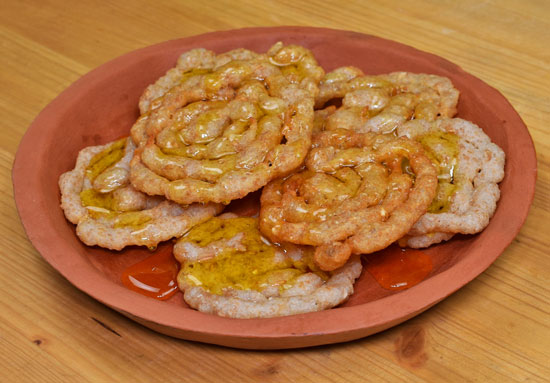
Cato’s recipes are usually characterized by the use of a few and simple ingredients: cheese, honey, cereals, eggs, poppy seeds, bay laurel leaves, and similar. It is a cuisine very similar to the descriptions we find in Athenaeus’ Deipnosophists, in particular in the books dedicated to bread and cakes, called in the same way as one of the most famous recipes by Cato: plakountai. A few recipes collected in Cato’s De Agri Cultura, a fundamental book for Roman agriculture written around the 2nd century BCE, derives from other cultures, for example puls Punica, epityrum, or placenta. The encytum is not an exception: it is mentioned a few times in the Deipnosophists, but it is Cato who provides a complete recipe.
Encytum is a funnel cake prepared with spelt and cheese, cooked in lard, and coated with honey. There are plenty of examples of similar sweets not only in historical recipes, but also in traditional, modern-day cuisine, such as strauben or jalebi.
According to Cato, the encytum is prepared as globi, but cooked in a different way. The recipe for globi requires the same quantity of spelt and cheese; however, to obtain a batter sufficiently soft to be poured through a funnel, we need a good amount of water. You may use a bit of the soaking water of the spelt or choose a cheese with good water content, to your choice.
Cato recommends serving the encytum with honey or mulsum, which is a wine prepared with grape must and honey. It may be substituted with mead, appreciated by Romans and called aqua mulsa, or raisin wine, called passum.
Original text
Encytum ad eundem modum facito, uti globos, nisi calicem pertusum cavum habeat. Ita in unguen caldum fundito. Honestum quasi spiram facito idque duabus rudibus vorsato praestatoque. Item unguito coloratoque caldum ne nimium. Id cum melle aut cum mulso adponito.Translation
The encytum is made in the same way as globi, except that you need an empty, holed glass. Pour it in hot lard, shaping a form similar to spira [a spiral form, the author is referring to another recipe] and turn it with the help of two rods. Spread and color [with honey] when it is still hot. Serve with honey or mulsum.
Encytum (Ancient Roman Fritters) Recipe
200 grams spelt
200 grams fresh cheese
honey
lard
Pound the spelt coarsely in the mortar and soak it in water overnight. Strain the spelt, keeping aside the water.
Pound in the mortar the cheese and mix it with the spelt. If the paste is not soft enough, add a bit of the soaking water.
Melt in a pan the lard. Pour the batter in the lard through a funnel, making a spiral.
Cook the first side for one and a half minutes and the second side for one minute, then remove from the fire.
Coat the encytum with honey and serve.
