Roman Bread
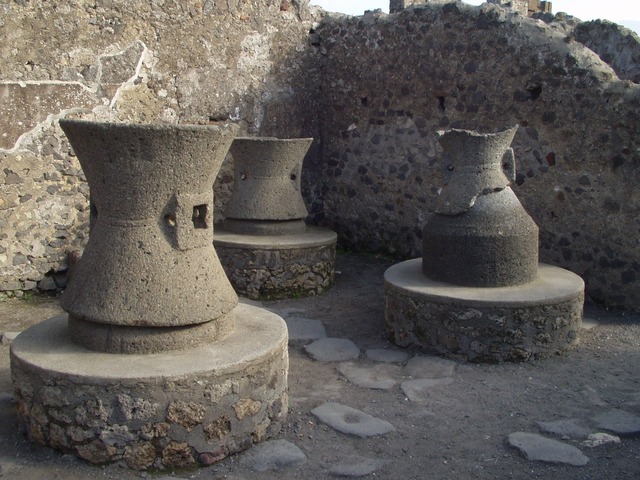
Grain Mills
Bakeries
If you should happen to visit Italy and the town of Pompeii, visit the ruins of that ancient city and you will find the reason Romans have such an important place in bread history. Romans were responsible for the development of mechanical mills. It is in Pompeii in a half-shattered courtyard that you stumble upon several stone towers about two yards high in the shape of an hour glass – narrow in the middle and wide at the top and bottom. The upper portion is in two pieces. The bottom part is a fixed millstone and the upper part is a narrow cone and is movable. From this upper part jut poles that enabled the animals to move the upper stone, in effect grinding the wheat and allowing the flour to trickle out into the lower part of the hourglass shape. The whole contraption was made of volcanic stone which meant it was light weight but durable.
The work began in the bakery with the weighing of grain, wheat was then placed in the mills by the journeymen bakers (pistores). The flour obtained was then collected on a lead sheet that covered the circular base of brick mills. The flour was then sieved using a seive which was very fine and was destined for very rich customers and another sieve that was slightly less fine, this would be called integral that would be sold to the lower class citizens and poor folk.
In the bakery of Popidius Priscus, an industrial scale bread making machine was discovered with the dough mixed with large paddles. Machinery was common in Roman baking. Special kneading machines existed. Dough was wound around a horizontal shaft in the bottom of a basin and then pressed between wooden slats in the basin’s sides. Only the shaping and stamping with the mark of the bakery was done by hand.
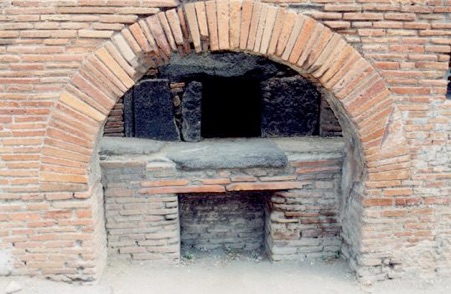
Bakery Oven
Right near the mill you will find an oven, a modern oven that was constructed over two thousand years ago. It was an arched oven with a hollow space to insulate the hot air and it included a draft for the smoke and a container for ashes. The oven doors would be made of iron. The arched brick oven had a capacity for 80 loaves of bread.
The ovens were made of bricks (opus latericiumcium), while the floor of the bakery was made of slabs of basalt lava, the same material used to pave roads, which facilitate the revolution of animals or slaves who pushed the millstones tied to wooden beams.
A few feet away from this were the rooms for the bakers where they worked at stone tables to mold the dough. Everything was mixed with water and distributed on special boards where they gave the required shape. Some types of bread were decorated with anise, poppy seeds, sesame and other trees established on the crust with egg white. Bakeries would keep on hand baking pans made of bronze for making cakes with.
Professional bakers were common in the eastern Mediterranean. The Greeks felt that the best bakers were, in this order, the Cappadocians, the Lydians, and then the Phoenicians. The habit of buying professionally baked bread from a shop seems to have come to Rome sometime around or after 280 BC. Before that, bread was baked at home — perhaps part of the reason that Puls remained a dietary staple as it was easier to make than bread. In the earlier periods, most of the grain was ground at home by hand using a hand mill or quern, both of which rely on two stones rubbing back and forth or in a circle to grind the grain between them into meal or flour.
It seems that only in the late-Republican (c. 509 BC–27 BC, between the Roman Kingdom and the Roman Empire) began to use the yeast, obtained by mixing millet or bran flour to sour. The introduction of a yeast product into Roman culture is in almost direct correlation to the formation of bread baking as a specialty profession. A bakers’ guild was formed around 168 BC. Called the Collegium Pistorum, it was an important, respected guild. The word pistorum comes from the phrase to grind so the guild members not only baked but also milled grains. Soon after the formation of the guild, the Roman government took control; bread became a regulated public commodity with price increases requiring high levels of legislative approval.
In Roman cities, professional bakeries increased in number in the 2nd century BC. Cities had dozens of bakeries where bakers (pistors) sold their fluffy loaves to city dwellers. By Augustus’ time (31 BC – 14 AD), there were over 250 bakeries in Rome. Modern estimates put their output at 500,000 loaves a day. In the small provincial town of Pompeii there were about 35!
Most Romans in Rome lived in apartments without kitchens, let alone ovens, so they couldn’t bake their own bread. They would buy bread from the bakeries. Whenever they were given free grain by the state, they would often take most of it to a bakery to grind it for them into flour and make bread from it for them. They still had to pay the bakers for the milling and bread-making, so rather than receiving free grain, it perhaps more accurate to say they got cheap bread (as only the grain part was free.) They also had communal ovens to which you could bring your dough to be baked overnight.
Wealthier homes could bake their own bread in their own ovens, but even they still seemed to send their grain out to millers for grinding.
The presence of many bakeries and pastry shops (about 34) for the production and sale of products made of flour, suggests that the bakery was one of the most thriving city of Pompeii. Almost two-thirds were large enough to have their own donkey or slave-powered flour mills. With the high increased in bread consumption, professional bakers, called pistor, and bakery owners became some of the most lucrative businessmen in the empire.
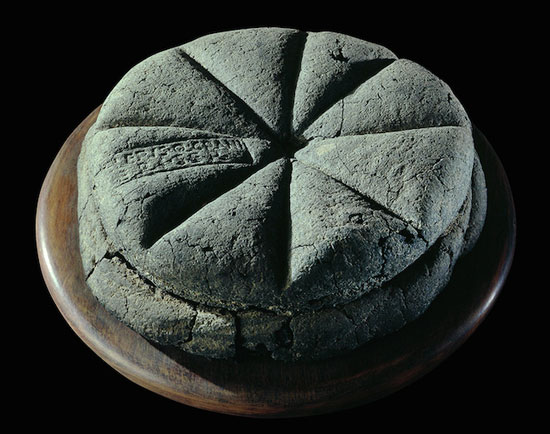
Despite the devastation of the eruption of Mount Vesuvius, quite a few loaves have been found. Eighty charred loaves alone were recovered from the ovens of one baker in Pompeii, Modestus. They have nearly all of a circular shape to eight segments, a diameter of about 20cm, and an average weight of about 580g. Apart from surviving the eruption, the loaf is notable for two things. There’s the bread stamp on it which reads ‘Property of Celer, Slave of Q. Granius Verus’.
Then there’s the division of the loaf into wedges. They’re deep cuts. Why the wedges? No one seems sure, but the simplest explantion is that the loaves could be sold or served by the slice, just as some loaves are sold in France today.
And the bread stamp? Roman bakers didn’t just sell their own bread, which would be stamped. For a fee you could have your own loaves baked in their ovens (a communal tradition that only recently died out in France but survives in Morocco). The stamp identifies who the bread belongs to. Also, bread was provided to the Roman people by the government - bakers were given grain to make the free bread, but some of them stole the government grain to use in other baked goods and would add various substitutes, like sawdust or even worse things, to the bread instead. So if people complained that their free bread was not proper bread, the stamp told them exactly what bakery made the loaf.
Grains Used for Making Bread
The Romans were quick to take note of what types of grains were favored and which ones worked best for certain dishes such as breads and pottages (pulses). The cultivation and use of barley (hordeum) was learned from the Greeks, and it was preferred ground into a product known as polenta. This was generally used for pulses or coarser less desirable breads. These loaves were commonly referred to as panis plebeius or panis rusticus.
Oats (avena) were generally considered a weed even though they had been cultivated for many thousands of years. Although favored by the Celts, oats were commonly grown as a fodder crop for livestock, especially in the British Isles by the time of Roman occupation.
The Romans used several different varieties of wheat to make their bread. The early wheat breads were made from a grain called emmer, a domesticated variety of wheat (Triticum dicoccum) and were shaped into cakes. Emmer has been enjoyed by Italians for centuries — it provided sustenance for the Roman legions around the turn of the first millennium — and is still cultivated in Italy. In the “BC” portion of Rome’s history, spelt (Triticum spelta) was largely unknown except in the northern provinces, as it was a central European grain.
Later, Romans preferred baked goods made of spelt (farina), wheat (triticum), or rye (secale). Millet (millium) was sometimes used in the southern region of Italy. In the very early days of the colonies of Roman Britain, rye was grown as the primary grain source used for baked goods. Its tolerance of cooler, wetter weather made it an ideal crop for the area. In Italy, the popular bread wheat triticum aestivum (common, or bread wheat) grew poorly. It was widely imported from the Balkans, Sicily, and also from Egypt during the Roman imperial period. Barley, millet, rye and even legumes and rice are also known as bread ingredients.
Early on in the evolution of bread making, milled wheat was often sieved and re-milled several times to create a fine white flour know as siligo. This siligo flour was generally preferred for bread and it was thought to be the finest most expensive flour available. In the days of the late Republic, Romans generally preferred their bread white and one of the tests of the quality of bread was the color. This white bread was usually made with the finest siligo wheat flour and it was quite pricey. As with most purchased goods, the price of flour was regulated by the amount of processing it needed as well as the size of the stones and sieves used to refine it. It was baked into loaves commonly known as panis siligineus. Dioscorides describes this bread as a fine and light with a dry and springy texture.
Einkorn (Triticum monococcum), the original or “mother” wheat, is a diploid wheat, and it has never been hybridized.
Emmer (Triticum dicoccum), a hybrid of einkorn and a type of wild grass, is a tetraploid wheat.
Spelt (Triticum spelta), a hybrid of emmer and another wild grass, is a hexaploid wheat with six sets of chromosomes. Modern wheat is also hexaploid.
All of these wheats are hulled wheats, as distinguished from the more modern free-threshing wheats, in that hulled wheat needs to be processed after threshing to remove the inedible glumes or hulls from the heads. With free-threshing wheats, this process is not needed.
The first identifiable bread wheat (Triticum aestivum) with sufficient gluten for yeasted breads has been identified using DNA analysis in samples from a granary dating to approximately 1350 BCE at Assiros in Macedonia and was available to ancient Greece and Rome. Modern free-threshing wheats:
- common, or bread wheat (Triticum aestivum)
- durum, or pasta wheat (Triticum durum)
Although the Romans did use Emmer, they came to prefer the wheat we grow today (“Triticum aestivum”). In the days of the Roman Republic and then during the Roman Empire, a softer wheat—which made a better quality loaf— gradually replaced emmer. Around the late fifth century BC appeared new hard wheat (durum) and soft grains, probably originating in Sicily and Africa, of higher quality and more readily releasable from the chaff, which allowed a rapid improvement of bread making softer and less acids buns and bread.
*"alica"refers to spelt or emmer. Spelt grain was generally polished into pearls. Spelt was replaced with wheat.
Leavening, the process which produces carbon dioxide bubbles to help bread rise and give it an airier texture, didn't come to the Romans until later, which it is believed it was introduced by the Greeks. Before this, allowing the dough to rise was seen as the equivalent to letting to it go bad (sour, as in sourdough) and the Romans were disgusted that people would choose to let their dough "putrefy" before baking. Because of the lack of leavening techniques, the earliest Roman breads made resembled the flatbreads seen today. These early unleavened breads were made by a simple combination of flour and water mixed together and baked into a coarse flatbread called maza. These flatbreads were often made on the hearth at home or in pans over the fire.
When leavening did make an appearance, it seems to have heavily influenced Roman bread making. It was not long before bread production was begun on a large and public scale. The introduction of a yeast product into Roman culture is in almost direct correlation to the formation of bread baking as a specialty profession. Many of the breads represented in art and frescoes from the Roman Empire are pictured as being round and risen and scored into eight equal wedges. Other breads resembled pancakes, croissants, buns, and wafers.
The breads that came out of the ovens in Roman antiquity were of a very diverse nature. Dozens are mentioned in ancient texts, such as Oyster Bread, Mushroom Bread, Sponge Bread, Hate Bread, Pot Bread, Cake Bread, Water Bread, Camp Bread, Cappadocian and Picenian Bread, depending on their shape, cooking method, ingredients or origin. For flavor, oil, lard, butter, grape must, wine, milk, and eggs were added to the bread. As well as seeds such as cumin, pepper, caraway, fennel, sesame and poppy.
Panis Quadratus
The most famous bread from Roman times is the Panis Quadratus. We know its name from Ateneo de Naucratis ( (Athenaeus of Naucratis, Deipnosofistas, 2nd century AD). Its appearance has frequently been depicted in frescoes and is known from archaeological finds. It is shaped like a wheel. In the Modestus bakery in Pompeii, 81 charred loaves of this shape were found!
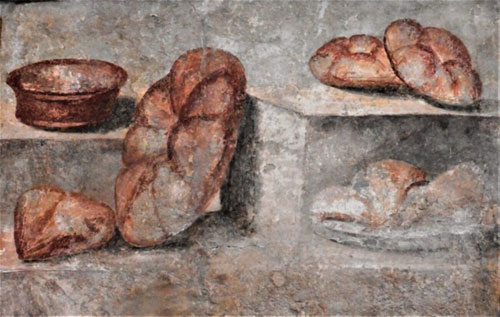
This fresco from the house of Julia Felix in Pompeii
shows traditional round loaves with eight tear-off wedges.
On the far left are two broken-off pieces. Fresco of Panis Quadratus,
or Panis Siligineusm from Ancient History Encyclopedia, Farrell Monaco.
The iconic eight-section rounded loaf of bread, also appears in several Pompeii frescoes, as they were highly represented in the site's archaeological record.
What we can take from these depictions is that bread was produced in large quantities in Pompeii, but that the Pompeians also valued it enough to paint it on the walls of several of Pompeii's homes and businesses. This type of Roman bread was often considered a "luxury" bread, as the flour was refined several times to produce a lighter, more leavened loaf. The depiction of this bread in Pompeii food frescoes could have symbolized status, industry, a well-fed community or household, or a community with unlimited access to grain and a complement of competent bakers. These images were not just about the bread. These are projections of identity that represent status.
Common Breads of Rome
Emmer wheat was one of the first cultivated crops to provide sustenance in the form of porridges and fermented beverages, such as beer. We know from the writings of Herodotus, 484-430 B.C.E.ii, that the Egyptians grew, harvested, and consumed wheat very early in history. This agricultural technology was quickly adopted by other cultures and spread rapidly through out the civilized world, especially in the Mediterranean region, which gave rise to the great Roman Empire.
In the days of the early Republic, bread was rather bland and nondescript. Cato refers to this particular baked good as panis strepticius, or kneaded bread (160 BCE). These hard baked loaves, prepared under a dome-shaped cover known as a testa, soon became the primary staple of the Roman’s diet. This common staple changed what Plautus of Sarsina referred to as a nation of ‘porridge eaters’ into a nation dependant on bread as a mainstay.
Yeast, as a leavener for bread, made its way into Rome at the height of the Republic during the outbreak of the third Macedonian War (171-168. BCE.). Many of the more conservative citizens resisted the temptation to indulge in the light or raised loaves, thinking them unhealthy. Pliny described six different ways to make and maintain yeast cultures.
Since bread wheat did not grow in most of Greece, nor in most of central Italy, classical Athens and Rome came to depend on imported wheat for the leavened bread which became their preferred staple.
The collection of texts written by Athenaeus of Naucratis (2nd century AD) is an important source for types of bread and ingredients in antique bread. Athenaeus was a classical Greek gourmand who recorded culinary information about the incredible interconnected, cosmopolitan Romano-Graeco world of the Mediterranean in classical times. His book is named Deipnosophistae.
As was the case with many other cultures, Roman bread was made with all types of cereals. Sometimes loaves were made from ground pulses like chickpeas and other less common grains such as rice. Many times, bread dough was mixed with oils or fat from bacon to improve flavor. Other common flavor enhancers included grape and other fruit juices, wine, eggs, milk, and dried fruits or honey. Aromatics used in baking bread included ajowan (also known as carom seeds or bishops weed), black cumin, poppy seed, linseed, sesame and aniseed. In fact, the Romans favored a type of bread known in the first century as Alexandrian bread. Apicius and the other popular scholars tell us very little of this delicacy except that the main spice used in its flavoring was cumin.
In the days of the late Republic, Romans generally preferred their bread white and one of the tests of the quality of bread was the color. This white bread was usually made with the finest siligo wheat flour and it was quite pricey. As with most purchased goods, the price of flour was regulated by the amount of processing it needed as well as the size of the stones and sieves used to refine it. It was baked into loaves commonly known as panis siligineus. Dioscorides describes this bread as a fine and light with a dry and springy texture. With the growth of the population in Rome and its provinces and the state support of baking as a trade, time and money were both allotted so that the baker could experiment with different ingredients and perfect specialty recipes.
From the writings of Apicius, Cato, and Pliny, we can glean enough information to put together a substantial list that gives us some insight into the scope of the Roman’s baking abilities and some of their common recipes through description and ingredients.
Greek and Roman words for types of bread:
Greak artos means bread, loaf; sitos means food, staple food, cereal food and in practice bread. The classical Latin word for bread is panis. Unleavened bread is azymos in Greek, azymus in Latin.
White bread is katharos artos in Greek, panis mundus in Latin; wholemeal bread is ryparos artos and autopyros artos in Greek, autopyrus in Latin. The distinction between wholemeal and white bread is made as far back as the 3rd millennium BC in Mesopotamia.
Greek and Roman words for breads for the grains used:
Breads named for the origin of the flour or meal: semidalites frum durum wheat, krithinos artos and Latin panis hordeacius from barley, khondrites from emmer meal and krimmatias from wheatmeal, etnitas and lekithitas from legumes. An orindes artos was conjectured by Athenaeus to mean either rice bread or sawa millet bread. Both are historically unlikely.
Methods used to Bake Bread
Small loaves could be baked under the ashes: called artos enkryphias and spodites.
Made on a spit: obelias artos
Greek eskharites was a loaf baked over a brazier. The ἐσχάρα was an open brazier, not an oven. Lynceus talks of diakhristos eskharites, anointed, presumably dipped in a sweet wine. From Athenaeus’ Deipnosophistae, “Antidotus in The Premier Danseur: 'He took some hot brazier-bread — why not? — and folding it over he dipped it into sweet wine.' . . . And when they are tired and sated with eating, they then introduce a most delightful allurement in what is called smeared brazier-bread. It is a soft and delectable compound dipped in sweet wine, with such harmonious effect that a marvellous result comes to one whether he will or no; for just as the drunken man often becomes sober again, so the eater of it grows hungry again with its delicious flavour.” And later in the Deipnosophistae, “But bread made over a brazier or in a pan, owing to the admixture of oil [from oiling the pan?], is easier to excrete, but steam from the drying makes it rather unwholesome.”
Common in ancient times was the use of a bread crock (Greek klibannos, Latin clibanus). Crock-baked bread was called klibanites artos. Picene bread, a traditional Italian style, was made in an earthenware pot which was broken to extract the bread.
Baked in an oven (Greek ipnos, Latin furnus): panis furnceus or ipnites meaning oven loaf. In the past, wood oven (or fourno in Greek) was an essential tool in homemade bread baking, in preparing rusks and drying fruit and nuts.
'Oven-bread' is so named from being baked; it is mentioned by Timocles in Sham Robbers thus: 'Seeing that a dough-pan fresh from the fire was lying there, I ate some of the oven-bread piping hot.'
from Athenaeus’ Deipnosophistae. [b. III. , 74]Cyclades islands faced acute fuel shortage, thus the oven was traditionally heated with dried brushwood meticulously picked from the countryside. Sheep manure was also used as fuel. On the other hand, the ovens in Crete and Pelloponese are heated with olive wood since olive cultivation is widespread across these regions. Ovens in central Greece are heated with oak wood and wood of the beech tree.
Breads named for the method and equipment used: artoptikios artos, panis artopticius; panis depsticius, literally kneaded bread, which was crock-baked;,;,.
Types of Bread (Panis is bread in Latin)
Estas kyboi or dice bread are a good example. Athenaeus writes in his book Deipnosophistae: “How should you know that dice, not the kind you always use, are square-shaped loaves seasoned with dill, cheese, and oil, as Heracleides says in his Art of Cookery?”
Panis hordeacius was made with barley and by and large for slaves and the poor.
Panis mustaceus— Bread commonly baked in a ring with a laurel wreath on top. Cato gives us a list of ingredients: 660g. fat, 330g. fresh cheese, 8.7 liters farina, anis, cumin, and must, which gives the bread its name. (CAT. R.R. CXXI) this bread was commonly eaten at wedding feasts, hence the larger quantities of ingredients.
Panis farreus— Bread made of coarse spelt flour to be broken and shared by a bride and groom on their wedding night.
Panis adipatus— A flat bread resembling pizza that contained a good quantity of bacon and bacon fat.
Panis militaris-- Soldier’s bread. It commonly came in two varieties. Both were a type of hard dry biscuit that had to be soaked before eaten. (Pliny. N.H. XVIII-68)
- Casternsis: camp bread
- Mundus (white): marching bread
Panis nauticus-- Much like soldier’s bread. Known as ship’s biscuits. (Pliny. N.H. XXII138)
Panis picentino— Another hard bread that required soaking, generally in milk or mulsum* before eating. Picentino was luxury bread made from alica, which was soaked for nine days and then kneaded with uvae passae suco (the sweet juice of dried grapes or raisin juice). It was shaped into a long roll, placed in a clay pot and baked in the oven until the pot burst. (Pliny. N.H. XVIII-106)
*Mulsum was an aperitif beverage common in Republic and Imperial Rome. It was basically dry wine to which honey was added. It
was consumed either during the blending process or thirty-one days later. (Pliny. N.H. XXII-24, 53)
Panis quadratus— Despite its name this bread is not square but circular. It owes its name to the slashes on the top of the loaf that divides it into quarters.
Panis boletus — Bread that has risen in the shape of a mushroom. It was covered with poppy seeds. The poppy seeds ensured that the bread did not stick. It was the color of smoked cheese.
There is also a 'boletus' bread, so called, shaped like a mushroom. The kneading-trough is greased and sprinkled with poppy-seed, on which the dough is spread, and so it does not stick to the trough during the rising. When it is placed in the oven, some coarse meal is sprinkled over the earthenware pan, after which the loaf is laid upon it and takes on a delightful colour, like that of smoked cheese.
from Athenaeus’ Deipnosophistae, Book III (Part 4 of 5)
Panis alexandrinus — popular bread that is frequently mentioned in recipes and texts. We do not know the exact ingredients or recipe for this bread, other than the fact that it contained Egyptian cumin and was imported from Alexandria, hence the name.
Panis cappadocianus-- A ‘Turkish’ style bread that was produced by making very wet dough out of flour and milk. To it was added oil and salt. It was baked in a very hot oven for a short period of time and had a soft crust.
The Greeks have a bread called 'soft,' which is made with a little milk and oil and sufficient salt; the dough must be quite soft. This bread is called Cappadocian, since it is chiefly in Cappadocia that 'soft' bread is made. Such bread is called lachma by the Syrians and is found to be very serviceable in Syria, because it may be eaten when very warm. It also resembles a flower.
from Athenaeus’ Deipnosophistae, Book III (Part 4 of 5)
Panis secundarius—A common type of white bread. During the days of the Republic, eating white bread was considered very much a luxury and a costly venture. By the time the Empire was in its heyday, white bread was considered a commonality and thus known as a second choice or secundus. With the Emperor Augustus, came the popularity of brown bread or less refined products, thus reintroducing recipes that had long been forgotten; heavier breads were back in vogue once again.
- Orindes—Orindes was a bread made by the Ancient Greeks from rice flour. It was also sometimes made from a small Ethiopian grain, which some sources speculate might have been teff. Orindes was an expensive bread.
“And Sophocles makes mention of a loaf called orindes, in his Triptolemus, which has its name from being made of rice or from a grain raised in Ethiopia, which resembles seasamum.”
from Athenaeus’ Deipnosophistae, Book III (Part 4 of 5)
- Cybus—Cube shaped bread with anis, fresh sheep’s cheese and olive oil.
- Mazas—Barley biscuits
- Cribana- Bread made with curd cheese. Shaped to resemble a woman’s breast.
While the government of ancient Rome controlled the import and export of wheat and the common trade of baking, it is noted from the list above that the baker still controlled the artistic avenue in which the recipes were developed. From the evolution of Cato’s unleavened loaves to untold varieties of the artisan bakers of Rome and her provinces, the freemen of the Republic and the Empire enjoyed a multitude of fresh baked goods and unlimited flavors. It is the whole of these products, and the conglomeration of so many different cultures that helped entitle Rome as the ’melting pot’ and urban center of the ancient world. Her citizens’ passion for a gourmet and diversified diet still influences the eating habits and cooking customs of many modern cultures today.
Flat breads - shaping (by pouring the batter on a griddle or by sheeting and eventually punching the dough); and baking. Depending on the gluten content of the starting flour, flat breads can be obtained from either compact and elastic dough, which requires strong and extensible gluten, or from a semi-fluid batter, which, on the contrary, can be obtained from an array of gluten-free flours. Consistent dough, usually wheat based, can be spread into sheets with a rolling pin, whereas the semi-fluid batters are directly poured onto the cooking surface, resulting in “pancake-like” flat breads. These variations allow obtaining an array of flat breads.
The various types of flat breads can be schematically classified according to the consistency of the dough, the presence or absence of a leavening phase, the baking system used, and the thickness and structure of the finished product. Based on these factors, flat breads can be categorized as i) pancake-like breads, obtained from batters; ii) flat breads with consistent dough, unleavened; iii) flat breads with consistent dough, leavened, shaped as a thick sheet and eventually punched (single layered); iv) flat breads with consistent dough, leavened, and shaped as a thin sheet (double layered, such as pita). Without leavening, bread is easier to chew if the dough is spread to a very thin layer.
With the alveolation conferred by leavening, which renders bread softer, dough thickness can be increased up to 3–4 cm. Before baking, the dough discs have to be pressed with fingertips or punched to prevent excessive expansion in the oven.
When leavened dough is sheeted to a few millimeters and is not punched, it inflates visibly in the oven (puffing up) and forms a “balloon” due to the thermal expansion of gases such as carbon dioxide developed during fermentation, dough humidity, and air entrapped during kneading (Fig. 3). The expansion in volume is optimal if the flour used has good viscoelastic properties; therefore, good-quality gluten-containing flour is needed. After baking, the balloon deflates due to cooling, giving a soft and flexible bread, with a characteristic inner cavity, or “pocket”, that can be stuffed with meat and/or vegetables. This kind of flat bread is the most widespread also in Western countries, where it is known as “Arabic bread” or “pita bread”. Alternatively, the two layers can be separated by cutting the loaf along the edges and can be baked for a second time to dry them, as in the case of the Italian carasau and pistoccu.
The major difference between flat breads and voluminous breads is the way they are baked. Given the reduced thickness and mass, all flat breads are cooked very quickly (a few minutes) and remain in a rather pale color, with almost no crust. On the contrary, voluminous and heavy bread loaves develop the typical brown crust because they are baked longer (up to 60 minutes for breads reaching 15–20 cm in thickness and weighing approximately 1 kg), so as to cook perfectly the inner part of the loaf as well. Therefore, voluminous and heavy breads require a stable support and, above all, a prolonged heat surround such as in the baking chamber of an oven, which is not necessarily needed to bake flat breads.
The simplest baking methods of flat breads have remained almost unchanged since ancient times. For example, a technique still used today in the nomadic communities of Sinai, southern Tunisia, and Algeria consists in baking bread under a layer of sand, embers, and ash (pain de sable or “ash-baked bread”), without the need for baking tools. A step forward is the use of the fire plates, whereas a more structured system is represented by the vertical ovens, where bread baking is a sort of “side effect” of meat cooking (ex: tandoor). The technical choice depends, among other practical and cultural factors, also on the baking properties of bread ingredients (gluten-free batters can be baked only on a griddle). All the double-layered flat breads, which require a horizontal support to puff optimally, are baked in domed ovens similar to those used for western-style voluminous and heavy breads.
The Italian testo, a cast iron baking tool composed of a conical cover and a round flat support, is very similar to the ancient Roman testum. The testo is made red-hot by putting on the charcoals before pouring a flour pastel on it. The Italian testarolo pontremolese is baked on a cast iron testo in the Lunigiana area (between Tuscany and Liguria), whereas clay versions of testo are more similar to the ancient testum.
Lentaculum was made of emmer and a little bit of salt, and had flat and round loaves.
Artolaganus was a kind of fatty cake bread that was made of meal which was like a coarse unsifted powder ground from the seeds of wheat grain.
Speusticus (from the Greek word: σπευστικός) was a hastily made bread.
The Parthian bread was kneaded and soaked in water before being baked giving it a light soft texture.
There were also honey and wine soaked breads such as picennum which was a sweet bread baked with nuts and honey in clay molds. The molds had to be craked before the bread could be eaten.
There were many other kinds of breads such as bread eaten only with oysters or
"water bread" which was light and full of holes, just like a sponge according to Pliny.
Jeff Renner
February 15, 2018 at 6:45 am · Reply on https://tavolamediterranea.com/
I finally got around to baking a loaf. I used a little more than half bread flour and the balance whole spelt flour, leavened with a culture I’ve had for more than 25 years. (I’m a semi-retired bread baker by trade.)
I duplicated the groove around the edge by placing a disk of one half the dough on top of another. I think that this is the simplest explanation. All of the others seem complicated and to no purpose.
I divided the loaf into eight sections by docking the risen loaf all the way to the bottom with a metal pastry scraper. Again, this seems to me to be more logical than slashing the top as it allows the finished loaf to be broken into more or less 16 equal pieces (eight wedges then separated top from bottom) of four ounces each,
The finished loaf looks just like the ones in the mosaics and, taking into account the carbonization, the one from Pompeii. Since it doesn’t appear that I can post photos, I will PM them to you.
