German Cuisine
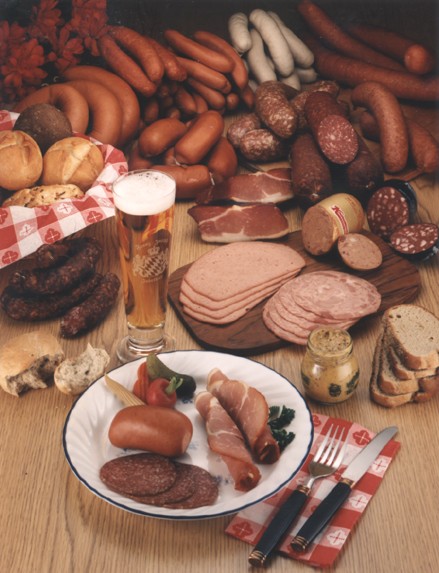 German cuisine is a style of cooking derived from the nation of Germany. It has evolved as a national cuisine through centuries of social and political change with variations from region to region. The southern regions of Germany, Bavaria and Swabia share many dishes. Ingredients and dishes vary by province. There are many significant regional dishes that have become both national and regional. Many dishes that were once regional, however, have proliferated in different variations across the country in the present day.
Ancient Times and Influences on German Cooking
In prehistoric times German fare was likely bland. Unlike the Mediterranean countries, the growing season limited them to early forms of wheat, barley and pasture land for livestock. The fertile terrain and ample water supplies made for good grazing and Germany has always been rich in beef, dairy cattle, sheep, and pigs. Sheep, cows and goats were used for milk, butter and cheese and occasionally meat products, which were served most often during feasts. Thus, until the Middle Ages, the German diet mainly consisted of meat and their by-products i.e. milk and cheese. Smoking, marinating and salting techniques were developed to store the abundance of meat, a practice which has survived and is evident with their myriad of sausages and preserved foods. The earliest spices were parsley, celery and dill, which you still see used today.
The Romans were the probably the first to make any significant comment on German food. Latin literature records that German cuisine was a simple affair, consisting of a lot of meat and a lot of mead. By 96 AD, the Romans completed their colonisation of regions in southern Germany and it is undeniable that their eating and drinking habits influenced the German cuisine.
The Romans introduced fruit tree cultivation and grapevines. Oats and rye were also added into cultivation, as agricultural methods became more sophisticated. The areas around Cologne were especially rich in exotic spices and food due to its powerhouse status as a trading city.
Not much is known about the period after the Romans withdrew, but there seems to have been a culinary revival with the spreading of Christianity and the inevitable founding of monasteries. Another influence came with the political stabilisation of Western Europe under Charlemagne around the 8th century. It was at that time that extensive cultivation of grapes, vegetables, fruit and herbs was recorded. Also, with this stability came wealth (at least for some) and it was the ruling classes who were responsible for introducing spices from around the adding another dimension to traditional German cooking.
The following period of wars probably had the most influence on modern-day German cuisine. Both France and parts of Italy were conquered and now came under Charlemagne's rule, as did Switzerland and Austria. One doesn't immediately think of German cuisine being akin to French cuisine, but it's certain that culinary customs were picked up from both the French and Italians.
By the 18th century sugar, rice and potatoes (introduced by King Frederick the Great of Prussia) became widely available to the German populace.
Current Day German Cuisine
Today simple but substantial food remains a characteristic of German cuisine. Meat, Game, game birds and rabbit are considered traditional foods, as is the use of juniper berries, with mustard and horseradish being common condiments. The renowned Sauerkraut is still popular as are their vast range sausages (wurst), speciality cured meats and dairy products e.g. cheese, often eaten with Pumpernickel bread which originated in Northern Germany.
As one would expect, the geographical differences and the bordering countries still have an influence on regional cuisine. Cooking in the north still tends to reflect the customs of the nearby Scandinavian countries. The diet here is much heavier than that in the south, with an emphasis on meat and potatoes. In the south, a lighter cuisine can be found with strong influences from nearby Italy and Austria. Also grain products are substituted for potatoes in many instances e.g. Spatzle which is a special type of pasta noodle.
Regional cuisine
Thuringia (central Germany)
Agriculture figures highly in the diet of Thuringia with about half of the state being used for agriculture. Wheat, rapeseed, sugarbeet, and barley grow well, along with a variety of vegetables which grow near Erfurt, the state's capital. Cauliflower (740 acres), cabbage (savoy, red, white) (25 acres), kohlrabi (37 acres), broccoli (37 acres) grow by traditional means near Erfurt. Tomatoes, lettuce, broad beans, onions, and cucumbers are grown in the eastern portion of the region near Jena under glass centers on about 12 acres (49,000 m2) of land. Thuringia is the second largest herb-growing region in Germany; the town of Kolleda was once considered the "peppermint town", where herb growers used to congregate to study herb cultivation.
One-third of Thuringia is covered in forest, and is considered to be one of the best game hunting regions in Germany. Until the unification of East and West Germany, the game meats were reserved for those privileged enough to obtain it in luxury hotels, or it was exported. Today anyone with a proper permit may hunt for game such as red deer, roe deer, wild boar, rabbit, duck, and mouflon (mountain sheep). Pheasant, capercaillie, and black cock are all protected game species that may not be hunted. The wooded areas also contain a wide variety of edible mushrooms such as chestnut mushrooms, porcini, and chanterelle, along with wild berries such as blueberries, cranberries, raspberries, and blackberries which are all traditional accompaniments to game dishes.
The most famous foods from Thuringia are Thuringian sausages and Thuringian dumplings. The state is also known for its sausages; steamed, scaled, and cured varieties are all prepared. Popular varieties include Thüringer mettwurst (a spreadable cured sausage), Feldkieker (a cured, air-dried sausage dried up to eight months), Thüringer leberwurst (a steamed pork and liver sausage), Thüringer rotwurst (a steamed blood sausage packed in a bladder or other natural casing).
Saxony-Anhalt (central Germany)
The town of Wittenburg is the birthplace of the Reformation, with Martin Luther's home (Lutherhaus) and Schlosskirche, the storied church where he's buried.
Cereal grain cultivation occupies 62% of the cultivated land in Saxony-Anhalt. Wheat, barley, oats, and rye are grown, with the rye being grown near Borde, where the rye is used to make Burger Knackebrot, a flatbread produced there since 1931. Another ten percent of the cultivated area is planted in sugar beets for conversion to sugar, popularized after the 19th century when the region had an economic boom.
Whitefish have figured into the regional diet after a fisherman introduced them to the Arendsee over 110 years ago. Fishing was once prominent in the Elbe river, which contains 33 of the 40 species of fish caught in the region. Mercury, hexachlorobenzene, DDT, musk compounds and heptachlor have caused the Elbe to become contaminated, so commercial fishing has been banned since 1989.
Structure of meals
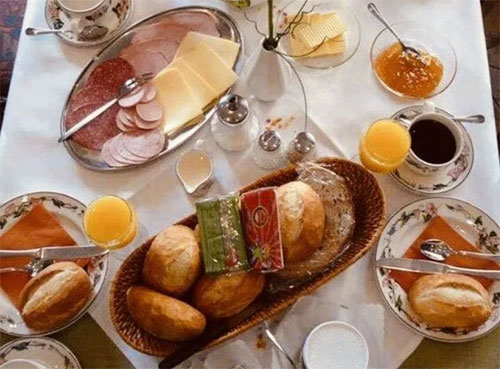
German breakfast
Breakfast (Frühstück) commonly consists of bread, toast, and/or bread rolls with jam ("Konfitüre" or more commonly called "Marmelade"), marmalade or honey, eggs, and strong coffee or tea (milk, cocoa or juice for children). Deli meats, such as ham, salted meats and salami, are also commonly eaten on bread in the morning, as are various cheeses. A variety of meat-based spreads such as Leberwurst (liver sausage) are eaten during breakfast as well.
The Second Breakfast (zweites Frühstück) Mid-morning Break (Pause) A quick meal between breakfast and lunch is common. Many German schools even have an official Pausenbrot. This could also be called Zwischenmahlzeit (between-meal-time) or Zweites Frühstück (second breakfast). Vesper is another name for a snack and could be used for the morning pause, or another snack in the afternoon between lunch and dinner.
Lunch (das Mittagessen) In Germany, lunch is the main meal of the day. This may be the day’s only hot meal, and it is usually served punctually between noon and 2:00. Workers and schoolchildren would traditionally return home so the family could eat together. Understandably, this German custom is getting harder to maintain. Quick meals are becoming the standard. If you want a quick meal in the middle of the day, try an Imbiss (snack booth) for Bratwurst, Currywurst, Buletten/Frikadellen and the ever-present Pommes (French fries) or Kartoffelsalat (German potato salad). You could also try a Metzgerei (butcher) for a fresh, inexpensive, delectable meal.
Coffee and Cake (Kaffee und Kuchen) Kaffee und Kuchen is a cherished tradition.
In Germany, the habit of meeting over coffee and something sweet was first established in the late 17th century. Once coffee became more accessible, beyond the country’s elite, in the 19th century, Kaffee und Kuchen became a fixture for those seeking a little break from the everyday grind. The German pastime is practiced all over the country, but it's perhaps best put to use in the vibrant capital of Berlin, as a way to slow down. To participate, simply find a friend, arrive on time (this is Germany, after all), and get lost in conversation, caffeine, and cake.
Though few people have time for it everyday, this is an opportunity to meet with friends and enjoy some of the country’s finest treats. German cakes like Käsekuchen (cheesecake with Quark), Schwarzwälderkirschtorte (Black Forest cherry cake) and Apfelkuchen (apple tart) are served with a warm cup of coffee or tea to stay up past the sugar rush. Be aware that while German cakes are usually heavy with cream and fruit and nuts, they’re rarely as rich as American sweets. When planning a get-together, note that this is more than a hasty sit-down. Like brunch, Kaffee und Kuchen is a sprawling affair that can stretch out for hours. Cafés often provide a special combo deal, or – if you’re lucky – you’ll be invited into someone’s home.
Dinner (Abendessen or Abendbrot), eaten usually between 18:00 and 19:00, was always a smaller meal, often consisting only of a variety of breads, meat or sausages, cheese and some kind of vegetables, similar to breakfast, or possibly sandwiches, accompanied by mustard and pickles. Sometimes Abendbrot may include hot soup, especially in winter. However, in Germany, as in other parts of Europe, dining habits have changed over the last 50 years. Today, many people eat only a small meal in the middle of the day at work, and enjoy a hot dinner in the evening at home with the whole family. This is also the reason why the availability of cheap restaurants close to the office or the existence of a factory canteen cannot be assumed automatically.
For others, the traditional way of eating is still rather common, and not only in rural areas. Breakfast is still very popular and may be elaborated and extended on weekends, with friends invited as guests. Since the 1990s the Sunday brunch has also become common, especially in city cafés.
Typical German Dishes
- Sauerbraten – A beef roast with a special marinade, usually served with Rotkohl (Sweet and Sour Red Cabbage)
- Wurst – Unsurprisingly, Germany has a sausages for all occasions. Bratwurst is the most common, with Currywurst (served with spicy curry ketchup) the ideal Imbiss (fast food places) food. Also try regional versions of Blutwurst (blood sausage).
- Kartoffelsalat mit Würstchen – German potato salad with sausage. This is a common lunch dish.
- Schnitzel – This Austrian dish has been adopted by the Germans. A cutlet of veal or pork is breaded and deliciously fried. Different versions include Jägerschnitzel with gravy and mushroom, Cordon-Bleu stuffed with ham and cheese, Rahmschnitzel with cream sauce and pepper, etc.
- Rippchen – Pork ribs
- Hasenpfeffer - Hasenpfeffer is a favorite German dish. It’s a rabbit stew where the meat is braised with wine and onions before it’s cooked for hours. It has a very rich flavor and tender meat.
- Maultaschen - Another traditional German dish that originated in the Swabian region. It’s basically a kind of pasta dough, which is filled with meat, spinach, bread crumbs, onions, and various herbs and spices.
- Spätzle – Schwabian (region of Schwabia) noodles usually served with cheese and bacon
- Kartoffel – Potatoes are used in almost every meal, either pan-fried (Bratkartoffeln), boiled (Salzkartoffeln), French fried (Pommes frites), or mashed (Kartoffelpüree).
- Dumplings – Another common side dish is dumplings of either bread or potatoes. Names and method vary by region: Klöße in the north and Knödel in the south.
- Eintopf – A “one pot” stew made with everything in the fridge, like beans, peas, sausage or lentils.
- Seafood – Served in fine-dining restaurants and the ever-present Nordsee, seafood is particularly popular in the north. Everything from smoked fish, herring and salmon (Lachs) is popular.
Staple foods
Meat
Pork, beef, and poultry are the main varieties of meat consumed in Germany, with pork being the most popular. The average person in Germany will consume up to 61 kg. (140 lbs.) meat in a year. Among poultry, chicken is most common, although duck, goose, and turkey are also enjoyed. Game meats, especially boar, rabbit, and venison are also widely available all year round. Lamb and goat are also available, but are not as popular.
Meat is usually pot-roasted; pan-fried dishes also exist, but these recipes usually originate from France. Throughout Germany, meat is very often eaten as sausages. There are more than 1500 different types of sausage (Wurst) in Germany.
Fish
Trout is the most common freshwater fish on the German menu; pike, carp, and European perch also are listed frequently. Seafood traditionally was restricted to the northern coastal areas, except for pickled herring, often served as Rollmops (a pickled herring fillet rolled into a cylindrical shape around a piece of pickled gherkin or onion). Today many sea fish, like fresh herring, tuna, mackerel, salmon and sardines are well established throughout the country. Prior to the industrial revolution and the ensuing pollution of the rivers, salmon were common in the rivers of Rhine, Elbe, and Oder.
Vegetables
Vegetables are often used in stews or vegetable soups, but are also served as a side dish. Carrots, turnips, spinach, peas, beans, broccoli and many types of cabbage are very common. Fried onions are a common addition to many meat dishes throughout the country. Asparagus, especially white asparagus known in English as spargel (the German name for asparagus), is a common side dish or may be prepared as a main dish. Restaurants will sometimes devote an entire menu to nothing but white asparagus when it is in season. Spargel season (German: Spargelzeit or Spargelsaison) traditionally begins in mid-May and ends on St. John's Day (24 June).
Potatoes, while a major part of the German cuisine, are usually not counted among vegetables by Germans.
Side dishes
Noodles, made from wheat flour and egg, are usually thicker than the Italian flat pasta. Especially in the southwestern part of the country, the predominant variety of noodles are spätzle, made with large amounts of egg yolk, and maultaschen, traditional stuffed noodles reminiscent of ravioli.
Besides noodles, potatoes are common. Potatoes entered the German cuisine in the late 18th century, and were almost ubiquitous in the 19th century and since. Potatoes most often are boiled (in salt water, Salzkartoffeln), but mashed (Kartoffelpüree) and fried potatoes (Bratkartoffeln) also are traditional. French fries, called Pommes frites or Pommes in German, are a common style of fried potatoes; they are traditionally offered with either ketchup or mayonnaise, or, as pommes rot-weiß, with both.
Also common, especially in the south of Germany, are dumplings (including klöße or knödel) and potato noodles including schupfnudel which is similar to Italian gnocchi.
Spices and condiments
Generally, with the exception of mustard for sausages, German dishes are rarely hot and spicy; the most popular herbs are traditionally parsley, thyme, laurel, chives, black pepper (used in small amounts), juniper berries and caraway. Cardamom, aniseed, and cinnamon are often used in sweet cakes or beverages associated with Christmas time, and sometimes in the preparation of sausages, but are otherwise rare in German meals. Other herbs and spices like basil, sage, oregano, and hot chili peppers have become more popular in recent times.
Mustard ("Senf") is a very common accompaniment to sausages and can vary in strength, the most common version being "Mittelscharf" (lit. middle-hot), which is somewhere between traditional English and French mustards in strength. Düsseldorf and the surrounding area is known for its particularly spicy mustard, which is used both as a table condiment and in local dishes such as Senfrostbraten (roasted steak with mustard). In the southern parts of the country, a sweet variety of mustard is made which is almost exclusively served with the Bavarian speciality Weißwurst. German mustard is usually considerably less acidic than American varieties.
Horseradish is commonly used as a condiment either on its own served as a paste, enriched with cream ("Sahnemeerettich"), or combined with mustard. In some regions of Germany it is used with meats and sausages where mustard would otherwise be used.
Garlic was long frowned upon as "making one's breath smell bad and ghastly" and thus has never played a large role in traditional German cuisine, but has risen in popularity in recent decades due to the influence of French, Italian, Spanish, Portuguese, Greek, and Turkish cuisine. Bear's garlic, a rediscovered spice from earlier centuries, has become quite popular again since the 1990s.
Desserts
A wide variety of cakes and tarts are served throughout the country, most commonly made with fresh fruit. Apples, plums, strawberries, and cherries are used regularly in cakes. Cheesecake is also very popular, often made with quark. Schwarzwälder Kirschtorte is another very well-known cake, made with cherries. German doughnuts (which have no hole) are usually balls of yeast dough with jam or other fillings, and are known as Berliner, Kreppel or Krapfen depending on the region. Eierkuchen or Pfannkuchen are large, and relatively thin pancakes, comparable to the French Crèpes. They are served covered with sugar, jam or syrup. Salty variants with cheese, ground meat or bacon exist as well (but aren't usually considered desserts, but main dishes). In some regions Eierkuchen are filled and then wrapped, in others they're cut into small pieces and arranged in a heap. The word Pfannkuchen can either mean German doughnuts (see Berliner) or pancakes (see Eierkuchen), depending on the region.
A popular dessert in northern Germany is "Rote Grütze", red fruit pudding, which is made with black and red currants, raspberries and sometimes strawberries or cherries cooked in juice with corn starch as a thickener. It is traditionally served with cream, but also is served with vanilla sauce, milk or whipped cream. "Rhabarbergrütze" (rhubarb pudding) and "Grüne Grütze" (gooseberry fruit pudding) are variations of the "Rote Grütze". A similar dish, Obstkaltschale, may also be found all around Germany. In the northern regions of Germany, strawberries are often served with vanilla ice cream and black pepper. This northern specialty was brought to Germany by the Hanseatic League in the late 17th century.
Ice cream and sorbets are also very popular. Italian-run ice cream parlours were the first large wave of foreign-run eateries in Germany, becoming widespread in the 1920s. A popular ice cream treat is called Spaghettieis.
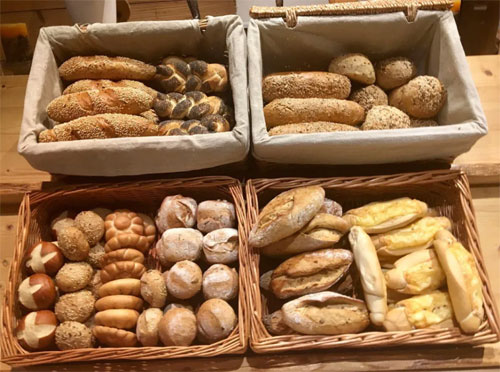
Brot
Bread
Bread is a significant part of German cuisine and is considered necessary for a healthy diet. About 600 main types of breads and 1,200 different types of pastries and rolls are produced in about 17,000 bakeries and another 10,000 in-shop bakeries.
Bread is served usually for breakfast and in the evening as sandwiches, but rarely as a side dish for the main meal. The importance of bread (Brot) in German cuisine is also illustrated by words such as Abendbrot (meaning supper, literally Evening Bread) and Brotzeit (snack, literally Bread Time). In fact, one of the major complaints of the German expatriates in many parts of the world is their inability to find acceptable local breads.
Regarding bread, German cuisine is more varied than that of either Eastern or Western Europe. Bread types range from white wheat bread to grey (Graubrot) to black (Schwarzbrot), actually dark brown rye bread. Most breads contain both wheat and rye flour (hence Mischbrot, mixed bread), and often wholemeal and whole seeds (such as linseed, sunflower seed, or pumpkin seed) as well. Darker, rye-dominated breads such as Vollkornbrot or Schwarzbrot are typical of German cuisine. Pumpernickel, a steamed, sweet-tasting bread, is internationally well-known, although not representative of German black bread as a whole. Most German breads are made with sourdough. Whole grain is preferred for high fibre. Germans use almost all available types of grain for their breads: wheat, rye, barley, spelt, oats, millet, corn and rice. Some breads are made with potato flour.
Germany's most popular breads are:
Rye-wheat ("Roggenmischbrot")
Toast bread ("Toastbrot")
Whole-grain ("Vollkornbrot")
Wheat-rye ("Weizenmischbrot")
White bread ("Weißbrot")
Multi-grain, usually wheat-rye-oats with sesame or linseed ("Mehrkornbrot")
Rye ("Roggenbrot")
Sunflower seeds in dark rye bread ("Sonnenblumenkernbrot")
Pumpkin seeds in dark rye bread ("Kürbiskernbrot")
Roasted onions in light wheat-rye bread ("Zwiebelbrot")
Bread rolls
Bread rolls, known in Germany as Brötchen (a diminutive of "brot"), Semmel, Schrippe, Rundstück or Weck / Weckle / Weckli, depending on the region, are common in German cuisine. A typical serving is a roll cut in half, and spread with butter or margarine. Cheese, honey, jam, Nutella, meat, fish, or preserves are then placed between the two halves, or on each half separately, known as an open sandwich.
Rolls are also used for snacks like Bratwurst or Brätel in a hot-dog style.
A sweet roll which originated in the area of Hamburg is the Franzbrötchen, small, sweet pastry, baked with butter and cinnamon.
Drinks
Beer is very common throughout all parts of Germany, with many local and regional breweries producing a wide variety of superb beers. Beer is generally not as expensive as in other countries and is of excellent quality. The pale lager pilsener, a style developed in the mid-19th century, is predominant in most parts of the country today, whereas wheat beer (Weissbier) and other types of lager are common, especially in Bavaria. A number of regions have local specialties, many of which, like Weissbier, are more traditionally-brewed ales. Among these are Altbier, a dark beer available around the lower Rhine, Kölsch, a similar style in the Cologne area, and the low-alcohol Berliner Weiße, a sour beer made in Berlin that is often mixed with raspberry syrup. Since the reunification of 1990, Schwarzbier, which was common in East Germany but could hardly be found in West Germany, has become increasingly popular in Germany as a whole. Beer may also be mixed with other beverages:
pils or lager and lemonade: Radler, Alsterwasser
pils or lager and cola: Diesel, Schmutziges or simply Colabier
Altbier and cola: Krefelder
wheat beer and lemonade: Russ
wheat beer and cola: Colaweizen
In the few last years, many breweries served this trend of mixing beer with other drinks by selling bottles of already-mixed beverages. Examples are Bibob (from Köstritzer), Veltins V+, Mixery (from Karlsberg) and Cab (from Krombacher).
Beer is generally sold in bottles or from draught. Canned beer is available, but cans almost vanished after the introduction of a deposit fee.
Wine is also popular throughout the country. German wine comes predominantly from the areas along the upper and middle Rhine and its tributaries. Riesling and Silvaner are among the best-known varieties of white wine, while Spätburgunder and Dornfelder are important German red wines. The sweet German wines sold in English speaking countries seem mostly to cater to the foreign market, as they are rare in Germany.
Korn is a German spirit made from malt (wheat, rye and/or barley), that is consumed predominantly in the middle and northern parts of Germany. Obstler on the other hand, distilled from apples and pears ("Obstler"), plums, cherries (Kirschwasser), or mirabelle plums, is preferred in the southern parts. The term Schnaps refers to both kinds of hard liquors.
Coffee is also very common, not only for breakfast, but also accompanying a piece of cake in the afternoon, usually on Sundays or special occasions and birthdays. It is generally filter coffee, somewhat stronger than usual in the UK though weaker than espresso. Tea is more common in the Northwest. East Frisians traditionally have their tea with cream and rock candy ("Kluntje").
Popular soft drinks include Apfelschorle, apple juice mixed with sparkling mineral water, and Spezi, made with cola and an orange-flavored drink such as Fanta. Germans are unique among their neighbors in preferring bottled, carbonated mineral water, either plain ("Sprudel") or flavored (usually lemon) to non-carbonated ones.
Drinking water of excellent quality is available everywhere and at any time in Germany. Water provided by the public water industry can be had without hesitation directly from the tap. No chlorine is added. Drinking water is controlled by state authority to ensure it is potable. Regulations are even stricter than those for bottled water (see Trinkwasserverordnung). There is no need at all to buy water in bottles in Germany for health reasons, though the taste of the tap water varies widely, usually being better in rural areas. Germans prefer bottled water and other Getränke (beverages) like Mineralwasser (mineral water, sparkling or plain), Saft (juice), coffee or beer. (You may be surprised to learn that Germans drink far more mineral water than beer.)
Table Manners (Tischmanieren)
Dining customs in Germany are not so far off from eating in North America, but there are a few key differences. Utensils, or Besteck. Use ‘em. Most German food is meant to be eaten with utensils and you should only resort to fingers when eating informally, like at a Grillparty. Even fries from an Imbiss come with tiny forks. It can be awkward watching a German struggle to eat a burger or burrito with knife and fork, but they feel similarly uncomfortable watching us pick everything up with our hands.
