What is Hoisin Sauce?
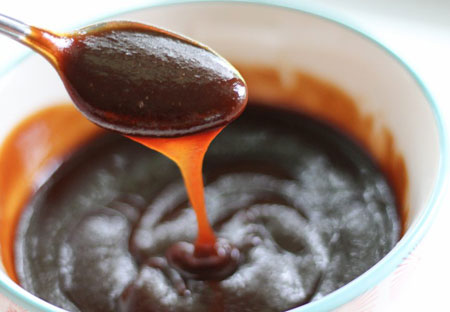
Hoisin sauce is used in Chinese cooking much like barbecue sauce is used in American cooking. It is used as a glaze for fish and meats, as in Chinese Spareribs (Char Siu), and as a condiment. A little dab of hoisin sauce gives extra flavor to stir-fry and noodle dishes. See Chicken Broccoli Stir-fry and Kung Pao Chicken. It's also often used as a flavor enhancer. It is especially common for Cantonese cuisine flavoring.
A number of Chinese cuisine dishes use hoisin sauce as a condiment on Mandarin Pancakes that are rolled around a filling: Mu Shu Pork, Peking Duck, and the British version of Peking Duck, Crispy Aromatic Duck. Hoisin sauce is sometimes called Peking sauce, because it's used in making Peking Duck.
Hoisin comes in a jar or a bottle and is a reddish-brown sauce that's salty, sweet, and spicy. It is made from fermented soybean paste, garlic, chilies, and various spices, and can contain sugar and vinegar.
It used to be that hoisin sauce could only be found in specialty markets or in a Chinese market. However with the expansion of Asian foods and other international cuisines, hoisin sauce is now readily available in most major grocery stores. Look for it it in the international foods section.
According to Cook's Illustrated, the best brands to buy are Kikkoman's Hoisin Sauce, Koon Chun Hoisin Sauce and Lee Kum Kee Hoisin Sauce with Kikkoman's being the best of all three.
Hoisin Sauce - use Koon Chun brand, Lee Kum Kee if can't find Koon Chun
from different web sites and discussion groups:
- Hoisin is made from fermented soybeans, sugar, garlic, chiles, and vinegar, and its high sugar content makes it a wonderful addition to barbecue sauces and marinades for roasted or grilled meats.
- I usually buy Koon Chun Brand. I mix a little water in it to serve. Also mix it with peanut butter for another kind of dipping sauce.
- I look for a hoisin sauce that lists soybeans or paste as the first ingredient, not sugar. I see on the label of Koon Chun that both sugar and vinegar are listed before soybean.
- from https://www.bonappetit.com/ - What drew us to Lee Kum Kee is the fact that the ingredients, like sugar, fermented soybean paste, dried garlic, and sesame paste, among others, mostly sound like things we would recognize, and staff photographer Alex Lau’s mom cooks with and swears by their sauces as well.
- although sold pretty much everywhere, ive never liked LKK much. I like Koon Chung, it seems to have more flavor.
- Bruce Cost's Asian Ingredients is some years old now but that book, he highly recommends Ma Ling and recommends Koon Chun and Wei-Chuan.
- from https://www.vietworldkitchen.com/ - My preferred brands of hoisin are Lee Kum Kee and Koon Chun, the former being easier to find in regular supermarkets than the latter. The Lee Kum Kee hoisin in the squirt bottle didn’t have as strong of a flavor as that in the jar. The jarred condiment offered a more complex flavor as it is based on sweet soybean paste, an earthy, savory fermented bean sauce that’s a favorite in northern Chinese cooking. The squirt bottle hoisin was actually bland tasting in comparison and not interesting whatsoever.
Fine Cooking did a taste test of Supermarkets Brands:
- Kikkoman hoisin sauce ($3.29 for a 9.3-ounce jar) took the prize for its glossy appearance and “deep and dark aroma of fermented soybeans,” according to one impressed taster. There was a lovely balance of roasty soybean flavor, sweet caramel, spicy heat, and a moderate saltiness. This hoisin is our top choice for spreading onto mu-shu pancakes or serving on its own as a dipping sauce.
- Lee Kum Kee hoisin sauce ($2.19 for an 8.5-ounce jar) was a close second. Our tasters liked its pleasant aroma and commented that the flavors of chiles and soybeans shone through the sauce’s sweetness with a nice spicy kick, although some wished it had a bit more tang. This hoisin would be a great addition to a barbecue sauce or marinade in which you could amp up the flavors according to your taste.
- Koon Chun. After scouring the supermarket shelves, I decided to check out my local Asian market to see if there was anything I was missing. There I found Koon Chun hoisin, which our tasters loved. Almost too thick to be called a sauce—it was jammy and not nearly as smooth as the supermarket brands—this hoisin had the most complex flavor profile by far, with an almost smoky fermented soybean and molasses taste that unfolded across the palate into perfectly proportioned sweet and sour notes. The only down side to this hoisin was its saltiness, which was troublesome for a few tasters. Use this brand sparingly, as a condiment or in sauces and marinades, for a marvelous depth of flavor that the supermarket brands lack. Look for Koon Chun hoisin at an Asian market or online at Adrianascaravan.com, where a 15-ounce jar costs $3.95.
