Indian Breads
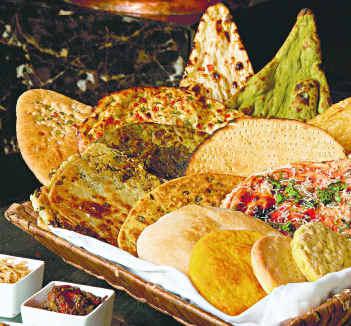 Indian breads are a primary food in the daily menu of most people in India. Most of the Indian households consume bread for all the three meals of the day. It is made fresh for each meal. Indian breads comprise complex carbohydrates as well as a good amount of dietary fiber and make for a nutritious and wholesome meal.
The wide variety of grains and cereals grown in the country are used to make different kinds of breads, broiled, steamed, fried and cooked over direct heat. They are usually made of finely milled flour and water. Most breads make use of the yeast spores in the atmosphere for fermentation, others use added yeast or curds (yogurt), a few use baking soda, and still others are made without fermentation. The dough for one type of a bread may be used to make another bread by changing cooking method.
There are dry, moist, soft, and hard breads. Depending upon the ingredients and method of preparation, a variety of breads are made in India - Chapati, Puran Poli, Phulka, Luchi, Puri, Roti, Paratha, Naan, Appam, Dosa, Bhatoora, Kulcha, Pathiri, Baqar Khani, and many more. Some of these, like Paratha and Roti have many varieties. Some varieties depend on the kind of grain used to prepare them, and others depend on the fillings they contain. Indians are fond of adding fillings to their breads.
Indian breads are always served to the accompaniment of vegetables, sweet dishes and curries.
Regional
One of the things that distinguishes south India from the north is its unique variety of breads.
North India is known for its ubiquitous wheat-based flatbreads such as paratha, roti, and chapati. They're consumed in south India as well but often they'll be made from different ingredients, along with the other exclusive breads in the region. Rice, in combination with lentils (daal), forms the basis of most south Indian breads because it's the most popular crop there. Unlike in the West, the breads in south India are usually steamed or cooked in a pan, rather than baked.
Most flat breads from northern India are unleavened and made primarily from milled flour, usually atta or maida, and water. Some flatbreads, especially paratha, may be stuffed with vegetables and layered with either ghee or butter. In northern India, a dough of the main ingredient is prepared and flattened by rolling. Most Indian breads, such as roti, kulcha and chapati, are baked on tava, a griddle made from cast iron, steel or aluminum. Others such as puri and bhatura are deep-fried. The dough for these breads is usually made with less water in order to reduce oil soaked up when frying.
In southern India and the West Coast, most flat breads are basically crêpes made from peeled and split black lentils (urad dal) and rice. Popular varieties include dosa, appam, uttapam and rice rotis and ragi rotis. In Southern India, a batter of rice and black lentils is prepared and ladled in small amounts onto a hot greased skillet, where it is spread out into a thin circle and fried with oil or ghee until golden brown.
In Western India (including the states of Maharashtra, Gujarat and Rajasthan) bread may be made from coarse grains such as bajra, sorghum or ragi, though wheat is the staple in these regions. The grains or cereals are usually milled into a fine powder, and mixed with a little water to make a smooth dough. This dough is patted into a circle by hand, either by holding it between the two hands or by placing it on an upturned plate or other flat surface.
Indian breads of Central Asian origin, such as naan and tandoori roti, are baked in a tandoor. Naan is usually leavened with yeast.
Cooking Techniques
Most breads are fried in a concave griddle called a tawa (see Roti below) except Naan and other breads in the Tandoori class of breads. A special oven called a tandoor clay oven is used for cooking Naan directly over a flame. Naan is a flatbread usually leavened with yeast. Some breads, like Puri and Luchi, are deep fried in oil. The Appam is a fermented bread usually prepared with finely powdered rice flour. In Kerala in South India, there are Kallappam, Vattayappam and Palappam (Vellayappam). The kallappam is made on flat iron griddles. The vattayappam is a steamed bread, and palappam is made in small shallow bottomed pans, which are kept covered while the bread cooks. Palappam has a thin crisp lace like strip around it.
Roti
Roti is the universal term for any flat unleavened Indian bread. It might just be the most ambiguous term in the Indian cuisine terminology. Just plain roti can mean phulka roti, naan roti, double roti (bread make after double rising of dough), rumali roti, makki-di-roti, tandoori roti or any other form of desi bread.
The word 'Roti' is used commonly in north, central and east India, whereas 'Chapati' is used more in west (Mumbai), and south India. Only in south India Chapati is fried in a bit of oil! Elsewhere, only a Paratha is fried with oil or ghee.
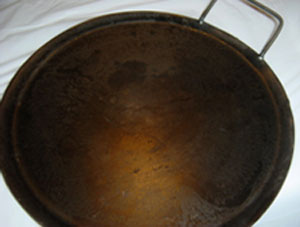
Roti is usually made of wheat flour and cooked in a tawa (see picture to the left). A tawa, also known as tawah, is a large, flat or slightly concave disc-shaped griddle made from cast iron, steel or aluminum. It is one of the many cooking tools that is used in Pakistani and Indian cooking and cuisines. It is specifically used to prepare several kinds of roti, including chapati, paratha, chaap, pao bhaaji, chaat, etc. Tawa is also used to make South Indian dishes like Dosa and Pesarattu. If you don't have a tawa, use a slightly round iron griddle.
Chapati
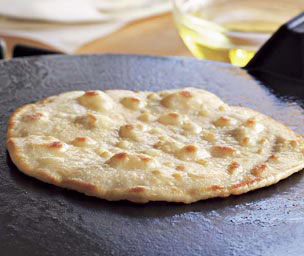
Chapati can be a thin or a thick roti. It is called a chapati because it is traditionally made by patting the dough balls between the palms of the two hands and flattening it (chappat in Hindi means flat). Some veterans would say that it is not a chapati if it is not flattened by hand, i.e. without the use of a rolling pin. Chapati sizes (diameter and thickness) vary from region to region and kitchen to kitchen. In Gujarat, for example, the chapati is called a 'rotli' and can be as thin as tissue paper.
The beauty of chapatis is that they can be eaten with anything. Chapati is unleavened Indian flatbread traditionally cooked on a tava (flat skillet) but you can use a griddle or cast iron pan. The secret to getting soft chapatis is to knead the dough thoroughly—the longer you knead the dough, the softer the bread will be. Using milk or fresh yogurt instead of water will also result in a soft chapati.
A chapati may or may not puff up like a phulka (see below) as it is cooked. Some also cook it completely on a tawa, by applying slight pressure on the surface of the dough-disc thereby cooking it completely. But chappatis cooked this way tended to harden up quickly. Chapatis are a great accompaniment to soup, curry dishes, or grilled meat.
Recipe for Chapati
Naan
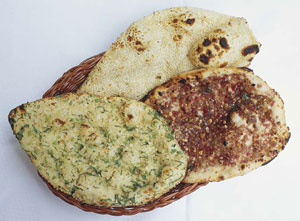
Naan is one of the most common Indian breads that you see in American grocery stores and is the bread served in restaurants in India. The Naan is a raised flatbread, usually round, that is made up of white flour and yeast. It is similar to Pita bread; but unlike the Pita, Naan is cooked using a clay oven called the tandoor. Nigella seeds or saffron water is sometimes added to give naan a distinct flavor. Garlic paste, dates, cottage cheese (paneer) or almonds may also be added to the dough to give it a different taste.
Recipe for Naan
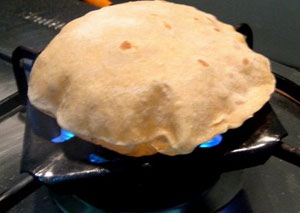
Phulka (swollen roti)
Phulka is a thin roti, which is oil or grease free. The dough is made with just water, sometimes even omitting salt. Then portions of the dough is rolled out into thin discs about 6 inches in diameter and half roasted on a tawa, then on an open flame. The phulka puffs up into a ball due to accumulation of steam inside it. Once it puffs up, it is removed from heat and served sooka (dry), without any added grease (although there are those who do add ghee or butter after the phulka is cooked while it's still hot). This becomes a phulka (literally means swollen) roti. Phulka will deflat shortly after cooking.
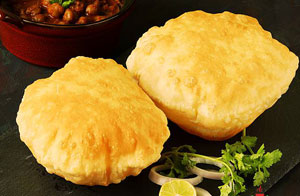
Bhatura
Bhatura is a Indian deep fried leavened bread made with flour, yogurt and a leavening agent. It is eaten with chole or chickpea curry.
Recipe for Bhatura
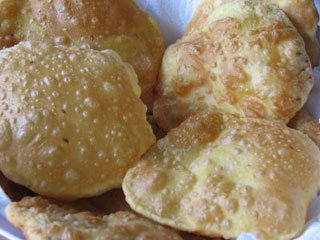
Poori (Puri)
Poori are round, puffy and are deep fried in oil. At times poppy seeds or lentils are added to the dough to bring a different flavor to the puris. These are generally served during festive occasions.
Recipe for Poori
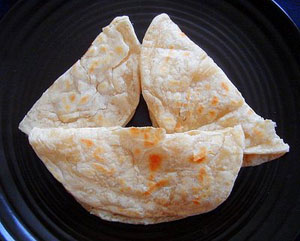
Paratha (or Parantha)
Paratha, also called parantha, are flatbreads that are flaky and somewhat more elaborate than chappatis or rotis. The dough is rolled out and brushed with ghee or oil, folded and brushed with ghee or oil again, then folded and rolled out once more to form a layered slice. The more layers you create by folding the dough over itself, the flakier the flatbread will be.
They are then cooked on a hot griddle and brushed with a final coating of oil and flipping the bread a few times in the hot pan. The heat makes the layers of dough swell, puff and crisp, resulting in flaky, pastry-like flat breads.
Sometimes, parathas have stuffings such as paneer (a type of cottage cheese), boiled potatoes, cauliflower or radish. At other times, parathas are simply eaten with pickles or dipped in yogurt. The shape of the paratha varies. It can be round, square, or even triangular.
Parathas go well with most Indian dishes, be it a gravied curry or a dry stir-fry. They may also be used as snacks, lunch-box favorites, light brunch items or traveling munching companions.
Recipes: Plain Parathas, Lachcha Parathas (layered bread), Aaloo Paratha (Potato Flatbread). Paratha is a breakfast bread in Punjab.
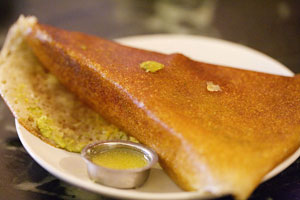
Dosa
The bread most eaten in South India is the Dosa. The dosa is made from lentils and rice, which are ground to a paste and then fermented overnight, and is an Indian version of the crepe. This type of bread is rich in protein as well as carbohydrates. Many people from South India eat the dosa during breakfast or lunch. It is usually eaten with vegetables, meats, or even special sauces made from different mild Indian spices.
Dosa is made from the same batter as idli (see below), however it's smeared on to a pan and cooked, making it thin and deliciously crispy. It's eaten for breakfast or as a snack. The most popular type is the masala dosa — a dosa rolled up with a mixture of potato, onion, and spices inside. However, the options for fillings are almost endless. In its simplest form, the dosa is eaten with sambar and chutney on the side, similar to idli.
Recipe for Dosa
Also see Dosa Information page.
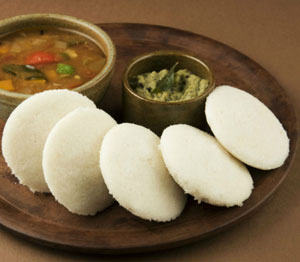
Idli
Idli is another traditional bread made in South Indian Kitchens. The batter for Idlis is very similar to that for Dosas and also needs to be fermented overnight, but Idlis are steamed instead of being cooked on a tawa like a Dosa is. Idlis are steamed in special Indian idli moulds.
South Indians are fanatical about their idli, especially for breakfast! These soft, spongy discs are made out of a batter of fermented urad daal (black lentils) and rice flour. It's steamed in a special cooker, which gives the idli the round shape. The addition of lentils provides protein. Best of all, the cooking process involves no oil or butter, making it healthy. By itself, idli is quite tasteless. However, it's served paired with sambar (a spicy vegetable soup) and chutney, which provide bursts of flavor. Dip pieces of idli into these and enjoy!
Recipe for Idlis
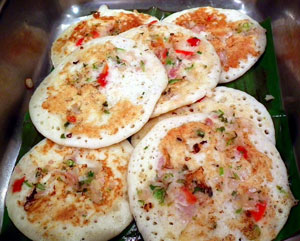
Uttappams
Uttapam is made from the same batter as dosa (and idli) but it's cooked much thicker. It also has toppings, kind of like a pizza! The toppings are usually tomato, onions, chilies, capsicum and coriander. However, all kinds of vegetables can be added, including bell peppers and cilantro. It is often eaten with sambar (yellow split pea soup) or chutney. It is one of the popular dishes of South India.
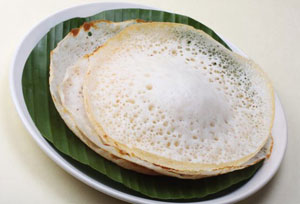
Appam (Hoppers)
The southern parts of India also have another bread that they often eat. It is called the Hoppers, popularly known as the appam. Appam is a type of pancake made with fermented rice batter and coconut milk. It is a common food in Kerala, Tamil Nadu and Sri Lanka. It is eaten most frequently for breakfast or dinner.
There are different kinds of appams such as the plain appam, egg appam, milk appam, and the string appam or idiyappam. The differences between the various hoppers depend on the ingredients used to cook them. Some use coconut while others have honey.
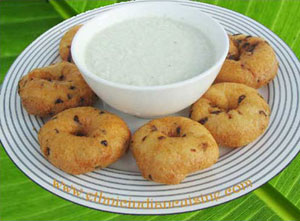
Vada
South Indian vada (not to be confused with that from Mumbai in Maharashtra) can best be described as a savory version of the western doughnut. It's crispy on the outside and soft on the inside.
The most common type is the medu vada, fried from a batter of urad daal. The batter is often flavored with spices such as ginger, cumin, green chilli, and pepper. You'll find vada served alongside idli for breakfast, with sambar and chutney. It's popularly eaten at any time of the day though.
