Types of Curry
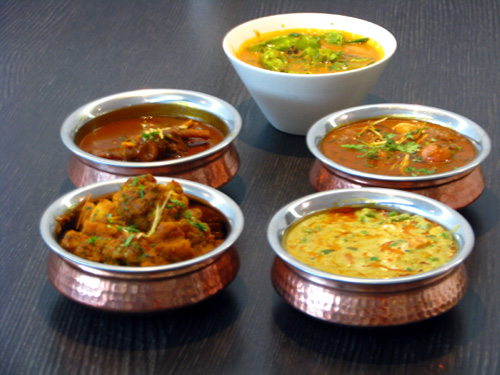
Curry is the generic English term primarily employed in Western culture to denote a wide variety of dishes whose origins are Southern and Southeastern Asian cuisines. Their common feature is the incorporation of more or less complex combinations of spices and/or herbs, usually (but not invariably) including fresh or dried hot chillies.
The term likely derives from kari, the word for sauce in Tamil, a South-Indian language. Perplexed by that region's wide variety of savory dishes, 17th-century British traders lumped them all under the term curry. A curry, as the Brits defined it, might be a mélange of onion, ginger, turmeric, garlic, pepper, chilies, coriander, cumin, and other spices cooked with shellfish, meat, or vegetables.
In the original traditional cuisines, the precise selection of spices for each dish is a matter of national or regional cultural tradition, religious practice, and, to some extent, family preference. Traditionally, spices are used both whole and ground; cooked or raw; and they may be added at different times during the cooking process to produce different results.
Curry powder, a commercially prepared mixture of spices, is largely a Western notion, dating to the 18th century. Such mixtures are commonly thought to have first been prepared by Indian merchants for sale to members of the British Colonial government and army returning to Britain.
Dishes called "curry" may contain meat, poultry, fish, or shellfish, either alone or in combination with vegetables. They may instead be entirely vegetarian, especially among those for whom there are religious proscriptions against eating meat or seafood.
Curries may be either "wet" or "dry." Wet curries contain significant amounts of sauce or gravy based on yoghurt, coconut milk, legume purée (dal), or stock. Dry curries are cooked with very little liquid which is allowed to evaporate, leaving the other ingredients coated with the spice mixture.
Origins and dissemination
Dishes of highly spiced meat are thought to have originated in pre-historic times among the inhabitants of the Indus Valley Civilization. Archaeological evidence dating to 2600 BCE from Mohenjo-daro suggests the use of mortar and pestle to pound spices including mustard, fennel, cumin, and tamarind pods with which they flavoured food. Such dishes are also recorded during the Vedic Period of Indian history, roughly 1700 to 500 BCE.
Spiced dishes in the Indian style were apparently carried eastward to Burma, Thailand, and China by Buddhist monks in the 7th century CE, and carried southwards to Indonesia, The Philippines, and elsewhere by coastal traders at about the same time. The establishment of the Mughal Empire, beginning in the early 16th century, transformed much of older Indian cuisine, especially in the north. Another influence was the establishment of the Portuguese trading centre in Goa in 1510, resulting in the first introduction of the Chili pepper to India, as a byproduct of the Columbian Exchange.
From the mid-19th century, curry has been increasingly popular in Great Britain. During the 19th century, curry was also carried to the Caribbean by Indian indentured workers in the British sugar industry. Since the mid-20th century, curries of many national styles have become popular far from their origins, and increasingly become part of international fusion cuisine.
Indian Curries
There are hundreds of Indian curries - Alu Gobhi or Potatoes and Cauliflower; Alu Mattar or Potatoes and Peas; saag paneer or spinach and cheese; mixed vegetable curry; chicken, lamb, or fish curry, etc. Typical ingredients in Indian curry powders include: anise, asafetida, Indian bay leaves, cardamom, cassia (a cinnamon-like bark), cinnamon, chilies, cloves, coriander, cumin, curry leaf, fennel seeds, fenugreek, garlic, ginger, mustard seeds, nutmeg, tamarind, turmeric, and saffron. Dishes range from spicy, creamy, herb-driven masalas to mild and mellow tandooris to burning-hot Madras, which are made sour by the acid from lemon juice and tomatoes.
An Indian curry begins with a base of onions, garlic, and ginger which are cooked until well-browned. To this base, a mixture of spices is added. Traditionally, this spice mix is ground specifically for a particular dish. In India, most cooks grind and mix their own spice mixes by hand and for each individual dish. Indian cooks toast their spices before grinding to bring their aromatic flavors out. Coconut milk is an ingredient in some southern curries, but elsewhere it's much less common. Generally water, or sometimes a light vegetable broth will be used to moisten an Indian curry.
In Northern and Eastern India you will be served with a hearty curry bursting with garam masala and other spices along with crisp naans. As you move towards the west, warm notes of poppy-seeds, cardamom and khada masalas dominate the dish that sits atop a bed of steaming rice. From down south, comes a soothing coconut-y concoction. Coconut milk adds comfort to their curries.
The cooking medium also differs as per local tastes. For instance, ghee (clarified butter) or vegetable oil is used predominantly in North India and coconut oil lends it unique flavor to Southern curries. Mustard oil brightens up the curries from East and the West is known for the heavy use of sesame and groundnut oil.
In the south, curries are served with rice; in the north, plain unleavened roti or naan soak up the sauces.
Glossary of Indian Restaurant Curries
These curry sauces were listed on an Indian restaurant menu near where we live. They were listed for creating your own curry pot. You choose a sauce and a vegetable or protein (paneer = cheese, chicken, lamb, or shrimp).
Korma - cashew, onion (Chicken Korma)
Chettinad - coconut milk, chettinad spice (Chettinad Chicken)
Makhani - tomato, onion, spice blend (Murgh Makhani - Butter Chicken) (Daal Makhani also called Kaali Daal - split black lentils) Makhani means buttery
Traditional curry - ginger, garlic, garam masala
Kadai - sauteed tomato, onion, bell pepper
Vindaloo - red chili, black peppercorn (Pork Vindaloo)
Tikka Masala - tomato, onion, spice blend (Chicken Tikka Masala)
Mild Curries
Korma - Korma curries are spiced not for heat, but for flavor. Rather than cumin and black pepper, korma goes for flavors such as cardamom and cinnamon. Mixed together with butter and cream, and often combined with yogurt-marinated meats that are slow cooked, kormas are definitely for those who want zest without burn. In fact, korma is not one particular dish but rather a method of cooking similar to braising, Because korma is a cooking method there are a wide variety of dishes that could be describecd as "korma". Many kormas call for the meat to be marinated in yoghurt and then the meat plus marinade are braised on a very low heat until all the juices condense down into a thick sauce. The restaurant chef has to cook to order so doesn't have time for long, slow cooking. The korma you find in Indian restaurants usually contains ground almonds, coconut and thick cream to produce a thicker sauce. It is often described on restaurant menus as being "very mild" but a good korma should not be bland.
Pasanda - a mild curry sauce made with cream, coconut milk, and almonds. Derived from a court dish of the Moghul emperors the pasanda is traditionally made with thinly sliced and marinated lamb fillets. It is sometimes called lamb badam pasanda because the dish contains ground almonds, the "badam" of the title. The restaurant pasanda is usually quite mild and contains ground almonds, cardamon pods, pureed tomatoes and cream.
Sagwala - Chicken saagwala is a lightly spiced curry made with spinach. If you crave a bit more heat, a sprinkle of freshly chopped green chillies will do the job.
Tikka masala Chicken tikka masala is the all time most popular dish on the Indian restaurant menu and what the restaurant diner really needs to know is whether the restaurant is providing a good example of the dish. And what is a good example? Well, the chicken tikka pieces should be aromatic and slightly smoky from the tandoor. The masala sauce should be well spiced but not hot, rich and creamy and have a hint of coconut. Tikka masala usually has a deep red colour, gained from the use of artificial food colourings. Chicken tikka massala, which is one of the most hot selling dish in the West today, is basically a derivative of the famous butter chicken invented in the kitchens of the Moti Mahal restaurant in India.
*Chicken (or Shrimp) Tikka Masala (red colored)
Hariyali Chicken Tikka Kebabs (green colored tikka made w/ fresh herbs)Biryani is not a curry at all but the curry connection comes from the mixed vegetable curry with which it is served in most Indian restaurants. Biryani is a rice dish, cooked together with whatever meat or vegetable it is ordered with. The meat and vegetables are pre-cooked and then mixed with the pillau rice. Biryani originated in Persia and, at its simplest, was rice and meat baked together in the oven. The cooks to the Moghul emperors took the biryani and transformed it into a courtly delicacy by adding aromatic spices and other exotic ingredients. Traditionally, biryanis are baked in the oven for some time so the aromatic spices and juices from the meat permeate the rice. In the Indian restaurant, however, all the dishes are made to order and the poor chef has to find a way of preparing the biryani in double quick time. So the restaurant biryani is often just pilau rice stir fried with chicken or lamb which has been cooked as an extra dry bhuna. The restaurant biryani is usually garnished with almonds and sultanas (equivalent word in American English golden raisins) and is accompanied by a mixed vegetable curry to add a little juiciness to the rice. The dish may be served with dahi chutney or Raita, korma, curry, a sour dish of aubergine (brinjal), boiled egg, and salad. Mild.
Medium Hot Curries
Balti is more a style of cooking than one particular curry. The word balti can be translated as "bucket" (i.e. a cooking pan) and some say the style of cooking is indigenous to an area of northern Pakistan known as Baltistan. A balti pan is basically a karahi which has the shape of a Chinese wok but with 2 small round handles on either side of the pan instead of one long handle. In specialist "Balti Houses" the balti is a meal in itself which contains both meat and vegetables and is eaten straight from the karahi using curled up pieces of naan bread. In standard Indian restaurants the balti is more of a stir-fried curry containing plenty of fried green peppers and fresh coriander (equivalent word in American English cilantro).
The main regional cooking influence of Balti curries is Punjabi (the large Punjab region is spread over the border of Pakistan and India). A Balti curry is cooked quickly over a high heat and is served, sizzling hot, in the Balti dish. Knives and forks are not usually used to eat the curry. Instead, naan bread or chapattis are used to scoop up the curry. Medium hot.
Bhuna - A Bhuna is a fairly dry fried curry containing onions and spices. Bhuna is first and foremost a cooking process where spices are gently fried in plenty of oil to bring out their flavour. The dish "bhuna" is an extension of that process where meat is added to the spices and then cooked in its own juices which results in deep strong flavours but very little sauce. The restaurant bhuna is a well spiced curry with a thick sauce. It is often garnished with fried green peppers (equivalent word in American English bell peppers) and shredded onions. Usually medium hot although I have had some pretty hot ones in my time. Like Dopiaza, but less onions.
Dhansak - medium/hot, sweet and sour sauce with lentils. Dhansak has its origins in a Parsee (Middle Eastern, Persia) dish and was probably a very special dish presented at a feast. Interestingly the dhan part of the name means rice and a dhansak is traditionally served with a pulao of fried and spiced rice. An authentic dhansak will made with lamb and contain vegetables and many different types of dhal (the sak in the name). The curry house dhansak is often referred to as "hot, sweet and sour with lentils". The "hot" is chilli powder, the "sweet" is sugar and the "sour" is lemon juice. Curry houses commonly use masoor dhal (split red lentils) but some restaurants now use chana dhal (chickpeas) to good effect. If it is done well the dhansak is an excellent curry with contrasting flavours and textures. The serving varies from restaurant to restaurant, but often expect a pineapple ring to be included in the curry for added sweetness and contrast. The strength depends on the chef or restauranteurs interpretation, so you need to take the advice from the menu. I have seen it described as mild, medium and hot.
Dopiaza - medium curry, the word means "double onion" referring to the boiled and fried onions used as its primary ingredient. The dopiaza is a classic Indian dish dating back at least to Moghul times. The name dopiaza broadly translates as "2 onions" or "double onions". Some traditional versions of the dopiaza use twice the weight of onions compared to the weight of meat but a classic Indian dopiaza is more likely to use the onions in 2 different ways, fried and boiled, at different stages of the cooking. The restaurant version has small fried pieces of onion in the sauce and then larger chunks of lightly cooked onion are added towards the end of the cooking. Typically this is a fairly basic Indian restaurant curry, prepared as a Bhuna or Bhoona but with the addition of extra onions probably both in the cooking and as a garnish. It is also the same strength as a Bhuna which is medium, so not in the Madras league. Medium hot.
Korai Many Indian restaurants had a balti-style curry on their menu long before the rise in popularity of balti cooking in the UK. They did not call the curry a balti but rather a korai or karahi and many restaurants still carry one on their menu. Both the balti and korai contain stir fried meat and vegetables and both take their name from the utensil in which they are cooked. Because korai is a style of cooking rather than a traditional recipe the curry house versions can vary considerably from restaurant to restaurant. It can be medium or hot and will usually contain green peppers, tomatoes and onions.
Moghul masala The Moghul dynasty ruled much of the Asian sub-continent for 3 centuries and left behind a fabulous legacy not just in art and architecture but also in sumptuous cuisine. There is no one Moghul style but the usual restaurant interpretation is rich and creamy. The curry house Moghul masala (masala meaning spice mixture) contains plenty of ginger, ground almonds, yoghurt and cream. Some restaurants offer a Shahi Moghul dish which is garnished with a small omelette flavoured with chopped coriander leaves. Mild to medium.
Patia/Pathia - generally similar to a Madras with lemon juice and tomato purée. Like it's more famous cousin, dhansak, patia is a Parsee dish. A traditional Parsee patia is made with fish cooked in a dark vinegar sauce. The restaurant patia is hot, sweet and sour in equal measure. The restaurant patia grew popular as a starter using prawns (equivalent word in American English shrimps) as the main ingredient. Many restaurants now offer the patia as a main course as well and give you the choice of a prawn, chicken or lamb version. It is usually garnished with fried tomato pieces.
Rogan josh/Kashmiri - from "Roghan" (fat) and "Josh" (energy/heat - which as in English may refer to either 'spiciness' or temperature) - medium, with tomatoes. Another all time favourite on the curry house menu. It was originally a Kashmiri dish but is equally at home in the Punjab. An authentic rogan josh will be made with lamb and may, at its most elaborate, contain dozens of spices. Now in Indian restaurant parlance it means cooked with tomatoes and onions and probably capsicum for good measure. The Kashmiri and Punjabi versions do differ (the Kashmiri does not traditionally contain onions or garlic) but they are both highly spiced and share a deep red colour derived from the liberal use of dried red Kashmiri chillies. The curry house rogan is also red but the colour comes from red peppers and tomatoes rather than Kashmiri chillies. The restaurant rogan is characterised by its garnish of tomato pieces and fresh coriander. It is generally presented as a medium hot curry, not as hot as a Madras.
Saag gosht is a classic curry traditionally made with spinach and lamb. Saag is, strictly speaking, a general term for tender green leaves such as spinach, mustard greens and fresh fenugreek leaves. If you were talking about spinach on its own it would be called palak. Many restaurants these days will offer a chicken or a prawn alternative to lamb and so the dish will show on the menu as just "saag" or "palak" omitting the gosht (lamb) from the name altogether. The saag is usually served medium hot and is made in the bhuna style.
Sambhar is a bit similar to Dhansak, in as much as it is prepared with a lentil base. It is less common on the Indian menu than Dhansak but it can also appear as well as. It is hard to give guidance on the difference between the two dishes as often it is only the interpretation of the chef that classifies them one way or the other. I would personally, expect the Samber to be presented as a sour curry, with the addition of lemon juice, but read the menu.
Hot Curries
Jalfrezi - onion, green chili and a thick sauce. Jalfrezi is not a traditional Indian dish as such but, like the bhuna, is actually a method of cooking. It literally means "hot-fry" but is probably better translated as "stir-fry". The term jalfrezi entered the English language at the time of the British Raj in India. Colonial households employed Indian cooks who would use the jalfrezi method of cooking to heat up cold roasted meat and potatoes. But the restaurant jalfrezi is not a version of the Anglo-Indian dish. Oh no. The Indian restaurant chef uses the jalfrezi method to stir-fry green peppers, onions and plenty of green chillies as the basis for a curry with just a little sauce. It usually also contains visible onion, tomato and capsicum. It is the addition of the green chillis and probably addition of extra chilli powder that sets this dish apart from other typical curries on the menu. It is generally served as hot as a Madras or Vindaloo depending on the chef’s interpretation or mood. The chillies make the jalfrezi taste very fresh but also make it one of the hotter curries on the restaurant menu.
Madras - fairly hot curry, red in colour and with heavy use of chili powder. Madras is a city in Southern India. In an Indian restaurant, Madras means a 'hot dish'. The curry house Madras is a restaurant invention which started life as simply a hotted up version of the standard restaurant curry. Because it is a restaurant invention rather than a traditional recipe the Madras can vary considerably from one restaurant to another. The restaurant Madras can be hot or very hot, red or brown, a hotter version of a plain curry or quite rich in tomatoes. Mostly though it comes with plenty of sauce and is strongly spiced. It is the standard restaurant hot curry.
Vindaloo - this is generally regarded as the classic "hot" restaurant curry, although a true Vindaloo does not specify any particular level of spiciness. The name has European origins, derived from the Portuguese "vinho" (wine) and "alho" (garlic). Vindaloo was originally a Portuguese dish which took its name from the 2 main ingredients which were "vinho", wine/wine vinegar, and "alhos", garlic. Over time it was spiced up, hotted up and otherwise changed by the indigenous peoples of the ex-Portuguese colony of Goa. Not many restaurants produce an authentic Goan vindaloo not least because the pork used by Christian Goans in their recipe would not be acceptable to Muslim chefs. In some restaurants the vindaloo is just a pumped-up Madras i.e. the same recipe but with lots more chilli powder. Other restaurants have interpreted the "aloo" part of the name as meaning potato and introduced diced potato to a hot standard curry with added lemon juice for tartness and black pepper for extra pungency. Very hot.
Indian Curries made with Dal
Dal Tadka - A delicacy as popular as dal tadka hardly needs any introduction. It is the most popular type of dal famous in North India, known for its spicy Tadka, and is present in every Indian restaurant menu. This dal is made with toor dal, split yellow lentils, and famous for its 'tadka' or seasoning with dry red chillies and ghee which is added at the end to the curry.
Luckowi Dal - Compared to the searing tadka of the previous dal recipe, Lucknowi dal is a mild dish. Like dal tadka it is cooked with toor dal (yellow split peas) but the milk used in this recipe softens up the zesty spices. It is basically an Awadhi recipe that not only tastes good but also smells delicious.
Mango Dal - Summer would never be the same with the sour delight of Mango Dal. This is an Andhra style pappu curry (dal cooked as curry) that makes use of green unripe mangoes. The sour taste is a trademark of this dal recipe.
Dal Sabji - The proteins of dal do not make a complete meal. You need to add the essential nutrients of vegetables to it. Dal sabji is a delicious Indian dal made with 3 different kinds of pulses and a variety of vegetables. You can add any vegetable of your choice to this dish.
Dal Makhani - A popular Punjabi delicacy very much liked across the country made with black urad dal and plenty of butter (Makhani means buttery). Dal makhani provides a creamy taste that is not spicy at all. The urad dal has to be pre-cooked. Then it is brewed in milk, butter and spices to get the rich brown colour.
Kaali Daal (split black lentils) - also called Daal Makhani.
Dal Gosht - Succulent pieces of lamb cooked in curry of toor dal (split yellow lentils) and a assortment of spices.
Dal Lasooni - This is one of the favourite Indian dals from the state of Bihar. It is a mixture of toor (split yellow lentils), masoor (red split lentils) and moong (split mung beans) dal. An excess of minced garlic is added to it for flavour. If you like the pungent aroma of garlic, you will love Dal Lasooni.
Andhra Tomato Pappu - In Andhra Pradesh, dals are called pappus and cooked like curries with lots of bold spices. The tomato pappu curry is a perfect example. It is cooked with the South Indian seasoning of mustard and curry leaves. It also has a generous amount of tomatoes for the tangy taste.
Kheema Dal - This is another delicacy specially for meat lovers. Kheema is a Hindi word which means to mince. Minced meat of kheema is cooked in the smooth taste of of Bengal gram dal (cholar dal, or split chickpeas) with green peas or potatoes. It usually includes ghee/butter, onions, garlic, ginger, chilis, and spices. Garnished with raw onions and coriander leaves, it makes quite a meal. Keema can be used as a filling for samosas or naan.
Dal Panchratna - Five types of lentil cooked together with butter and indian spices
Dal Dhokli - Lentils tempered and served with savoury dumplings, a typical Gujarati delicacy.
Burmese Curries
Burmese cuisine is based on a very different understanding of curries. The principal ingredients of almost all Burmese curries are fresh onion (which provides the gravy and main body of the curry), Indian spices and red chilies. Usually, meat and fish are the main ingredients for popular curries.
Burmese curries can be generalised into two types – the hot spicy dishes which exhibit north Indian or Pakistani influence, and the milder "sweet" curries. Burmese curries almost overwhelmingly lack coconut milk, setting them apart from most southeast Asian curries.
Regular ingredients include fresh onion, garlic and chili paste. Common spices include garam masala, dried chili powder, cumin powder, turmeric and ngapi, a fermented paste made from either fish or prawns. Burmese curries are quite oily, as the extra oil helps the food to last longer. A spaghetti equivalent called Nan gyi thohk exists, in which wheat or rice noodles are eaten with thick chicken curry.
Thai Curries
A Thai curry dish is made from curry paste, coconut milk or water, meat, seafood, vegetables or fruit, and herbs. Curries in Thailand mainly differ from the curries in Indian cuisine in their use of fresh ingredients such as herbs and aromatic leaves over a mix of spices. In the West, some of the Thai curries are described by colour; red curries use red chilies while green curries use green chilies.
Thai curries are always made with a curry paste. Ingredients used in many Thai curry pastes are: shrimp paste, chillies, depending on the curry these can be dried or fresh, red or green, onions or shallots, garlic, lemongrass, galangal, and coriander (cilantro) root. Depending on the type of curry, additional ingredients for the paste can include spices as, for instance, turmeric, pepper, coriander seeds, cardamom pods, and cumin, or other ingredients such as boiled fermented fish, and fingerroot.
Thai curries fall into three basic families: yellow, enriched with coconut milk; red, spiked with dried chiles; and the spiciest of the trio, green, heavily laden with fresh green chiles and finely shredded lime leaves. Unlike Indian curries, each sauce uses more fresh aromatics than dried spices and has a soupy consistency. Garlic, galangal, lemongrass, shallots, fiery bird's-eye chiles and fish sauce are all staples of Thai cooking. As a result, Thai curries tend to be more aromatic than Indian curries.
The ingredients for the curry paste are ground together, traditionally with a mortar and pestle and non-traditionally with an electric food processor. With many curries, the paste is first stir-fried in cooking oil before other ingredients are added in to the dish. Due to the oil reaching higher temperatures than boiling water, this technique releases certain flavours from the spices and other ingredients in the paste which would not have been possible by only cooking it.
Most Thai curries are made with meat, fish or shellfish as their main ingredient. Sugar (traditionally palm sugar) is used with curries that need to be sweetened. Besides lime juice, tamarind juice can also see use in sour curries as the souring agent such as in kaeng som. To achieve the most fragrance from the ingredients in a curry paste, the curry paste is often first fried together with vegetable oil or coconut oil that has separated from the coconut cream, before adding in the other ingredients.
Fresh kaffir lime leaves (bai makrut), fingerroot (krachai), or fresh herbds such as Thai basil (horapa) are often added to Thai curries. Kaffir lime leaves and krachai are often cooked along with the other ingredients but fresh herbs such as Thai basil are nearly always added at the last moment to preserve the full taste and serve as a contrasting note to the flavours of a curry. Fish sauce is not only used when cooking the curry as a flavouring and for its salty taste, but it is usually also available at the table as a condiment, mixed together with sliced green bird's-eye chillies for those that prefer their curries more salty and spicy.
