Corned Beef Hash
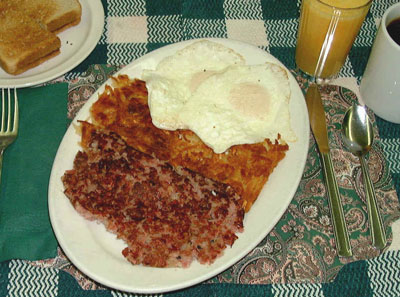
Corned Beef Hash has origins that trace back to England, Scotland and other parts of Europe. America began eating corned beef hash on a regular basis during the World War II era. As our nation began to ration fresh meat and other staple ingredients, housewives got creative and used leftovers from dinner the night before to create a filling breakfast. However, as rationing increased, it quickly became the meal du jour, finding its way to the table for breakfast, lunch and dinner.
Hash is a dish consisting of a mixture of beef (usually corned beef or roast beef), onions, and potatoes that are mashed together into a coarse, chunky paste, and then fried until brown, either alone, or with other ingredients. In many locations, corned beef hash is served primarily as a breakfast food, often served with eggs and toast (or biscuits). The dish is usually known as corned beef hash with eggs, or corned beef hash and eggs.
The photo to the right also shows a serving of hash browns, potatoes that have been shredded and fried until brown and crisp, that is frequently served with corned beef hash and eggs for breakfast.
Also see Baked Corned Beef Hash w/ Eggs
Corned Beef Hash
Can be made from leftover Corned Beef and Cabbage.
3 cups roughly chopped boiled red new potatoes (leftover from Corned Beef and Cabbage or other cooked pototoes)
2 cups finely chopped or shredded leftover cooked corned beef
1/4 cup cooking liquid from your corned beef or chicken broth
1/2 medium yellow medium onion, grated
Freshly ground black pepper
1 tablespoon chopped flat-leaf parsley
1/4 cup plus 1 tablespoon unsalted butter
In large bowl, place 1 1/2 cup of the potatoes and mash with a fork. Add the remaining 1 1/2 cup potatoes, corned beef, cooking liquid, and onion. Season generously with pepper and mix well. Store in the refrigerator overnight.
Remove the hash mixture from the refrigerator and stir in the parsley.
Heat 1/4 cup butter in a large cast-iron skillet over medium-high heat. When the foaming subsides, add the hash mixture and cook, stirring, for 30 seconds. Using a spatula, press the mixture down into a round cake the size of the skillet. Cook, shaking the skillet occasionally, for 4 minutes. Reduce the heat to medium and continue cooking, moving the skillet occasionally, until the underside is browned and crusty, about 6 minutes more.
To flip the hash, remove from the skillet. Heat the remaining 1 tablespoon butter. When the foaming subsides, slide the hash into the skillet cooked-side up. Cook, shaking the skillet occasionally, for 3 minutes. Reduce the heat to medium and cook, shaking the skillet occasionally, until the underside is browned and crispy, about 5 minutes more. Set aside covered with foil to keep warm.
Note: Emeril Lagasse sautes his hash on the stovetop for about six minutes, then "Using the back of a large spoon or spatula, pack the mixture firmly into the pan. Place the pan in a 400° oven. Cook for 8 to 10 minutes or until golden brown. Remove from the oven and slice into individual servings."
Good served topped with poached eggs.
4 servings
