Pizza Styles
Also see The Pizza Lab: Three Doughs to Know
History of Pizza in America
The story of pizza in America seems to have begun officially in 1905 when Gennaro Lombardi, a native of Naples, opened the first licensed pizzeria in America in Manhattan’s Little Italy, Lombardi’s. He had been making versions of this strictly Neapolitan fast food at the bakery in which he worked, which was also being done elsewhere, at least in his neighborhood. The New York Tribune noted a couple of years earlier in 1903 in Little Italy that “apparently the Italian has invented a kind of pie. The ‘pomidore pizza,’ or tomato pie.” These pizza pies were just the province of these Neapolitans; in Italy at the time, it was not found outside of the vicinity of Naples. “There are only two places in New York where you can get real, genuine Neapolitan pizze. One is on Spring Street and one on Grand. The rest are Americanized substitutes,” reported an informed source, “the Dago,” in a Sun piece in the summer of 1905.
With that first pizzeria at 52 Spring Street, Lombardi used a coal-fired oven, a typical commercial oven at the time. Though wood was used in the pizzerias in Naples, coal was readily available in New York and burned more efficiently than wood. The coal-fired ovens would help give New York pies a distinctive crust and taste.
These pizzas first found an audience with those recently arrived Neapolitans and quickly spread to all the Italians living in the neighborhood. Pizza has proven to be a very easy sell over the years. In the 1920s and 1930s Lombardi’s former employees, all Neapolitans, opened pizzerias in Brooklyn, East Harlem and uptown Manhattan that would be destined to become icons in their own right. But, pizzas were really an ethnic, mostly Italian, specialty until after the Second World War, even in New York City.
Also in the 1920s, pizzerias were opened by Neapolitan immigrants in the Italian neighborhoods of New Haven, Connecticut, Trenton, and Boston. Philadelphia and Chicago were two of the few other cities with Neapolitan pizzaioli and pizza before the Depression. Pizzerias were then still run solely by these Neapolitans and their offspring.
Another trademark American quality, in addition to convenience and efficiency, is size. The size of pizzas grew in diameter from its original ten inches or so. Instead of just one, these now fed two to four people, perfectly suited for families and groups of friends. The pizzas were all fairly similar, still thin-crust with a minimal number of toppings. Cheese, mushrooms, anchovies, ground beef, onions, and that Italian-American creation, pepperoni, were common, and often used in combinations.
Variations of Early Pizzas
A New Haven pizzeria, Pepe's Pizzeria Napoletana, eventually introduced a version topped with clams (in the 1960s), but there still were not many regional differences. Pizzas were simple, satisfying, affordable, and easy-to-like. One variation to the standard pie, found in St. Louis to Chicago and east to West Virginia was to cut the thin circular pizzas into squares.
Somewhere along the line, the Sicilian pizza also joined the mix, likely the result of a pizzeria worker or owner from Palermo. Customers began to have two options dished with the same sauce and toppings: the original circular thin-crust, and a rectangular construction with a thick, usually softer crust. The latter, the Sicilian pizza was derived from the sfincione served in Palermo, which is a type of spongy focaccia usually topped with vegetables or tomato sauce and cheese or sardines or anchovies.
A local specialty began in Chicago in 1943 with the first deep-dish pizza. Created at Pizzeria Uno by non-Italians, this hefty dish was really more of a casserole than a pizza (but still a pie), in line with the city’s big-food traditions. It was baked at lower temperatures for around forty-five minutes or so, far longer than the thin-crust versions, but contained the usual pizza ingredients and flavors and grew to become the fiercely loved, dominant style in and around the Windy City. Chicago-style has come to mean deep-dish.
Another type of pizza was added by a non-Italian, the designer pizza, or the California pizza, introduced in the early 1980s by Wolfgang Puck at his Spago restaurant in Los Angeles. This helped expand the range of toppings thought possible. Goat cheese, salmon, chicken, shrimp and even caviar were all successfully found atop Spago’s finely crafted pies. Its success created a designer pizza craze in Los Angeles in the mid-1980s. And, though Alice Water’s Chez Panisse might have been the first to do so a few years earlier and inspired Puck, Spago’s example was the one that really popularized the idea that pizza could be served at serious restaurants.
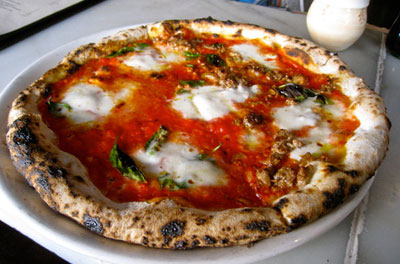
Neapolitan Pizza
Neapolitan pizza
Neapolitan is the original pizza. This delicious pie dates all the way back to the 18th century in Naples, Italy. During this time, the poorer citizens of this seaside city frequently purchased food that was cheap and could be eaten quickly. Luckily for them, Neapolitan pizza was affordable and readily available through numerous street vendors.
Authentic Neapolitan pizzas are made with local ingredients like San Marzano tomatoes, which grow on the volcanic plains to the south of Mount Vesuvius, and Mozzarella di Bufala Campana, made with the milk from water buffalo raised in the marshlands of Campania and Lazio in a semi-wild state. According to the rules proposed by the Associazione Verace Pizza Napoletana, the genuine Neapolitan pizza dough consists of Italian wheat flour, natural Neapolitan yeast or brewer's yeast, salt and water. For proper results, strong flour with high protein content must be used. The dough must be kneaded by hand or with a low-speed mixer.
After the rising process, the dough must be formed by hand without the help of a rolling pin or other mechanical device, and may be no more than 3 mm thick. Neapolitan pizza sauce is very simple. It is not cooked ahead of time; it cooks on the pie when it goes into the oven. The pizza must be baked for 60–90 seconds in a 485 °C (905 °F) stone oven with an oak-wood fire. When cooked, it should be crispy, tender and fragrant.
The typical Neapolitan pizza toppings are fresh mozzarella, tomatoes, basil leaves, oregano, and olive oil. Since Neapolitan pizza is thin, it isn't designed to handle the weight of too many toppings. In fact, Neapolitan pizza is so thin that it's typically eaten with a fork and knife.
Neapolitan pizza has been given the status of a "guaranteed traditional specialty" in Italy. This allows only three official variants:
- Pizza Marinara, which is made with tomato, garlic, oregano and extra virgin olive oil (although most Neapolitan pizzerias also add basil to the marinara)
- Pizza Margherita, made with tomato, sliced mozzarella, basil and extra-virgin olive oil
- Pizza Margherita Extra made with tomato, buffalo mozzarella from Campania in fillets, basil and extra virgin olive oil
- See The Pizza Lab: Three Doughs to Know
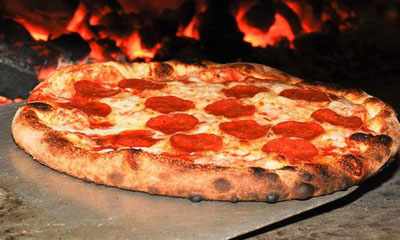
New York-style Pizza
New York-style pizza
With its characteristic large, foldable slices and crispy outer crust, New York pizza is one of America’s most famous regional pizza types. Originally a variation of Neapolitan pizza, the New York slice has taken on fame all its own, with some saying its unique flavor has to do with the minerals present in New York’s tap water supply.
New York-style pizza is a style originally developed in New York City by immigrants from Naples, where pizza was created. It is often sold in generously sized, thin and flexible slices. It is traditionally hand-tossed, moderate on sauce, and moderately covered with cheese essentially amounting to a much larger version of the Neapolitan style. The slices are sometimes eaten folded in half, or even stacked, as its size and flexibility may otherwise make it unwieldy to eat by hand. This style of pizza tends to dominate the Northeastern states, and is very similar to the basic style common through the United States and known simply as pizza.
New York pizza usually features tomato sauce and mozzarella cheese. Unlike its thin crust counterpart, the Neapolitan, New York pizzas can handle a wide range of additional toppings, from pepperoni and sausage to mushrooms and anchovies. While this type of pizza can have virtually anything added to it, it's common to find pizza lovers topping New York pizza with condiments like oregano, red pepper flakes, Parmesan cheese, and garlic powder.
Many pizza establishments in the New York metropolitan area offer two varieties of pizza: "Neapolitan", or "regular", made with a relatively thin, circular crust and served in wedge-shaped slices, and "Sicilian", or "square", made with a thicker, rectangular crust and served in large, rectangular slices. Another type of pizza, more popular on Long Island but can be found, albeit rarely, in Queens and Manhattan is Grandma pizza. It is cooked in a square pan like Sicilian, but it is much thinner. It has a thin, crispy crust, usually has tomato chunks in addition, or in exception, to the sauce. Generally, it will contain less cheese than regular slices, and sometimes has extra spices or oils baked into the crust.
Pizza Dough (New York Style)
New York-style Pizza Sauce
Also see The Pizza Lab: Three Doughs to Know
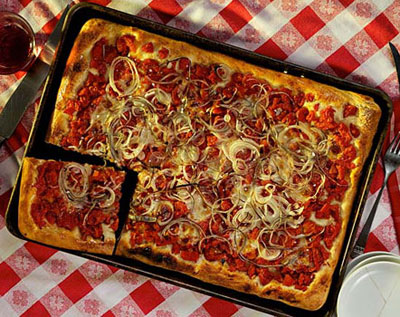
Sicilian-style Pizza
Sicilian Style pizza
Sicilian pizza is pizza prepared in a manner that originated in Sicily, Italy. In the United States, the phrase Sicilian pizza is often synonymous with thick-crust or deep-dish pizza derived from the Sicilian Sfincione (focaccia with toppings) and introduced in the United States by the first Italian (Sicilian) immigrants. Sicilian pizza was brought to America in the 19th century by Sicilian immigrants and became popular in the United States after the Second World War.
Sfincione (loosely translated as "thick sponge") is a thick bread, baked on a sheet, not in a deep-dish pan. It is made with a thick, spongy dough that will soak up the olive oil spread on the bottom of the pan and create a crispy, charred bottom, while the middle will remain soft and spongy.
Unlike the more familiar Neapolitan pizza, it is typically rectangular, with more dough, sauce and cheese. An authentic recipe often calls for herbs, onion, a robust tomato sauce, strong cheese like the Sicilian cheeses caciocavallo or pecorino, and anchovies. The sauce is sometimes placed on top of the toppings to prevent it from soaking into the thick dough and making the bottom crust soggy.
Sicilian pizzas are often topped with bits of tomato, onion, anchovies, and herbs. This square-cut pizza is served with or without cheese.
See http://slice.seriouseats.com/archives/2011/12/the-pizza-lab-sfincione-the-original-sicilian-pizza.html and http://www.seriouseats.com/recipes/2011/12/sfincione-sicilian-new-years-pizza-with-bread.html
In the U.S. also known as a "square slice," because it's cut into squares (or rectangular shapes close enough to square to merit the name).
See The Pizza Lab: Three Doughs to Know
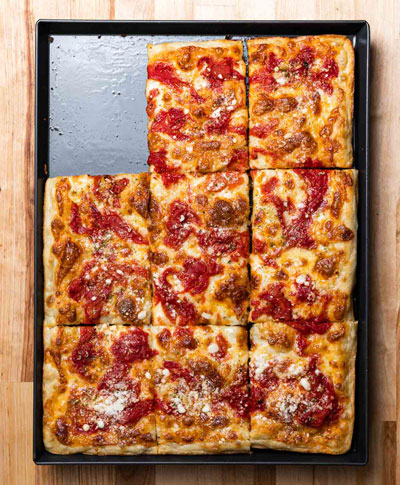
Grandma Pizza
Pizza alla Nonna (translation: Pizza Grandma Style) was developed by first generation Italian immigrants in the boroughs of New York. It holds its origins in the traditional Italian Pizza alla Casalinga (translation: Pizza Housewife Style). This pizza variety has its roots in Italian households, where housewives prepared pizzas alla casalinga in their home ovens. Grandma pizza can trace its roots to Italian immigrants, who developed the style in their home kitchens, using standard American cooking equipment like sheet pans and home ovens instead of the communal bread ovens found in Italy. Grandma style pizza has very humble origins, being baked at home by immigrant housewives (and as the years went on, grandmas). Calling it “grandma pizza” is a nod to these homespun origins.
The style remained relatively unknown until the mid-1990s, when a pizza chef named Umberto Corteo began selling grandma pizza at his popular Long Island pizzeria, Umberto’s of New Hyde Park. This pizzeria is today considered a pilgrimage-worthy ground zero of grandma pizza popularity, and it’s the reason why so many other pizzerias across the New York area began to sell it.
The crust is the primary differentiator between Sicilian and grandma pizzas. After a Sicilian pizza crust’s dough is stretched on an oiled sheet pan, it’s allowed to rise for an extended period of time before toppings are applied and it’s baked. This gives it a crust that can be an inch thick, and it’s airy and chewy. Grandma pizza, on the other hand, has a crust that isn’t given that extra time to rise before it’s topped and baked, so while it may still be thicker than a standard New York slice, it’s still much thinner and less chewy than Sicilian crust. Both styles are baked on a sheet pan that’s been covered with olive oil, so the bottom is golden brown and crisp, with an almost fried texture.
Most Sicilian pizzas are topped like traditional New York-style pizzas, with a layer of tomato sauce atop the crust, followed by cheese and toppings. Grandma pizza traditionally reverses the order, with sliced mozzarella cheese going down first, followed by an uneven layer of tomato sauce (sometimes no sauce at all, just fresh crushed tomatoes with garlic and olive oil); by not covering the entire pizza with sauce, the cheese still gets golden brown and bubbly, creating a distinctive appearance.
Recipe for Grandma Pizza
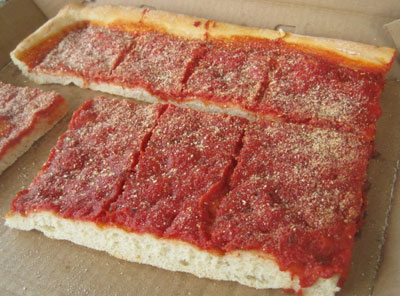
Philadelphia Tomato Pie
Philadelphia Tomato Pie
Not to be confused with its neighboring tomato pie to the north, Philladelphia Tomato Pie is stretched and baked into sheet pans. The thick, bready crust is as thick as a Sicilian—about 1 inch tall. The tomatoes for this sauce are cooked down with lots of seasoning into a thick, heavy, sweet sauce.
In his review of Conshohocken Bakery pizza, Philly correspondent Hawk Krall described this style as, "distinct from everyday pizza—the best Tomato Pies come room temperature from old-school neighborhood bakeries rather than hot from a pizzeria. No toppings and no cheese, save for a scant shake of Romano or Parmesan. For many who grew up in the area, this simple bakery style pie says "Philly" more than any other style of pizza."
The focaccia-like bread is always cut into squares.
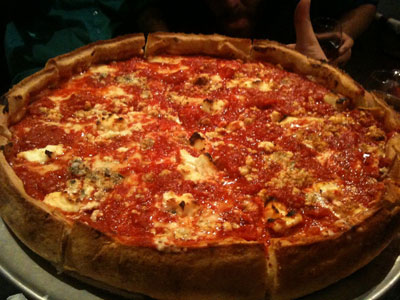
Chicago-style Deep Dish Pizza
Chicago-style pizza
Chicago pizza, also called deep-dish pizza, gets its name from the city it was invented in. During the early 1900s, Italian immigrants in the windy city were searching for something similar to the Neapolitan pizza that they knew and loved. Instead of imitating the notoriously thin pie, Ike Sewell had something else in mind. He created a pizza with a thick crust that had raised edges, similar to a pie, and ingredients in reverse, with slices of mozzarella lining the dough followed by meat and vegetables, and then topped with a can of crushed tomatoes. This original creation led Sewell to create the now-famous chain restaurant, Pizzeria Uno in 1943, which is still operating along with its twin restaurant, Pizzeria Due, in the River North neighborhood.
Chicago-style deep-dish pizza, contains a crust which is formed up the sides of a deep-dish pan. It reverses the order of some ingredients, using crust, cheese, filling, then sauce on top. Some versions (usually referred to as stuffed) have two layers of crust with the sauce on top.
Generally, the toppings for Chicago pizza are mozzarella, ground beef, sausage, pepperoni, onion, mushrooms, and green peppers, placed underneath the tomato sauce. Some locations will finish off their pizzas with a sprinkle of Parmesan cheese across the tomato sauce.
Chicago-style thin-crust pizza has a thinner crust than Chicago-style deep dish, and is baked flat rather than in a deep dish pan. The crust is thin and firm enough to have a noticeable crunch, unlike a New York-style pizza, yet thick enough to be soft and doughy on the top. The crust is invariably topped with a liberal quantity of southern-Italian style tomato sauce, which is usually quite herbal or highly spiced, and typically contains no visible chunks of tomato.
Next, a layer of toppings is added, and a layer of mozzarella cheese which frequently separates from the bottom crust due to the quantity of tomato sauce. Chicago-style thin crust pizzas are cut into three-to-four-inch (8–10 cm) squares, also known as "party cut", as opposed to a "pie cut" into wedges. The small size of the squares makes it unnecessary to fold the slices. Chicago-style pizza is prevalent throughout the Midwestern US. In fact, most of the neighborhood pizza parlors in Chicago and the rest of the Midwest serve Chicago-style thin crust, not deep dish as is commonly assumed.
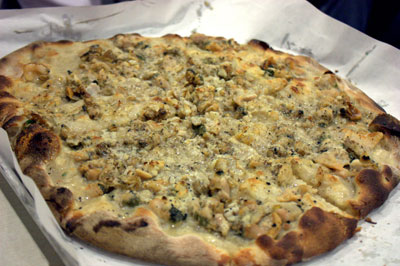
Pepe's White Clam Pie
New Haven-style pizza
New Haven-style pizza, locally known as apizza (it is pronounces ah-BEETS, and that's what the locals call it in their colloquial Italian-American), is a style of Neapolitan pizza common in and around New Haven, Connecticut. It originated at the Frank Pepe Pizzeria Napoletana and is now served in many other pizza restaurants in the area. It has a thin crust that varies between chewy and tender, depending on the particular establishment.
The default version is a "white" pizza topped with only garlic and hard cheeses; customers who want tomato sauce or mozzarella cheese have to ask for them explicitly. Apizza has a very dark, "scorched" crisp crust that offers a distinctive bitter flavor, which can be offset by the sweetness of tomatoes or other toppings. What makes New Haven style pizza distinct is its thin, oblong crust, characteristic charring, chewy texture, and limited use of melting cheeses. It tends to be drier and thicker than, but closely related to, traditional New York style pizza. Both styles in turn are close descendants of the original Neapolitan style.
Pepe invented the "white clam pie." Pepe's restaurant used to serve littleneck clams on the half shell at the bar which he eventually decided to put on the pizza. The white clam pie is crust, olive oil, oregano, grated cheese, chopped garlic, and fresh littleneck clams.
New Haven-Style White Clam & Garlic Pizza
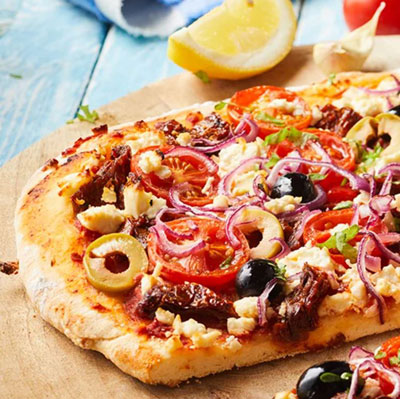
Greek pizza
Greek pizza was created by Greek immigrants who came to America and were introduced to Italian pizza. Greek pizza is a variation popular in New England; its name comes from it being typical of the style of pizzerias owned by Greek immigrants.
It has a puffier, chewier crust and is baked in shallow, oiled pans in a pizza oven, instead of directly on the bricks. Baking in oiled pans results in a nearly deep-fried bottom. Greek pizza crust is spongy with lots of tiny brown bubbles and and depending on how long the dough has been left to rise in the pan the crust becomes much thicker than Italian-style pizzas, but not quite as thick as a deep-dish or Sicilian crust.
Plain olive oil is a common part of the topping, as well as being liberally used to grease the pans and crisp the crust. Greek pizza is usually heavier on the sauce than the cheese. The sauce typically has a tangy tomato paste with a strong oregano flavor. It is often only topped with cheese, which is usually a mix of cheeses like mozzarella, cheddar, or provolone. It may feature a variety of non-Greek or Greek toppings, such as feta cheese, Kalamata olives, and red onion
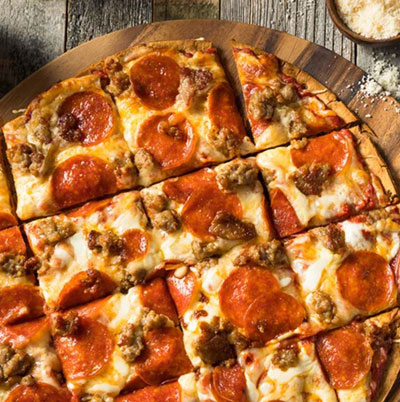
St. Louis-style pizza
St. Louis-style pizza is a thin crust variant that is popular in and around St. Louis, Missouri. St. Louis received an influx of Italian immigrants in the 19th century who were looking for employment opportunities. The Italian community, largely from Milan and Sicily, created the St. Louis pizza. Its sweet sauce is reminiscent of the Sicilian influence.The most notable characteristic of St. Louis-style pizza is the distinctively St. Louisan Provel cheese used instead of (or rarely in addition to) the mozzarella common to Chicago-style thin crust.
St. Louis pizza features a thin crust with a cracker-like consistency that is made without yeast. The toppings usually consist of fresh, never frozen, ingredients sliced instead of diced. It is common for the pizza to be topped with large pieces of onion, round slices of bell pepper, and full strips of bacon. If ordered with sausage or hamburger, the meat is squeezed off by hand into marble-sized chunks. This pizza features Provel processed cheese, which is a gooey combination of cheddar, Swiss, and provolone cheeses.
The crust is thin enough that it becomes very crunchy in the oven and is sometimes compared to a cracker. Even though the crust is round, due to the crispy crust, St. Louis pizza is usually cut into 3- or 4-inch rectangles, known as "party" or "tavern" cut.
St. Louis pizza features Provel cheese and a sweeter tomato sauce with a hefty dosage of oregano. Because of its firm crust, St. Louis pizza can support several toppings of your choice.
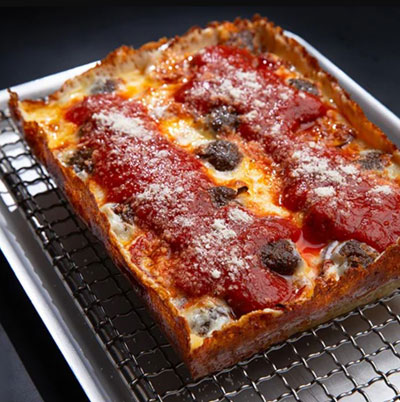
Detroit Style Pizza
Reflecting the city’s deep ties to the auto industry, Detroit pizza was originally baked in a square automotive parts pan in the 1940s. Detroit pizza is first topped with pepperoni, followed by brick cheese (a semi-hard cheese named after the bricks used to press the curds) which is spread to the very edges of the pan, yielding a caramelized cheese perimeter. The sauce is then spooned over the pizza, an order similar to Chicago pizza (“upside-down”). The sauce is traditionally spooned in stripes. This pizza features a thick, extra-crispy crust that is tender and airy on the inside.
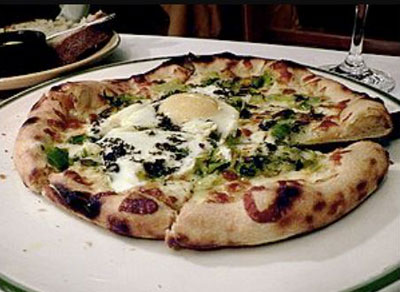
Pizza topped with an egg from the Chez Panisse cafe
California-style pizza
The California-style pizza, or gourmet pizza, was first invented by Alice Waters’ Chez Panisse restaurant in Berkeley, California, and popularized by the California Pizza Kitchen chain, along with Wolfgang Puck's various fine dining and casual restaurant chains and retail products.
By 1980, Alice Waters' Chez Panisse and its head chef, Jeremiah Tower, had already invented California cuisine, a combination of French and Italian techniques and presentation with fresh local ingredient-focused flavors. Waters was a long-time fan of Tommaso's Italian restaurant in San Francisco's North Beach, which had installed the West Coast's first wood-fired pizza oven when it opened in 1935. After traveling to Italy, Waters decided to make an open kitchen featuring a Tommaso's-style pizza oven the focus of the new cafe she was opening above her main dining room. Although prepared classically, her chefs added exotic fine ingredients to their single-serving pizzas and calzones, such as goat cheese and duck sausage. Her cafe, and its pizzas, in particular, were an instant success, attracting wide attention among food critics.
California-style pizza was invented more or less simultaneously in 1980 by Ed LaDou (the "Prince of Pizza"), then working as a pizza chef for Spectrum Foods' Prego Restaurant in San Francisco's Cow Hollow neighborhood, and by pizza chefs working for Alice Waters at the Chez Panisse Cafe in Berkeley, California. LaDou had learned pizza-making in the 1970s as a teenager at Frankie, Johnnie & Luigi Too, a traditional New York–style pizzeria in Mountain View, California. He made pizzas briefly at Ecco, an upscale restaurant at the Hyatt Hotel in Palo Alto, California, before starting at Prego.
Although Prego specialized in classic, Italian-style thin-crust pizzas, its chefs encouraged LaDou to experiment with prosciutto, goat cheese, and truffles in their wood-burning oven, and send his results to guests. At one table, the guest to whom he served an off-menu invention involving mustard, ricotta, pâté, and red pepper turned out to be chef Wolfgang Puck.
Wolfgang Puck, in 1980 and 1981, was preparing to open the restaurant that would make him famous, Spago, in West Hollywood, California. Initially conceived as a pizzeria, Spago's was modeled after the upstairs cafe at Chez Panisse. He was so impressed with the pizza LaDou had made for him at Prego, he hired LaDou as head pizza chef. Under Puck's guidance, LaDou developed more than 250 pizza concepts using ingredients such as scallops, roe, and baby zucchini flowers. Among their most famous invention was "Jewish pizza", a pizza dough first cooked then topped with smoked salmon, crème fraîche, capers, and dill. Another innovation was using infused olive oil, baby vegetables, chili oil, and flavored dough.
In 1985, LaDou helped two inexperienced lawyer-restaurateurs, Richard L. Rosenfeld and Larry S. Flax, start a new restaurant concept, California Pizza Kitchen (also known as "CPK"). He brought them many of Spago's recipes, which he had carefully saved. The new restaurant borrowed the concept of open kitchens centered around wood-burning pizza ovens from Spago, but instead of exotic gourmet ingredients, it used innovative but simpler comfort food toppings. When the new restaurant's chef quit less than a month before opening, LaDou quickly designed and cooked an entire menu, inventing barbecue chicken pizza on the spot.
Both Wolfgang Puck and California Pizza Kitchen were instrumental in turning California-style pizza from a gourmet food trend to a mass consumer food product. Based on the success of his pizzas and his status as a celebrity chef, Puck opened a series of restaurants, ranging from high-end clones of Spago to convenience chains for airports and mall food courts. California Pizza Kitchen grew to 200 outlets.
"Hawaiian" pizza
Hawaiian pizza has "Canadian bacon" (or sliced ham) and pineapple toppings with Mozzarella cheese. This type of pizza is especially popular in the western United States, and is also a popular topping combination in Australia, Canada, and Sweden, but notably not in Hawaii. This type is also common within the EU, where it is known as pizza Hawaii.
Grilled pizza
Grilled pizza, invented in Providence, Rhode Island, uses a fairly thin crust cooked on a grill; the toppings are placed on the baked side after the pizza has cooked for a bit and been flipped over. See Grilled Pizza.
