Italian Regional Cuisines
from Kyle Phillips of italianfood.about.com
Also see http://www.rusticocooking.com/regions.htm
Italian cuisine is regional. Extremely; though you may think about, say, Tuscan, or Friulano, or Piemontese cooking, the variations are actually much more local. A couple of examples:
- To celebrate Christmas, the residents of the Tuscan city of Siena enjoy Panforte, a nutty fruitcake sweetened with honey that dates back to the Middle Ages, and Ricciarelli, chewy orange-laced amaretti. Come the season, every bar and pastry shop makes them and proudly puts them on display. In Florence, which is just a half hour's drive from Siena, you wouldn't have found either, at least not freshly made, until quite recently, and Florentines who buy Panforte (much is bought by tourists) say it's a Sienese thing.
- Friuli Venzia Giulia has many ties with central Europe, and as a result the cuisine includes ingredients one simply doesn't find in much of the rest of Italy. Sauerkraut, for example, which the inhabitants of the highlands above Trieste combine with beans to make Jota (pronounced Yota), an unusual but tasty bean soup that's one of the area's signature dishes. Jota is made with sauerkraut as far inland as Gorizia, about 40 miles, where they also add barley, but if you continue on to Cormons, another 9 miles, you'll find it made with brovada, pickled turnips, rather than sauerkraut. And if you continue on to Udine, another 15 miles, people consider it to be foreign and don't make it.
The reason for this culinary fragmentation is simple: With the exception of the nobility and the clergy, before WWII most Italians simply didn't travel, and as a result every town and every valley has something unique. Neighboring towns and valleys will also share techniques, or recipes, albeit with individualistic twists, but from one end of a region to the other the picture can change completely. Therefore, when speaking of regional cuisines, it's a good idea to keep in mind that we are really dealing with a series of local cuisines, each of which is related to those around it.
Having said this, one can make some broad distinctions from North to South.
The Use of Fats
Though now extravirgin olive oil is popular throughout Italy, this has not always been true. With the exception of a few areas near lakes that exert a moderating influence, Northern Italy is too cold for olive trees to grow, and as a result much of the population used butter for cooking. In much of Central and Southern Italy, and the Islands, on the other hand, people cooked with olive oil. Much but not all; rendered lard was used in Campania, Basilicata, the Abruzzo, and Calabria until recently.
The Kinds of Pasta Used
In the days before industrialization, dry pasta made from durum wheat, water, and a pinch of salt (spaghetti, rigatoni, and so on), was easier to make, and therefore more popular, in the South, where warmer temperatures and increased sunlight hastened the drying of the pasta. And indeed, though there are now dry pasta factories everywhere, modern Italians generally feel that southerners still make the best dry pasta.
Central and parts of Northern Italy (especially Emilia Romagna and Piemonte) are instead known for fresh pasta made with eggs, flour, and salt, for example tagliatelle, tajarin, or pappardelle, all of which are flat forms. The center and north are also known for stuffed pasta, for example ravioli or tortellini, and one can find these kinds of pasta in areas where they didn't eat much flat or dry pasta until recently, for example Lombardia. What did they eat in the sections of the north where pasta wasn't as popular in the past?
Polenta, or corn meal mush, which was a staple food of the poor, and risotto; most of the world's best short-grained strains of rice, including Arborio, Carnaroli, and Vialone Nano are North Italian.
Popular Vegetables
The South is much warmer and has a much longer growing season than the North. As a result vegetables that thrive under hotter conditions, especially tomatoes, are more popular in the South, which thus also has many more dishes with red sauces than the North. Among the other more Southern vegetables are eggplant and broccoli raab. In the North, on the other hand, one finds plants better adapted to cooler temperatures and less sunlight, for example head cabbages, black leaf kale, cardoons, and radicchio.
Foreign Influences
Given its position in the middle of the Mediterranean, Italy is a crossroads, and many foreign powers have left their mark. As you might expect, you'll find quite a bit of French influence (regional French, not haute cuisine) in the areas of Liguria, Piemonte, and the Valle D'Aosta bordering France, and Austro-Hungarian influences in the Veneto, Trentino Alto Adige, and Friuli Venezia Giulia. There is also Spanish influence, especially in Milano, which was under the Spaniards for a time; this Spanish influence surfaces again in the South, which was ruled by the Bourbons until the unification of Italy in mid 1850s, and in Sardinia, which was ruled directly by Spain for a time. You'll find English influence in Tuscany, where the classic bistecca alla Fiorentina and zuppa Inglese, English steak and English trifle, respectively, were initially prepared for the enjoyment of the sizeable English colony that settled Tuscany in the 1800s. And you'll find Jewish influences in Rome, dating to the 1500s, when Jews fleeing the Inquisition settled in the Eternal City. Finally, in Sicily you'll find a fascinating mixture of Roman influence, Arab influences dating both to the time that Sicily was an Arab province, and to more recent trade with North Africa (cuscus, for example), Norman French influence, and Spanish influence.
In short, Italian food is as varied as the land and the people, and this means that there are a great many delights to be discovered.
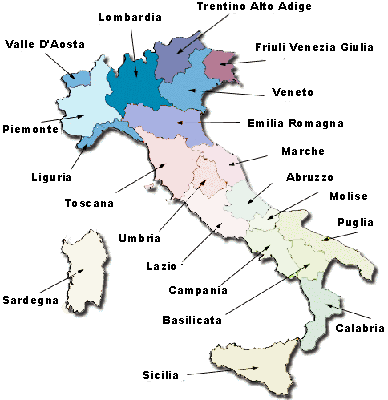 North Italian Cuisines: An Overview of the North
Northern Italy differs from the rest of the Peninsula in a number of ways. Most traditional North Italian recipes call for unsalted butter rather than olive oil, and though there are many kinds of stuffed pasta, except in Emilia Romagna and Liguria the flat and extruded forms that are so important further south are less important, giving way to polenta and risotto, and, in the winter, to rich, hearty soups.
The North, especially Piemonte and Emilia Romagna, has excellent cattle breeds suited to meat and milk production, and also excellent hogs; as a consequence beef, veal, and pork are the meats of choice, with lamb and other animals playing a lesser role. Cooking ranges from boiling and frying through slow braising and stewing, and in the latter cases northern cooks use much less tomato, preferring to use wine or broth as the liquid, and chopped herbs for flavor. The results can be extraordinarily elegant, and the same holds true for roasts, especially those that contain winter vegetable stuffings.
There is also an extraordinary variety of fish; Comacchio, south of the Po Delta, is renowned for its eels, while the Veneto's coastal lowlands provide mussels and clams, and the lakes and waterways inland a tremendous variety of fresh water fish, in addition to ducks and other wild birds.
La Cucina Valdostana
Because of its location the cooking of the Valle D'Aosta is more closely related to French and German than to Peninsular Italian. The traditional Pranzo Valdostano was a substantial one course-meal, followed by bread and cheese if cheese wasn't the primary ingredient of the main course. Dinner was a soup, followed by rye bread and cheese.
If the main meal didn't involve cheese it was meat-based, consisting either of sausages and cured meats (which are now antipasti), roasts, or boiled meats. On holidays, boiled and roasted meats were followed by soup. Family meals were simpler, with dishes made with lesser cuts of meat, for example, carbonade, beef or pork diced and stewed in wine with onions.
Traditional side dishes consist for the most part of salads made from wild greens collected in the fields, and dressed with walnut oil, as it's too cold for olives to grow in the Valley. Potatoes also figure prominently, and in the past often took the place of bread. Polenta is also important.
And finally, there is cheese. Much of Val D'Aosta is either too steep or at too high of an altitude to make planting crops feasible. But those highlands have wonderful pastures; herders take their animals up into the mountains after the snows melt, and spend the summers making formaggio d'alpeggio, cheeses from Alpine forage. Tough, backbreaking work, but the results are spectacular. True fontina is a treat you won't easily forget.
La Cucina Piemontese
Of the various Italian regional cuisines, Piemonte's is one of the most multifaceted.
On the one hand, the Region was ruled by the future Kings of Italy, who enjoyed extremely refined dishes at court. A meal at a good Piemontese restaurant today will begin with a long series of antipasti, which may include, among other things, chopped raw beef with shaved white truffles (in season), delicate, creamy cheese tarts, a vegetable flan, and a delicate salad. These may be followed by agnolotti, stuffed pasta seasoned with the drippings from a roast, or risotto (Aborio rice is Piemontese), or tajarin, egg noodles seasoned with meat sauce or butter and shaved truffles, followed in turn by a rich main course along the lines of brasato al Barolo, beef braised in Barolo wine. Desserts are equally elegant, for example panna cotta or hazelnut cake, and to finish up, with your coffee you may have Gianduiotti, creamy candies made from chocolate hazelnut paste that are a specialty of Torino's chocolatiers.
On the other, there is a rich peasant tradition with much earthier dishes, including the extraordinarily garlicky bagna caoda, ravioli in Barbera wine (in the Province of Alessandria), and bollito misto, a selection of boiled meats and vegetables that Piemonte's Crown Princes were known to sneak out of court to enjoy.
And to tie it all together, Piemonte boasts some of the world's finest wines, including Gavi, Dolcetto, Barbera, Barbaresco, Barolo. Paradise on Earth.
La Cucina Dell'Emilia Romagna
If Campania is the source of many of the dishes we consider to be Italian, pizza for example, Emilia Romagna is the source of many of the ingredients, including Parmigiano, Prosciutto, Bologna (known as Mortadella di Bologna in Italy), Lambrusco, Aceto Balsamico, and even flat pasta. Indeed, though southerners are known for their dried pasta, Italians consider Emiliani to be the masters at making fresh pasta, the sheets of which they either cut into strips to make tagliatelle, leave whole to make lasagna (both seasoned with sugo alla Bolognese in winter), or use to make some of the most classic stuffed pastas, including tortellini and cappelletti.
Nor does the bounty stop here; in addition to Prosciutto the region's hogs provide the meat for a prized salami from the town of Felino, zampone and cotechino, winter sausages from Modena, and culatello, a rump muscle cured in the mists along the banks of the Po river. And the cattle are second to none; veal Parmesan is just the beginning.
As you move east from Emilia into Romagna, the landscape flattens and the wetlands increase; Ferrara is famed for feathered game and fresh water fish, and rice cookery as well, while the towns along the Adriatic coast are known for both their seafood and their nightlife.
Romagna is also home to piadine, flat peasant breads street vendors will fill with all sorts of savory combinations; if you visit by all means try one.
La Cucina Lombarda
Lombardy is less cohesive culinarily than some other Italian regions, though there are some common denominators -- it's a land of butter and lard, as opposed to olive oil, and many of the traditional recipes call for slow braising or stewing. Also, though Lombardi do now consume pasta, the traditional starches were rice and polenta, and soups, both thick and thin played a major role. In other words, one could almost say it was a cuisine better suited to spoon than fork. This said, in Lombardia you'll find both Alpine -- game, braised meats, alpine cheeses -- and flatland -- risotti, Grana Padano and other lowland cheeses, wetland game, lake fish, beef, and pork -- cooking.
And a number of superb specialties; ossibuchi and Risotto alla Milanese immediately come to mind, but there's also mostarda di cremona, risotto alla pitocca, made with chicken (they make it in Emilia too)---, polenta e fasoi, polenta with beans, tortelli di zucca, Mantova's spectacular squash-filled pasta, and Panettone, one of the Italian signature Christmas cakes. In short, the cooking is as varied as the region, and there's a great deal to discover.
La Cucina Veneta
The Veneto is dominated by Venice, whose position as a great merchant city has had a tremendous influence on the region's cuisine; trade with the Arabs led to the introduction of rice, which rapidly became a dominant element in the regional diet. The same commerce also brought baccalà from the north, and it too plays an extremely important role, as do beans and polenta.
The supporting elements for the major players in the regional diet vary within the Veneto; the lagoon is famed for the variety and quality of its fish, and if you like visiting markets do see Venice's Rialto market. Fish is also important inland -- fresh water fish, and also baccalà, which travels well.
Inland, in addition to fish, you'll find meats, including beef, pork, and, in some areas, horse. And if you continue further inland, up into the Alps, you'll find spectacular game. Don't be surprised if it's offered as a goulash, because following Venice's decline the region became an Austro-Hungarian Province, and there are many Mitteleuropean elements in the inland cuisine.
Finally, wine and cheese: The inner highlands give us Asiago, one of Italy's finest sharp cheeses, and also Monte Veronese. And the wines: Bardolino is perfect for quaffing, the Valpolicella's wines are among the finest in the world, there's Soave, a vastly underrated white, and Prosecco's merry sparkle.
La Cucina del Trentino Alto Adige
Trentino Alto Adige sits astride the cultural border between Italy and Germany; the southern half of the region (Trentino) is Italian, whereas the northern half (Alto Adige, or Südtirol) is German, and was annexed by Italy at the end of WWI. There has been remarkably little integration, and the cuisines of the two areas are quite distinct.
Trentino draws heavily from the Veneto and Lombardia, with polenta, both plain cornmeal and made with corn meal and a variety of other grains, including buckwheat, playing the role of both bread and pasta. Fish is also extremely important -- there are hundreds of other lakes in addition to Lake Garda, as is furred game from the high Alpine valleys. Much of the land is better suited for meadows than crops, and there are many alpine cheeses. Trentino is also known for apples, as is the Alto Adige, and both provinces are known for speck, smoked prosciutto.
If you visit the Alto Adige you may be served pasta as a side dish, so stick to local foods -- knödel, bread balls often flavored with speck or mushrooms (they're called canederli in Trentino), sauerkraut, wurst, and again excellent stewed game. You'll also find superb German pastries and cakes in the Alto Adige.
Wines? Trentino's Teroldego, a red, is superb, as is the Alto Adige's Lagrein. And then there's Moscato Rosa, or Rosenmuscateller, a sweet rose-laced gift from the Gods.
La Cucina Ligure
Liguria boasts some of the most rugged topography in Italy, a steady succession of high mountains plunging to the sea, and as a result the population lived (and lives) mostly in the valley mouths, drawing what little substance they could from the flatter parts of the valley floors, and putting their boats to sea, both to fish and to communicate. Indeed, until the railway was built a little more than a century ago it was much easier for people to go by boat than to travel overland, and even now what would be a quick drive on the highway can take hours on the old roads.
Given the scarcity of arable land, it's natural that the Ligurian diet be primarily vegetarian and fish-based; Ligurians do enjoy pasta, but often add potatoes or string beans to the water, and tend to use simple sauces, of which Pesto is perhaps the best known. Ravioli are also a Ligurian creation; most of the traditional recipes are vegetarian, with greens (especially borragine, an herb gathered on mountain slopes) and ricotta, though they can also be meat-filled. And during the spring there are many green-based pies, e.g. torta Pasqualina.
Ligurians enjoy fish in all manner of ways, from hearty fish stews such as buridda and ciupin, through more elegant dishes. Meats, on the other hand, play a lesser role; cima alla genovese, stuffed breast of veal, was for festive occasions, as was tocco di carne, stewed beef.
La Cucina del Friuli Venezia Giulia
Friuli Venezia Giulia is located in the far northeast, and in many ways is distinct from the rest of Italy. For many years the region was a province of the Austro-Hungarian Empire, and as a result the local cuisine reveals a great many Mitteleuropean influences, for example the use of sauerkraut, the preparation of savory and sweet strudels (and a local boiled variation called strucolo), potatoes and turnips, and a custom of lightly smoking cold cuts, especially prosciutto, that one doesn't easily encounter in other parts of Italy. Another significant characteristic of the cooking of the region is a relative lack of tomatoes; though you may encounter them, they are certainly not as important as they are further south.
So what else will you find? Quite a bit of barley; Friuli Venezia Giulia is kown for orzotti, which are similar to a risotto but made with barley, and offer a delightful change of pace. An abundance of game, especially in the inland regions. Good Beef, too. And superb wines; Friuli Venezia Giulia produces many of the best Italian white wines, is no slouch with reds, and also boasts Picolit, an extraordinary sweet wine developed in the 1700s, when a war kept Tokay from reaching Europe's courts.
And to finish up? In addition to strudel, Friulia Venezia Giulia boasts many other cakes, including Gubana, a spicy sweetbread with a healthy shot of grappa. For that matter, a grappa -- Friuli makes some of the best.
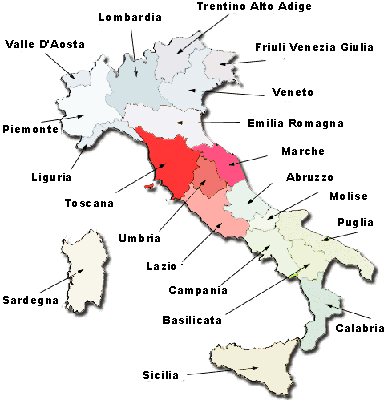 Central Italian Cooking: An Overview of Central Italian Cooking
In Central Italy the summers are hotter and longer than those of the North, and consequently tomato-based dishes are more common than they are further north; at the same time the winters are chill inland, making it possible to grow leafy vegetables that reach their best after it frosts, for example black leaf kale. Though there are braised meats and stews, in much of central Italy the centerpiece of a classic holiday meal will be a platter of mixed grilled or roasted meats, with poultry, pork, and beef, especially in Tuscany, where the renowned Chianina cattle graze the fields. In Lazio, on the other hand, the platter will likely also have lamb, which may also be present in Umbria and the Marche.
Central Italy also has a rich specialty farming tradition, with many crops that are difficult to find elsewhere, including farro, an ancient grain domesticated by the Romans, and saffron, whose distinctive sharpness adds considerably to many dishes. The area, which is almost entirely hilly or mountainous, also boasts massive chestnut stands on the steeper slopes; chestnuts were in the past one of the staple foods of the poor and even now roasted chestnuts are a wonderful treat in winter, as are the dishes made with fresh chestnut flour.
La Cucina Toscana
At first glance Tuscan food appears simple: Not much in the way of spices other than pepper, few sauces or seasonings other than olive oil, and only a minimum of herbs. Even the bread is unsalted.
In truth it's not simple at all, but rather elemental: Tuscans seek out the best meats, vegetables, fish, and fruit, and once they have the best don't want to add anything that might distract. Chianina beef is superb, for example, so season it with just a little salt when grilling up a Fiorentina (porterhouse steak).
A festive Tuscan meal begins with crostini, slices of toasted bread spread with a dip, followed by either pasta or soup; menus tend to be seasonal with more substantial fare in winter, for example pasta e fagioli (bean soup), ribollita, pasta with game sauce or meat sauce, or lasagna in winter, and lighter fare in summer, for example panzanella (bread salad) or pappa al pomodoro, or pasta with tomato sauce.
The main course follows the same dichotomy, with heartier roasts and stews in the winter months, and more quickly cooked grilled or even fried entrees (meat or fish) in summer. Salads are standard year round, seasoned with olive oil vinegar, and salt -- no pepper -- and beans are also extremely popular. Fresh when available, but dried when there is no choice.
Desserts, with a few exceptions, are quite simple, and for those who want more, Tuscan pecorino, a mild to sharp sheep's milk cheese, is superb. Enjoy it with a pear, or with a glass of good wine.
La Cucina Marchigiana
The traditional diet in The Marches was almost exclusively vegetarian for the vast majority of the population living inland, and though fish did play a part in the coastal cities, the pickings were still primarily vegetarian: Polenta made from corn, seasoned with oil, cheese, lard, onions, ricotta, tomatoes, greens, legumes, etc.; bread made from a mixture of cornmeal and flour, wine only in the periods of greatest exertion, and salt pork only occasionally. Cuts of veal, lamb or chicken only appeared at holiday meals and wedding banquets, with the portions being so lavish that every guest could take something home. Though there is more prosperity now, the traditions shine through.
There's still lots of polenta, wild herbs, especially wild fennel in the mountains, mushrooms, including truffles (which the farmers used to sell for cash), snails, which were especially popular on meatless days inland where the only fish available was baccalà, and greens. Greens everywhere. Meats do appear more frequently now than they used to, but certainly don't predominate. And fish does of course does play an important role in the diet in the coastal areas, though many of the recipes include ingredients that reveal close ties to the land, for example wild fennel fronds.
La Cucina Laziale (Rome)
The cooking of Lazio is in essence the cooking of Rome; the Eternal City dominates the region now and did so to an even greater degree in the past. As a result the city became the depository of all of Lazio's local culinary traditions, including some one might not expect, for example that of the Roman Jewish population, part of which arrived before Paul.
This said, if one were to select a single word to describe the cooking of Lazio, it would likely be simple (as opposed to elaborate). The region boasts some of the finest farmland in all of Italy, and the produce is superb, in particular the artichokes, olives, chicory, and salad greens, and the cooks have wisely realized that the less they do to these ingredients in the kitchen the better. Pasta sauces also tend to be simple, aio e oio (garlic and olive oil), for example, or all'amatriciana, a spicy tomato sauce with pancetta or guanciale, or alla carbonara, with pancetta and eggs. And this simplicity carries through into the meats dishes, which are, with a few exceptions -- coda alla vaccinara comes to mind -- primarily veal and lamb based: Quickly cooked veal cutlets, either with wine sauce or prosciutto (what's called saltimbocca), and roasted or grilled abbacchio, i.e. suckling lamb.
The wine to enjoy with all this? Though Lazio's producers are now making reds as well, tradition dictates one quaff the light zesty whites from the Alban Hills, and a fine pairing it is.
La Cucina Umbra
Umbria, the only landlocked region in Peninsular Italy, is known as Il Cuore Verde D'Italia, the Green Heart of Italy, because of its ample valleys, green hills, and relative lack of industrialization. The cooking is one of the most local of all Italian cuisines, in the sense that the Umbrians have stayed true to tradition, feeling little need for ingredients or procedures introduced from elsewhere.
The region is known for its pork products, especially salami and prosciutto, which is Salato, in other words more heavily salted than the prosciutto of Parma. Other meats include beef, and a wide variety of poultry, including chickens and guinea hens. Lamb is less common, though the lambs of Colfiorito are renowned.
In terms of cooking technique Umbria is known for grilling, which is done simply, with few herbs or spices to alter the flavors of the meats. In addition to meats, the Umbrian diet is rich in vegetables -- family vegetable plots produce a greater volume of produce than commercial farmers, who export much of their produce to neighboring regions. Again, cooking and seasoning is simple; Umbria has excellent olive oil and many people use it and a little salt.
Forests also play an important role in the diet; Umbria is renowned for the variety and quality of its mushrooms, which include both porcini and truffles, and the chestnut crop is also superb.
Wines? Look for Orvieto, a white, and Torgiano and Sagrantino, both reds.
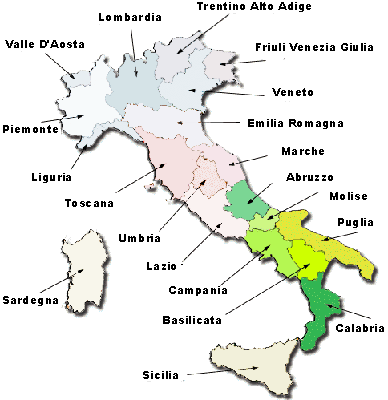 South Italian Cooking: An Overview of the South
With respect to Northern and Central Italy there is greater use of dried pasta (as opposed to egg pasta), though people also enjoy vegetable based soups, and entrees, many of which also include fish. In terms of meat, though there are cattle, historically the South is known for shepherding, and lamb and kid play a much more important role in the diet than they do in much of the north. Fish also contribute strongly, and indeed in many coastal areas dominate.
The growing season is much longer, and hotter in the South; among the most popular summer vegetables are tomatoes (many of which go into red sauces) and eggplant, whereas in the winter months broccoli raab and cauliflower come to the fore.
Southern cheeses are also worth mentioning; they tend to be firm, for example caciocavallo and provolone, though there is a wonderful exception: Mozzarella.
Finally, Southern desserts tend to be much more opulent than those made further north.
La Cucina Campana
Campania boasts one of Italy's most elegant and refined cuisines. It's also one of the best-known worldwide, thanks to the tremendous number of Neapolitans who emigrated in the last century. Pizza, arguably the most popular food on the planet, is Neapolitan (see Pizza Margherita), as are many kinds of durum wheat pasta including spaghetti, and the red sauces (marinara, puttanesca, genovese, and so on) so many people put over them. Campania has also given us lasagna with ricotta, eggplant Parmesan, wedding soup, zesty carne alla pizzaiola, Christmas's struffoli, the Easter pastiera, and has contributed greatly to the popularity of the Seven Fish dinner on Christmas Eve.
In terms of produce the region is singularly blessed, with the slopes of Mount Vesuvius producing the San Marzano plum tomatoes that give the red sauces their richness, and there's much more too, from cauliflower through broccoli raab and greens to eggplant, peppers, and zucchini. In terms of meats, though there is some beef, the lamb and pork are better, and inland you'll also find water buffalo -- the animals are raised primarily for their milk, which gives Mozzarella a tangy richness cow's milk mozzarella simply lacks. Not into cheese or meat? The fish you'll find along the coast is superb, as are the walnuts from Sorrento, and when you want to relax, what could be better than a glass of well-chilled limoncello?
La Cucina Abruzzese
The Regione Abruzzo has a reputation of being something of a wildland: Inland it is mostly rugged mountains and valleys, and until not too long ago the primary economic activity was shepherding, which was even more important in the past.
Following the unification of Italy in the 1860s the new government passed laws hindering the migration of the flocks, and as a result the Abruzzo region became more isolated, an isolation that has only ended with the increase in tourism since the War -- summer mountaineering and winter skiing inland, and swimming, sunning and boating along the Adriatic coast.
People also come to enjoy the foods -- lamb and mutton, pecorino and goat's milk cheese, olive oil, wines, saffron (which has always been grown for use in medicines and dyes, but is now being used in the kitchens too), hot peppers, and more.
The cuisine? Like most peasant cuisines it's simple, but quite wholesome, especially in more modern interpretations that allow the use of some meat or oil (back in the peasant days there would have been little of either, nor much cheese for those who weren't well off). After lamb and mutton, pork was the meat of choice inland, with many people raising animals in a semi-wild state, allowing them to forage what they could find in the forests and butchering them in the fall. Along the coast, as one might expect, fish also plays a major part in the diet.
La Cucina della Basilicata
Historically one of Italy's poorest regions, Basilicata is also one of its least populated: high, craggy mountains and intractable soil have made agriculture a difficult proposition, and many Lucani (as the people of Basilicata are called) emigrated for luckier lands in the 1900s. Today, the economic situation is much improved, but the cuisine of Basilicata remains a rural one, deeply anchored in peasant traditions. Matera, known as "The City of Stone," is one of only two cities in the region with over 50,000 inhabitants.
One might expect the traditional cuisine of Basilicata to include a fair amount of seafood, given the region's long stretch of coast along the instep of the Peninsular boot. Not so; the inhabitants of Basilicata are called Lucani, which derives from Lucanus, or forest: Because of its inviting coastline Basilicata was visited often by raiders and colonists, and the local population as a result moved inland to the rugged highlands.
As a general rule, the cuisine is fairly simple, with fresh meats and seasonal vegetables, as well as sausages and such, in particular the Luganega, a long smooth-sided (no links) sausage that was well known and highly admired by the Ancient Romans and continues to delight today.
Olive oil is the fat of choice, while the predominant spice is hot pepper, locally known as diavulicchiu (little devil), frangisello (saddle breaker), or cerasella. Dishes made with hot pepper are often referred to as farmers' or shepherds' meals because hot pepper was so important in the rural diet.
Wines? Aglianico del Vulture, a powerful red that can also display great finesse, is drawing considerable, well deserved attention from the wine press. Do try a bottle with a thick, hearty steak.
La Cucina Calabrese
Calabrian cooking strikes a beautiful balance between meat-based dishes, featuring pork, ovines (lambs, kid, and so on) vegetables, especially eggplant, and fish, all flavored with richly fragrant mountain herbs. With respect to the inhabitants of some other Italian regions, Calabrians have traditionally placed a greater emphasis on preserving their foods, in part because the heat and dryness of the mountains inland make crop failure a distinct possibility -- people plan ahead, packing vegetables and meats in oil, preparing cold cuts, and, along the coast, curing fish as well, especially swordfish.
One of the dishes that sums up the Calabrian philosophy of food is caviale dei poveri, poor people's caviar, made by packing herring roe in oil, and flavoring it with hot peppers. A rich, frugal peasant tradition that combines simple ingredients to make lively, tasty foods.
La Cucina Molisana
Molise, Italy's second-smallest Region, is almost entirely mountainous, except for a thin strip of coast. This situation is reflected by the cuisine, which, inland, is derived from farming traditions, and largely based on seasonal crops, while pork is the meat of choice. The region's sausages, seasoned with local herbs and aromas, are eagerly sought out by connoisseurs, as are soppressata and ventricina, cold cuts made from the finest parts of the pig.
Along the coast, as one might expect, fish predominate, in association with soups and risotti.
La Cucina Pugliese
If you visit Puglia and drive north from Bari towards the Gargano Peninsula, you will pass dozens of miles of olive groves. It's little wonder that olive oil should play a major role in the region's cooking, as do cereals and grains gown on the flat stony plateau that extends south from Bari, reaching all the way to Taranto. Some of the grain becomes pasta -- Puglia is especially known for orecchiette, pasta whose shape brings the human ear to mind -- and some becomes bread; the bread of the town of Altamura is renowned, and throughout the region you'll find friselle, disks of dried bread to be dipped in water and seasoned, with olive oil, hot peppers, and freshly cut tomatoes.
What else is there to enjoy? Fine cheeses and excellent lamb and kid -- Puglia was once one of the major shepherding regions of Italy -- and superb fish: the region boasts hundreds of miles of coastline, the water is crystal clear, and the catch is both plentiful and varied. Among the preferred vegetables are fava beans, lampasioni (a type of bulb), and eggplant. And to finish up, Puglia boasts some spectacular almond cakes, and has excellent fruit; especially figs.
A final word about wine: Though Puglia was known for supplying powerful blending wines to winemakers elsewhere, the region's producers have begun to attract considerable attention with the wines they bottle themselves. In particular, look for Primitivo and Nero di Troia.
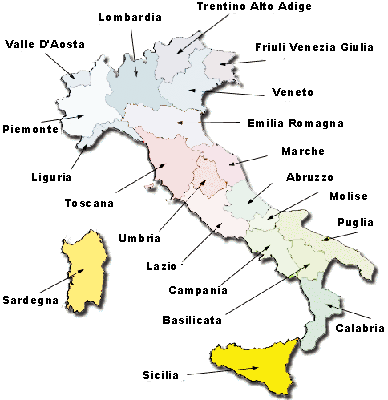 Italian Island Cooking: An Overview
Italy's major islands, Sardinia and Sicily, have had very different histories; indeed, the only thing they share is their being distinct from the continent. Sicily's position in the center of the Mediterranean has made it a stopping place for every people that sailed the Sea, beginning with the Greeks and Carthaginians, and continuing on through Romans, Byzantines, Arabs, Normans, and Spanish, all of whom left their mark one way or another.
Sardinia followed a similar initial path, being settled by the Phoenicians, followed by Carthaginians, Romans, and Byzantines, but was never under the Arabs, rather spending a time under Pisa and Genova, two of the great Maritime Republics, before falling under the sway of the Spaniards, who ruled the island for close to 500 years before loosing it to the Austrians in 1714; they in turn gave it to Duke Amadeo di Savoia, who took power and declared himself King, thus becoming Royalty (his descendents became the Kings of Italy).
La Cucina Siciliana
Sicilian Cuisine is one of Italy's most sophisticated and certainly the most eclectic; almost every people to sail the Mediterranean -- the Greeks, Romans, Carthaginians, Arabs, Normans, Spaniards, and even the English -- has visited, bringing new ingredients and ideas that the long-term residents adapted and reworked.
A few specifics: Around Syracuse and Ragusa cooks still draw from Greek traditions, making abundant use of vegetables -- their eggplant parmesan is renowned -- while meats, mostly pork and mutton, were traditionally reserved for feast days.
Palermo's cooking is more sophisticated, revealing French influences that emerge in dishes such as caponata, falsomagro, a rich meats stew, and involtini alla palermitana.
In Trapani fish of all kinds predominate. The area, which faces North Africa, has maintained closer ties with the Arabs than other parts of the island, and is especially known for fish-laced cuscus.
Messina is instead more Continental, with an abundance of fish, many recipes that reveal French influences, and others that hearken back to the peasantry, for example Spaghetti alla Norma (spaghetti with a rich, tomatoey eggplant sauce).
Finally, there are the sweets: Pasta Reale, Cassata, Cannoli... Truly a blessed land.
La Cucina Sarda
Considering that Sardegna is a major island, one might expect fish to play an important part in the region's cuisine. And it does, to a degree - Sardegna's tuna and bottarga, or tuna roe are prized - but fish is not paramount, and this is because Sardinians historically considered the sea to be a source of invaders; they thus turned inland, devoting their energy to agriculture and shepherding.
Consequently traditional Sardinian cuisine features quite a bit of lamb, especially roasted, and pork, in particular porceddu, roast sucking pig, and a tremendous variety of sheep and goat's milk cheese, including Pecorino Sardo, one of the world's great cheeses. But there's more; Sardegna is known for Pane Carasau, a crisp flatbread the shepherds could take with them, and enjoy with cheese, malloreddus, little gnocchi flavored with saffron, maccherones and pillus, respectively twisted macaroni and lasagna, and fregula, pasta blebs used in soups and in a manner akin to cuscus. Traditional pastries also reveal shepherding roots, with cheese and honey.
This isn't to say Sardinians completely turned their backs on the invaders; they sold sea bass bottarga to the Phoenicians, there's a Sardinian variation on buridda, a Ligurian fish stew, and they adopted both the Spanish scapece sweet and sour sauce for fish, which they call scabecciau, and mazzamorru, a bread soup eaten by the sailors of the fleet.
But their cuisine does reflect their independence.
