Japanese Cuisine
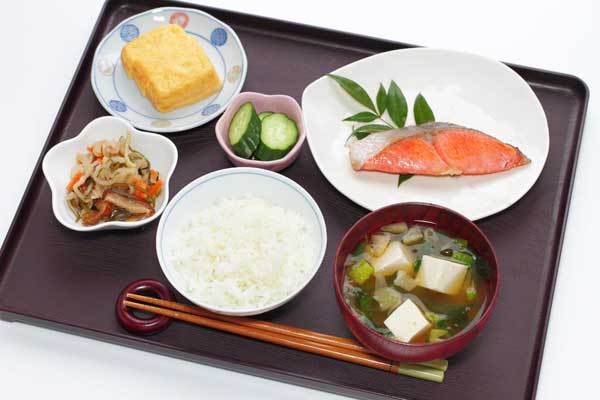
Washoku Setting: The typical Japanese meal consists of a bowl of rice (gohan),
a bowl of miso soup (miso shiru), pickled vegetables (tsukemono) and fish or meat.
The traditional cuisine of Japan, Washoku, is based on rice with miso soup and other dishes; there is an emphasis on seasonal ingredients. Side dishes often consist of fish, pickled vegetables, and vegetables cooked in broth. Seafood is common, often grilled, but also served raw as sashimi or in sushi. Seafood and vegetables are also deep-fried in a light batter, as tempura. Apart from rice, staples include noodles, such as soba, udon, and ramen which are cheap and very popular for light meals. Japan also has many simmered dishes such as fish products in broth called oden, or beef in sukiyaki (a hot pot dish) and nikujaga (a meat and potato stew). A characteristic of traditional Japanese food is the sparing use of red meat, oils and fats, and dairy products. Instead, fish, soybean, tofu, and soy products are used.
Historically influenced by Chinese cuisine, Japanese cuisine has opened up to influence from Western cuisines in the modern era. Dishes inspired by foreign food—in particular Chinese food—like ramen and gyōza, as well as foods like spaghetti, curry, and hamburgers have become adopted with variants for Japanese tastes and ingredients. Traditionally, the Japanese shunned meat due to Buddhism, but with the modernization of Japan in the 1880s, meat-based dishes such as tonkatsu (deep-fried pork cutlet) and yakiniku (grilled) have become common. Japanese cuisine, particularly sushi, has become popular throughout the world.
Flavor Profile
In Japanese cooking, there are five major flavor profiles: salty, hot(spicy), sweet, sour and bitter. Actually, there is the sixth flavor – the magical Umami, or the savory depth found naturally in Hanakatsuo (bonito flakes), Kombu (kelp) and Shiitake (Japanese forest mushrooms). Dashi is the all-important building base to all Japanese dishes, and it contains all the Umami elements from the amino acids extracted from the natural ingredients. The most common type of dashi is made from dried kelp, dried bonito flakes and water, but there is one made with dried shiitake mushrooms, among others.
Japanese Meal
No meal is complete in Japan without steamed rice, from breakfast through late night. The name for steamed rice, Gohan, literally means "meal." You must cook it properly and with the respect and attention it deserves. Polished, short-grain rice (hakumai) is the preferred variety for making steamed rice. Look for Calrose short-grain rice, sushi rice, or Japonica rice. The rice is meant to be a little sticky when cooked so it can be easier to eat with chopsticks.
Rice is served in its own small bowl (chawan), and each main course item is placed on its own small plate (sara) or bowl (hachi) for each individual portion. This is done even in Japanese homes. It contrasts with the Western-style dinners at home, where each individual takes helpings from the large serving dishes of food presented at the middle of the dining table. Japanese style traditionally abhors different flavored dishes touching each other on a single plate, so different dishes are given their own individual plates as mentioned, or are partitioned using leaves, etc. Placing main dishes on top of rice and "soiling" it is also frowned upon by old-fashioned etiquette. However, an exception is the popular donburi (a rice bowl with fish, meat and vegetables).
Traditional Japanese cuisine also focuses on balance, with preparation techniques that aim to draw out the natural flavors of ingredients rather than masking them in heavy sauces. Food preparation is refined to exacting textures and temperatures ideal for the ingredient at hand, as well as seasonal suitability. The structure of a washoku meal relies on the principle of “ichi ju san sai”, or the “one soup, three side dishes” meant to accompany a bowl of steamed rice. These dishes provide a variety of flavors and colors, as well as a well-balanced, nutritional meal.
Miso soup is one of the two basic soup types of Japanese cuisine – the other one is suimono (clear soup), which translates to “sipping things.” The base of traditional miso soup is a simple combination of dashi and miso. Dashi is a basic Japanese soup stock, made with dried bonito flakes, kelp and anchovy. Miso is a fermented paste created from a mixture of soybeans, sea salt and rice koji. Other ingredients, such as tofu, vegetables and seaweed, can be added, too. Suimono is based on a well-balanced, umami-packed dashi broth base and the ingredients in the soup should ideally reflect the season in which the soup is being served. For instance, a suimono in the spring might feature pink shrimp and bamboo shoots, snow peas as the aomi (green accent) and green leaf mitsuba (Japanese parsley) as the fragrant garnish.
Table Setting
The traditional Japanese table setting has varied considerably over the centuries, depending primarily on the type of table common during a given era. Before the 19th century, small individual box tables (hakozen, 箱膳) or flat floor trays were set before each diner. Larger low tables (chabudai, ちゃぶ台) that accommodated entire families were gaining popularity by the beginning of the 20th century, but these gave way to Western-style dining tables and chairs by the end of the 20th century.
Traditional Japanese table setting is to place a bowl of rice on your left and to place a bowl of miso soup on your right side at the table. Behind these, each okazu (rice side dish), which are typically made from fish, meat, vegetable, or tofu, is served on its own individual plate. Based on the standard three okazu formula, behind the rice and soup are three flat plates to hold the three okazu; one to far back left, one at far back right, and one in the center. Pickled vegetables are often served on the side but are not counted as part of the three okazu. Chopsticks are generally placed at the very front of the tray near the diner with pointed ends facing left and supported by a chopstick rest, or hashioki.
Japanese cuisine encompasses not only food, but also the servingware that they’re served in. The servingware should complement the arrangement, reflect the season or the occasion, and serve a function when needed. Japanese foods are served in individual servingware, miss-matched in design, and is appealing to the eye as the food it contains. The skill of a Japanese chef extends beyond cooking, to include the art of food arrangement.
Seasonality of Food
Emphasis is placed on seasonality of food or shun (旬), and dishes are designed to herald the arrival of the four seasons or calendar months. Seasonality means taking advantage of the "fruit of the mountains" (山の幸 yama no sachi, alt. "bounty of the mountains") (e.g. bamboo shoots in spring, chestnuts in the autumn) as well as the "fruit of the sea" (海の幸 umi no sachi, alt. "bounty of the sea") as they come into season. Thus the first catch of skipjack tunas (初鰹 hatsu-gatsuo) that arrives with the Kuroshio Current has traditionally been greatly prized.
Use of tree leaves and branches as decor is also characteristic of Japanese cuisine. Maple leaves are often floated on water to exude coolness or ryō (涼); sprigs of nandina are popularly used. The haran (Aspidistra) and sasa bamboo leaves were often cut into shapes and placed underneath or used as separators.
Seasonings & Garnish
Traditional Japanese food is typically seasoned with a combination of dashi (stock made from dried kelp and dried bonito flakes), soy sauce, sake and mirin, vinegar, sugar, and salt. These are typically the only seasonings used when grilling or braising an item. A modest number of herbs and spices may be used during cooking as a hint or accent, or as a means of neutralizing fishy or gamy odors present. Examples of such spices include ginger and takanotsume (鷹の爪) red pepper.
Once a main dish has been cooked, spices such as minced ginger and various pungent herbs may be added as a garnish, called tsuma. With certain milder items, a dollop of wasabi and grated daikon (daikon-oroshi), or Japanese mustard are provided as condiments. A sprig of mitsuba or a piece of yuzu rind floated on soups are called ukimi. Minced shiso leaves and myoga often serve as yakumi, a type of condiment paired with tataki of katsuo or soba. Finally, a dish may be garnished with minced seaweed in the form of crumpled nori or flakes of aonori. Shichimi is also a very popular spice mixture often added to soups, noodles and rice cakes. Shichimi is a chilli based spice mix which contains seven spices: chilli, sansho, orange peel, black sesame, white sesame, hemp, ginger, and nori.
Cooking Methods
Five main cooking methods are featured at a formal Japanese dining experience:
Namamono – fresh and raw: the selection of the fresh ingredients is the key. Sashimi, Sunomono, vegetable salads, etc. Thin slices of daikon and carrot may be dressed with a blend of vinegar, mirin, and soy sauce.
Mushimono – steamed: ingredients are served most and tender. Emphasizes the natural flavors while minimizing the loss of nourishment.
Nimono – simmered: involves no less than fifteen methods and is the most difficult to master. Typical Japanese simmering liquids use sake and mirin. Vegetables are often cut to size, steeped in dashi broth, and eaten with dashes of soy sauce. Infusing the seasonings into the ingredients while leaving the food intact and tender is an art.
Yakimono – broiled: covers wide range of foods. Yakimono ranges from charcoal-grilled whole fish to chicken tidbits on skewers, ideally crisp on the outside, while tender and succulent on the inside. Charcoal grilling and broiling is common, but in general, Japanese cuisine does not include the smoky flavor of cooking over charcoal.
Hibachi-style restautants are typically known in the United States as a style of dining where the cooking surfaces used for cooking your food are combined with the dining tables. The chef prepares your meal as you look on and frequently performs gimmicks such as tossing the cooking knife up in the air and catching it. These restaurants are designed as much for entertainment as they are for the food.
Hibachi is a grilling technique that originated in Japan and has evolved over the years. Typically, meats, vegetables, and rice are cooked on a large, flat-top grill made of sheet metal or cast iron. Hibachi cooking enhances the flavors of the foods, rather than covering them up. Because of this, seasonings are typically limited to soy sauce, vinegar, salt, pepper, and sometimes garlic. The cooking style that we are all familiar with is traditionally called teppanyaki, which translates roughly to “grilling on an iron plate.” A traditional hibachi grill features an open grate for cooking food, while a teppanyaki grill is a flat, solid griddle. Over the years, we have come to accept hibachi-style cooking as a term interchangeable with teppanyaki.
Agemono – deep fried: a professional chef can make a career as an Agemono specialist. The secret to the lightness of Japanese Agemono lies in careful attention to the temperature of the oil, quality of the oil and the consistency of the batter.
Japanese Noodles
Japanese noodles often substitute for a rice-based meal. Soba (thin, grayish-brown noodles containing buckwheat flour) and udon (thick wheat noodles) are the main traditional noodles, while ramen is a modern import and now very popular. There are also other, less common noodles.
Japanese noodles, such as soba and udon, are eaten as a standalone, and usually not with a side dish, in terms of general custom, although it may have toppings, such as fried battered shrimp tempura.
Hot noodles are usually served in a bowl already steeped in their broth and are called kakesoba or kakeudon.
Cold soba arrive unseasoned and heaped atop a zaru or seiro*, and are picked up with a chopstick and dunked in their dipping broth (tsuyu). The broth is a soy-dashi-mirin type of mix; the dip is similar but more concentrated (heavier on soy sauce). In the simple form, yakumi (condiments and spices) such as shichimi, nori, finely chopped scallions, wasabi, etc. are added to the noodles, besides the broth/dip sauce. See recipe for Cold Somen Noodles. Somen is a type of wheat noodle.
*Both “Zaru (ざる)” and “Seiro (せいろ)” are the name of ancient Japanese cooking utensils. Zaru is a traditional Japanese round basket with a concave shape that is made with strips of bamboos, and Seiro is a wooden steamer used in both Japanese cuisine and Chinese cuisine. Generally, the Soba noodles heaped on the bamboo “Zaru” basket are called “Zaru Soba (ざるそば)”, while “Seiro Soba (せいろそば)” refers to the Soba noodles served on the wooden “Seiro” steamer.
Udon may also be eaten in kama-age style, piping hot straight out of the boiling pot, and eaten with plain soy sauce and sometimes with raw egg also.
Japanese noodles are traditionally eaten by bringing the bowl close to the mouth, and sucking in the noodles with the aid of chopsticks. The resulting loud slurping noise is considered normal in Japan, although in the 2010s concerns began to be voiced about the slurping being offensive to others, especially tourists. The word nuuhara (ヌーハラ, from "nuudoru harasumento", noodle harassment) was coined to describe this.
