Medieval Puddings
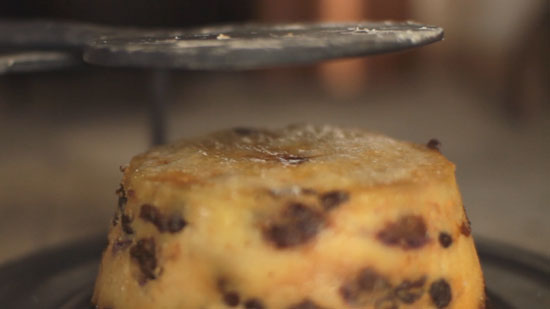
A White Pot with a topping of sugar being browned with a period salamander.
The salamander disk is heated until red-hot before being passed closely over food.
Salamander became popular in the 18th century. Shovels heated in the coals were used as an alternative.
Also see History of Puddings and 17th Century Puddings for recipes for many kinds of different puddings.
Puddings - initially referred to mixtures used for "stuffings," or mixtures boiled in skins, like sausages, and later in boiling or pudding bags. Many of the early pudding names are of Norman-French derivation and probably came in with Duke William, first Norman King of England, reigning from 1066 until his death in 1087.
Food historians generally agree the first puddings made by ancient cooks produced foods similar to sausages. The British claim pudding as part of their culinary heritage. Medieval puddings (black and white) were still mostly meat-based. 17th century English puddings were either savory (meat-based) or sweet (flour, nuts & sugar) and were typically boiled in special pudding bags. By the latter half 18th century traditional English puddings no longer included meat. 19th century puddings were still boiled but the finished product was more like cake. These puddings are still traditionally served at Christmas time. Plum pudding (aka Christmas pudding) is a prime example. Modern steamed puddings decend from this tradition.
The original pudding was formed by mixing various ingredients with a grain product or other binder such as butter, flour, cereal, eggs, and/or suet, resulting in a solid mass. These puddings are baked, steamed or boiled. Such puddings were a very important part of the Medieval diet, and cooking them in this way continued into the 1800's. These puddings had a great advantage over the porridge or "pottage" which came before. Instead of taking up a whole pot with a pottage, a pudding version of the dish could be cooked in a bag, right alongside a piece of mutton, beef, or salted pork so that two courses were cooked together in the same pot.
For pease pudding, the dried peas were soaked overnight, then boiled and drained, before being mixed with a little seasoning, perhaps sugar and pepper. When available, butter, eggs, or breadcrumbs might be added. The mixture was placed into the pudding cloth which was tied up and lowered into a cauldron of boiling water to be boiled for around an hour. If available, the resultant pudding was served with salted pork, which went particularly well with the pease pudding, since it the bacon was very salty and the pudding was hardly salted at all, creating a balance.
The peas - yellow split peas, actually - were tied into a muslin cloth along with some thyme and onion and suspended in the broth where the bacon was boiling. Once soft, they were mashed with salt, pepper and (in some cookery books) an egg. In the Middle Ages, when potatoes were still unknown in England, pease pudding was a useful source of starch and a filling foundation for a meal.
Boiled Puddings
This recipe is interesting in that it uses a canvas satchel in place of the ususal intestine or stomach casing. Pudding bags were not used extensively until the 16th century.
The Forme of Cury, 1390
XX.VIII. XVIII. Sachus. (Satchels) [1]
Take smale Sachellis of canuas (canvas) and fille hem full of þe same fars [2] & seeþ hem. and whan þey buth ynowz take of the canvas, rost hem & colour hem &c.
[1] Sachus. A culinary dish made in and shaped like satchels. [2] same fars as Pomme Dorryle (see recipe below).XX.VIII. XIIII. For to Make Pomme Dorryle [1] and Oþer þnges (Other things) .
Take þe lire of Pork rawe. and grynde it smale. medle it up wiþ powdre fort, safroun, and salt, and do þerto Raisouns of Coraunce, make balles þerof. and wete it wele in white of ayrenn. & do it to seeþ in boillyng water. take hem up and put hem on a spyt. rost hem wel and take parsel ygronde and wryng it up with ayren & a party of flour. and lat erne (run) aboute þe spyt. And if þou wilt, take for parsel safroun, and serue it forth.
[1] Pomme dorryle. So named from the balls and the gilding. "Pommes dorees, golden apples."
Forme of Cury (p. 72) where a Wastel loaf is filled & boiled like a pudding:
xx vii. xix. Wastels yfarced:
Take a Wastel and hewe out [th]e crinnes. take ayren & shepis talow & [th]e crinn of [th]e same Wastell powdor fort & salt wt Safron and Raisons corance. & medle alle [th]ise yfere & do it in [th]e Wastel. close it & bynde it fast togidre. and see[th] it wel.
Potage-type Puddings
Whitepots - combinations of rice, milk and eggs such as we would call puddings. One of the most wonderful baked puddings of the early modern period was the whitepot, a precusrsor of the bread and butter pudding, but even nicer. These bread or sometimes rice-based puddings were usually flavoured with rosewater and lightly spiced with nutmeg. There are recipes for them in most of the cookery books published in the 17th and 19th centuries. See John Nott's Cooks and Confectioner's Dictionary of 1723.
The Queen-like Closet, Hannah Woolley, 1670
XXXVIII. To make a Devonshire-White-pot.
Take two quarts of new Milk, a peny white Loaf sliced very thin, then make the Milk scalding hot, then put to it the Bread, and break it, and strain it through a Cul∣lender, then put in four Eggs, a little Spice, Sugar, Raisins, and Currans, and a little Salt, and so bake it, but not too much, for then it will whey.
CCLIII. To make a dainty White-Pot.
Take a Manchet cut like Lozenges, and scald it in some Cream, then put to it beaten Spice, Eggs, Sugar and a little Salt, then put in Raisins, and Dates stoned, and some marrow; do not bake it too much for fear it Whey, then strew on some fine Sugar and serve it in.
Tailours - 15th century Harleian manuscript
.xlviij. Tayloures.—Take a gode mylke of Almaundys y-draw with Wyne an Water, an caste hym in-to a potte, and caste gret Roysouns of corauns, Also mencyd Datys, Clowes, Maces, Pouder Pepir, Canel, Safroun, & a gode dele Salt, & let boyle a whyle; þan take it and ly*. [Lye; allay.] it wyth Flowre of Rys, or ellys with Brede y-gratyd, & caste þer-to Sugre, & serue forth lyke Mortrewys, & caste pouder of Gyngere a-boue y-now.
Peynreguson - 15th century Laud manuscript
Peynreguson̄—Nym resons & do out ye stones, and bray it in a morter with pepir & gingiuer, & salt and wastel bred; tempre hit with wyn, boille hit, dresse hit forth.
Figee - 15th century Laud manuscript
Figee.—Nym figes, & boille hem in wyn, & bray hem in a morter with lied bred; tempre hit vp with goud wyn / boille it / do therto good spicere, & hole resons / dresse hit / florisshe it a-boue with pomme-garnetes.
Leche - any made dish stiff enough to cut into slices.
Leche Lumbard is slices of date paste flavored w/ wine & spices, served w/ claree or syrup poured over).
Forme of Cury, (England, 1390)
Leche Lumbard. XX.III. V. Take rawe Pork and pulle of the skyn. and pyke out þe skyn synewes and bray the Pork in a morter with ayrenn rawe do þerto suger,salt, raysouns coraunce, dates mynced, and powdour of Peper powdour gylofre. an do it in a bladder, and lat it seeþ til it be ynowhz. and whan it is ynowh, kerf if leshe it in likenesse of a peskodde [pea pod], and take grete raysouns and grynde hem in a morter, drawe hem Up wiþ rede wyne, do þerto mylke of almaundes colour it withsaunders an safroun. and do þerto powdour of peper an of gilofre and boile it. and whan it is iboiled; take powdour of canel and gynger, and temper it up with wyne. and do alle þise thynges togyder. and loke þat it be rennyns, and lat it not seeþ after that it is cast togyder, an serue it forth.
Charlet - made of minced pork
Making a pudding in a carrot (or turnip) - by hollowing out the vegetable and filling it with forcemeat - The Book of Cookery (1620)
Dish of puddings the English Way - Patrick Lamb, Royal Cookery, Or, The Complete Court-cook, 1710, custard and bread-crumbs cooked in sausage skins
A new booke of Cookerie, John Murrell, 1615
To make an Italian Pudding.
Take a Penny white Loafe, pare off the crust, and cut it in square pieces like vnto great Dyes, mince a pound of Beefe Suit small: take halfe a pound of Razins of the Sunne, stone them and mingle them together, and season them with Sugar, Rosewater, and Nutmegge, wet these things in foure Egges, and stirre them very tenderly for breaking the Bread: then put it into a Dish, and pricke three or foure pieces of Marrow, and some sliced Dates: put it into an Ouen hot enough for a Chewet: if your Ouen be too hot, it will burne: if too colde, it will be heauy: when it is bakte scrape on Sugar, and serue it hot at dinner, but not at Supper.
A new booke of Cookerie, John Murrell, 1615
To boyle a legge of Mutton on the French fashion.
CUt out al the meat at the but-end, leauing the bone still in. Mince it small with Beefe Suit, and Marrow. Then take sweet Creame, yolkes of Egs, a few Razins of the Sun, two or three Dates minst, a little grated Bread. Season it with Pepper, Salt, and Nutmeg: then worke it stiffe, like a Pudding, and cram it in againe. Then stue it in a Pot with a Marrow bone, and a knuckle of Ueale: serue the Legge by it selfe, and your knuckle in stued broth, and your Marrow-bones vpon Bruys, with Carrets, and Pepper.
To bake a Tench with a Pudding in her belly.
LEt your Fish blood in the tayle, then scalde it, and scowre it: wash it cleane, and drie it with a cloth. Then take grated Bread, sweet Creame, the yolkes of two or three new laid Egges, a few parboyld Currins, a fewe sweete Hearbes, chopt fine. <<C2b>> Season it with Nutmeg, and Pepper, and make it into a stiffe Pudding, & put it into your Tenches belly. Season your Fish on the outside, with a little Pepper, Salt, and Nutmeg, and so put him in a deepe Coffin, with a piece of sweet butter, and so close your Pye, and bake it. Then take it out of the Ouen, and open it, and cast in a piece of a preserued Orenge minst. Then take Uinegar, Nutmeg, Butter, Sugar, and the yolke of a new layd Egge, and boyle it on a Chafingdish of coales, alwayes stirring it to keepe it from curding: then poure it into your Pye, shogge it well together, and serue it in.
To bake a Steake-Pye with a French Pudding in the Pye.
SEason your Steakes with Pepper, Salt, and Nutmeg: and let it stand in a tray an houre. Then take a piece of the leanest of a Legge of Mutton, and Mince it small with Oxe Suit, and a few sweet Hearbes, toppes of young Time, a branch of Pennyroyall, two, or three leaues of red Sage, grated bread, yolkes of Egges, sweet Creame, Razins of the Sunne: worke all together like a Pudding with your hand stiffe, and rowle it round like balles, and put them in your Steakes in a deepe Coffin, with a good piece of sweet Butter, sprinckle <<C3b>> a little Uergis on it, and bake it: then cut it vp, and rowle Sage leaues in Butter, and frye them, and sticke them vpright in your walles, and serue your Pye without a couer, with the iuyce of an Orenge or Lemmon.
To make blauncht Maunchet in a Frying-pan.
TAke halfe a dozen Egs, halfe a pint of sweet Creame, a penny manchet grated, a Nutmeg grated, two spoonefuls of Rosewater, two ounces of Sugar: worke all stiffe like a Pudding: then fry it like a Tansey in a very little frying Pan, that it may be thicke: fry it browne, and turne it out vpon a plate. Cut it in quarters, and serue it like a Pudding: scrape on Sugar.
