History of Pudding
17th century Rice Puddings from Ivan Day
Also see 17th Century Puddings. Hannah Woolley gives recipes for many types of puddings.
The history of pudding is a complicated topic. Why? Through time, many different kinds of foods have been known by this name. The creamy, rich pudding dessert we (Americans) think of today is more closely related to custard. The history of custard is likewise ancient. This food followed a separate, though parallel, path that managed to converge with pudding in 19th century America.
First Puddings cooked in Skins
Food historians generally agree the first puddings made by ancient cooks produced foods similar to sausages. In medieval England, "pudding" meant either black pudding, which was blood sausage, or white pudding, a delicate sausage of ground meat and fat lightened with bread crumbs. Medieval puddings (black and white) were mostly meat-based. Among its surviving relatives can be numbered the black pudding (bloodings), the haggis and the mealy pudding of Scotland, all of which are savoury foods. Extinct now, but once very popular, were leveridge, or liver puddings, an early form of liver sausage.
Since ancient times, continuing into Medieval, Tudor and later periods blood, chopped offal and fat were used to make black or blood puddings when pigs were slaughtered in autumn. When these ingredients were incorporated with oats and spices a nutritious, tasty food product would result. Such puddings, and other sausages as we now commonly call them, are known to be one of the oldest and most enduring forms of processed meat.
The intestines or animal casings were turned inside out and washed or “scoured” many times. The mixed ingredients were forced into the animal casings and twisted or tied off in “boudin” or sausage shapes, or for a larger pudding filled the animal’s stomach. Cooked immediately because a blood sausage’s keeping properties were very limited after this initial cooking, slices could be fried or boiled again shortly afterwards. But essentially the blood sausage was eaten “fresh” in England and in countries with similar climates. In hot or cold, dry and windy climates such as mountain areas of Spain or Scandinavia respectively, the same blood puddings were cured by air drying, thus prolonging their keeping properties
As well as pork meat, other types of sausage filling were popular in Medieval times. Porpoise, then common sea and a mammal not unlike a dolphin, with pepper and ginger fillings were enjoyed by nobles during Lent. Classified as a fish, porpoise could be eaten all year long! The same exception applied to the flesh of very young rabbits. Other white meat charcuterie based on (real) fish and cheese was popular - all complying with the medieval church’s strict “laws” on abstinence from meat for many days of the year.
In Medieval, Tudor and later times sweet “white puddings” were also favourites on the high class menu and based on rice, oatmeal, almonds, bread, eggs and cream with spices. Or alternatively unctious “marrow puddings” often eaten for breakfast. Often parboiled and then cooled and kept, they were gently toasted to brown them off before eating.
Among the sweet skin puddings was the hack pudding of the Lake Counties, a sweet haggis traditionally eaten on Christmas morning. This spicy concoction of minced beef, dried fruit, sugar and oats was probably the original Christmas Pudding. Almond puddings cooked in hogs' guts, rice puddings in skins, marrow puddings, bread puddings and even puddings perfumed with rosewater or ambergris, were all boiled in lengths of small intestine. They were all generally known as 'white puddings'. Unlike their first cousin, the sausage, these puddings were always boiled. Most were cooked a second time, usually by toasting them over the embers or baking them gently at the mouth of the oven.
Shift to more Modern Puddings
From the year 1575 to 1621 was a time remarkably prolific in cookery books, and, judging from the character of their contents, the 16th century was an era of change in culinary matters. Most of the old pounded mixtures we find have vanished; joints of meat, both roast and boiled, are more conspicuous in the bills of fare; and a large crop of genuine sweet dishes, notably jellies, creams, and fruit-tarts have sprung up. Seasoning is not applied so indiscriminately or profusely. Meats and poultry are still stewed with prunes and raisins, but their general character is more modern.
Mortrews, Bucknade, Marmeny, and their like, have quite disappeared, and we catch one of the older mixtures of chopped raisins, egg, and bread-crumbs, being placed in a wooden bowl and being tied up within a cloth. After cooking, Sir Kenelm Digby's Quaking Pudding, 1669, is then ornamented on its outside with 'citern and all manner of suckets.'
'Pudding,' regarded in light of a typical English dish, has its own history. Until comparatively recent times 'plum' pudding was only represented by minced figs, dates, prunes, raisins and citron, either baked with custard in open dishes under the name of 'torts,' or else boiled into porridge with bread-crumbs, wine, and spices. Combinations of rice, milk, and eggs, such as we now call puddings, for a long time went by the name of 'Whitepots,' and the word pudding was principally applied either to mixtures used for 'stuffing,' or to mixtures boiled in skins like sausages.
In The Book of Cookery, 1620, we find directions for making a pudding in a carrot or other vegetables by hollowing out the vegetable and fillin them with forcemeat. Yet, a century lager Partick Lamb in this Royal Cookery speaks of custard and bread-crumbs cooked in sausage skins, as a 'dish of puddings the English way.'
Pudding Bags and Baked Puddings
The trouble with making puddings in skins were the the intestines or stomach linings, which needed a lot of cleansing and were akward to fill. The method of boiling the pudding mixture in a cloth proved to be a much more practical alternative and became widespread during the course of the seventeenth century. These cloths or 'clouts' were given a coating of butter and flour before they were filled with pudding mixture. Suet puddings were tied loosely to allow the pudding inside to expand as it cooked, while batter puddings were tied tightly in order to keep their shape. The cloths were never washed with soap, as it imparted an unpleasant flavour and could spoil a delicate pudding. They were thoroughly scoured and boiled instead. Pudding moulds, dome moulds and basins were also tied up firmly in a cloth.
The principal ingredients of an oatmeal pudding - cereal, fat and eggs - formed the basis of cloth-boiled and baked puddings. Suet, the most commonly used fat, was not chopped too fine in case it boiled away and made the puddings 'too dry in the eating'.
Baked puddings were usually cooked in a dish which had been lined with pastry. Before the pudding mix was poured in, the rim was often garnished with a border or collar of puff pastry. As the pudding baked, this border rose and effectively retained the expanding pudding mixture. Some authors tell us to decorate the top of the pudding with lozenges, or flowers of pastry. Sometimes elaborate cut covers were used, as in this recipe from John Thacker's book. In another of his recipes , he tells us to fill the little holes in the cut cover with sweetmeats.
Later Historical Changes in Puddings
17th century English puddings were either savory (meat-based) or sweet (flour, nuts & sugar) and were typically boiled in special pudding bags. The "pease porridge" most of us know from the old nursery rhyme was most likely a simple boiled pudding of pease meal. By the latter half 18th century traditional English puddings no longer included meat. 19th century puddings were still boiled but the finished product was more like cake. These puddings are still traditionally served at Christmas time. Plum pudding (aka Christmas pudding) is a prime example. Modern steamed puddings decend from this tradition.
The modern usage of the word pudding to denote primarily desserts has evolved over time from the almost exclusive use of the term to describe savoury dishes, specifically those created using a process similar to sausages where meat and other ingredients in a mostly liquid form are encased and then steamed or boiled to set the contents. The most famous examples still surviving are black pudding, which was a favourite of King Henry VIII, and haggis.
Early Puddings
If one looks at the old recipes for pudding, it rapidly becomes obvious (and many historians and etymologists agree) that the meaning of the term is difficult to pin down. The word appears to find its origin in an old French term describing a blood-sausage stuffed into animal intestines and stomachs that the Normans brought with them as they invaded the British Isles in the 12th century.
This recipe is interesting in that it uses a canvas satchel in place of the ususal intestine or stomach casing. Pudding bags were not used extensively until the 16th century.
The Forme of Cury, 1390
XX.VIII. XVIII. Sachus. (Satchels) [1]
Take smale Sachellis of canuas (canvas) and fille hem full of þe same fars [2] & seeþ hem. and whan þey buth ynowz take of the canvas, rost hem & colour hem &c.
[1] Sachus. A culinary dish made in and shaped like satchels. [2] same fars as Pomme Dorryle (see recipe below).XX.VIII. XIIII. For to Make Pomme Dorryle [1] and Oþer þnges (Other things) .
Take þe lire of Pork rawe. and grynde it smale. medle it up wiþ powdre fort, safroun, and salt, and do þerto Raisouns of Coraunce, make balles þerof. and wete it wele in white of ayrenn. & do it to seeþ in boillyng water. take hem up and put hem on a spyt. rost hem wel and take parsel ygronde and wryng it up with ayren & a party of flour. and lat erne (run) aboute þe spyt. And if þou wilt, take for parsel safroun, and serue it forth.
[1] Pomme dorryle. So named from the balls and the gilding. "Pommes dorees, golden apples."
Forme of Cury (p. 72) where a Wastel loaf is filled & boiled like a pudding:
xx vii. xix. Wastels yfarced:
Take a Wastel and hewe out [th]e crinnes. take ayren & shepis talow & [th]e crinn of [th]e same Wastell powdor fort & salt wt Safron and Raisons corance. & medle alle [th]ise yfere & do it in [th]e Wastel. close it & bynde it fast togidre. and see[th] it wel.
16th Century
Puddings really exploded onto the culinary scene around the early 16th century. Instead of natural casings, a piece of cloth became a viable substitute. John Murrell’s A New Booke of Cookerie from 1615 has a recipe for a Cambridge Pudding containing breadcrumbs, flour, dates, currants, nutmeg, cinnamon, pepper, suet, milk, sugar and eggs and most importantly, it’s boiled in a cloth. This was the simple finding that a piece of sturdy cloth, dipped in hot water and then well floured, could be tied up around a suety or batter mix--savoury or sweet--and boiled without the contents leaching out as they swelled. Before the discovery of the pudding cloth, the preparation of puddings was constrained by the shortage of containers, either stomach or large intestine; if an animal was not slaughtered, then it was not possible to cook a pudding. Once cloth came into play, however, puddings became the welcome weeds of the British culinary landscape, and contributed in no small way to the development of a distinctive national cuisine.
Puddings were often boiled alongside the meat. They were likewise often served prior to or along with the meat course so that less meat would be required to satisfy hungry appetites. Puddings could be served hot or cold finished with a sprinkle of sugar, a little honey, maple syrup (Americas), or a “pudding sauce” made of equal parts melted butter, sugar, and sack (sherry wine).
But as sugar became more widely available, it began to alter the palates of English societies. Even savory dishes, including puddings, were often seasoned with sugar. Eventually, the definition of pudding began to apply to a broader collection of foods that weighed heavily on the dessert end of the table.
There were dozens, if not hundreds of different kinds of puddings: boiled puddings, dripping puddings (e.g., Yorkshire), plumb, marrow, and pastry puddings. There were regional and local puddings. There were bread puddings that used bread crumbs and bread-and-butter puddings that actually used slices of bread (e.g., a white pot). There were apple puddings that we would now call apple dumplings. There were also quaking and custard puddings (e.g., “Flummery”), made primarily of egg and milk with only a fraction of the flour seemingly necessary to hold it together. Our Thanksgiving turkey stuffing and pumpkin pie. They both started as puddings. And the Christmas fruitcake - also a pudding.
Another pudding type was called Blancmange. Different from custard (which is thickened with egg), blancmange is a dairy dessert thickened originally with either isinglass or calve’s feet jelly, and by the turn of the 20th century, with corn starch. There were different kinds of manges, depending on how they were flavored and/or colored. Blancmange colored with cochineal, for instance, was called rougemange, and that colored with spinach was verdemange.
17th Century
Among the sweet skin puddings was the hack pudding of the Lake Counties, a sweet haggis traditionally eaten on Christmas morning. This spicy concoction of minced beef, dried fruit, sugar and oats was probably the original Christmas Pudding. Almond puddings cooked in hogs' guts, rice puddings in skins, marrow puddings, bread puddings and even puddings perfumed with rosewater or ambergris, were all boiled in lengths of small intestine. They were all generally known as 'white puddings'. Unlike their first cousin, the sausage, these puddings were always boiled. Most were cooked a second time, usually by toasting them over the embers or baking them gently at the mouth of the oven.
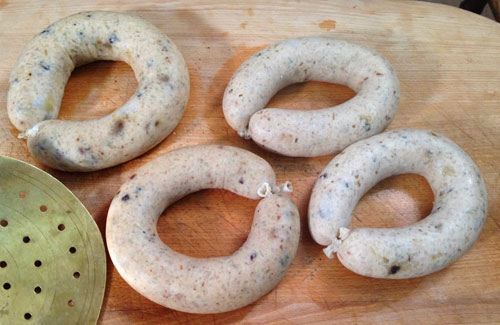
Rice Puddings Cooked in Skins from the 17th century.
John Murrell, A Newe Booke of Cookery. (London: 1615).
A Ryse Pudding
Murrell's recipe stands out as it calls for barberries, as well as the more usual currants included in puddings of this kind. Nowadays barberries, the fruits of the British native Berberis vulgaris L. are hardly used at all in British cookery, but were immensely popular at this time for their pleasant acidic flavour and stunning red colour. They were frequently used as a striking garnish and were the basis of a number of sweetmeats and preserves. Another important role they enjoyed was to add acidity as well as colour to forcemeats, pie fillings and in this case - puddings.
Markham published a recipe for Rice puddings in skins in 1615 in his celebrated recipe collection, The English Housewife (London: 1615)
Rice Puddings
Take half a pound of Rice, and sttep it in new milk a whole night, and in the morning drain it, and let the milk drop away, and take a quart of the best sweetest, and thickest Cream, and put the Rice into it and boyl it a little; then set it to cool an hour or two, and after put in the Yelks of half a dozen Eggs, a little Pepper, Cloves, Mace, Currants, Dates, Sugar and Salt; and having mixt them well together, put in great store of Beef suet well beaten, and small shred, and so put it into the farms, and boyl them as before shewed, and serve them after a day old.
Robert May's The Accomplisht Cook (London: 1660), with a specific direction to tie the ends of the guts together, making a ring shaped pudding.
To make Rice Puddings in guts
Boil half a pound of rice with three pints of milk, and a little beaten mace, boil it until the rice be dry, but never stir it, if you do, you must stir it continually, or else it will burn, pour your rice into a cullender or strainer, that the moisture may run clean from it, then put to it six eggs, (put away the whites of three) half a pound of sugar, a quarter of a pint of rose-water, a pound of currans, and a pound of beef-suet shred small, season it with nutmeg, cinamon, and salt, then dry the small guts of a hog, sheep, or beefer, and being, finely cleansed for the purpose, steep and fill them, cut the guts a foot long, and fill them three quarters full, tie both ends together, and put them in boiling water, a quarter of an hour will boil them.
Another of May's rice pudding recipes instructs us to boil a very similar preparation in a bag or napkin. However, as an afterthought, he explains that when you make rice puddings in guts, you should toast them before the fire 'in a silver dish or tosting pan'. This makes much more sense of Murrell's 1615 recipe, who instructs us to parboil the puddings, indicating that there was a second cooking process to follow. Toasting or broiling them afterwards cooks the puddings so they end up looking like grilled sausages.
To make marrow Puddings of Rice and grated Bread
Steep half a pound of rice in milk all night, then drain it from the milk, and boil it in a quart of cream; being boild strain it and put it to half a pound of sugar, beaten nutmeg and mace steeped in rose water, and put to the foresaid materials eight yolks of eggs, and five grated manchets, put to it also half a pound of marrow, cut like dice, and salt; mingle all together, and fill your bag or napkin, and serve it with beaten butter, being boiled and stuck with almonds.
If in guts, being boild, tost them before the fire in a silver dish or tosting pan.
Leveridge, or Liver, Puddings
The accomplisht cook, by Robert May, 1660
To make Leveridge Puddings. [liver puddings]
Boil a hogs liver, and let it be thorowly cold, then grate and sift it through a cullender, put new milk to it and the fleck of a hog minced small put into the liver, and some grated bread, divide the meat in two parts, then take store of herbs, mince them fine, and put the herbs into one part with nutmeg, mace, pepper, anniseed, rosewater, cream, and eggs, fill them up and boil them. To the other part or sort put barberries, slic’t dates, currans, cream, and eggs.
Other Leveridge Puddings.
Boil a hogs liver very dry, and when it is cold grate it and take as much grated manchet as liver, sift them through a cullender; and season them with cloves, mace, and cinamon, as much of all the other spices, half a pound of sugar, a pound and a half of currans, half a pint of rose-water, three pound of beef suet minced small, eight eggs and but four whites.
Pudding Bags
In the early days the pudding mixture was put into a deep wooden bowl, which was wrapped in a linen cloth. In a very detailed recipe for Quaking Pudding, Sir Kenelm Digby (1670) tells us how to do this:
The Closet Of Sir Kenelm Digby Knight Opened, 1669
A Good Quaking Bag-Pudding
Set a quart of good morning Milk upon the fire, having seasoned it with Salt, and sliced or grated Nutmeg. When it beginneth to boil, take it from the fire, and put into it four peny Manchets of light French-bread sliced very thin (If it were Kingstone-bread, which is firmer, it must be grated) and a lump of Sweet-butter as big as a Wall-nut, and enough Sugar to season it; and cover the possnet with a plate to keep the heat in, that the bread may soak perfectly. Whiles this standeth thus, take ten yolks of New-laid-eggs, with one White, and beat them very well with a spoonful or two of Milk; and when the Milk is cooled enough, pour it (with the bread in it,) into the bason, where the beaten Eggs are, (which likewise should first be sweetned with Sugar to their proportion,) and put about three spoonfuls of fine flower into the composition, and knead them well together. If you will, you may put in a spoonful of Sack or Muscadine, and Ambared Sugar, working all well together; as also, some lumps of Marrow or Suet shred very small: but it will be very good without either of these.
Then put this mixtion into a deep Woodden dish (like a great Butter-box) which must first be on the inside a little greased with Butter, and a little Flower sprinkled thereon, to save the Pudding from sticking to the sides of the dish. Then put a linnen cloth or handkercher over the mouth of the dish, and reverse the mouth downwards, so that you may tye the Napkin close with two knots by the corners cross, or with a strong thred, upon the bottom of the dish, then turned upwards; all which is, that the matter may not get out, and yet the boiling water get through the linnen upon it on one side enough to bake the pudding sufficiently. Put the Woodden-dish thus filled and tyed up into a great Possnet or little Kettle of boiling water. The faster it boils, the better it will be. The dish will turn and rowl up and down in the water, as it gallopeth in boiling. An hours boiling is sufficient. Then unty your linnen, and take it off, and reverse the mouth of the dish downwards into the Silver-dish you will serve it up in; wherein is sufficient melted Butter thickened with beating, and sweetened to your taste with Sugar, to serve for Sauce. You may beat a little Sack or Muscadine, or Rose, or Orange-flower-water with the Sauce; a little of any of which may also go into the Composition of the Pudding. If you put in more Flower, or more then one white of Egg to this proportion, it will binde the Pudding too close and stiff.
In plain Bag-puddings it makes them much more savoury, to put into them a little Penny-royal shreded very small, as also other sweet-Herbs. You must put in so little, as not to taste strong of them, but onely to quicken the other flat Ingredients.
18th Century
Rice puddings survived into the eighteenth century, as witness this recipe from the Yorkshire cookery author Elizabeth Moxon. Elizabeth tells us to 'cree' the rice in milk. This interesting word is from the French crever, to burst or split. To cree rice or frumenty was to boil it until it burst and came to a soft mash. However, it could also mean to crush, mill or kibble. The wheat or barley used for making frumenty was 'creed' or crushed in a 'creeing trough'.
English Housewifery Exemplified, Elizabeth Moxon (1764)
To make White Puddings in skins
Take half a pound of rice, simmer it in milk while it be soft, when it is ready put it into a cullinder to drain; take a penny loaf, cut off the crust, then cut it in thin slices, scald it in a little milk, but do not make it over wet; take six eggs and beat them very well, a pound of currants well cleaned, a pound of beef-suet shred fine, two or three spoonfuls of rose-water, half a pound of powder sugar, a little salt, a quarter of an ounce of mace, a large nutmeg grated, and a small stick of cinnamon; beat them together, mix them very well, and put them into the skins; if you find it be too thick put to it a little cream; you may boil them near half an hour, it will make them keep the better.
Whitepots - One of the most wonderful baked puddings of the early modern period was the whitepot, a precusrsor of the bread and butter pudding. These bread or sometimes rice-based puddings were usually flavoured with rosewater and lightly spiced with nutmeg. There are recipes for them in most of the cookery books published in the 17th and 19th centuries. See John Nott's Cooks and Confectioner's Dictionary of 1723.
From the Oxford English Dictionary: A dish made (chiefly in Devonshire) of milk or cream boiled with various ingredients, as eggs, flour, raisins, sugar, spices, etc.; a kind of custard or milk-pudding.
From A glossary and etymological dictionary, by William Toone, 1834: “A composition made with milk, eggs, bread, sugar, and spice, and baked in a pie: a dish peculiar to the county of Devon.
This style of pudding is not exclusive to Devon of course. Bread custards are eaten all over Britain, this just happens to be the name used for the dish in Devonshire.
19th Century
The new London family cook: or, Town and country housekeeper's guide, by Duncan MacDonald, 1808.
White Pudding in Skins.
After washing half a pound of rice in warm water, boil it in milk till tender. Put it into a sieve to drain, and beat half a pound of Jordan almonds very fine, with rose-water. Wash and dry a pound of currants, cut a pound of hog’s lard small, beat up six eggs, half a pound of sugar, a nutmeg grated, a stick of cinnamon, some mace, and a little salt. Mix them well together, fill the skins, and boil them.
Why did boiled puddings disappear?
Authors speak of their disappearance from British tables, but they were once also very popular in America. Most English cookbooks used in early America were British (or heavily influenced by British cooking). So it’s no surprise to find a plethora of boiled pudding recipes even in those earliest “American” works published in Philadelphia and Boston. It’s interesting to realize, however, that even as American cookbooks began to reflect a distinctively American cuisine through the 19th century, British pudding recipes continued to hold on. It was only in the 20th century that they were finally nudged out of print by various custard and mange-type recipes going by the same name.
There are several reasons why boiled puddings disappeared off the American culinary landscape. It was a slow death that may have started even at the height of its popularity. First, American colonists relied heavily on corn, as most of the wheat crop grown in North America was exported to Britain. Maize was considered by the British as suitable fare for Yankees. Beyond that, it was animal fodder. The exportation of much of the wheat crop would have naturally limited the primary ingredients for pudding: flour and bread. Some of the earliest distinctions in American cookbooks were made by the additions of Indian Pudding recipes made with corn flour instead of wheat flour.
Another early contributor to the boiled pudding’s demise was likely the development of pearl ash, saleratus, and finally baking powder. These chemical leavening agents appear to have steered preferences away from heavier foods to lighter fare.
Another contributing factor was advances in kitchen technology. With the continued development of kitchen ovens, it became easier and more reliable (as well as more efficient) to bake than it was to boil. Consequently, as pudding recipes developed in the 19th century, more recipes called for the puddings to be baked or steamed with a water bath rather than boiled.
Another likely factor was simply the amount time required to make a boiled pudding. Full-sized bag puddings typically required boiling times between four and six hours. During that time, cooks had to keep a watchful eye on the pot to make sure it didn’t boil dry, and when additional water was needed to be added, it had to be boiling water so that the cooking time wasn’t extended any longer than it already was. Frustration over lengthy cook times can be felt even in early 18th century cookbooks. The answer to this was hasty puddings.
Hasty puddings were actually a category of puddings. Any pudding that required less time to cook, for whatever reason, can be considered a hasty pudding. For American colonists, corn mush was a common form of hasty pudding. It didn’t take long at all for the corn meal, boiled with disproportionate amounts of water, to thicken up. Other hasty puddings could be made from larger pudding recipes simply by divvying the dough or batter into smaller portions. For instance, the earliest known bag pudding (the “College” or “Cambridge” pudding) soon became the “New College” pudding. These recipes were in essence the same, but the mix of ingredients in the New College recipe was divided into smaller dumpling-size portions and either fried or boiled. The bag was dropped altogether.
And finally, the last nail in the boiled pudding’s coffin was likely the changing public perceptions regarding a key ingredient in most puddings: suet. It fell out of general favor with a society that was increasingly becoming more health conscious. Suet has since been relegated to bird food.
