Medieval Sauces
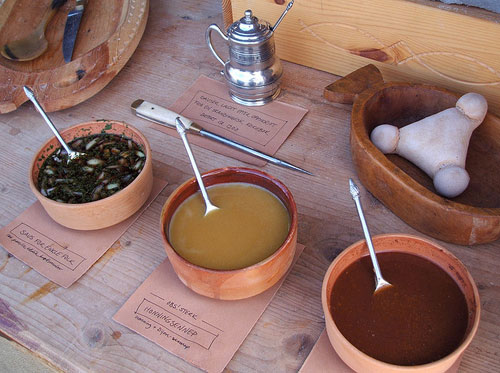
Medieval Sauces: Common Sauce, Honey Mustard, and Cameline
Humoral Theory
In order to begin to understand the medieval cook’s approach to cuisine, including the making of sauces, it is important to understand the humoral theory as it applies to food. Each food ingredient was categorized on two basic qualities; if it were moist or dry and hot or cold. The qualities of the humors were given a degree of intensity. Intensity ranged from the 1st to 4th degree. In addition the method of preparation would also affect the humoral qualities of the food. The table below lists the four basic humors, it’s qualities, the season and element associated with it.
| The Four Humors Humor | Quality |
Season |
Element |
Blood (Sanguine) |
Moist & Hot |
Spring |
Air |
Yellow Bile (Choler) |
Dry & Hot |
Summer |
Fire |
Black Bile (Melancholy) |
Dry & Cold |
Autumn |
Earth |
Phlegm |
Moist & Cold |
Winter |
Water |
The humoral theory of food certainly has its background in the teachings of Hippocrates in the 5th century BCE. It was further refined in the treatises by Galen in the 2nd century. Sauces were used to balance out the humors of the food stuff well into the 16th century.
There were two different goals for the medieval cook. For the healthy diner, the goal was to provide a dish (or series of dishes) where the humoral qualities of the ingredients were used to balance each other into a neutral state. For the ill, the goal was to provide a dish (or series of dishes) where the humoral qualities of the ingredients were used to balance the humors of the individual in order to bring him back into a healthy “neutral” state.
“In choosing or in elaborating a sauce a cook accepted an enormously serious responsibility. At this time an ignorance of the humoral complexion of any ingredient could easily lead to a charge of inadvertently undermining someone’s health, or even murder. A cook’s job was in many respects an offshoot of that of a physician; he had almost as much responsibility.”
The sauce served with a meat or fish was usually selected on the basis of the theory of humors (hot/cold, moist/dry). The idea was to 'correct' the food to be almost equally dry and moist, hot and cold, but leaning very slightly toward the dry and warm.
Scully says: "Sauces function primarily as a means by which any foods which happen not to be entirely suitable for safe human consumption-- because they are too hot, too cold, too moist or too dry-- can be 'corrected' sufficiently to be eaten . . . without seriously harming the eater . . . Other variables-- especially seasonal considerations and methods of cooking-- must enter into a determination of the proper sauce to be used to dress a particular meat, but the prime factors remain the inherent qualities of the meat and of the sauce, their relative moisture and temperature . . . in warm weather food is healthier if relatively cool in nature, whereas in cold weather food should be warmer."
Types of Sauces
Roast meats served at medieval banquets were usually accompanied with sauces that were designed to counteract the presumed hot and dry qualities of the meat by providing coolness and moisture. King Richard II of England in all likelihood dipped his meat in an unboiled sauce from the Forme of Cury (The [Proper] Method of Cookery) called Sawse Camelyne, or “Cameline Sauce.” It consists of currants, nuts, the crusts of bread, powdered cloves, and cinnamon, all mixed together. Then salt and vinegar are added and the sauce is ready to serve. However, for veal, wildfowl, and venison, the aristocratic meats par excellence, a boiled pepper sauce was the sauce of choice. According to a recipe for black pepper sauce found in the Viandier of Taillevent, ground ginger, round pepper, and burnt toast are to be infused in vinegar or verjuice and then boiled.
Mustards were very popular sauces in period because they possessed moderate heat, and therefore were good with cold dishes such as brawn, [boiled] beef, and fish such as cod. Medieval doctors and health-hobbyists like Platina suggested it to counteract 'cold' foods and 'cold' conditions. It was drunk and gargled with in wine for sore throats. But indications in books such as Le Menagier de Paris treat mustard as the basic sauce, except for salt, to be provided (much as we provide ketchup in everyday cooking today). Sometimes, the higher ranks of the tables got a variety of sauces while the lower ranks only got mustard sauce.
In summer: "verjuice, lime or lemon juice, vinegar, fresh elderberry juice, vine-shoot juice, pomegranate wine, rosewater, almond milk, and toast soaked in vinegar or any of the preceding liquids." No hot spices, but thyme or parsley used to produce a moderate heating/drying effect.
In winter: "mustard, rocket, white ginger, pepper, cinnamon, cloves, garlic, sage, mint, thyme, parsley, wine, meat broth, and weak vinegar which is close to the nature of wine (that is, warmer than normal vinegar.)."
"In warmer weather, the sauce should be cooled a little by reducing the quantity of the spices; conversely in colder weather the amount of spices in the sauce should be increased and the liquid base should be provided either by wine rather than the vinegar, or by a vinegar which is less strong and therefore less cold." (Scully, Medium Aevum, 1986).
Meats by humoral quality:
- Beef: cold and dry
- Veal, kid and lamb: temperate (balanced)
- Pork: cold and moist
- Venison: cold and dry
- Rabbit: cold and dry
- Chicken, young: moderately cold and moist
- Chicken, old: moderately cold and very dry
- Game birds: warmer than chicken, but moist
- Capons, pheasants: temperate
- Waterfowl: cold and dry
- Fish: according to some authorities cold and moist; others say cold and dry; the 'grosser' the fish, the colder and drier.
Medieval Sauces
With the knowledge at hand of the humors of any given ingredient, including spices, the medieval cook can now make a variety of sauces to suit his needs. There were four basic uses for sauces: basting sauces, cooking sauces, serving sauces and dipping sauces. In many of the extant medieval texts on cuisine that is currently available, there are notable sections devoted to the making of sauces. Some sauces were cooked (boiled), some were not (cold). Some sauces were thick and opaque, some thin and runny, some very spicy, and others delicate and bland.
The Medieval “Mother” Sauces
Unlike the modern mother sauces that are used as a basis for a vast variety of sauces, these medieval “mother” sauces appear in almost all the cuisines. These sauces can be found in almost all the cuisines of the Middle Ages. They are Cameline Sauce (cinnamon), Green Sauce (parsley, spinach, etc.), White Sauce, Yellow Pepper Sauce, Black Pepper Sauce and Mustard Sauce.
Some common sauces:
- Cameline Sauce -- made with cinnamon & thickened with breadcrumbs
- Green Sauce -- made with green herbs, usually parsley. Sage and other 'hot' herbs are common ingredients/variants.
- White Sauce --
- Yellow Pepper Sauce -- "Jance," French ginger based sauce w/ toasted bread & vinegar, served hot
- Black Pepper sauce -- made with pepper and toasted or fried bread
- Mustard -- mustard seeds with liquid and spices and/or sweeteners and thickeners
- Garlic -- usually garlic and thickener (nut milk, animal milk, bread crumbs)
- Jance -- a yellow sauce, French sauce generally made with ginger, see Yellow Pepper Sauce
- Fruit sauces -- cooked and/or ground fruit
- Galantine -- usually a gelatin-like sauce, often used on fish
- Galyntyne - English spiced sauce of galingale & bread crumbs
- Civey or Civet-- thickened cooking juices with onion; usually an integral rather than additional sauce.
Common points about period sauces:
- Straining the sauce is very important. In some cases the type of strainer (cloth, fine, coarse) is mentioned; other times you have to guess. Have muslin, a wire strainer, and a colander-type strainer ready to experiment with.
- The spices to be added are not always specified. Some period spices to keep on hand: saffron, cassia, Ceylon cinnamon, pepper, long pepper, ginger (powdered ginger should be replaced every six months), cloves, nutmeg (grate your own nutmeg), mace, galangal, cardamom, grains of paradise, cubebs.
- In period, most spices would be bought whole and ground with mortar and pestles of various sizes. For small amounts, this approach is just as good today. However, for large amounts, you may want to use a cranked or electric coffee-grinder.
- "First, when you grind spices and bread for any sauces or soups, you must grind the spices first and remove them from the mortar, for as you grind the bread it will gather up any spices remaining; thus you do not lose any speck which would be lost otherwise." -- Le Menagier de Paris
(In other words, after you grind spices in a mortar or grinder, run the bread crumbs through to pick up any remaining spices.)
- "In winter all sauces should be stronger than in summer." --Le Menagier de Paris
- Remember that breadcrumbs and nuts will soak up water and thicken your sauce over time; and that heating mixtures with breadcrumbs, milk or nut milk will also thicken them.
- Graters were used in period to make breadcrumbs from dry (day old) bread; you can use a grater or run dry bread through a food processor.
The table below indicates the color of the sauce and what it should be served with:
| Sauces | Colour | Cooking Method/Main Ingredients | Serve With |
| Cameline | White [brown from the cinnamon?] |
Uncooked Cinnamon, bread crumbs, vinegar, spices |
Beef Lamb Veal Pork Rabbit |
| Cinnamon-Orange | Orange | Chicken | |
| Cumin | Beige | Chicken | |
| Green Sauce | Green |
Green herbs, usually parsley. Sage and other 'hot' herbs are common ingredients/variants | Frogs legs Fish Goose |
| Murrey Sauce | Purple/Blue |
Poultry Excellent with turkey |
|
| Garlic Sauce | Usually garlic and thickener (nut milk, animal milk, bread crumbs) | ||
| Pink Garlic Sauce | Pink |
Roast meats Chicken Vegetables |
|
| Sharp Pepper Sauce | Beige |
Roast beef Venison |
|
| Sweet and Sour | Red | Ham | |
| Fruit Sauces | Cooked and/or ground fruit | ||
| Galantine | Usually a gelatin-like sauce, often used on fish | Fish | |
| Mustard | Mustard seeds with liquid and spices and/or sweeteners and thickeners | Salt boar |
|
| Black Pepper Sauce | Cooked Pepper and toasted or fried bread |
Goose | |
| Yellow Pepper Sauce | Cooked Ginger |
||
| Jance | Yellow | Generally made with ginger | Capons Barbel (fish) |
| Civey or Civet | Thickened cooking juices with onion; usually an integral rather than additional sauce. Recipe for Civey |
This table is compiled from information found in various chapters of D. Eleanor & Terence Scully’s Early French Cookery.
It lists various meats & fish with the desired cooking method as well as the appropriate sauce to accompany the dish.
| Sauces for Meats & Fish Main Ingredient | Cooking Method | Serving Sauce(s) |
| Pork | Roasted | Verjuice Onions, wine & verjuice |
| Pork | Baked in pie | Verjuice |
| Veal | Roasted | Spice Powder Cameline Sauce |
| Veal | Baked in pie | Verjuice |
| Mutton | Roasted | Fine salt Cameline Sauce Verjuice |
| Goat, kid or lamb | Roasted | Cameline Sauce Green Verjuice |
| Goose | Roasted | White Garlic Sauce Green Garlic Sauce Black Pepper Sauce Yellow Pepper Sauce |
| Mallard | Roasted | Drippings, lard, wine, verjuice & parsley |
| Chicken | Roasted | Cameline Sauce Green Verjuice Grape Mash Cold Sage Sauce |
| Chicken | Baked in pie | Sharp verjuice |
| Capons | Roasted | Must Sauce Poitevine Jance Sauce |
| Capons | Boiled | Wine Verjuice |
| Rabbits & hares | Roasted | Cameline Sauce Saupiquet |
| Rabbit & hares | Baked in pie | Cameline Sauce Verjuice |
| Partridge, pheasant, pigeons, doves, peacock & small birds | Roasted | Fine salt |
| Swan | Roasted | Yellow Pepper Sauce |
| Venison | Boiled | Cameline Sauce |
| Venison | Roasted | Cameline Sauce |
| Fresh boar | Boiled | Cameline Sauce Sharp Pepper Sauce |
| Salt boar | Boiled | Mustard Sauce |
| Anchovies | Roasted | Mustard Sauce Wine Sauce Parsley, onions & vinegar w/ spice powder on top |
| Barbel | Boiled | Sharp Pepper Sauce |
| Barbel | Roasted | Verjuice |
| Barbel | Fried | Jance |
| Bass | Boiled | Green Sauce |
| Cockles | Fried | White Garlic Sauce |
| Crayfish | Boiled | Vinegar |
| Eels | Boiled | Green Garlic Sauce |
| Eels | Baked in pie | White Garlic Sauce |
| Gurnard | Fried | Cameline Sauce |
| Gurnard | Roasted | Verjuice |
| Herrings | Fried | Garlice Sauce |
| Loach | Boiled | Mustard Sauce |
| Lobster | Boiled | Vinegar |
| Fresh mackerel | Roasted | Cameline Sauce Vinegar & spice powder |
| Salted mackerel | Boiled | Wine & shallots Mustard Sauce |
| Mussels | Boiled | Vinegar Sharp Verjuice Green Garlic Sauce |
| Oysters | Boiled & Fried | Garlic Sauce |
| Pickerel or Pollack | Fried | Green Sorrel Verjuice with white almond sops |
| Rayfish | Fried | Cameline Garlic Sauce made with ray liver |
| Salmon | Roasted | Cameline Sauce |
| Sole | Fried | Sorrel Verjuice with Orange Juice |
| Turbot | Fried | Green Sauce |
Thickening Agents
Not all medieval sauces were thickened, some sauces described were simply a dressing of verjuice. Many of the sauces, however, were thickened. For some sauces the main flavor ingredient itself could be the thickening agents, as in the case of mustard. Some sauces used reduction as a means to thicken it.
Other sauces used an ingredient whose sole purpose was to thicken the sauce. In the modern mother sauces, a common thickening agent is roux (flour cooked in butter or oil). However, currently there is no evidence of roux being used prior to the 17th century. The predominant thickening agents used in medieval sauces are: breadcrumbs, eggs, milk, almonds and almond milk, ground nuts, organ meat, 'grease', and hard-boiled egg yolks. There is evidence that raw eggs were tempered prior to being introduced to a boiled sauce.
When breadcrumbs were used, they were often pushed through a sieve with liquid to combine the two, similar to what food processors do today.
Also note that period sauces are rarely 'emulsified' sauces. In the simplest terms, an emulsion is a stable mixture of two liquids - such as oil and water - that normally separate from each other. An example of an emulsified sauce is mayonnaise.
This table lists the variety of boiled and cold sauces found in extant medieval manuscripts.
Medieval Sauces Source |
Author |
Place & Time |
Sauces |
| Libellus de arte coquinaria | Unknown | Denmark, Iceland & Germany, 13th century. | A Sauce for Lords |
| Another Sauce (Honey Mustard) | |||
| Another Sauce (Honey Mustard with Anise) | |||
| Fish in a Sauce Proper to It | |||
| A Sauce of Minimal Cost | |||
| A Sauce Good for Small Fish | |||
| A Sauce Good for Three Days and No More (Green Sauce) | |||
| A Sauce for Fresh Meat | |||
| (Another Green Sauce) | |||
| Onion Sauce | |||
| Viandier of Taillevent | Guillaume Tirel | France, 13th century | Cameline Sauce |
| Fresh Herring Garlic Sauce | |||
| (Almond Garlic Sauce) | |||
| Green Sauce | |||
| A Sauce to Preserve Sea-Fish | |||
| Robert’s Beard Sauce | |||
| Yellow Pepper Sauce | |||
| Black Pepper Sauce | |||
| Cow’s Milk Jance | |||
| Garlic Jance | |||
| Ginger Jance | |||
| Poitevin Sauce | |||
| Cameline Mustard Sauce | |||
| Marjoram Sauce | |||
| Le Ménagier de Paris | Unknown | France, 14th century | Mustard |
| Sorrel Verjuice | |||
| Cameline Sauce | |||
| White or Green Garlic Sauce for Ducklings or Beef | |||
| Musty Garlic for Fresh Herrings | |||
| Green Spice Sauce | |||
| Green Pickle for Preserving Salt-Water Fish | |||
| Yellow or Sharp Pepper Sauce | |||
| Black Pepper Sauce | |||
| Galentine for Carp | |||
| Saupiquet for Coney, River Fowl or Wood Pigeons | |||
| Calimafrée or Lazy Sauce | |||
| Jance of Cow’s Milk | |||
| Garlic Jance | |||
| Jance | |||
| Poitevine Sauce | |||
| Must for Young Capons | |||
| Quick Sauce for a Capon | |||
| Sauce to be put to Boil in Pasties of Halebrans, Ducklings, Little Rabbits and Wild Coneys | |||
| Boar’s Tail Sauce | |||
| Sauce for a Capon or Hen | |||
| Sauce for Eggs Poached in Oil | |||
| Daz bůch von gůter spise | Unknown | Germany, 14th century | A dish (Garlic Sauce) |
| Agraz (Sour Sauce) | |||
| Another Condiment (Shallot Sauce) | |||
| A Sauce (Grape & Sage Sauce) | |||
| Agraz (Crab apple & Beet Sauce) | |||
| A Little Sauce (Yellow Sauce) | |||
| A Good Sauce (Wine & Honey Sauce) | |||
| Diuersa Cibaria | Unknown | England, 14th century | Blanc Desire (White Sauce) |
| Vert Desire (Green Sauce) | |||
| Suade (Elderflower Sauce) | |||
| Galantine | |||
| Forme of Cury | Unknown | England, 14th century | Sobre Sawse |
| Sawse Blaunche (White Sauce) | |||
| Sawse Noyre for Capouns (Black Sauce) | |||
| Galyntyne | |||
| Gyngeuer | |||
| Verde Sawse | |||
| Sawse Noyre for Malard (Black Sauce) | |||
| Sawse Camelyne | |||
| Lumbard Mustard | |||
Libro de arte coquinaria |
Maestro Martino da Como |
Italy, 15th Century |
White Sauce |
| Gold of Pleasure Sauce | |||
| Peacock Sauce | |||
| Dried Prune Sauce | |||
| Green Sauce | |||
| Peach Blossom Sauce | |||
| Broom Flower Sauce | |||
| Grape Sauce | |||
| Mulberry Sauce | |||
| Black Cherry or Sour Cherry Sauce | |||
| Cornel Cherry Sauce | |||
| Mustard | |||
| Red or Violet Mustard | |||
| Mustard that can be Carried in Pieces on Horseback | |||
| Heavenly Summertime Sauce | |||
| Yellow Pepper Sauce for Fish | |||
| White Garlic Sauce | |||
| Violet Garlic Sauce | |||
| Green Verjuice | |||
| Sauce (Grape leaf & Garlic) | |||
| Verjuice with Fennel | |||
| Rose-Apple Sauce | |||
| Sauce for Pullet Pieces | |||
| Sauce for Hare | |||
| Good Sauce | |||
| Lemon Sauce | |||
| Sauce for Marzipan | |||
| Sauce for Every Type of Wild Beast | |||
| Saracen Sauce | |||
| Everyday Sauce | |||
| Northern Italian Sauce | |||
| French-Style Sauce for Partridge, Hen or Other Fowl | |||
| Papal Sauce | |||
| Regal Sauce | |||
| French Mustard | |||
| Vivendier | Unknown | France, 15th century | Barbe Robert |
| Cameline Sauce | |||
| Cameline Garlic Sauce | |||
| White Garlic Sauce | |||
| Yellow Pepper Sauce | |||
| Hot Black Pepper Sauce | |||
| Jance of Cow’s Milk | |||
| De Honesta Voluptate et Valetudine | Bartolomeo Sacchi | Italy, 15th century | Pepper Sauce for Wild Meat |
| Lard Sauce | |||
| Consommé Saffron Sauce | |||
| White Sauce | |||
| Green Sauce | |||
| Camelline Sauce | |||
| Bright Colored Sauce | |||
| Relish from dried Plums | |||
| Green Relish | |||
| Persian Relish | |||
| Broom-colored Relish | |||
| Relish from Grapes | |||
| Relish from Mulberries | |||
| Relish with Sweet and Sour Cherries | |||
| Mustard | |||
| Red Mustard Sauce | |||
| Mustard Sauce in Bits | |||
| Heavenly Relish in Summer | |||
| Saffron-Seasoned Sauce for Fish | |||
| Garlic Sauce with Walnuts or Almonds | |||
| Rather Highly Colored Garlic Sauce | |||
| Green Verjuice | |||
| Vine Tendril Relish | |||
| Verjuice with Fennel | |||
| Rose Bud Flavoring | |||
| Relish from Cornel Cherries | |||
| Samuel Pepys’ manuscript | Unknown | England, 15th century | Capons in Sauce |
| Salmon roasted in Sauce | |||
| Galantine | |||
| Sauce for a Pike | |||
| Sauce for roated Mallard | |||
| Harleian MS. 401619 | Unknown | England, 15th century | Sauce Gamelyne |
| Sauce Sermstele | |||
| Sauce Oylepeuer | |||
| Sauce Verte | |||
| Sauce Gynger | |||
| Sauce Sorell | |||
| Sauce Galentyne | |||
| Ashmole MS. 1439. Sauces | Unknown | England, 15th century | Sauces pur Diuerse Viaundes |
| Sauce Alepeuere | |||
| Sauce Galentyne | |||
| Sauce Gingyuer | |||
| Sauce for a Gos | |||
| Sauce Camelyne | |||
| Sauce Rous | |||
| Sauce for Stokefysshe | |||
| Sauce for Stokfysshe in an-other maner | |||
| Sauce for peiouns | |||
| Sauce for Shulder of Moton | |||
| Sauce Vert | |||
| Surelle | |||
| Sauce Percely | |||
| Sauce Gauncile | |||
| Piper for Feel and for Venysoun | |||
| White Sauce | |||
| Black Sauce | |||
| Sauce Newe for Malardis | |||
| Libre de Sent Soví | Unknown | Catalan (Spain), 15th century | White Sauce |
| Lemon Sauce | |||
| White Garlic Sauce | |||
| Fresh Onion Salsa | |||
| Mustard | |||
| Parsley Sauce | |||
| Esquabey Sauce | |||
| A Proper Newe Booke of Cokerye | Unknown | England, 16th century | A Pyke Sauce |
| Libro de Cozina | Master Ruperto de Nola | Catalan (Spain), 16th century | White Sauce |
| Sauce with Apples | |||
| Lemon Sauce | |||
| Vinagre | |||
| Sauce for Graylag Goose | |||
| Light Sauce for Wild Poultry | |||
| A Dish Called White Sauce | |||
| Light Sauce for Roast Doves | |||
| Another Light Sauce for Roast Doves | |||
| Light Sauce for Roast Poultry | |||
| Lights Sauce for Partridges or Roast Chickens | |||
| Light Sauce of Bitter Pomegranate Juice | |||
| Almond Sauce for Invalida | |||
| Another Almond Sauce for Invalids (Weak) | |||
| Another Almond Sauce for Invalids (Fever) | |||
| White Light Sauce | |||
| Sauce Gironfina | |||
| Sauce Camelline | |||
| White Sauce Camelline | |||
| Smooth Sauce for Poultry | |||
| Granada Sauce | |||
| Dark Sauce | |||
| Rosemary Sauce | |||
| Agalura Sauce | |||
| Garlic Sauce | |||
| Mustard | |||
| French Mustard | |||
| Another French Mustard | |||
| Sauce of Horseradish and of Clary Sage | |||
| Good Sauce Galantine | |||
| Pepper Sauce | |||
| Bastard Camelline | |||
| Parsley Sauce | |||
| Sauce Called Cinnamon Must | |||
| Emperor’s Sauce |
Le Viandier de Taillevent
3. Large cuts of boiled meat.
Large cuts of boiled meat (beef, pork or mutton) are cooked in water and salt. The beef is eaten with Green Garlic [Sauce] in summer and White Garlic [Sauce] in winter. The pork and mutton are eaten (if fresh) with good Green Sauce made without wine, and (if salted) with Mustard [Sauce]
4. Mutton haricot.
Take raw mutton, cut it into small pieces, and fry it lightly in lard with some finely chopped onions. Steep it in beef broth, add some wine, verjuice, mace, hyssop and sage, and boil well together.
5. Larded boiled meat.
Take your meat (understand that it is my meat or my venison), lard it, put it to cook in water or wine, and add only some mace (with some saffron if you wish).
6. Fresh wild red deer and roe deer venison.
Parboil it, lard it all over, add some mace and plenty of wine, cook it well, and eat it with Cameline [Sauce]. Or, put it in a pie, parboiled and larded, and eat it with Cameline [Sauce].
7. Boar venison.
Cook it in wine and water. Eat it (if fresh) with Cameline [Sauce] and Sour Pepper [Sauce], and (if salted) with Mustard [Sauce].
8. Capons or veal with herbs.
Cook them in water, pork fat, parsley, sage, hyssop, costmary, wine, verjuice, saffron and ginger, as you wish.
