Medieval Potage
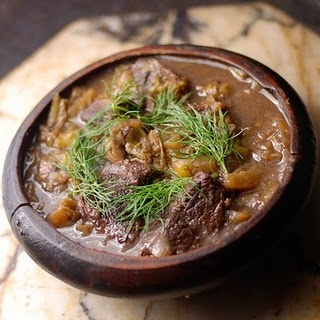
A Beef Stew
Potage (from Old French pottage; "potted dish" - the contents of a pot) is a category of thick soups, stews, or porridges, in some of which meat and vegetables are boiled together with water. The word pottage comes from the same Old French root as potage, which is a similar type of dish of more recent origin. Potage has its origins in the medieval cuisine of northern France and increased in popularity from the High Middle Ages onward.
For most people, almost all cooking was done in simple pots since this was the most efficient use of firewood and did not waste precious cooking juices. Thus Pottage, a generic name to various stews or thick cereal porridges, was the most common dish. It was eaten daily by everyone from the lowliest peasant to the Lord at his high table. Stews could be prepared much like a soup or so thick that they could be almost sliced. Cereal based pottages were mainly savoury but some could be made sweet by the addition of seasonal fruit. Pottage was made from whatever was available and could be a combination of vegetables, pulses, lentils, barley, herbs and stock, with the addition of meat for those who could afford it – or poach it!
Potages were important in medieval cookery — bread, ale and potage were the staples for much of the population. The simplest kinds were cereal pottages: oatmeal in the north, barley, rye, or wheat frumenty in the south. For ordinary people potages were often no more than steel-cut oatmeal, stewed roots or boiled vegetables. Pease pottage, made from dried peas, that some of us remember from the children’s rhyme, and other pulse pottages were equally important. To the rich these dishes were an accompaniment to meat; to the poor they were complete meals.
Potage as a Daily Staple
For many in medieval times, cooking potage was an everyday activity, potage being their main daily staple. In this case, it was essentially a broth in which meat and/or vegetables were boiled, then chopped meat, herbs and pulses added. In other words … a soup stew very similar to what we know today as Scotch Broth. Potage could be thick or thin. The average peasant would cook potage in an earthenware pot amongst the hot ashes beside their fire in the down-hearth. If their hut had a beam stretched across it, they had the option of hanging a cauldron (usually a cast-iron one) from it over the fire. The potage was boiled and stirred occasionally with a ladle or wooden stick called a "spartle."
Potage recipes varied depending upon the vegetables and meat available and peasants tended to be able to make only thin potage with the thicker and more tasty potages being enjoyed by the wealthy. For the better off, the liquid might be chicken, mutton or veal broth, with the beaten-up yolk of egg sometimes added to thicken it.
Unlike today's multi-ingredient miscellanies, medieval stews were simple affairs. Some meat, some onions, a few fresh herbs and (for the rich) some spices. Alcohol, broth or almond milk might be added, maybe even an egg or two, but on the whole simplicity was key. The meat was either stewed in liquid, or pre-roasted and then stewed (this makes excellent use of roast dinner leftovers). Our practise of tossing cubed meat in flour and cooking it before putting it in a stew is a French technique introduced around the C.17th in England.
Medieval herbs and spices were an extra source of flavouring. Common herbs used in potage recipes included parsley, sage, thyme and rosemary. Common spices included cloves, nutmeg and cinammon.
The poems of the 12th and 13th Century mention soups made of peas, of bacon, of vegetables, and of groats. In the southern provinces soups were made of almonds, and of olive oil. Water-cress soup, cabbage soup, cheese soup, and the gramose soup, which was prepared by adding stewed meat to the water in which meat had already been boiled, and adding beaten eggs and verjuice.
Peasant Pottage
Here is a simple, authentic recipe for a traditional medieval peasant pottage. It uses historical ingredients like oats (steel-cut, not rolled oats), split peas, and root vegetables to create a thick, comforting stew. The recipe is historically accurate in its profile, but it has been adapted with modern culinary tech and conveniences to make it taste good to a 21st-century palate: Pre-made broth, Step-by-step layering of flavors while cooking, Black pepper. While herbs like thyme and rosemary were plucked straight from the garden, black pepper was an incredibly expensive import from Asia. Only royals and wealthy merchants could afford it. A peasant would use mustard seed or wild garlic for kick instead.
Using steel-cut oats and split peas as thickeners is perfectly accurate. Medieval peasants rarely had access to highly refined wheat flour, so they relied on coarse grains to turn water into a filling meal. The "Wortes" (Vegetables): Leeks, cabbage, carrots, and parsnips/turnips were the exact staple crops grown in medieval peasant cottage gardens. Collectively, these leafy greens and herbs were known as "wortes. The Texture: Authentic pottage was not a smooth, blended soup. It was a thick, mushy, porridge-like stew designed to be eaten with a spoon or scooped up with dense bread.
Yield: 4 to 6 servings
1 cup steel-cut oats (or coarse pearl barley)
1/2 cup yellow or green split peas (or lentils)
1 large leek, washed thoroughly and sliced
2 cloves garlic, minced
2 carrots, chopped
2 parsnips or turnips, peeled and chopped
1 cup cabbage, shredded
6 cups vegetable or mushroom broth (or water with a pinch of salt)
1 tablespoon fresh herbs (thyme, rosemary, or parsley), chopped
Salt and black pepper to tasteSimmer the base: In a large pot, combine your broth (or water), steel-cut oats, and split peas. Bring the liquid to a boil, then reduce the heat to low, cover, and let it simmer for 20 minutes.
Add the aromatics & roots: Stir in the leeks, garlic, carrots, and parsnips/turnips. Cover the pot again and let it simmer for another 20 minutes, stirring occasionally so the grains don't stick to the bottom.
Add the greens: Stir in the shredded cabbage and fresh herbs. Simmer uncovered for the final 10 to 15 minutes until the cabbage is tender and the pottage reaches a thick, porridge-like consistency.
Season and serve: Season with salt and pepper to taste. Ladle it into bowls hot.
Historical Pro-Tips
Make it hearty: If you want a more luxurious version, peasants would occasionally add a bit of salted pork, bacon lardons, or whatever scraps of meat were available.
Serving: This is best enjoyed with a thick slice of coarse, dense rye or whole-grain sourdough bread to scoop up the stew.
Wealthy Noble's Version of Pottage
In the medieval era, this luxurious variation was often called Frumenty (if made with cracked wheat and almond milk) or a "Spiced Pottage." Unlike the peasant version, this dish showcases expensive imported spices, white wine, sugar, and almonds, which were massive status symbols for the elite.
Why This Was an Elite Dish in the Medieval Court
The Color Gold: Saffron didn't just add a subtle earthy flavor; its primary job was to turn the food bright yellow-gold. Medieval lords loved serving food that looked like literal gold to impress their guests.
No "Wortes": You will notice a distinct lack of onions, leeks, or root vegetables. Wealthy nobles viewed common garden vegetables as "lowly" food fit only for peasants whose stomachs were supposedly built for rough forage.
Sweet & Savory Fusion: If this were served on a non-fasting day, the wine would be replaced with a rich beef or capon broth, creating a flavor profile that heavily mixed sweet fruit and sugar with savory meat—a defining hallmark of high-class medieval cuisine.
Yield: 4 servings
1 cup cracked wheat (bulgur wheat is a perfect modern substitute)
2 cups almond milk (The medieval elite obsessed over almond milk; it was used as a base for almost everything, especially on fasting days when dairy milk was banned by the Church)
2 cups dry white wine (or a rich meat broth like capon/chicken broth)
1/2 cup currants or raisins (Plumped in warm water)
1/4 cup sugar or honey (Sugar was a wildly expensive luxury import)
A large pinch of saffron threads (Steeped in a tablespoon of warm wine to give the dish a vibrant, "golden" royal color)
1/2 teaspoon ground cinnamon
1/4 teaspoon ground ginger
1/4 teaspoon ground nutmeg or mace
A pinch of salt
Optional egg yolks (2-3): Beaten and stirred in at the very end to create a rich, custard-like texture.Infuse the liquid: In a large saucepan, combine the almond milk, white wine (or broth), saffron (with its steeping liquid), cinnamon, ginger, and nutmeg. Bring it to a gentle simmer over medium heat.
Cook the grains: Stir in the cracked wheat. Reduce the heat to low, cover, and let it simmer for about 20 minutes (or according to package instructions) until the wheat is tender and has absorbed most of the liquid. Stir frequently to prevent the almond milk from scorching.
Sweeten and enrich: Stir in the sugar (or honey) and the currants/raisins. Simmer uncovered for another 5 to 10 minutes until the mixture is thick, rich, and creamy.
Finish (The Royal Touch): Remove the pot from the heat. If using egg yolks, whisk a few spoonfuls of the hot pottage into the beaten yolks to temper them, then slowly stir the egg mixture back into the pot. This will instantly thicken the pottage into a glossy, velvety porridge.
Serve: Garnish with a sprinkle of extra cinnamon or a few toasted almonds.
Potage Recipes in the Cookbooks
In the Middle Ages, potage was quite broad in meaning, " something cooked in a pot," and thus has a very wide application. It was used for diverse foods ranging in consistency and ingredients from a few crusts of bread soaking in light broth (called sops, or sippets of bread) to substantial dishes of stewed venison with very little sauce. They were served in the deep plates, or bowls, known as écuelles and eaten with spoons. (The écuelle preceded the plate.) As part of a complete meal, potages were brought out during the first service. Some potages that were typical of medieval cuisine were frumenty, jelly (flesh or fish in aspic), mawmenny (a thickened stew of capon or similar fowl), and pears in syrup.
Vegetable and meat pottages were thickened with breadcrumbs, oatmeal, eggs, or, for the rich, amidon (wheat starch). Most contained onions. One universal favorite was green porray, made from a large number of green vegetables and herbs which were boiled until thoroughly soft. There were luxurious pottages for those who could afford them.
There were many kinds of potages made of thickened liquids (such as milk and almond milk) with mashed flowers, or mashed or strained fruit. Some potages were simply mashed pears or other fruit in water, thickened milk or almond milk, sometimes even with mashed flowers.
Period Cookbooks with Recipes for Potages
Recipes for soup-like dishes appeared in several cookery manuscripts from medieval England. The earliest known cookery manuscript in the English language, The Forme of Cury, written by the court chefs of King Richard II in 1390, contains several recipes for soups and potages, which were poured over toasted bread or sops, including one made from cabbage, ham, onions and leeks.. A slightly later manuscript from the 1430s is called Potage Dyvers ("Various Potages") and contains many potage recipes.
The most extensive English treatment of potages, broths, and soups is found in Robert May's Accomplished Cook (London, 1660). May received his chef's training in Paris, but served his apprenticeship in London. Subsequently, he was employed in thirteen different households of minor English nobility. He was knowledgeable about food trends in Europe: while he did not fully break with the prevalent food customs of the Middle Ages, he did introduce new culinary concepts. Among his English potages May embraced recipes for French Bisques and Italian Brodos. His "Soops" called for savory ingredients, such as spinach, carrots, artichokes, potatoes, skirrets, and parsnips. He offered broth recipes for the sick. Like previous writers, May maintained the medieval custom of pouring the liquids over toasted bread. Of the two hundred pages in the book, potages and soups consume almost 20 percent of the entire work. May's diagrams for table settings featured a large potage dish in the middle of the table. Subsequent British cookbooks included many more recipes.
Types of Potages
A course in a medieval feast often began with one or two potages, which would be followed by roasted meats. In Middle English thick pottages (stondyng) made with cereals, shredded meat, seasoned with spices and sometimes thickened with egg yolks and bread crumbs were called by various names like brewet, egerdouce, mortrew, mawmenee, blancmange and blance dessore. Thinner pottages were said to be ronnyng. Frumenty was a pottage made with fresh cleaned wheat grain that was boiled until it burst, allowed to cool, then boiled with broth and either cow milk or almond milk, and thickened with egg yolk and flavored with sugar and spices.
Vegetable Potage
Vegetable potage was the potage most eaten. European cottage gardens often contained a variety of crops grown together. These were called potage gardens by the French, as the harvest from that garden was used to make potage. The most common vegetables used were onions, leeks, celery, white cabbage, beans, carrots, garden peas, oats, herbs, and sometimes meat. Saffron strands were sometimes used in making potage to add colour and extra flavour but generally only the wealthy could afford saffron.
Generally it was made from vegetables that were easy to grow such as cabbage, leeks, onions and garlic. Often an extra flavour was adding with a few herbs or ground nuts and, if available, carrots and turnips. There weren’t really many recipes for this at the time because it was really simple food prepared in a simple way with whatever ingredients were available.
The 14th century French cookbook Le Viandier de Taillevant says this:
"154. D'autres menuz potaiges...: Other Lesser Pottages, such as stewed chard, cabbage, turnip greens, leeks, veal in Yellow Sauce, and plain shallot pottage, peas, frenched beans, mashed beans, sieved beans or beans in their shell, pork offal, brewet of pork tripe -- women are experts with these and anyone knows how to do them."
White and Green Porrays. The names of most ancient pottages are now unfamiliar, such as porray. Strictly speaking, this should have been made from leeks, because the name is from the Latin porrum, meaning that vegetable, but the word got confused with the French purée and so became a general word for all sorts of thick broths. White porry was mainly leeks, but green porray (also called joute, from the Old French word for a pot-herb or vegetable) was a varied and variable confection of green leaves according to season or that could be harvested from the fields or hedgerows, such as beet leaves (a favourite) or coleworts. This was a general name for any sort of brassica, which weren’t as differentiated as they are now; cole is Old English, from Latin caulis, cabbage, the origin of our modern kale; wort was a general name for a useful plant. Other less familiar native English plants might be included, such as docks, borage, or bugloss, possibly with parsley, thyme, mint or sorrel added to flavour it.
Joutes is a pottage or soup made primarily of vegetables or pot-herbs. It is typically a dish of spring greens, sometimes with meat, & sometimes without. It is a type of porray, but typically not containing leeks.
Porry, porray, poree, porrey = a soup or pottage of green vegetables, esp. leeks, peas, and cabbage.
Thick Potage
Frumenty and morrews were types of thick pottage eaten mainly by wealthy people.
Frumenty (Old French frumentee from Latin frumentum, corn) was made with hulled wheat boiled in milk, perhaps with egg yolks beaten in to thicken and colour it (rye or barley were sometimes substituted for wheat). Peasants, by contrast, generally ate thin pottage which was runny, less filling and less nutritious. Better-off households might add almonds, cream, currants, and sugar to enhance the flavour and might serve it with venison; by the 1700s it had become a sweet dish served as dessert. For common people it might as well have called for gold coins. Richer ingredients for rich people.
From British Food: An Extraordinary Thousand Years of History:
Other favourite dishes where the main ingredient and the sauce mingled so that they were so thick they could be moulded were: mortrews, Blanc Dessore, mawmenny. These are all different names for much the same dish: pork or chicken ground to a pulp mixed with breadcrumbs and egg yolks, spiced and coloured, then moulded, and served cold with powdered ginger.
A white mortrew was combined with almond milk and rice flour.
Blanc Dessore could be eaten with a sweet, spicy red wine sauce.
Mawmenny tended to be made from richer ingredients: pheasant, partridge or capon mixed with pine nuts and spices. A red wine sauce with added currants and chardequince (marmalade) reinforced with aqua vitae would be poured over it and set alight, then served flaming.
Grand houses, with better resources and skilled cooks, could ring the changes on a lot of different pottages. They used a variety of sauces that supplied most of the flavour, as well as many of their names, which had usually been brought over from French.
- Mortrews or mortress (Old French morterel or morteruel, a kind of milk soup) was based on milk and bread, with various pounded-up meats added to it, such as chicken or pork.
- Blanc dessore (from Old French; corrupted later to the meaningless English blank desire) was similar, sometimes served side by side with mawmenny or malmeny, essentially chicken with almonds and wine (the origins of these names is obscure).
- Egerdouce was a sweet and sour pottage that included a sauce of raisins, currants, and honey for the sweet flavour and vinegar for the sour (the name is from French aigre-doux, sour-sweet, but was Anglicized in various ways, including eager-dulce and even egg-douce, though it had no eggs in it).
Gravy wasn’t then the juices of meat — it didn’t take on that meaning until Elizabethan times — but a more ornate sweet and spicy sauce of ground almonds and broth, seasoned with sugar and ginger, into which were placed small pieces of oysters, eels, rabbit, or chicken. Its name is probably a misreading by scribes of Old French grané, a grain of spice.
Blancmange (originally blancmanger, from Old French blanc mangier, white food) wasn’t then a dessert but a mild meat dish without any strong spices in it, containing chicken, rice, almonds, sugar, eggs, and cream. Leave out the meat and you’re halfway to our modern version, which became a sweet jelly in the eighteenth century.
Charlet (from an Old French name for a type of pot) was usually boiled shredded pork mixed with eggs, milk and saffron seasoning, not so different from jussell or jusshell (Old French jussel, a juice or broth), which was a broth of various meats with eggs, breadcrumbs and saffron.
Yet another pottage was bukkenade; the first English cookery book, The Forme of Cury (cury then meant cookery, from Old French queurie), compiled by Richard II’s master cooks about 1390, said this was made from chicken, rabbit, veal or other meat, stewed with almonds, currants, sugar, onions and salt, thickened if necessary with flour and again coloured with saffron.
Many later recipes confirm that the type of meat in these recipes wasn’t important, since the sauce created the flavour.
The key feature of civey was onions (its name isn’t French, but Old English, from cipe, a type of onion, from which we get chive, so it's unconnected with modern French civet, a stew of rabbit or hare).
Cullis (ultimately from Latin colare, to strain or sieve) is recorded from the fifteenth century. It was often made with chicken, though other meats or fish could replace it; it was boiled and strained to make a thick broth that was considered to be good for invalids. In the eighteenth century one variety became known as beef tea.
Civet - A French term for a well seasoned stew of game, usually hare, or rabbit.
Stew Type Potages
The texture of medieval dishes was frequently that of a purée, usually quite thick, and with some pieces in it: often, it is not clear whether one should consider the result to be a stew with small pieces of meat or fish in sauce, or closer to a purée. Otherwise, there are thinner pottages, roasted game birds (often served simply with salt or with ginger sauce).
Three receipts from the Wagstaff Miscellany (Beinecke MS 163) will give an idea of the associations of flavours in late medieval English cooking. As was noted earlier, the basics were dishes dominated by the acid, by the sweet, or by the sweet and sour mix. An example of the first type is the receipt for ‘Conynggez in cyve’ [cyve means "chives"]:
An Ordinance of Pottage: An Edition of the 15th Century Culinary Recipes in Yale University's MS Beinecke 163 by Constance B. Hieatt (Author). Recipes reproduced in British Library MSS Sloane 7 and 442 and Bodleian Library MS Rawlinson D 1222.
Chop conyngys in pecys; do hem in a pott. Take onyons and good herbes ychopyd togedyr, boyle hem up in swete brothe; do therto poudyr of pepyr. Make a lyour of paryngys of crustys if whyte bredde drawyn with wyn and a lytylle blode; aley hit up but a lytyll. Do therto poudyr of canell, a grete dele, sesyn hit up with poudyr of gynger, wenigger, & salt.
This would produce a fairly thin sauce for the pieces of meat: here we are at the stew end of the spectrum. Characteristic of medieval cookery is the use of bread to thicken the sauce, and the wine, spice and vinegar base to the sauce. The other ‘cyve’ receipts in this collection have similar sauces. The sweet-sour combination is represented by ‘Blaunch bruet’:
Take hennys of porke, rostyd & chopyd; do hit in a pott. Do almonde mylke therto. Aley hit up with floure of rys. Do theryn a lytyll broth & a quantyte of wyne, clovys & macys, & sesyn hit up with venyger & pouderes & a lytyll sygure, steynyd with alkenet.
Most (seven out of nine) of the ‘bruet’ receipts contain the sweet-sour mix, and in seven the colour is specified, varying from red to yellow, with one green sauce. These sauces were also quite thin, while the stews which are interspersed with the bruets have even thinner sauces, often not thickened at all.
One of the sweet meat (or fish) dishes was ‘mortruys’, here in its meat version, ‘Mortruys of flesch’:
Take brawn of capons & porke, sodyn & groundyn; tempyr hit up with milke of almondes drawn with the broth. Set hit on the fyre; put to sigure & safron. When hit boyleth, tak som of thy mylke, boylyng, fro the fyre & aley hit up with yolkes of eyron that hit be ryght chargeaunt; styre hit wel for quelling. Put therto that othyr, & ster hem togedyr, & serve hem forth as mortruys; and strew on poudyr of gynger.
This is a very thick purée, bright yellow from egg yolks and saffron, sweet, and with a final flavouring and decoration of powdered ginger sprinkled over the mound on the dish. All the ‘mortruys’ receipts indicate a purée of this nature, often white and decorated with a scattering of ‘blaunch poudyr’, a pale spice mix. If, as Hieatt suggests, the order in which these receipts follow each other in the manuscript corresponds even loosely to the order of consumption, the implication is that the dishes with sweet-and-sour or simply sweet flavours were thought more prestigious than those with an acid-spice component. This hypothesis is strengthened by the directions for ‘Mawmene ryall’ (an elaborate stew of small pieces of meat from several different birds with a rich, sweet, spiced, dried-fruit-based sauce) which tell the cook to ‘florysch hit with sygure plate stikyd uppon’. The exotic and expensive flavours of the dish are signalled visually by the sugar decoration.
16th and 17th Centuries
In the sixteenth century the term hasty pudding begin to be applied to a dish of flour boiled in water to a thick consistency, with milk or beer afterwards added; the name comes from the speed with which it could be prepared, not quite up to today's instant mixes, but quick enough. This was as much a porridge as a pottage, and indeed the word porridge evolved from pottage, though the first porridges often contained vegetables, herbs, or meat and the word was applied specifically to a salted or sweetened oatmeal dish only in the 1640s. Another name for the dish in Scotland and Northern England was crowdie, a word of unknown origin that seems not to be connected with the much more recent term for a type of Scottish cottage cheese often served with cream.
A similar dish was flummery (from Welsh llymru; perhaps related to llymrig, soft or slippery), first mentioned by Gervase Markham in his English Housewife of 1623. He called it "an excellent dish" of "wholesomeness and rare goodness"; it was made by steeping wheatmeal or oatmeal in water, then straining and boiling it until it was "a thick and stiff jelly"; it was served with honey, wine, beer, or milk. Later that century it became a light, sweet dish made with eggs and flour. Its name was borrowed in the next century to describe empty compliments or nonsense:
This word flummery, you must know, Sir, means at London, flattery, and compliment; and is the present reigning word among the beaux and belles. Pardon my telling you what your dictionary would not have told you.
from a Letter by Lady Luxborough to William Shenstone, 29 Nov. 1749.
As the centuries passed, pottages went out of favour and their components were separately developed, with the meat element being served instead as fricassées, hashes, ragouts and similar dishes, and the sauces becoming distinct culinary items. All three words are French: fricassée from fricasser, to cut up and cook in sauce; hash comes via hacher, to cut up, from hache, a hatchet; and ragout from ragoûter, to revive the taste of a dish.
The thin broth derived from stewing meat also began to be served as a separate course, for which another French word, soupe, was borrowed; in French this was broth poured on slices of bread, a thing commonly done in earlier centuries with pottages, and for which the closely related English sop was used. Soup, in that sense and spelling, came into the English language only in the middle of the seventeenth century. One of its earliest users recorded it thus:
W. Hewer and I did walk to the Cocke, at the end of Suffolke Streete, where I never was, a great ordinary, mightily cried up, and there bespoke a pullett; which, while dressing, he and I walked into St. James's Park, and thence back, and dined very handsome, with a good soup, and a pullet, for 4s. 6d. the whole.
Diary, by Samuel Pepys, 15 Mar. 1668.
An ordinary was a set meal in an eating-house or tavern; in a transferred sense, it came to mean the eating-house itself, which is the way that Pepys is using it. The term comes from a thing that is ordained — established by custom or rule.
Pepys was very fond of his food. Some of the meals described in his diary might cause indigestion today just from reading about them:.
We had a fricasee of rabbits and chickens, a leg of mutton boiled, three carps in a dish, a great dish of a side of lamb, a dish of roasted pigeons, a dish of four lobsters, three tarts, a lamprey pie (a most rare pie), a dish of anchovies, good wine of several sorts, and all things mighty noble and to my great content.
Diary, 4 Apr. 1663.
Lampreys (from Latin lambere, to lick, plus petra, stone, because the lamprey attaches itself to stones by its mouth) are a native freshwater fish, notorious for supposedly having caused the death of Henry I (though the Dictionary of National Biography says firmly "The legend that Henry died of 'a surfeit of lampreys' has no basis in the historical record. It was not that he ate too many lampreys, but that his physician had advised him not to eat any at all"); in lamprey pie they were baked in butter, drained, and then sealed under more butter so they would keep; Pepys's pie almost certainly came up from Gloucester and contained the famous Severn lampreys. Pepys also mentions hog's pudding, an early type of sausage that today is regarded as a traditional dish of Cornwall and Devon; in his time the entrails of a hog were stuffed with a mixture either of oatmeal, suet, and tripe, or of flour, currants, and spices, making a sort of West Country haggis.
In July 1663 Pepys recorded eating umbles:
Mrs. Turner came in, and did bring us an umble pie hot out of her oven, extraordinary good.
Umbles were originally numbles (that first letter was especially variable, since the original was Latin lumbulus, the diminutive of lumbus, loin), which were the innards of the deer — the liver, heart, entrails and other third-class bits. It was common practice in medieval times after a hunt to serve umble pie made from these parts of the animal to the servants who had taken part. In the nineteenth century, in the phrase eating humble pie, and with a nod to its lowly origins, it was created as a punning term for the state of being deeply apologetic. In Pepys's day, umble pie clearly had a higher status, since he records serving it to his eminent colleague Sir William Batten, Surveyor of the Navy; Pepys is often rude about Batten in his diary, but would hardly feed him low-class rubbish.
Pepys doesn't record salmagundi because the name is first recorded shortly after he stopped writing his diary for fear of his eyesight failing. It has been known by many names, including salladmagundy and Solomon Gundy (it can be traced back to the French salmigondis, but there the etymological trail goes cold, though theories abound). Like its name it was a rather variable dish. Elizabeth Moxon, in her English Housewife in 1764, describes it as a Lenten dish and instructs the cook to take "herrings, a quarter of a pound of anchovies, a large apple, a little onion ... or shalot, and a little lemon-peel" and shred them all together. Other recipes suggested eggs, chicken, almonds, grapes, and raisins as ingredients. This highly variable mix led salmagundi later to take on the sense of a mixture or miscellany. Solomon Gundy was also sometimes known as Solomon Grundy, which may explain the nursery rhyme about "Solomon Grundy, born on a Monday ..." and the name of Mrs Grundy, the personification of social conformity and disapproval, whose name first appears in Thomas Morton's play Speed the Plough in 1798.
Other terms for confused concoctions also come from cookery. A hotchpotch or hodgepodge was in the fifteenth century term a meat broth or pottage that contained a lot of ingredients (its first form was hotchpot, from the French word that contained the verb hocher to shake, suggesting ingredients mixed up in a pot; later versions are popular misunderstandings that turned the term into a rhyming couplet). Another, from the next century, is gallimaufry (French galimafrée, a word of medieval origin that may derive from old French galer, to have fun, plus the Picardy dialect mafrer, meaning to eat a lot), a hash made up of odds and ends of leftovers. In the seventeenth century, balderdash, now meaning nonsense, was an unappetising mixture of incompatible drinks, such as beer and milk or beer and wine; despite lots of theories, nobody knows where this one comes from.
