Medieval Vegetables
from http://www.godecookery.com/how2cook/how2cook.htm, James Matterer's Gode Cookery site of medieval recipes
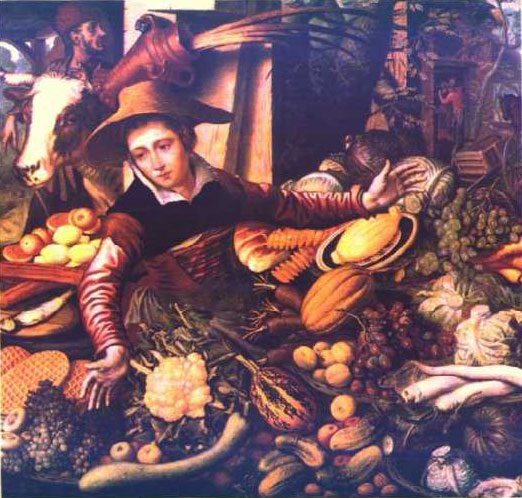
Market Woman With Vegetable Stall, by Pieter Aertsen, 1567
Notice the waffles at the lower left.
Vegetables were eaten daily in the Middle Ages & Renaissance, but, like today, were in many ways considered an inferior or secondary menu item; vegetable dishes are hardly ever mentioned in Medieval cookbooks. Victorian & early-20th century food historians seized on this fact as proof that vegetables were hardly ever eaten, but this was an erroneous assumption which fortunately is not given much credence today. The fact is that the use of vegetables was wide-spread and prolific, and vegetables were an important food item in the diet of nearly all Medieval people. The pure simplicity of vegetable preparation often meant that precious vellum or parchment wasn't wasted on recording the recipes; some cookbooks go so far as to point out that the ability to prepare vegetables is common knowledge and further instructions are not necessary.
A good example of the attitude toward vegetables is seen in the prevalent period response to onions, a staple of Medieval cooking. Onions were considered lower-class & peasant fare, an ingredient to be used for the meanest of meals only, and a food that should be disdained by the upper classes. Eating onions was also said to be bad for one's complexion or humour; the pallid countenance, waxy hair, and ill-manners of Chaucer's Summoner is blamed on his diet of onions and garlic. Still, no matter how people may have turned up their noses to the idea of eating onions, they ate them in great numbers anyway. Nearly every garden plot grew onions and they are mentioned in all of the existing Medieval cookbooks.
In the Medieval era, the differences between vegetables, herbs, and any plant used in cooking was less distinct than today. All of the various available vegetables were frequently lumped together under the term "potherb," which also included edible flowers such as violets and primroses and herbs such as fennel and rue. Judging by the significant usage of the word "potherb" in Medieval times, vegetables and other plants played a major role in everyday meals, enough that their absence would've resulted in a considerable loss of nutrition and vitamins.
Wortes was another common expression for certain vegetables, and included all leafy edible plants. Wortes were generally herb-plants such as parsley, but also included cabbage, spinach, and even onions & leeks.
The modern salad, with raw lettuce & vegetables tossed in oil and vinegar, is one of the most popular ways of eating vegetables today, and that was true in Medieval cookery as well. Many period cookbooks instruct vegetables to be served raw, by themselves or with vinegar, oil, and salt. And also like today, this way of serving vegetables was considered an excellent way to begin a meal. Platina wrote in De honesta voluptate:
"What should be eaten first. There is an order to be observed in taking food, since everything that moves the bowels and whatever is of light and slight nourishment, like apples and pears, is more safely and pleasantly eaten in the first course. I even add lettuce and whatever is served with vinegar and oil, raw or cooked." - Terence Scully, The Art of Cookery in the Middle Ages.
Le Menagier de Paris (a 14th century home manual written by an elderly bridegroom), in giving planting instructions to the Menagier's young bride, mentions many different flowers, vegetables, herbs, and fruits that are to be contained within their domestic garden. The list of vegetables features beet, leek, cabbage, parsley, bean, pea, spinach, lettuce, pumpkin, turnip, radish, & parsnip. In addition are other vegetables that the Menagier includes in his cooking instructions, which were purchased and not grown: carrots (which were specifically mentioned as being acquired in the market), shallots, cress, & garlic. The Menagier's recipes for vegetables are typical of the time period: simple and not nearly as numerous as his instructions for preparing meat and fish.
Terence Scully, in his book The Art of Cookery in the Middle Ages, 1995, has this to say about the preparation of vegetables:
"Most vegetables, whether leaves or roots, were chopped, ground and cooked by boiling. The logic of this cooking method lay in the tendency of vegetables, being products of the earth, to be dry in their nature (the exceptions being vegetable marrows, melons, & chard, all three of which were held to be rather moist); the action of stewing vegetables lent them the moisture they lacked by their nature. Members of the onion family, however, being moist in the third, and even fourth - or most dangerous (even mortal) - degree, were usually fried, thus removing a little of their superfluous moisture."
The 14th century French cookbook Le Viandier de Taillevant says this:
"154. D'autres menuz potaiges...: Other Lesser Pottages, such as stewed chard, cabbage, turnip greens, leeks, veal in Yellow Sauce, and plain shallot pottage, peas, frenched beans, mashed beans, sieved beans or beans in their shell, pork offal, brewet of pork tripe -- women are experts with these and anyone knows how to do them."
Medival Vegetable (Pottage) Garden
You might think that the Medieval diet was quite boring—after all, people were eating the same thing on a daily basis—but that’s not entirely true. Unlike today, where we pop down to the shop for strawberries in January, Medieval people ate what was in season. As such, their pottage would contain different ingredients from week to week. For example, fresh peas would only be around for a few weeks in springtime, whilst leeks and cabbages would only be eaten in autumn and winter.
NEVER, NEVER, NEVER: Potatoes; Yams; Artichokes; Green Beans; Corn (the yellow, white, or brown kernel-variety, grown on large cobs); Red, Green, & Yellow Peppers; Chilies; Tomatoes; Squash, Pumpkins. These are all modern foods that were not known in the Middle Ages. See Native American Foods
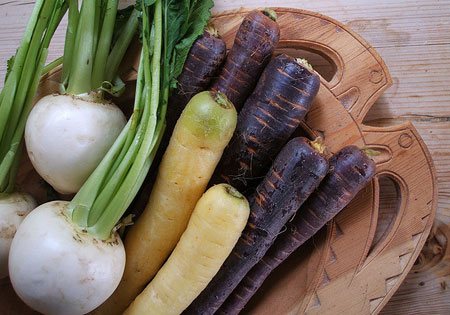
Vegetables List
Asparagus - used since Roman times.
Native to the Old World, asparagus was known to the Greeks and cultivated by the Romans. After the fall of the Roman Empire, it was mainly grown in Arab-ruled Syria, Egypt, and Spain. By the end of the Middle Ages it was cultivated in France, and by the early sixteenth century in England as well. It was usually eaten boiled and seasoned, but sometimes also coated in flour and fried.
Praised by physicians as a nutritious food, it was also considered an aphrodisiac for men. (See History of Asparagus)
Broad beans or fava beans - broadbean, fava (most common), haricot, hairy vetch, sweet vetch, but NEVER the modern green bean or dried beans such as navy beans, kidney beans, pinto beans, black beans,lima beans, and many others; see: Potage Fene Boiles.
Broad beans were indigenous to Europe, North Africa, and western Asia. They had been a staple for thousands of years before the discovery of the New World led to the introduction of the haricot bean. Perhaps because the consumption of beans causes flatulence, and, in some people, a disease called “favism,” beans have over time been the subject of much superstition. Pythagoras and his followers, for instance, abstained from eating meat as well as beans.
In medieval Europe both green and dry fava beans were eaten, mainly by the poor and by monks. Beans were a popular Lenten fare, and in times of famine bean meal was used in bread making. Most European upper-class cookbooks of the late Middle Ages contain few if any bean recipes.
Physicians recommended beans as a remedy for various ailments, but often warned of their consumption as food. It was thought that they caused dizziness, confusion in the head, sighing, a feeling of malaise, and an abundance of bad humors.
Beets - both the root and the tops.
A native of the Mediterranean and Atlantic coasts of Europe and North Africa, the beet was by 300 B.C. already cultivated to yield edible roots. In addition to the red beet, also called “Roman beet,” there were several other varieties that had yellow roots. Both the roots and leaves of beets, and of the related chard, the leaves and stalks, were eaten in the Middle Ages. As a staple of the lower classes, beet is rarely mentioned in the cookbooks of the rich. If it does turn up, then as an ingredient in sauces and broths, and as a coloring agent.
Beets were considered by medieval medicine as being of a cold and moist nature. The juice extracted from their leaves was used as a stool softener, and the root, burned and mixed with honey, as a remedy against hair loss.
Brussels Sprouts - not an overly common Medieval vegetable, but still widely available; see: Sprouts.
Cabbage/kale, or colewort - very common & popular, sometimes known as wortes; see: Compost & Buttered Wortes.
Of European ancestry, cabbages were originally headless, and were eaten by the ancient Egyptians, Greeks, and Romans. Not until the first century B.C. do we hear of headed cabbages that may have been cultivated in northern Europe first. In the Middle Ages the headless kale, or colewort, was a staple food of the Scots, while headed cabbage was favored by the Dutch and Germans. Other varieties belonging to the cabbage family that were cultivated in medieval Europe, especially in Italy, were cauliflower and broccoli. Headed cabbage was usually boiled or made into sauerkraut, as it still is today. The fact that in
Bavaria cabbage was eaten three to four times a day, as one sixteenth-century physician tells us, illustrates how important a foodstuff cabbage was for the common people. In the upper-class cookbooks, however, cabbage is rarely mentioned. Not only did it lack exclusivity, it was also thought to generate melancholy and cause nightmares. Its one redeeming feature was that it was considered an antidote to drunkenness. Cabbage juice with honey was recommended for people who had lost their voice, and cabbage leaves were used to dress wounds.
Capers
Carrots - not modern orange ones but a smaller variety, either red or white; see: Compost (Cold spiced vegetables in wine and honey sauce).
Known in Europe since prehistoric times, the carrot appears to have been cultivated for something other than its root early on, since it is not mentioned as a foodstuff by the Greeks and Romans. The carrot eaten in medieval Europe was introduced by the Arabs probably between the eighth and tenth centuries. Its root came in a tasty purplish red variety, and a coarser, somewhat inferior yellow-to-green variety. From Arab Spain carrots gradually moved north and reached France, the Netherlands, and Germany in the fourteenth century, and Britain in the fifteenth century. The orange carrots we still eat today first appeared in the Netherlands in the seventeenth century. (see History of Carrots)
Physicians described the dietetic qualities of carrots and parsnips in much the same way.
Cauliflower - its use seems to be mostly late-Renaissance; see: How to butter a Colle-flowre.
Celery - usually referred to as "wild celery," both the outer stalks and the hearts were used. (see History of Celery)
Chard - considered "moist" and treated differently than dry vegetables.
Chick Peas/garbonzo beans - see Chyches.
First cultivated in the Levant and ancient Egypt, the chickpea was a popular legume throughout the Mediterranean region in the Middle Ages. It played an important role in Arab cuisine and in the cuisines of Spain, southern France, southern Italy and Sicily, which were heavily influenced by the Arabs.
Like the bean, it causes flatulence and was thought to increase sperm, and provoke urine and menstruation. Physicians also recommended it against kidney and bladder stones.
Cress - a garden plant, considered a potherb or a worte; see: Salat.
Cucumbers - considered a "moist" fruit and treated differently than dry vegetables.
Thought to have originated in southern India, the cucumber was eaten in the ancient world and in medieval Europe. Because of their presumed cooling effect on the body cucumbers were recommended against fever, for hot climates, and for people with a naturally hot temperament.
Eggplant
Originally from India, eggplants were introduced to medieval Europe by the Arabs, but outside Spain and Italy only found slow acceptance. In the Spanish recipes they are usually peeled, cored, and stuffed, or chopped, fried, seasoned, and cooked. Medieval medicine warned of the melancholic humor they supposedly generated in the body.
Garlic - used in many recipes, and a staple in Medieval cooking; see: Salat.
From central Asia garlic reached Europe via the Middle East. In ancient Egypt and Greece it was a highly esteemed vegetable thought to give strength, especially to manual laborers and soldiers, and to possess magical powers against evil. Some upper-class Romans, however, rejected it on account of its strong smell.
In the Middle Ages, garlic was an important flavoring across Europe, used for many different sauces. One of them, the aillade, from southern France was even named after it. Since time immemorial garlic has also been known for its medicinal properties, as a cure for anything from headaches to snake bites. Those who could not afford the dozens of rare and expensive ingredients mixed with honey that formed the compound drug theriac, an ancient antidote for the bite of venomous animals, were advised to eat garlic, the “theriac of the poor.” It was also used to ward off the plague, but had little effect.
With its extreme heating and drying effect on the body, garlic was believed to incite lust.
Gherkins
Gourds
Gourds were cultivated in the Old World. Physicians considered them as cold and moist in their effect on the diner, as a thirst quencher, a laxative, and as beneficial to the young and in hot temperatures.
Green onions - see: Salat. Leeks, scallions, & green onions were sometimes referred to as "porrettes."
Kale - see Cabbage
Leeks - used in many recipes; see: Salat.
Leeks, scallions, & green onions were sometimes referred to as "porrettes." Leeks were cultivated in medieval Europe as a vegetable both nourishing and stimulating to the “desires of Venus.” This thought continued through the Renaissance where they were commonly consumed on wedding nights.
Milder and sweeter in taste than garlic and onions, leeks were highly esteemed in the ancient world. Perhaps because the Roman emperor Nero was so fond of leeks, leek recipes abound in the Roman cookbook of Apicius. Whether or not it was the Romans who introduced leeks to Britain, the fact remains that leeks were cultivated and consumed across Europe in the Middle Ages.
The dietetic qualities of leeks, according to medieval physicians, were similar to those of onions. To reduce the amount of wind created in the body by leeks, cooks were advised to boil them twice in different water.
Lettuce - leafy varieties, such as leaf lettuce, Romaine, etc. make acceptable substitutes for Medieval lettuce. NEVER use iceberg/head lettuce. Lettuce would have been considered a worte; see: Salat & Simple Sallet.
Lettuce has been used in the kitchen for thousands of years. Hippocrates and other Greek writers discussed it, and the Romans were fond of it. Because of its proven sleep-inducing or soporific qualities, it was originally eaten at the end of a meal, but later also with vinegar at the beginning as an appetite stimulant. In the Middle Ages lettuce appears to have played a minor role in European cookery, at least be fore 1400. By the sixteenth century, however, it was used for raw salads across the Continent. Part of the resistance to eating raw lettuce came from the medical community, which classified lettuce as so extremely cold and moist in nature that it was believed to be capable of quenching a person’s thirst and even extinguishing any feelings of lust.
Mushrooms - not a true vegetable, but used as one in the Middle Ages; see: Funges & Mushroom Pasty.
Since prehistoric times fungi of various kinds have been gathered and eaten in Europe. Aside from the common field mushroom, and porcini cep or king bolete, chanterelles and morels appear to have found particular favor with medieval cooks. Truffles were already highly prized by the Romans, judging from the six truffle recipes in the Roman cookbook of Apicius, and they continued to be an exclu sive foodstuff in the Middle Ages. Occasionally, dough preparations in the shape of fungi, such as morels, were served and named after the mushrooms they resembled. The German nun Hildegard of Bingen
called mushrooms the foam and sweat of the earth.Classical and medieval physicians warned of the mushrooms’ harmful moisture and earthiness that were thought to cause melancholy.
Mustard Greens - part of the potherb or wortes variety of vegetables.
Olives - the source for the most common cooking oil.
Onions - used extensively in Medieval cooking; see: Tart in Ymbre Day, Funges, etc.
Onions, garlic, and leeks all belong to the same family of vegetables that came to Europe from central Asia via the Middle East. They were documented in Egypt as early as 3200 B.C., and were a popular foodstuff throughout the ancient world. Because of the bad breath they cause, they have traditionally been associated with the lower classes, who ate them both raw and cooked.
In medieval upper-class cookbooks they do appear; in fact, the medieval French dish civet is named after onions. Eaten in conjunction with the meat of wild and domestic animals, onions were added to a variety of sauces, broths, and stuffings. Some recipes specify particular kinds of onions, such as shallots.
Doctors generally praised cooked onions for their heating and diuretic effects on the body. Onions were also thought to increase male sperm, and to incite appetite for food and sex. When consumed raw, onions supposedly caused headache, stomachache, and superfluous humors, especially phlegm.
Parsnips
Growing wild in Europe and western Asia, the parsnip has been cultivated since antiquity and was an integral part of the Roman diet. Up to the early modern period writers did not always make a distinction between parsnips and carrots. Sweet and starchy, the white parsnip was used in the Middle Ages as a substitute for honey and sugar, which were substantially more expensive. Easily stored for the winter in a cool place, or left in the ground until needed, it was an important vegetable, especially for the peasants.
Peas - in or out of pods, one of the most common of Medieval vegetables; see: Perry of Pesoun.
Like the fava bean, the pea was a staple in Europe for thousands of years. It was either eaten green or dried and used as a source of protein, especially during the long winter months and on fast days. Judging from the many recipes using peas in the cookbooks of the wealthy, the pea did not have a reputation as poor man’s food, as the fava bean did. In addition to pea soup and potage, the combination of peas and bacon was popular even then, as were “peas on a spit,” a mixture of peas and eggs, seasoned, and fried, and then roasted. Peas also played a role in imitation meat dishes for Lent.
Physicians generally approved of cooked peas as food that was easy to digest.
Pumpkin - the American variety is different than the European, but is an acceptable substitute; see: Gourdes in Potage.
Radishes - see: Compost.
Radishes, which have traditionally come in a variety of shapes, sizes, and colors, were eaten by the ancient Egyptians, Greeks, and Romans but are apparently not mentioned in European sources until the thirteenth century, when the German scholar and monk Albertus Magnus described different kinds, including a giant radish.
The medieval literature that does mention radishes classifies them as warm and dry in nature, as a diuretic, and as a foodstuff that generates bad humors, but is beneficial to people with a cold complexion, to weak people, as a winter food, and for those living in the cold north.
Scallions - Leeks, scallions, & green onions were sometimes referred to as "porrettes." see: Salat.
Shallots - see Onions
Spinach - a leafy, green worte; see: & Salat & Buttered Wortes.
Cultivated in Persia by the fourth century A.D., spinach became a fa vorite vegetable of the Arabs, who brought it to Spain in the eleventh century. Eventually it replaced the green vegetables that had tradi tionally been used in Europe, such as sorrel and orach (also called mountain-spinach, a tall, hardy annual and common potherb). Spinach was frequently boiled together with other green vegetables, or parboiled and fried. Spinach juice was also a favorite coloring agent
in the late-medieval kitchen.Regarded as a moderately cold and moist foodstuff, spinach was considered good for the chest, and especially for coughs, but bad for digestion.
Sprouts - cabbage sprouts; see: Sprouts
Squash/gourd - sometimes referred to as Vegetable Marrows; see: Gourdes in Potage.
Turnips - a common root vegetable, sometimes used in recipes as a substitute for pears; the greens were also very popular. White Turnip - see: Compost.
Turnips presumably originated in northern Europe around 2000 B.C. Considered rustic food by the Romans and in medieval Europe, they generally played a minor role in upper-class cookery. Since potatoes weren’t introduced to Europe until the late 16th century, turnips were the root veg of choice way back when. German peasants and craftsmen were said to eat turnips boiled with beef or butter, or pickled like sauerkraut. Turnip greens, too, were used and put into potages.
Physicians described turnips as hot and moist, flatulent, and an aphrodisiac. They were said to be good for the chest and the lungs, and as an appetite stimulant when combined with vinegar and salt.
Cooking Methods for Vegetables
- Boil until tender then season with butter or olive oil and a little salt. For an example see: Buttered Wortes.
- Boil until tender with other ingredients & spices. For example see: Gourdes in Potage.
- Boil until very tender, then mash and mix with other ingredients and spices. For an example see: Potage Fene Boiles.
- Boil until very tender, then chop into very small pieces to mix with other ingredients to make stuffings, pie fillings, etc. For an example see: Tart in Ymbre Day.
- Raw or cooked with vinegar and/or oil and/or salt. For an example see: Sprouts & Simple Sallet.
