Vietnamese Cuisine
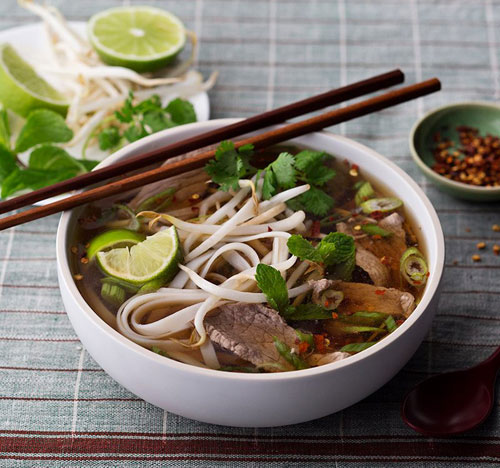
Vietnamese Pho made with beef
Vietnamese cuisine is a style of cooking with fish sauce, soy sauce, rice, fresh herbs, fruits and vegetables all commonly used. Vietnamese recipes utilize a diverse range of herbs, including lemongrass, mint, Vietnamese mint, long coriander and Thai basil leaves. See Vietnamese Herb Primer. Traditional Vietnamese cooking is greatly admired for freshness of the ingredients and for the healthy eating style.
The most common meats used in Vietnamese cuisine are pork, chicken, fish, and various kinds of seafood. Vietnamese also have a strong vegetarian tradition influenced by Buddhist values.
A staple combination of vegetables called a table salad accompanies almost any Vietnamese meal. It is eaten by itself, and is an integral part of dishes like charbroiled beef over rice vermicilli. It consists of pickled daikon, pickled (and fresh) carrots, mint leaves, bean sprouts, and lettuce. The daikon and carrots are often cut into curly squiggly matchsticks, for easy chopstick pickup. A table salad (xalach dia) of assorted fresh herbs, salad greens, and sprouts, and vinegared vegetables, comes as an accompaniment to almost every meal, and there are always condiments on hand. One of the most pleasurable aspects of eating Vietnamese food is the act of sampling, altering, and enhancing your food as you eat.
In Vietnam, a table salad is used in two main ways — as an accompaniment to meals in which little pieces of meat and seafood are wrapped in the lettuce and eaten out of hand and as an all-purpose salad. When eaten as a salad, diners tear off a piece of lettuce with some herbs and add to their bowls of rice or noodles, or fold the leaves and herbs into little packets to dip into a sauce.
Vietnamese soups exemplify the freshness, complex flavors, and flexible do-it-yourself aspect of Vietnamese cuisine. Large bowls of pho (hot soup) are a favorite breakfast in Vietnam—filled with noodles, bean sprouts, sprigs of fresh herbs, and lean pieces of chicken, pork, or beef. You can garnish your soup with more fresh herbs or sprouts from the table salad, or with any of the many little sauces and condiments that may be set out.
Vietnamese dipping and flavoring sauces are varied and wonderful. The most common of these is known as nuoc mam or nuoc cham. It's a pale blend of salty, pungent fish sauce diluted with fresh lime juice and sometimes vinegar, spiced with garlic and chopped chiles, and sweetened with a touch of sugar. You can drizzle it over your rice, use it as a dip for spring rolls or grilled meats, or add a spoonful to your soup. Other dipping sauces include nuoc leo, a peanut sauce; tuong ot, a red hot chile sauce similar to the Thai sriracha; and mam tom, a pungent shrimp sauce. One of our favorite condiments is a simple combination: a pile of black pepper and a pile of salt placed side-by-side on a small dish and served with a wedge of lime. You squeeze a little lime juice into the dish and blend some salt and pepper with it to make a paste into which you dip bits of meat from your soup.
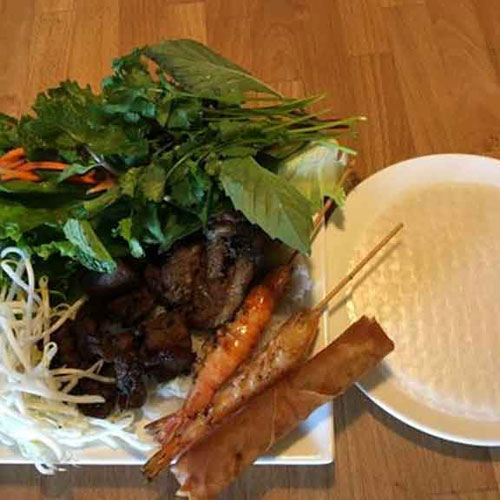
Bánh Hỏi Combo
Roll Your Own (Bánh Hỏi)
The other do-it-yourself element in many Vietnamese meals comes with roll-your-own rice-paper rolls. For example, grilled chunks of lemongrass beef (thit bo nuong), grilled meatballs (nem nuong), or freshly steamed shrimp (tom) all come served with a salad plate together with a stack of moist rice papers (banh trang) or fresh rice wrappers (banh uot). At the restaurant we went to, the rice papers were dry and it was served with a bowl of water to dip the rice paper in to soften in. You lay a wrapper on your open palm, put in a piece or two of meat, several strips of pickled radish, perhaps some herbs, sprouts, or rice vermicelli, then tuck over the ends and roll it up. You now have your own unique fresh spring roll that can be dipped in nuoc cham (fish sauce with lime and sugar) or nuoc leo (peanut sauce), or eaten simply on its own.
Recipe for Bánh Hỏi
Regional variations
Vietnamese cuisine can be divided into three categories, each pertaining to a distinct geographical region. With Northern Vietnam being the cradle of Vietnamese civilization, many of Vietnam's most notable dishes such as phở and bánh cuốn can trace their origin to the North. Northern cuisine is more traditional and less diverse in choosing spices and ingredients. The food of the north is heavily influenced by China with its stir-fries and noodle-based soups.
The cuisine of South Vietnam has historically been influenced by the influx of southern Chinese immigrants, French colonists and other nationalities. The tropical climate down south also sustains more rice paddies, coconut groves, jackfruit trees, and herb gardens. The food in southern Vietnam is typically sweeter: sweeter broths for pho, more palm sugar used in savory dishes, and those popular taffy-like coconut candies made with coconut cream. As a region of perhaps greater diversity in terms of external influences, the South's cuisine uses a wider variety of herbs.
The cuisine of Central Vietnam is distinct from the cuisines of both the Northern and Southern regions in its use of many small side dishes. For a while the country was ruled from Hue in Central Vietnam, so that most of the dishes were made small and dedicated to the kings. Compared to its counterparts, its cuisine is more spicy.
Typical Vietnamese family meals
A typical meal for the average Vietnamese family would include:
- Individual bowls of rice
- Meat, fish or seafood (grilled, boiled, steamed, stewed or stir fried with vegetables)
- Stir-fried, raw, pickled or steamed vegetables
- Canh (a clear broth with vegetables and often meat or seafood) or other Vietnamese-style soup
- Prepared fish sauce and/or soy sauce for dipping, to which garlic, chili, ginger or lime juice are sometimes added according to taste.
All dishes apart from the individual bowls of rice are communal and to be shared.
Popular Vietnamese dishes include:
| Vietnamese Dish | Description |
|---|---|
| Bánh hỏi | (Pronounced “baan hoy”) An extremely thin noodle that is woven into intricate bundles. Often topped with spring onion and a complementary meat dish, such as thịt heo quay (roasted pork, often eaten at weddings). |
| Bún thịt nướng | A thin rice vermicelli served cold with grilled marinated pork chops and nước chấm (fish sauce, served with julienned daikon and carrot). A similar Northern version is bún chả with grilled pork meatballs in placed of grilled pork chops. |
| Bún chả | A simple and popular dish, basically a combination vermicelli plate. Grilled pork (often ground) and vermicelli noodles are served over a bed of greens (salad and sliced cucumber), herbs and bean sprouts. Often includes a few chopped-up egg rolls, spring onions, and shrimp. Served with roasted peanuts on top and a small bowl of nước chấm. |
| Bún chả giò | It is similar to Bún chả except deep-fried spring rolls (giò) are substituted for the meats. |
| Cao lầu | A Hội An dish, made of specially "burnt-flavoured" egg noodles topped with meats. |
| Mì Quảng | A popular and extremely complicated noodle dish, originating from Quang Nam. Mi Quang varies in its preparation but features sharply contrasting flavors and textures in a shallow bowl of broth, noodles, herbs, vegetables, and roasted rice chips (Bánh tráng). |
| Mì xào dòn | A dish of crispy deep-fried egg noodles, topped with a wide array of seafood, vegetables and shrimp in a gravy sauce. This is a dish of Chinese origin. |
| Banh Tam Cari | A Ca Mau specialty, made of special rice noodles and very spicy chicken curry. |
