Vietnamese Noodles
from http://www.nguoi-viet.com/absolutenm/anmviewer.asp?a=80258
As Lan Nguyen Thi writes on her web page at http://www.vietnam-beauty.com/food-a-drink/vietnamese-food/22-vietnamese-food/166-vietnamese-cuisine.html, "...Vietnamese is noodle-crazy. You have seen regularly the appearance of noodle in their breakfast, lunch and dinner, in homes, restaurants and at roadside stands. Noodles are eaten wet and dry, in soup or beside soup, and are made in different shapes and thicknesses of wheat, rice and mung beans such as bun cha, Cao Lau, Hue beef noodle, bun rieu…Rice is also a main ingredients for making banh chung, banh bao, banh xeo, banh beo, xoi…
Knowing your Vietnamese noodles can be extremely helpful, especially if you’re about to order a noodle dish in a Vietnamese restaurant for the first time. Though many Việt noodles are made of rice flour and appear white when cooked, not all of them are the same.
On the Menu
Việt noodles are prepared in a variety of ways: In large bowls of soups, stir-fried, deep fried, eaten fresh topped with grilled meats or found in wrapped dishes such as fresh springrolls.
A Việt noodle dish is typically named by identifying the noodle first, then followed by the type of dish (stock and meat base) it is prepared in.
For example, seeing ''Bún'' in a restaurant means that the dish is identified as using Bún noodles. The dish will then follow the description of the dish. Just saying that you ate a Việt ''Bún'' is vague. A Vietnamese person would normally follow up by asking you, ''Which Bún are you talking about?'' For instance, ''Bún Bò Huế'' means the classic spicy noodle soup from the ancient Huế capital of Vietnam. ''Bún Thịt Nướng' means Bún noodles with grilled meat. In this dish, the bun noodles are served like a cold noodle salad, topped with meat, lettuce, herbs and dipping sauce.
The most common Việt beef noodle soup is known as ''Phở.'' This dish is collectively identified as the namesake of the noodle itself. In other dishes, larger, thicker strands of Phở noodles are stir fried or sometimes deep fried with meat and vegetables known as ''Phở áp Chảo'' or ''Phở Xào.''
To confuse things even more there’s ''Hủ Tiếu'' noodle soups. Hủ Tiếu are a general term for different varieties of noodle soup dishes that use Phở noodles and/or a combination of yellow egg flour noodles (''Mì'') or clear glass noodles (Miến). The base stock ranges from pork, chicken or duck.
If you just see ''Mì'' (Chinese egg noodles), then the noodles are specifically yellow egg flour noodles and they are prepared in either noodle soup or stir fried dishes.
Know Your Noodles
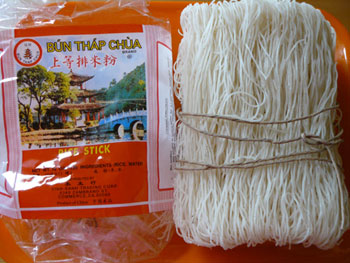
Bún noodles (Rice vermicelli): Round and white rice noodles
Common English names: Rice vermicelli, rice noodles, rice stick
We call it: Round, white, rice noodles or just Bún noodles. Easy.
Bún noodles are round and made of rice flour. Bún comes in two package forms, long strands that are folded and bundled up, and the other is in stick form. Bún noodles are available in different sizes, depending on the chef’s preference, or their regional specialties.
They’re used in a variety of brothy bowls of soup and fresh noodle dishes tossed with meat, lettuce and herbs. These noodles are used widely as a starch base (like rice), then topped or eaten along with meat, vegetable and/or herb accompaniments.
When eating cooked Bún, they should always be plump and still in its original long strands. If it’s in short, broken up strands, then it is considered overcooked and handled too roughly. Cooking Bún noodles can be tricky because it takes just one minute's difference between a great batch of plump Bún noodles to a bad, mushy batch.
Bún & Bún Dishes
Master Recipe for Vietnamese Bún Dishes
*Summer Rolls (Gỏi Cuốn)
Bì Cuốn (Shredded Pork Roll)
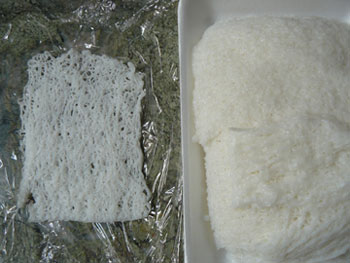
Bánh Hỏi: Square sheets of tiny, round rice noodles
Common English names: Fresh noodle sheet
We call it: Sheets of tiny rice noodles.
Bánh Hỏi are formed into flat, thin sheets of very tiny rice noodles. Normally eaten cold and used as a wrap for grilled meats, these noodles are very fun to eat. Because of their small square-size portions, they make the perfect accompaniment to add to lettuce wraps or fresh spring-rolls. Their unique size and form make them ideal for other hand foods.
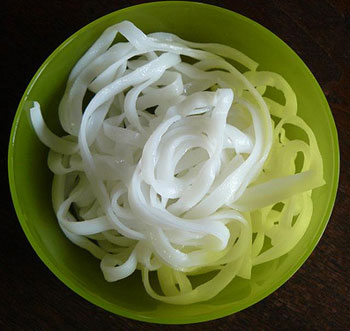
Phở noodles (Rice noodles): Flat, white rice noodles
Common English names: Rice stick, Rice noodles
We call it: Flat, white, rice noodles or just Phở noodles. Easy.
Phở noodles are flat and made of rice flour. Phở noodles are normally sold in long strands that are folded and bundled up. Also available in various size and thickness, cooked Phở noodles should be slightly chewy and not too soft.
In most good restaurants, the more commonly used Phở noodles in this popular beef noodle soup are the semi-dried types. These types are easily blanched and cooked to proper texture before the broth is added. When they are dropped into the bowl, they are usually still slightly undercooked, but as it simmers in the hot Phở broth, the noodles continue to cook in the bowl. If your bowl of Phở noodle soup has noodles that are starting to break apart right when you start to eat, then the noodles were overcooked.
Other popular noodle soup dishes using Phở type noodles will be called ''Hủ Tiếu,'' with meat accompaniments and stock base as chicken, pork or duck. These flat, rice noodle are also commonly used in ''Pad Thai'' noodle dishes and ''Phở áp Chảo,'' which are both cooked in a pan and tossed with meat and/or vegetables.
Vietnamese Noodle Soup (Easy)
Beef Pho Noodle Soup (Phở Bò)
Chicken Pho Noodle Soup (Phở Gà)
Pho Ap Chao Bo (Crisp Pan-fried Rice Noodles Sauteed w/ Beef)
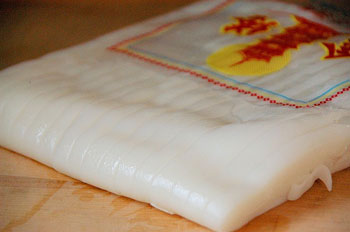
Mì Quảng Noodles: Flat rice noodle, traditionally yellow (most now are white)
Common English names: Have not found any yet
We call it: Flat, wide and thick, doughy rice noodle or Mì Quảng Noodles (yellow). Not so easy. But beware.
These noodles are used in two types of dishes. This noodle (in it’s white color) is used primarily in ''Phở Xào'' (stir fried Phở noodle dishes, not to be confused with the popular Phở beef noodle soup).Because they're wide and flat like Phở noodles normally are, these fresh ones are what restaurants choose to make the stir fried versions because they are already pre-cooked. Cooking thicker, dried Phở noodles can be tricky, so restaurants prefer these fresh ones. ''Phở Xào'' is prepared in the same way that ''Pad Thai'' is prepared.
In its yellow (turmeric addition) color, these flat, doughy rice noodles are traditionally eaten in Mì Quảng noodle dishes (some restaurants will use the white noodle version). But now many manufacturers are making them without the tumeric coloring, and just selling them in their original white color. Sold in ready to eat packages, these heavily oiled noodles must be separated, then unraveled into their separate strands. The reason for the oil is to keep the noodles from sticking together and drying out.
Mì Quảng noodle soups differ than most normal noodle soups in that Mì Quảng soups have just enough broth to barely cover the noodles. Unlike other Việt noodle soup bowls whose broth will cover the noodles almost completely, the Mì Quảng broth is barely enough to slurp during the meal. If you don’t eat a Mì Quảng bowl fast enough, the broth will quickly be soaked up by the noodles. Mì Quảng soups are generally pork & dried shrimp broth based, although some regional and family recipes will use chicken and even duck. What makes Mì Quảng soups unique is the richness of the broth, the lack of it and the crushed peanut toppings on the noodles.
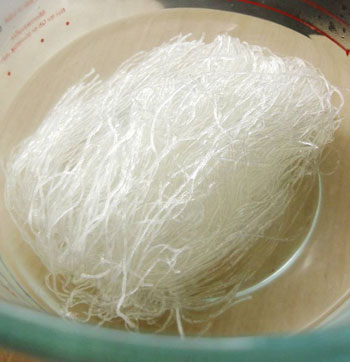
Miến Noodles (Glass noodles): Round and white (or translucent)
Common English names: Mung Bean threads/noodle/vermicelli, glass noodles, cellophane noodles
We call it: Round, glass, bean noodles or just Miến noodles. Kind of easy.
Miến are round and made of mung bean flour. Miến are sold in large packages or small, individual packages. Some manufacturers package these individuals in a pink, plastic netted bag, a dead give away as Miến.
Miến noodles are white when dried or after hydration in warm water, but when cooked, they become transparent and much more slimy and slippery than other noodles. Because these noodles are so fragile when boiling, they should be pre-soaked in warm/hot water for about 15 minutes. These delicate noodles will expand and be ready for cooking. When they are ready for boiling, they take just a few minutes to maintain the right, chewy texture. Anything more than that will be mush.
Miến noodles will be found in soups, tossed in stir-fries or mixed with meat and vegetables as a filler for other dishes. For example, many Việt fried springroll (Chả Gìo) recipes use Miến noodles as part of the filling.
Miến noodles should not be confused with rice vermicelli, which are made from rice and are white in color rather than clear.
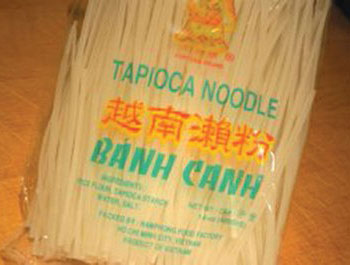
Bánh Canh Noodles (Tapioca noodles): Round and white
Common English names: Tapioca Noodle
We call it: Round, thick, chewy, ''Udon'' like , tapioca/rice noodle or Bánh Canh noodles. Not so easy.
Bánh Canh noodles are round, thick, pasty tapioca/rice flour noodles. Bánh Canh are normally sold dried as long sticks. Buying them in the fresh version is easier if it’s available at your Asian grocer. These noodles are similar in thickness to the Japanese Udon noodle. In fact, some Vietnamese restaurants will use the Udon noodle as a substitute for Bánh Canh noodle soups. Bánh Canh noodle soups usually have broths based with pork or chicken.
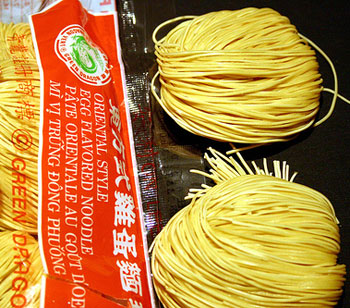
Mì Noodles (Chinese egg noodles): Round or flat and yellow
Common English names: Chinese egg noodles
We call it: Same as above or mì noodles. Easy.
Mì noodles are round or flat made from wheat flour and are commonly available in both the semi-fresh and dried forms. Most Chinese influenced Việt Mì noodle soups use the round noodles, although there are always exceptions to the rule and some cooks use the flat ones.
These common and hearty noodles are used throughout many Asian noodle soups, stir-fries and deep fries. The texture of these is more like pasta because of the use of wheat flour and/or eggs, so collectively most Vietnamese like them cooked just enough to maintain a bit of bite ''al dente.'' Việt Mì noodle soup bowls will have many varieties of soup stock bases, toppings such as meat balls, sliced meats and even meat filled wontons and dumplings.
