Cultured Dairy Products
Cultured creams have sour undertones that differ from the silky sweetness of creams that are not cultured. Cultured dairy foods enjoy a long and vibrant history. While culturing milk and cream inevitably offered the practical benefit of enabling dairy foods to last longer; it also enhanced their nutrient profile.
Cultured dairy is any food made by introducing live bacteria into fresh milk. As dairy ferments, beneficial bacteria release lactic acid, creating an acidic environment that helps to preserve the milk. This is why cultured dairy products taste sour. In essence, good bacteria convert the naturally occurring milk sugar (lactose) into acid. That process not only changes the flavor of the milk, but it also improves its nutritional profile and helps to preserve it for long-term storage.
This fermentation process is what converts milk into fresh cheese, yogurt, and other cultured dairy foods. It's also the reason yogurt and cheese have a longer shelf life than the cartons of milk you buy at the grocery store or from your local dairy. Historically, dairying people who relied heavily on milk needed a way to preserve it during the winter months when fresh milk wasn't accessible. Fermenting milk offered the perfect solution to preserve the food.
And it's those lactic acid bacteria (lactobacillus) that are also responsible for so many of fermented milk's health benefits.They're also the same kind of bacteria you find in other fermented food. This same class of beneficial bacteria turns cabbage into sauerkraut or cucumbers into sour pickles. In addition, they also release B vitamins during this process. That's why milk kefir and yogurt tend to be lower in sugar and often higher in some B vitamins than fresh milk. It's also why many people who are lactose intolerant can tolerate small amounts of hard cheeses or fermented dairy products.
Yogurt and similar foods are rich sources of probiotics (the product must contain live cultures - which are the probiotics), and researchers consider cultured milk to be a functional food. That means that it conveys more health benefits than nutrition alone.
Also see:
Sour Cream, Crema, Crème Fraîche: What's the Difference?
Making Homemade Cultured Dairy
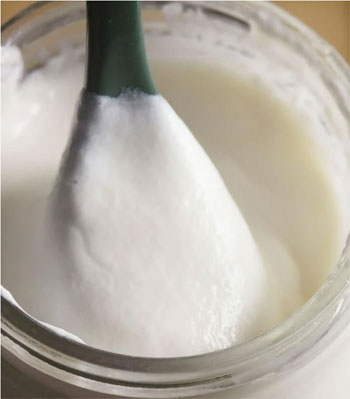
Buttermilk - 1–2% milk fat
Despite its name and creamy consistency, buttermilk is relatively low in fat. Most modern buttermilk is cultured buttermilk, made from low-fat or skim milk and has less than 2 percent fat. The resulting product is thicker than traditional buttermilk.
It's sometimes tolerated by people with lactose intolerance since some of the lactose is fermented by bacteria. Most of the buttermilk found in supermarkets is cultured buttermilk, made by adding a bacterial culture to low-fat or nonfat milk. More authentic and tasty, though, is churn buttermilk, which is the liquid that remains after milk is churned into butter. Since recipes often call for just small amounts of buttermilk, many cooks use reconstituted powdered buttermilk.
Substitutes:
- Combine one cup of milk (or soymilk) plus one tablespoon of lemon juice or vinegar, and allow to stand for ten minutes
- OR Combine one cup of milk plus two teaspoons cream of tartar, and allow to stand for ten minutes
- OR Combine two parts plain yogurt plus one part milk or sour cream (in batters that also call for baking soda)
Cooking hints: Churn buttermilk may require longer baking times than ordinary commercial buttermilk.
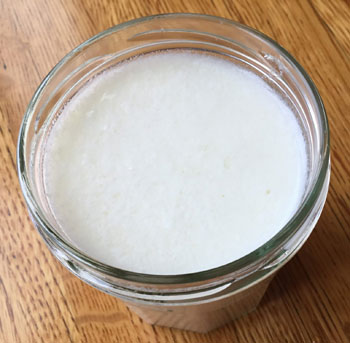
Sour Milk -
In older recipes that call for sour milk the term refers to milk that was not consumed before it went sour. Prior to refrigeration, this was a common occurrence. Sour milk is NOT the same as spoiled milk that has gone bad and which may contain toxins. Store-bought, pasteurized milk doesn't sour; it just goes bad. Spoiled milk looks, smells, and tastes bad because of an overgrowth of bacteria.
Sour milk is raw milk that was not used quickly enough. Raw milk is loaded with enzymes and probiotics. When raw milk starts to sour, it simply means that beneficial bacteria called probiotics have started to use up the lactose (milk sugar) which causes the milk to no longer taste as sweet.
Acidified milk, milk that has had an acid such as vinegar or lemon juice added to it, can be substituted for sour milk but it is not the same thing. Today with modern food safety ideas, it is not considered safe to drink sour milk, but it was commonly used in cooking which would have killed any bacteria present.
Substitutes: buttermilk OR Mix one tablespoon lemon juice or distilled white vinegar with one cup of milk, let stand for 5 minutes.
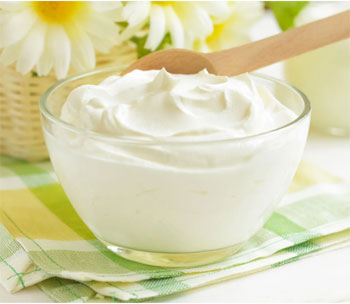
Yogurt - 0.5–4% milk fat
This is milk that's cultured with bacteria to make it thick and tangy. Ready-made yogurts are made from whole milk (with up to 4% butterfat), lowfat milk (with up to 2% butterfat), and skim milk (with up to .5% butterfat).
The origins of yogurt are unknown, but it is thought to have been invented in Mesopotamia around 5000 BC. In ancient Indian records, the combination of yogurt and honey is called "the food of the gods". Persian traditions hold that "Abraham owed his fecundity and longevity to the regular ingestion of yogurt". The cuisine of ancient Greece included a dairy product known as oxygala (οξύγαλα) which was a form of yogurt. Galen (AD 129 – c. 200/c. 216) mentioned that oxygala was consumed with honey, similar to the way thickened Greek yogurt is eaten today.
Health buffs prefer brands that contain active cultures, which help keep their intestines populated with friendly bacteria (probiotics). Many brands are heat-treated to destroy these cultures and increase shelf life.
Yogurt often comes with added flavorings and thickeners. To offset its natural sourness, yogurt is also sold sweetened, sweetened and flavored, or in containers with fruit or fruit jam on the bottom. In North America, strained yogurt is commonly called "Greek yogurt". Powdered milk is sometimes added in lieu of straining to achieve thickness. In Britain the name "Greek" may only be applied to yogurt made in Greece.
Homemade Fresh Yogurt
Homemade Yogurt Cheese
Indian Dishes:
Curd Rice (Yogurt Rice)
Butter Chicken
Tandoori Marinade (good for grilling chicken)
Chicken (or Shrimp) Tikka (skewers)
Chicken (or Shrimp) Tikka Masala
Mughlai Biryani
Hyderabadi Chicken Biryani
Raita (yogurt condiment, serve with tandoori meats or biryani)
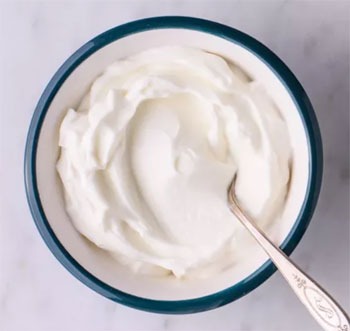
Sour Cream - 14–18% milk fat
Sour cream is a dairy product obtained by fermenting regular cream with certain kinds of lactic acid bacteria. The bacterial culture, which is introduced either deliberately or naturally, sours and thickens the cream. Its name comes from the production of lactic acid by bacterial fermentation, which is called souring. Crème fraîche is one type of sour cream with a high fat content and less sour taste.
Sour cream is commonly used as a condiment on foods, or combined with other ingredients to form a dipping sauce. It can be added to soups and sauces to help thicken and make them creamy, or in baking to help increase the moisture level over and above using milk. In Tex-Mex cuisine, it is often used as a substitute for crema in nachos, tacos, burritos, and taquitos.
Homemade Sour Cream
This ambrosial-tasting cultured dairy product can be easily made at home, and is significantly cheaper than shop-bought sour cream. Success depends on the freshness of your ingredients, as well as controlled incubation. Use homemade sour cream in any recipe calling for sour cream.
Preparation time: a few minutes
Culturing time: 24 hours
Makes: 2 cups
2 cups light cream (no more than 30 per cent butterfat), at room temperature
2 tablespoons cultured buttermilk at room temperature
Place the cream in a glass or ceramic bowl, or better still in a glass-lined thermos flask, or an electric yogurt maker.
Stir the buttermilk into the cream, and tightly cover it.
Leave it in a warm place for twenty-four hours. Stir to blend, and refrigerate.
Also see Homemade Sour Cream
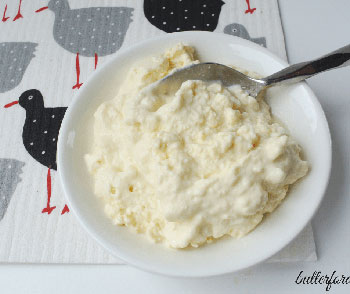
Clabber Cream - 55% milk fat
Clabber Cream is a spooning cream rather than a pouring cream. Clotted cream originated in Southwest England (either in Cornwall or Devon, depending on who you ask), and Cornish clotted cream has been awarded the EU’s Protection Designation of Origin. It has a minimum of 55% butterfat. Clabber Cream is very, very similar to créme fraîche, but Clabber Cream is thicker, more like a smooth ricotta. It isn’t made much anymore.
Raw cow’s milk is full of naturally occurring beneficial lactic acid bacteria. When that bacteria is supported with a warm environment, it will ferment the milk and create something like a cross between yogurt and kefir. Eventually, if left to ferment long enough, the clabber milk will separate into curds and whey.
A silky, golden-yellow cream made by allowing unpasteurized cow’s milk (traditionally from Jersey cows) to sit for 12-24 hours in shallow pans. During this time, the cream rose to the top and bacteria in the milk would eat the lactose sugar in the milk, converting it into lactic acid, which in turned thickened the milk by making minute curdles in it. Even though the cream was removed from the top, the milk underneath would be thicker than it was when it started, anyway. The milk and cream also acquired a slight sour cream taste, somewhat similar to yoghurt in flavour.
The cream was then slowly heated and left to cool for another 12-24 hours. The cream that rises to the surface and “clots” is skimmed off and served with scones, berries, or desserts. The best clotted cream is said to have a good, firm crust atop smooth, thick cream.
This can’t be done with pasteurized milk or cream, because the bacteria needed will have been killed off. The milk won’t clabber, it will just go sour. Consequently, if you wanted to make Clabber Cream at home, you’d have to buy commercial clabber cream to use some of it as a starter to put in pasteurized full-fat milk. To make modern pasteurized milk clabber, add buttermilk to it.
In the southern states of America, Clabber Cream was very popular. It would be served in a dish with sugar, fruit, cinnamon and brown sugar, or salt and black pepper on top, or used as a dessert topping. Creole cream cheese is made from Clabber Cream.
Clabber Cream is not the same as clotted cream (aka Devonshire Cream.)
Substitutes: créme fraîche (thinner consistency) OR ricotta cheese (especially suitable as a pasta filling) OR buttermilk cheese (as a pasta filling)
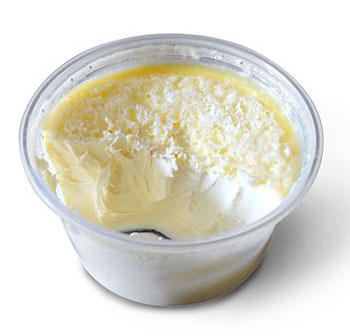
British Clotted Cream - served with scones and jam (55% milk fat)
Cornish Clotted Cream is a high-fat cows' milk cream. It is a thick cream, with a very high fat content (a minimum of 55 percent, but an average of 64 percent). Although its origin is uncertain, the cream's production is commonly associated with dairy farms in South West England and in particular the counties of Cornwall and Devon.
Traditionally, clotted cream was created by straining fresh cow's milk, letting it stand in a shallow pan in a cool place for several hours to allow the cream to rise to the surface, then heating it either over hot cinders or in a steam or water bath, before a slow cooling. During this time, the cream content rises to the surface and forms "clots" or "clouts", hence the name. The clots that formed on the top were then skimmed off with a long-handled cream-skimmer, known in Devon as a reamer or raimer.
During production, the product develops a characteristic nutty flavour and a consistency that is a mixture of thick and thin areas. It cannot be poured, but rather is usually rather spread, and it has little detectable smell. It has a surface crust which is golden in colour with a rough texture, whilst the underside is lighter in colour and both smooth and creamy in texture. The colour can vary between cream to a golden yellow depending on the breed of cow from which the milk was derived and the season of the year.
Clotted cream is an essential part of a cream tea, a favourite with tourists particularly in Cornwall and Devon. It is served on scones—or the more traditional "splits"—with strawberry jam, along with a pot of tea. Traditionally, there are differences in the way it is eaten in each county: in Devon, the cream is traditionally spread first on the scone, with the jam dolloped on top. In Cornwall the jam is spread first with a dollop of cream.
Homemade Clotted Cream (made by heating heavy cream for 12 hours or more)
Mock Clotted Cream (made with cream cheese, butter, sour cream)
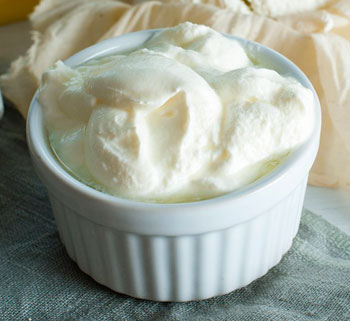
Crème Fraîche - 30-40% milk fat
Crème Fraîche is a soured cream containing about 28% butterfat and with a pH of around 4.5. It is soured with bacterial culture, but is less sour than sour cream. It has a comparatively high viscosity and a higher fat content. Originally a French product, it is available in many countries.
This slightly sour thick cream doesn't curdle when it's heated, so it's ideal for making cream sauces. It's also used for appetizers and as a dessert topping. Crème Fraîche can be whipped and used in desserts instead of whipped cream.
To make your own: Warm one cup heavy cream to about 100°, then add one or two tablespoons of sour cream or cultured buttermilk (make sure you buy a brand that contains active cultures). Allow the mixture to sit at room temperature for at least nine hours before refrigerating.
See the Crème Fraîche page for further information for making your own homemade Crème Fraîche.
Substitutes: crema Mexicana OR equal parts sour cream and heavy cream OR clabber cream (thicker consistency) OR sour cream (This has a lower fat content, and so it's more likely to curdle if boiled with an acidic ingredient.) OR yogurt (This will definitely curdle when boiled.)
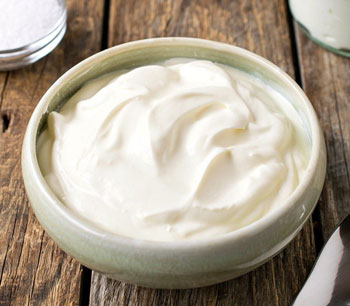
Mexican Crema - about 30% milk fat
Cremas are the Hispanic version of sour cream. Thick and slightly tangy Mexican crema adds the perfect touch of creamy richness to many Mexican dishes. Drizzle it on tacos, tostadas, enchiladas and anything spicy to tone down the heat!
Mexican Crema is a creamy and slightly tangy condiment very similar to sour cream. It’s thicker and richer than American sour cream, but not as thick and rich as French crème fraîche. Sour cream has a fat content of about 20%, is a bit more acidic in flavor and is fairly thick. It also tends to curdle easily when used in hot preparations. Mexican crema has a higher fat content of about 30%, isn’t quite as sour and is a lot thinner. It doesn’t curdle which makes it perfect for mixing into hot dishes and adding some richness.
Crema types include crema Mexicana (the most common one), which is similar to crème fraîche, crema Centroamericana, which is a bit thicker and sweeter than crema Mexicana, crema media, which is like whipping cream, crema Mexicana agria, which is thicker and more acidic than crema Mexicana and often used for savory dishes, and crema Salvadoreña, which is thick like sour cream.
Where to find: Mexican grocery stores
Substitutes: The best substitute is crème fraîche. You can use it as is or mix it together with a bit of lime juice to get it to a thinner consistency that resembles crema. Crème fraîche (not as sweet or creamy) OR sour cream (more sour and more likely to curdle when cooked in a sauce due to the lower milk fat)
See Mexican Crema for a recipe for making your own.
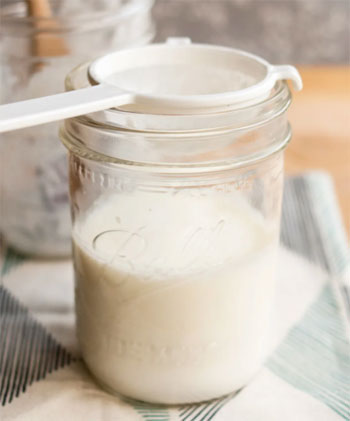
Kefir - 0-4% milk fat
Pronunciation: keh-FEER
Regarded as the king of dairy, the champagne of milk and the ancient food miracle, kefir is the fermented drink taking the world by storm. Kefir is a cultured, fermented milk drink that contains beneficial yeast, probiotic bacteria and an abundance of vitamins and minerals. Its proponents boast of its health benefits, particularly for the gut. It tastes similar to the Turkish yoghurt drink ayran, but with a much more tart taste and a slight fizz – and a barnyard smell.
It was originally made in Turkey out of camel's milk. Milk kefir can be made with milk from a cow, sheep or goat milk and kefir "grains", which aren't grains at all but a "scoby ", a symbiotic culture of various bacteria (vs only 2 bacteria in yogurt) and yeast, containing about 30 distinct microbes. This leads to a double fermentation (lactic + alcoholic) and develops the sour & fizzy attributes of kefir. If looked after properly, milk-kefir scoby is immortal and will double every seven to 10 days. It comes plain or flavored.
The gelatinous scoby look like clumps of coral. They ferment the milk (or water), and once the fermentation process has been completed, they are removed with a strainer.
Kefir's story originates in the Caucasus Mountains, where the folk developed the fermented drink by accident and consumed it in large quantities. Legend has it, those people lived long, healthy lives with little disease.
There are two types of kefir: milk and water. Water kefir has a much milder flavour than its milky sibling. It is also made using a scoby, but the bacteria and yeasts feed on carbohydrates instead of lactose. Water kefir can be produced from many liquids, including sugar water, coconut water and soy milk, and is flavoured with fruits, herbs and ginger.
To make your own: Add a tablespoon of plain kefir (with active cultures) to milk and keep it at roughly 110° for several hours, then refrigerate.
Substitutes: yogurt (tarter and thicker) OR kumiss
Kumiss - 4%? milk fat
Pronunciation: KOO-miss
Like kefir, kumiss is a beverage made from milk cultured with bacteria. Asian nomads originally made it with the milk of camels or mares, but commercial producers now use cow's milk.
Substitutes: kefir
