Cooking Fish
from "Fixing Fish," Mother Earth News, Issue # 105 - May/June 1987, by Carol Taylor (modified & recipes added)
Actually, fixing fish requires neither elaborate equipment nor complicated technique. If you can bake, broil, fry and simmer, you can produce superb seafood. When dinner goes awry, it's usually because:
1) the fish isn't fresh
2) the cooking method doesn't match the species
3) the fish overcooks.
All these pitfalls are easy to avoid. Basically, there are two kinds of fish and four ways to cook them. The trick is to match the former with the latter.
(Note: The most common fish species raised by fish farms are salmon, carp, tilapia, European seabass, striped bass, rainbow trout, catfish and cod. This list is not up to date.)
Kinds of Fish: Lean & Fat
Whether freshwater or saltwater, fish are either lean or fat. Lean salt water fish are usually demersal fish which live on or near the seafloor, whereas oily fish are pelagic, living in the water column away from the bottom.
Most are lean. Whatever oil they have is concentrated in the liver (hence cod-liver oil). With little fat in the flesh, lean fish are white or light-colored and mild in flavor. Because their flesh is often white in color, lean fish are sometimes referred to as whitefish. Examples of lean fish:
|
|
In fat fish, oil is distributed throughout the flesh, which is darker or pink, with a more pronounced flavor. Popular fat fish are:
|
|
(Don't be put off by that term. Even the oiliest fish are only about 10% fat; ground beef weighs in at 30%. And researchers are investigating the possibility that fatty omega-3 acids deter heart disease.)
Cooking Technique
Once you know a fish's fat content, you can decide on an appropriate cooking technique: baking, broiling, frying or poaching (simmering in a liquid).
With lean fish, the critical problem is to keep it from drying out. Thus, it lends itself to the wet-heat methods— poaching and frying-which add moisture or fat. Lean fish also bakes well, as long as it's covered with a sauce or basted with an oil-based marinade. Broiling is chancy. The intense, direct heat dries and toughens. If you must broil lean fish, watch it like a fish hawk and slather it with fat.
Fat fish, on the other hand, thrives under dry heat; it bakes and broils extremely well. It's less successful when fried (super-greasy) or poached (except for salmon, the classic poached fish). However it's cooked, fat fish can taste oily unless it's prepared with an acid ingredient: citrus, vinegar or wine.
The weather and the food distribution system being what they are, it's hard to predict what will be caught and delivered. So it's best to shop for a type of fish, rather than for a particular species. While the fish in each category are not identical, they are largely interchangeable. If your recipe calls for orange roughy—a lean New Zealand import—and there's none to be had, substitute any lean variety that's fresh and affordable. See Fish Substitutions.
The Four Techniques [actually 5 - "Frying" includes Pan Frying and Deep Frying, which are very different techniques]
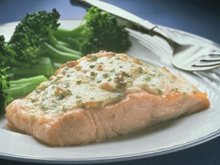 Baking. Baking is one of the simplest, easiest and safest ways to cook fish. Preheat the oven to 450°F and wipe the fish with paper towels. Oil a baking pan, or coat it with nonstick spray. Place the fish in the pan, and brush with a mixture of equal parts lemon juice and melted butter. Bake 10 minutes per inch, basting twice and checking for doneness 1 or 2 minutes earlier.
Baked stuffed fish may be made with any thin fish fillets that can easily be rolled. Sole and flounder are excellent choices, and tilapia can work as well.
The important thing is not how you cook it but when you stop.
*Baked Salmon or Tuna Steaks (butter, lemon, garlic, parsley)
*Baked Fish w/ Yogurt
Salmon in Puff Pastry
*Crab Stuffed Flounder w/ Shrimp Sauce
Scallop Stuffed Flounder
Founder with Shrimp Stuffing
Fantastic Flounder (Parmesan crusted)
Broiling (also Grilling). Preheat the broiler for 10 minutes. Oil a broiling pan (or coat it with nonstick spray), place the fish on the rack, brush with butter or oil (or butter and lemon juice) and broil 2 to 4 inches from the heat for 10 minutes per inch, basting and checking for doneness frequently. Only very thick pieces should be turned during cooking. When Grilling, it is a good idea to use aluminum foil to keeps the juices around the fish.
*Broiled or Grilled Fish Steaks (tuna, salmon)
*Broiled or Grilled Fish w/ Yogurt (cod, halibut)
*Grilled Salmon Steaks w/ Black Butter
Poaching. Texture largely determines whether a fish poaches well. Soft-textured fish—bluefish, for example—disintegrate in a simmering liquid. Firm fish—perch, trout, salmon, swordfish, snapper, in fact most fish—hold their shape.
The traditional poaching liquid is a Court-Bouillon ("coor boo-yon"), a vegetable-and-wine broth that varies with the cook. A typical list of ingredients: 6 1/2 cups water; 1 1/2 cups dry white wine; 1 large carrot, sliced; 1 rib celery, sliced; 1/2 lemon, sliced; 2 sprigs parsley; 6 black peppercorns; 1 bay leaf. Simmer the ingredients for 10 to 15 minutes to combine the flavors.
To poach fish, prepare the court bouillon (or use a liquid of your own devising) in a large pot. Wipe the fish with paper towels, place it on a rack and lower it into boiling liquid. Cover the pot. When the liquid returns to a boil, immediately reduce the heat until the liquid quivers but does not boil. (Small bubbles should rise gently from the bottom.) Cook 10 minutes per inch, checking for doneness 1 or 2 mintues earlier.
Plain poached fish can be rather bland. Plan to serve it with a sauce or condiment.
Poached Salmon w/ Tarragon Herb Sauce
Court-Bouillon for Poaching Fish
Frying. Fish can be pan-fried (in a little oil) or deep-fried (in a lot).
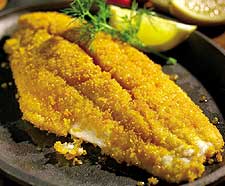 Panfried Catfish |
Pan-frying: Heat 1/8 to 1/4 inch vegetable oil in a heavy skillet until oil is medium hot (a drop of water should sizzle when dropped into the oil). Wipe the fish with paper towels, dust with seasoned flour (a mix of flour, salt and pepper) and fry 10 minutes per inch, dividing the time between the two sides and checking for doneness 1 or 2 minutes earlier. Don't crowd the fish while they're cooking, or the oil will cool and the fish will be soggy. Drain on paper towels and serve immediately. *Pan-fried Fish |
Deep-frying: Make a batter and chill it. (Any flour-based batter will do. One example: Combine 1 cup flour, 3 tablespoons cornstarch, l teaspoon salt, dash nutmeg and 1/8 teaspoon pepper. Add 1 cup beer and 1 tablespoon oil and mix until smooth.)
Chill the fish, which should be in relatively small pieces. Heat 2 to 3 inches oil in deep-fryer or deep skillet to 375°F (a 1-inch cube of bread should brown in 30 seconds). Don't fill the pan more than half full, or the oil will overflow when hot. Pat the fish pieces dry with paper towels, dip them in chilled batter and drop them into the oil. Don't crowd them, or the oil will cool. Fry 10 minutes per inch, turning once and checking 1 or 2 minutes before time is up. The outside should be crisp and brown, the inside moist and opaque. The batter should form a crust and seal the fat out.
*Southern Fried Fish Fillets (cornmeal breading) - great for catfish
*Beer Batter for Fish & Seafood (good for Fish 'n' Chips) - cod is traditional in England, but great for a frying fish & seafood
Deep-fried Breaded Fish (Allegany County Fish Fry) - haddock is traditional in Allegany County
Catfish Louisiana (w/ Cajun flavored shrimp sauce)
Japanese Tempura (a light batter that would work well for a light fish such as flounder or tilapia)
Fritto Misto (Italian "mixed fry," also a light batter that would work well for a light fish such as flounder or tilapia)
