Types of Brassica
Brassica (pronounced brás-si-ca) is a genus of plants in the mustard family (Brassicaceae). The members of the genus may be collectively known either as cabbages, or as mustards. Crops from this genus are sometimes called cole crops, which is derived from the Latin caulis, meaning stem or cabbage.
Brassicas should be stored whole in a roomy plastic bag or reusable produce bag in the refrigerator. To make your Brassica last for a long time, don’t wash it until you’re ready to eat it. Any lingering moisture on the leaves will result in faster spoilage, prompting it to become mushy. The same rule applies for cutting it: Don’t slice or shred Brassica until you want to cook or prepare it.
Widely considered to be healthful foods, they are high in vitamin C and soluble fibre and contain multiple nutrients with potent anti-cancer properties: diindolylmethane, sulforaphane and selenium.
Green Cabbage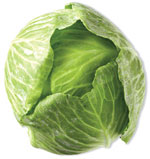 |
Green cabbage is a large, heavy, dense cabbage that has extraordinary storage power – it seems to last forever in the fridge, even when cut into. It’s the most common grocery store variety, and one of the most affordable, too. It is pale in color with tightly held leaves. It is used in soups and slaws. When looking for a head of green cabbage, look for one that is heavy for its size and has no discoloration. Like all cabbages and brassicas, green cabbage can be eaten raw and cooked. It is popular for its crunchiness and mild flavor. It’s the obvious choice for a refreshingly ice cold coleslaw at a summer cookout, but it works well in warm recipes, too. (It’s superb in a one-skillet meal, or a low-and-slow braise; and unlike spinach, it won’t cook down to nothing). Its slightly bitter, base-note flavor pairs well with sharp, pungent ingredients, like mustard, garlic, and horseradish. *Mom's Cole Slaw |
Red Cabbage 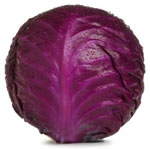 |
Red — sometimes called purple — cabbage is similar in shape, size, and density to green cabbage, and adds a burst of color to any salad or stir-fry. Red cabbage takes longer to mature than green cabbage, so they usually are not as tender. This variety is perfect for serving raw in salads and slaws. The color in red cabbage can often run when cooked. Other foods will turn red and the cabbage will take on a bluish hue. This can be avoided by cooking with an acid such as lemon juice or vinegar. *Salad Bar |
Savoy Cabbage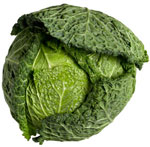 |
Adjacent in appearance to green cabbage, dark green Savoy cabbage is differentiated by softer leaves with a crinkled, frilly look. It’s also looser than ultra-dense green and purple cabbages, which makes it a nice substitute for recipes that call for Napa cabbage. Savoy cabbage was originally cultivated in the Alps, so France, Switzerland, and Italy can all lay culinary claim to this versatile cabbage. Tender and sweet, Savoy cabbage is popular in Italian recipes and has a milder flavor than green cabbage. It’s less satisfyingly crunchy than the hardier cabbage varieties, but does well when cooked. Savoy cabbage can stand up to your usual braises and low-and-slow varieties, but owing to its softer texture, it works in quick-cooking preparations, like sautéeing or stir-frying. Look for heads with even green coloring and slightly cone-shaped leaves. The leaves should be crisp, not limp, and there should be no sign of browning. The firmer leaves work well when cooked in such dishes as cabbage rolls. |
Napa (Chinese) Cabbage 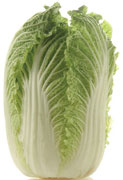 |
Napa cabbage was introduced into North America from China in the 1880's. Because this type of cabbage originated in China, it’s sometimes referred to as “Chinese cabbage.” It has thick, big white ribs and tender, pale green leaves. Compared with green and red cabbages, it has a less dense or heavy feeling; it’s also oblong, rather than round. Napa can be served cooked or raw and works particularly well in stir-fries and soups. That said, it has a rich history of use in plenty of other East Asian countries. Thai Cole Slaw |
Bok Choy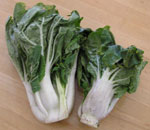 |
Bok choy is a Chinese cabbage sometimes spelled pak choi. The tops of its leaves are pale to dark green and tender, while the lower stem is crunchy, with a juicy, celery-like texture. Bok choy has a sweeter flavor than the denser cabbages, making it a natural choice for preparations where the veggies are meant to shine. It’s grown in summer (or year-round in temperate climates). Like kale, it’s most subtle and mild when it’s harvested young. It's usually stir-fried with other ingredients, but it can also be steamed or sautéed and served as a side dish. Baby bok choy can be cooked whole — it is a great addition to stir-fries — while mature bok choy is best prepared by shredding or slicing. |
Brussels Sprouts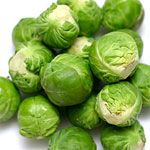 |
Brussels sprouts were originally cultivated in Brussels — which is why the name of the vegetable is always capitalized. Unlike traditional cabbages, which grow directly from the ground, Brussels sprouts grow on thick, woody stalks. They look like small cabbages and have tightly-packed heads that can range in the size of a quarter to a small lemon. They're most often boiled or steamed and served as a side dish. They have a rather strong flavor, so it's best not to pair them with anything that's delicately flavored. They are tasty when satuéed or roasted, but these easily-sourced brassicas also shine in raw preparations (letting them marinate in a dressing for a few hours before serving will take away some of the “bite.”) In the supermarket, look for fresh, unfaded green color with no sign of yellowing. The heads should be dense and firm, the leaves unwilted. *Steamed Brussels Sprouts |
Cauliflower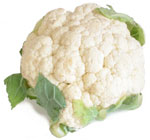 |
The milk, sweet, almost nutty flavor of cauliflower is at its best from December through March when it is in season and most plentiful in your local markets. Cauliflower lacks the green chlorophyll found in other members of the cruciferous family of vegetables like broccoli, cabbage and kale, because the leaves of the plant shield the florets from the sun as they grow. It has a compact head (called a "curd"), usually about six inches in diameter that is composed of undeveloped flower buds. The flowers are attached to a central stalk. |
Broccoli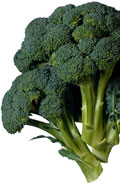 |
Broccoli possesses abundant arboreal, flower heads, usually green in color, arranged in a tree-like fashion on branches sprouting from a thick, edible, sturdy stalk. The mass of flower heads is surrounded by lavish leaves. Broccoli is usually boiled or steamed, but may be eaten raw and has become popular as a raw vegetable in hors-d'oeuvre trays. Although boiling has been shown to reduce the levels of suspected anticancer compounds in broccoli, other preparation methods such as steaming, microwaving, and stir-frying have not been shown to reduce the presence of these compounds. *Steamed Broccoli |
Broccoli Raab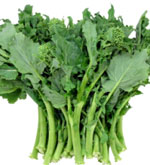 |
Broccoli Raab (or Rabe), also known as Rapini (rah-PEE-nee), is a common vegetable in Galician, Chinese, Italian, and Portuguese cuisine. Broccoli raab isn't actually related to broccoli. Instead, it's closely related to the turnip. And the best way to approach it is just as you would with bitter leafy greens, like mustard greens or turnip greens. Broccoli Raab has many spiked leaves that surround a green bud which looks very similar to a small head of broccoli. There may be small yellow flowers blooming from the buds, which are edible. The flavor of rapini has been described as nutty, bitter, pungent, and "an acquired taste". The Italian cultivar is similar to, but much more bitter than, the Chinese. However the Chinese cultivar is of a lighter green colour, not at all bitter or pungent, and more tender. It's particularly popular in Italian cuisine, and best when sautéed or blanched to soften the stalks and leaves. |
Broccolini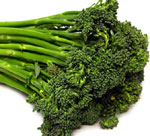 |
Broccolini is not young broccoli; it's a natural hybrid vegetable, a cross between broccoli and a Chinese kale (called kai-lan). Sweeter and more tender than broccoli, common cooking methods include sautéing, steaming, boiling, and stir frying. You can eat the entire bunch - leaves, stalk, and occasional yellow flowers. Easy to prepare and completely delicious. |
Chinese Broccoli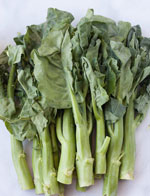 |
Chinese broccoli — also known as kai-lan, gai-lan, and Chinese kale — is a leafy green vegetable closely related to thick-stemmed broccoli, cabbage, and Brussels sprouts. It has flat leaves, thick stems, and tiny florets. Widely eaten in Chinese, Vietnamese, and Thai cuisine, Chinese broccoli has a slightly bitter and earthy taste, and is best after a quick steam or sauté, or in a stir-fry. It may prove tough to find Chinese broccoli in large grocery stores, so check your local Asian market, which is more likely to carry it. |
Kohlrabi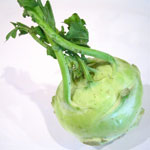 |
For all intents and purposes, kohlrabi appears to be a root vegetable in the same company as turnips, radishes and rutabagas. However, the bulbous shape of kohlrabi is caused by a swelling of the plant's stem near the ground. In that sense, kohlrabi is more of a tightly packed version of its cousin, cabbage. In fact, the name kohlrabi is derived from two German words: kohl meaning cabbage and rabi meaning turnip. It is not unusual to hear the term "turnip cabbage" to describe kohlrabi. The taste and texture of kohlrabi are similar to those of a broccoli stem or cabbage heart, but milder and sweeter, with a higher ratio of flesh to skin. It's light green and sometimes sold with its edible greens attached. It can be eaten raw or cooked. The young stem in particular can be as crisp and juicy as an apple, although much less sweet. Choose small ones, and peel before using. |
Kale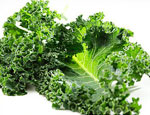 |
Kale is an archaic type of cabbage that grows loosely furled leaves, rather than forming a head, and is sometimes known as “leaf cabbage.” The leaves of kale have a distinctive ruffly appearance that distinguishes the plant from a close relative, collard greens. Kale tends to be a little bit bitter in flavor, although this bitterness is tempered by washing, cooking, and using younger leaves. Kale is also extraordinarily nutritionally rich, even among the leafy green vegetables. Most kale is eaten cooked, although very young leaves may be trimmed from the stalks and used raw in salads. Cooked, kale is mixed in with soups in Portugal, used in mashed potatoes in Ireland, roasted on pizza in Italy, and eaten plain as a side dish all over the world. When cooking kale, be aware that the stems take more time to cook than the more delicate leaves. Kale tends to be a little more versatile than other Brassicas, as it also can behave like a hardy lettuce. Before eating kale, the thick inner rib should be removed. It’s worth noting, too, that although kale will keep longer in the fridge than mesclun lettuce, it doesn’t have as good storage capacities as true cabbage. Kale & Ricotta Salata Salad |
Collards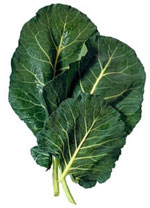 |
Collard greens (Brassica oleracea; Acephala Group) are a large-leafed, dark green relative of the cabbage. Collard greens are related to kale and mustard greens as well, and are relatively mild, the flavor approximating a combination of cabbage and kale. Unlike the curly-leaved kale, collard greens have smooth leaves. Because they have a tendency to be sandy, fresh collard greens should be washed thoroughly prior to cooking. Before cooking, trim off any tough stems or midribs. The traditional Southern method of cooking is to slowly simmer the collard greens in water with a bit of salt pork for flavor, until very tender. Alternatively, collards can be simmered in broth, omitting the pork. Because they are so fibrous, it can take about 45 minutes to 1 hour for collards to cook. Vinegar complements the bitterness of the collard greens and is often served alongside them as a condiment. |
