What are Cocktail Bitters?
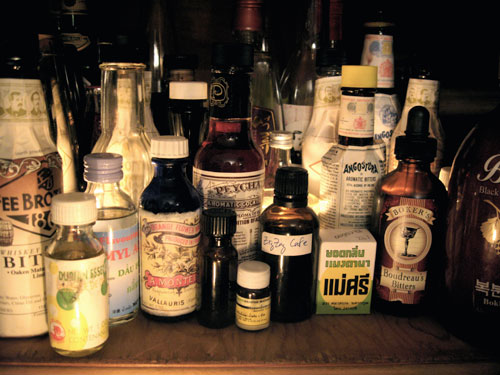
A bitters is traditionally an alcoholic preparation flavored with botanical matter such that the end result is characterized by a bitter, sour, or bittersweet flavor. Thus, bitters aren't necessarily bitter and frequently they add sweetness to a cocktail. "But why are the called bitter?"
The etymology of "bitters" comes from "small concentrated drink." Numerous longstanding brands of bitters were originally developed as patent medicines, but are now sold as digestifs and cocktail flavorings.
The botanical ingredients used in preparing bitters have historically consisted of aromatic herbs, bark, roots, and/or fruit for their flavour and medicinal properties and sold as medicinal tonics. Some of the more common ingredients are cascarilla, cassia, gentian, orange peel, and cinchona bark. Most bitters contain both water and alcohol, the latter of which functions as a solvent for botanical extracts as well as a preservative. The alcoholic strength of bitters varies widely across different brands and styles.
By the 19th century, the British practice of adding herbal bitters (used as preventive medicines) to Canary wine had become immensely popular in the American colonies. By 1806, American publications referenced the popularity of a new preparation termed "cocktail," which was described as a combination of "a stimulating liquor, composed of spirits of any kind, sugar, water, and bitters." By the end of the 19th century, bitters were firmly in place behind the bars of such pioneers as Jerry Thomas and Harry Johnson. In fact, many bartenders had more than a dozen brands of bitters at their disposal.
19th Century Bitters
Of the commercial aromatic bitters that would emerge from this period, perhaps the most well known is Angostura bitters, which was first compounded in Venezuela in 1824 by German physician Dr. Johann Gottlieb Benjamin Siegert. Originally, Dr. Siegert's bitters was compounded as a cure for sea sickness and stomach maladies, among other medicinal uses. Dr. Siegert subsequently formed the House of Angostura, a company that previously sold the bitters to sailors. Angostura bitters was named after the town of Angostura in Venezuela, although the preparation contains no angostura bark, a medicinal bark which is named after the same town.
Another renowned aromatic bitters with 19th century roots is Peychaud's Bitters, which was originally developed by apothecary Antoine Amédée Peychaud in New Orleans, Louisiana, and is most commonly associated with the Sazerac cocktail.
Over a hundred years ago there were over a hundred commonly found bitters on the market. Bitters went into decline in the 20th century, victim to not only the dark ages of Prohibition but also changing drinking habits. And today, I'm aware of only two brands that have lasted straight through since the 1800s, aside from a nap in the dark ages: Angostura and Peychaud's. We're fortunate these days to see a resurgence in bitters. Not only are more bartenders using them, but more brands and flavors are available now than at any time in decades.
Cocktail bitters
Cocktail bitters are highly concentrated flavoring agent made from roots, barks, herbs, and/or berries and are reputed to have medicinal qualities. Think of them as the spice of the cocktail world. They serve much the same role in cocktails that spices serve in food—they add depths of complexity and flavor to drinks. Bitters such as Angostura are also effective in minute quantities as smoothing out the taste of a particularly harsh or bitter whiskey. Cocktail bitters are typically used for flavoring cocktails in drops or dashes. In the United States, many cocktail bitters are classified as alcoholic non-beverage products. As such, they are often available from retailers who do not sell liquor, such as supermarkets in many US states.
According to one web site: "To have a bar, you need Angostura, second are Peychaud's, and third are orange bitters."
There are also what are called Potable Bitters. Potable bitters are bitter liqueurs that, although they can work well in cocktails, were originally meant to be sipped and enjoyed on their own. This category includes Italian amari (such as Fernet Branca and Campari) and bitter digestifs, such as Underberg. Some, such as Campari and Fernet-Branca from Italy and Jägermeister from Germany (digestive bitters), are believed to be such good stomach settlers and may even be useful in treating hangovers.
Some notable examples of cocktail bitters include:
Angostura bitters - Originally from Venezuela in 1830, currently from Trinidad and Tobago Angostura is the most common bitters. Angostura tastes of cinchona, ginger, cinnamon and cloves.
The Bitter Truth - Founded in 2006 in Germany, producing old time aromatic bitters, orange bitters, celery bitters, lemon bitters, Creole bitters, Jerry Thomas own decanter bitters, grapefruit bitters, spiced chocolate bitters, peach bitters and tonic bitters
Bittermens - Founded in 2007 in San Francisco, producing in New Orleans since 2013 - Xocolatl Mole (chocolate spice), Hopped Grapefruit, Burlesque Bitters (hibiscus, açai, quassia), 'Elemakule Tiki Bitters (clove, allspice, cinnamon, citrus), and Boston "Bittahs" (citrus, chamomile)
Fee Brothers bitters - from Rochester, New York - aromatic, orange, mint, lemon, rhubarb, cherry and peach; most are alcohol free, and many contain glycerin, artificial flavorings, and/or dyes
Orange Bitters - Made from the dried peel of the bitter Seville oranges, orange bitters are less aromatic and fruitier then the more popular and sophisticated Angostura bitters. Orange bitters are commonly called for in older cocktail recipes.
Peychaud's Bitters - Originally from New Orleans, LA but now produced in Kentucky. Peychaud's is very complex, it lightly tastes of vanilla and nuts, and there is a light anise flavor. Its bright red color adds fun to any cocktail, especially clear cocktails. Most noted for the Sazerac cocktail.
Cocktails Made with Bitters
Bajan Rum Punch
Planter's Punch
Rum Swizzle
Old Fashioned
Sazerac
The Seelbach
Rusty Nail
Manhatten
Rob Roy
Classic Champagne Cocktail
The Emerald - Irish whiskey, sweet vermouth, orange bitters
Irish Blond Cocktail - Irish whiskey, orange curacao, Fino sherry, orange bitters
Jean Harlow Cocktail
Navy Grog
Pear Spiced Sailor Cocktail
Bushmills Irish Punch (served hot)
Aromatic Bitters
Angostura bitters
The granduncle of all cocktail bitters, Angostura was developed in the 1820s by Johann Gottlieb Benjamin Siegert, a German doctor in the employ of Simón Bolívar during the latter man's liberation of Venezuela from the Spanish Empire.
Siegert was looking to provide a medicinal tonic for Bolívar's troops, so he concocted a mixture of herbs that he called amargo aromatíco, or aromatic bitters. He first produced these bitters in the town of Angostura, a trading post on the Orinoco River. Sailors arriving in Angostura often suffered from seasickness and took Dr. Siegert's remedy to settle their stomachs. This nautical trade, along with forceful marketing by Siegert's sons, eventually helped cement Angostura's worldwide brand.The Siegert family later moved its operation to Trinidad, where it branched out into rum production.
Flavor Profile
As an aromatic bitter, the base flavor is a bitter root. In the case of Angostura, it's thought to be gentian; the Angostura formula is secret, though, and no one from Angostura will confirm the ingredients. Other flavors you might encounter are clove, tamarind, and cinnamon.
Angostura is not, by the way, the only aromatic bitters on the market. Also look for Fee Brothers Old Fashioned Aromatic Bitters or The Bitter Truth Old Time Aromatic Bitters. Peychaud's is also in the aromatic style, but I've chosen to discuss it separately.
Aromatic bitters taste great with aged spirits: whiskies, rums, and brandies. Try them in an old fashioned, a Manhattan, or a Rob Roy. They're also good, perhaps surprisingly so, in a Pink Gin or a Champagne Cocktail.
Peychaud's Bitters
Peychaud's bitters also have a long history behind the bar. Developed in 1838 by Antoine Peychaud, a New Orleans apothecary of Creole origin, Peychaud's bitters carry on the tradition of bitters as a medicinal tonic. Peychaud used a family recipe brought to Louisiana by his father, who had fled Haiti 45 years earlier.
The younger Peychaud served a brandy toddy as a vehicle for his bitters. Years later, in 1850, the Sazerac Coffee House opened in the French Quarter. Named for a now defunct brand of cognac, Sazerac de Forge et Fils, the coffee house served a branded cocktail based on Peychaud's toddy, the Sazerac, with the house cognac and Peychaud's bitters.
Thanks to phylloxera, the blight that nearly destroyed France's wine and brandy industries in the late 19th century, Sazerac de Forge et Fils disappeared from New Orleans and was replaced in the namesake drink by rye whiskey, and such is the makeup of the Sazerac today.
Unlike Angostura, which was and still is made in the Caribbean, Peychaud's was bound by law to cease manufacture during Prohibition, but returned after repeal in 1933.
Flavor Profile
Moderately sweeter than Angostura. Slightly fruity. Hints of Christmas spices and anise.
For 172 years, Peychaud's stood alone in its flavor profile, but last year it was joined on the market by The Bitter Truth's Creole Bitters, designed to be similar to Peychaud's but less fruity and more herbal.
Tastes Great in... A Sazerac, of course—either the now traditional rye recipe or the original cognac version. Two other New Orleans classics are also fabulous with Peychaud's: the Vieux Carré and the Cocktail à la Louisiane.
Four Orange Bitters Available Today
Made by Fee Brothers, Regan (developed by Gary Regan, sold through Sazerac Company), Bitter Truth, and Angostura. How Do They Taste?
Flavor profiling is usually tricky, since everyone's got a good opinion about how things taste, but in general I find the Fee's to be the sweetest and fruitiest, and the least complex. Now, don't misunderstand: they're not sweet like a soda, they're just sweeter than the other brands.
The Regan's are zesty and fresh smelling, like you've just twisted an orange peel over a drink. There's mild spice in the background, and the finish is less fruity than the Fee's.
The Bitter Truth bitters are complex and spicy—perhaps the spiciest of the four. Earlier, I mentioned that other ingredients in orange bitters include such things as cardamom, cinnamon, and coriander, and it's the Bitter Truth orange that best expresses those flavors.
Finally, the Angostura Orange has the strongest orangey scent and flavor of them all. The spice is there, too, but it's a little less pronounced than in the Bitter Truth.
Bitter Truth and Angostura produce orange bitters with the strongest flavors of the four. For this reason, I tend to use a little less of them in a cocktail than I do when I'm using Fee's or Regan's. I also find that I prefer each bitters in different drinks.
I love a mix of Angostura Orange and Angostura Aromatic in whiskey and rum cocktails. I most love that blend of bitters in an old-fashioned, especially a rye old-fashioned.
Bitter Truth orange bitters are fabulous dashed into a margarita. I love the way the spices blend with tequila. They're also good in citrusy rum cocktails, such as a daiquiri.
Regan's and Fee's are probably my favorite in a martini. I find that the Bitter Truth and Angostura both can overpower a martini unless I'm very careful when mixing. When using Regan's, though, I like to dash in a goodly portion.
