Punch
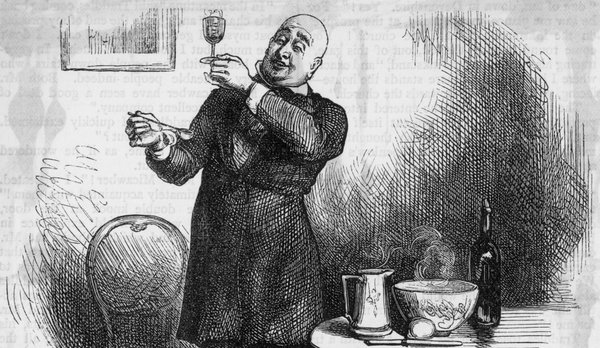
Illustration by Fred Barnard, titled "Micawber in his element," for the Household Edition of David Copperfield.
Mr. Micawber makes punch after a dinner party thrown for him by David Copperfield - a hot, steaming
bowl of lemon, sugar and spirits that made Micawber's face shine.
Charles Dickens, author of David Copperfield, was a punch aficionado.
From the middle of the 17th century until the middle of the 19th, the shared bowl of punch was the undisputed monarch of the kingdom of mixed drinks. It was the first popular mixed drink to incorporate distilled spirits. Before its invention, people drank their drams straight or poured them into a mug of ale or a tankard of wine. Batavia arrack, a fiery but highly aromatic molasses-and-rice distillate imported from the Dutch East Indies (Indonesian archipelago), was the preferred spirit, but Caribbean rum and French brandy were right behind it.
History of Punch
Before there were cocktails, there were punches: mixed drinks made in large quantities, presented in bowls, and shared socially. The great punch-bowl, not a very handy vessel to handle when filled with punch, was passed up and down as freely as though it were a loving-cup, and all drank from its brim. At college tables, and even at tavern boards, where table neighbors might be strangers, the flowing bowl and foaming tankard was passed serenely from one to another, and replenished to pass again.
Punch used to follow a strict formula, says cocktail historian Wondrich. Originally, it was composed of five ingredients: spirits (rum, brandy, or Batavia arrack*); sugar; water; citrus; and spice (usually grated nutmeg, but sometimes green or black tea). "It was like a martini," says Wondrich. "There was a way to make punch, and there were a couple of allowable variations, but it wasn't 'anything goes.'"
*Note: Batavia arrack was produced since at least the early 17th-century on the island of Java. Batavia arrack is rum's funky ancestor. Made from sugarcane and fermented red rice, this smoky, aromatic spirit was a mariner's favorite for years, and was an essential ingredient in punch until well into the 19th-century. Eventually supplanted by rum, Batavia arrack faded from the back bar and the liquor store.
The word punch is a loanword from Sanskrit पञ्च (pañc), meaning "five", as the drink was originally made with five ingredients: alcohol, sugar, lemon, water, and tea or spices. The drink was brought to England from India by sailors and employees of the British East India Company in the early seventeenth century. From there it was introduced into other European countries. When served communally, the drink is expected to be of a lower alcohol content than a typical cocktail. The earliest known reference to the drink dates from 1632, appearing in a letter to an India-bound merchant from an English colleague, who strongly warned against drinking it.
The early discovered recipe of a punch was recorded by a young German adventurer named Johan Albrecht de Mandelslo when visiting the English East India Company's factory in Surat, India in 1638. The recipe was written as containing, "aqua vitae, rosewater, citrus juice and sugar". Water is often omitted in early recipes as it was expected as a mixer into any spirituous liquor, the majority of which were rough-as-guts and overproof. By the 1650s, punch had become a standard British sailor's drink, consumed on ship and shore whenever the ingredients were close at hand. Recipes for punch in the 17th and 18th centuries often include toast.
Beer or ale was not included in punch recipes until the early 19th century, when it created a drink resembling the earlier mead wassail drinks, but on the whole, punch recipes have a higher alcoholic content, being made with spirits, and use sugar rather than honey. Today mulled wine is often served instead of either wassail or punch. Nutmeg was used in recipes both of wassail and punch. Ginger was included in wassail, rarely in punch.
The term punch sees its first listing in an English dictionary in 1658 entitled, The New World of English Words where it is simply described as, “A kind of Indian drink”. A later edition would elaborate on this definition further with; “A sort of strong Drink [sic] made of brandy, Water, Lime-Juice, Sugar, Spice &c [etc]”.
17th Century
By the mid 17th century, punch had spread out of the London docks and into mainstream society. In a world predating electricity or the gas heater, winters were terminally cold. Offering its own form of internal heating, many punch recipes evolved to help stave off the 17th century winter…or at least make an effort to do so. The term punch was first recorded in British documents in 1632.
At the time, most "punches" were of the Wassail type made with a wine or brandy base and mixed in a bowl. Brandy, sweet wine, whole egg, cream and a crack of nutmeg (if you could afford it) altered your classic five ingredients into a punch referred to as a Fillip (or Flip). There was also the Jorum, Phlegm-Cutter, Fog-Driver, Dogs Nose, Ebulum, Brick Wall, Bastard, Canary and the two Victorian classics, Negus and Bishop. All of which while substituting different ingredients, used a base of sweet wine referred to as sack. Believed to derive from the Spanish word seco meaning 'dry', sack was predominantly a mix of sweet Madeira wine and dry young port from which a punch was then built on top.
But around 1655, Jamaican rum came into use and the 'modern' punch emerged. One of the first times rum is mentioned is in a 1651 document from Barbados which stated,"The chief fuddling they make in the island is Rumbullion, alias Kill-Divil, and this is made of sugar canes distilled, a hot, hellish, and terrible liquor." A short time later in May 1657, the General Court of Massachusetts also decided to make illegal the sale of strong liquor "whether knowne by the name of rumme, strong water, wine, brandy, etc." The origin of the word "rum" is generally unclear. etymologists have mentioned the Romani word rum, meaning "strong" or "potent". These words have been linked to the ramboozle and rumfustian, both popular British drinks in the mid-17th century. However, neither was made with rum, but rather eggs, ale, wine, sugar, and various spices. The most probable origin is as a truncated version of rumbullion or rumbustion. Both words surfaced in English about the same time as rum did (Joan Coromines states 1651 as the first recording of "rumbullion", and 1654 for "rum.")
By 1671, documents make references to punch houses and by the 18th century, the spit-n'-sawdust tavern of old had given way to the more learned environment of the coffee house where punch found a new home in the middle classes. One popular establishment was the aptly named London Coffee and Punch House located on Ludgate Hill near St Paul's Cathedral. As described in The Daily Post-Boy in 1731, one could find "..the finest and best old Arrack, Rum, and French Brandy is made into Punch".
Opened by an ex-cheese wholesaler named James Ashley, The London Coffee and Punch House became the local for many famous artists, politicians and poets of the time. Even if one had never visited the venue, passersby on Ludgate Hill Street would recognise the three iron punch bowls on ornate openwork pedestals flanking a door.
Most interesting however is reference to a drink simply referred to as a sneaker, tiff or rub. These single-person serves were advertised as being mixed to order or as stated by Ashley himself, "Gentlemen may have it soon made as a gill of wine can be drawn". By many modern definitions this serve would be branded as a 'cocktail' and more than half a century before we'd find the word first in print. Whoever was the first to commercially sell single servings of mixed liquor (bitters or not), Ashley represents the cultural transition from large, socially shared bowls of punch, into single swiftly mixed serves designed for the individual. A social transition from punch into cocktail. A movement which while started in England, would only fully take place on a distant colonial island 70 years later.
Punch in Colonial America
As the first permanent settlers arrived into America at the start of the 17th century, booze and bowls were quick to follow. Never a shy bunch when it came to drinking liquor, English colonials took to punch with a vigor. Lime punch was the most popular version of the drink, and the beverage was aptly described as "Sower [sour] punch."
One of America's most popular punch recipes today still remains the Fish House Punch. A traditional mixture of rum, peach brandy, lemon, sugar and water (depending on your reference). In 1732 on the banks of the Schuylkill river in Philadelphia, a social club known as State in Schuylkill Fishing Corporation was established with the simple goal of socialising, fishing, eating and drinking. The club swiftly grew in stature and by 1747 they had built a club house which became affectionately known as The Castle. It is here that their official Fish House Punch was apparently invented. (Recipe below)
By the time Jerry Thomas published the first dedicated cocktail book in 1862 (How to Mix Drinks or the Bon Vivant’s Companion), punch was being slowly surpassed by the new era of the cock-tail. A trend believed to be driven by an increase in the pace and glamour of the American lifestyle alongside an advance in glassware technology. That said, his guide still dedicated 79 of a listed 236 recipes to punch, including of course directions for the Philadelphia Fish-House Punch.
Milk punch enjoyed a wave of popularity in the early eighteenth century.
Punches begat other popular drinks, such as shrubs and bounces (the predecessors of cordials made by macerating fruit in spirits); flips (hot drinks concocted in the winter); switchels (hardy drinks of molasses, vinegar, sugar and water sometimes spiked with hard cider); and cobblers (spirits or wine and sugar mixed with fruit juice that ushered in the shaken cocktails).
By the Victorian Age, teetotalling punches ruled the day. Queen Victoria disapproved of strong drink, so alcoholic punches gradually fell out of favor. Frothy egg white-based and sherbet versions grew popular, and continued to be served to ladies who lunched until the 1950s. By that time, cocktail culture was in full effect, and it was socially acceptable for women to drink in public.
Batavia Arrack
The importance of Batavia Arrack with classic cocktails cannot be understated. New York bartender Jerry Thomas's 1862 imprint, How to Mix Drinks, or the Bon Vivant's Companion (still considered the foundation-text for the fine art of mixing drinks) dedicates the first section of the book to Punches, with 78 recipes, many of which call for Batavia Arrack. Cocktail books still to this day highlight recipes with Batavia Arrack (or the Swedish Punch made from it), no matter the challenge of finding the spirit.
From the late 17th to 19th century, in an age when "Punch" was a celebration of all things then exotic – citrus, sugar, and spice, no Punch was without a true Batavia Arrack. In pre-Prohibition America, Batavia Arrack and most notably the Swedish Punsch were essential to many now-classic cocktails. Beyond these uses, Batavia Arrack is also today found in boutique European chocolates and cocktails at Bali resorts.
Batavia arrack, a liquor used in early punch-making, disappeared from the United States after Prohibition. In 2007, Haus Alpenz, a company that specializes in importing exotic and hard-to-find spirits, reintroduced it to North America.
Swedish Punsch (also known as Arrack Punch, Caloric Punch, Punch or Punsch) is a traditional liqueur in Sweden and to a lesser extent some other Nordic countries produced from arrack, neutral spirits, sugar, water, and various flavorings. Arrack, originally a strong Indian liquor, was imported from Java and became the base ingredient for making punsch. Although they both refer to certain kinds of mixed beverages with liquor as a base ingredient, traditional Swedish Punsch is different from punch. Both names probably come from the same source: a Hindi loanword for five, referring to the traditional number of ingredients. The Swedish Historical Museum of Wines and Spirits (see below) states that it is more probable that the word came to Swedish via English, than as a direct loan from Hindi.
Captain Radcliffe's Punch (1680)
German Punschgluhbowle
Bombay Government Punch (1694)
The precise proportions for this recipe are taken from the 1694 regulations the English government put out for Bombay punch houses, which mandated “if any man comes into a victualling house to drink punch, he may demand one quart good Goa arak, half a pound of sugar, and half a pint of good lime water, and make his own punch.”
Now, Goa arrack was made from coconut-palm sap, but sugar-cane arrack and then rum were natural substitutes. The further substitution of cognac for part of the rum or arrack was common as early as the 1680s, and indeed soon became the preferred way of making it. The addition of a goodly amount of water or tea is also both traditional and extremely sensible.
2 cups Demerara or turbinado sugar
7 cups water
12 limes
16 ounces Batavia arrack*
1 quart dark, funky rum
Grated nutmeg, for garnishIf you can't get the arrack, substitute 1 1/2 quarts rum or 1 (750-milliliter) bottle of rum and 1 (750-milliliter) bottle of VSOP-grade cognac.
To prepare, first stir 2 cups of Demerara or turbinado sugar in 1 cup water over a low flame until the sugar has dissolved (about 5 minutes). Let this cool.
Then squeeze 12 limes and combine the juice in a large bowl with the sugar syrup and stir. Add 16 ounces Batavia arrack and 1 quart dark, funky rum and top off with 1.5 liters/48 ounces water. Stir again and refrigerate.
Half an hour before serving, add a large block of ice (this can be made by freezing 2 quarts of water in a bowl overnight) and grate nutmeg over the top.
Makes: 20 drinks
*Batavia Arrack is a distillate of both sugarcane and fermented red rice, and is only manufactured on the island of Java in Indonesia. Between the rice and the time it spends stored in teak, it develops a distinct flavor. "It's veeeeerry funky, and very pungent," says David Wondrich, cocktail historian and author of Imbibe!. "If you make a bowl of proper arrack punch, you'll smell it everywhere."
Take note when shopping for it: Don't confuse Batavia arrack with Sri Lanka arak or arrak, which is a palm wine–based spirit; or Lebanese arak, which is an anise-flavored grape spirit.
What to buy: *If you can’t get the arrack, substitute 1 1/2 quarts rum or 1 (750-milliliter) bottle of rum and 1 (750-milliliter) bottle of VSOP-grade cognac.
Game plan: For a more stimulating concoction, use cold black or green tea (use 2 tablespoons loose tea or 6 tea bags) in place of the final 6 cups of water.
Fish House Punch (1700s)
One of the finest flavour matches around, peach liqueur with rum and cognac. Don`t be deceived by the flavour, there are no mixers, just booze with booze.
The Fish House Club on the Schuykill River near Philadelphia created this punch some time in the 1700`s, reputably the recipe was given to the club by one of its founders, George Washington. The drink was prepared as a lunchtime punch bowl that would sit on the bar and be slowly emptied by thirsty customers. George Washington himself declared that this punch was the only way to celebrate national holidays. Indeed, at several viewing of the troops, the corps would be presented to the President before moving away to where huge cauldrons of this punch had been prepared. It is no surprise that the President would get three rousing cheers from the soldiers. Lemon juice, Jamaican rum, Peach Brandy, cognac and water, this is a true military drink, simple and very very strong.
Fish House Punch Recipe from http://www.gaspee.org/
Note on recipe from gaspee.org: The following concoctions were discovered in the old files of the Gaspee Days Committee, and were apparently used by some Pawtuxet Village restaurants during Gaspee Days c1966-1972. Some selections were found in old hand-written cookbooks that had been families for over 200 years. [This recipe is one of them.]
Completely dissolve 3/4 pound of sugar in a little water, in punch bowl
Add a bottle of lemon juice.
Add 2 bottles Jamaican rum,
1 bottle cognac,
2 bottles of water
1 Wine glassful of peach cordial.Put a big cake of ice in the punch bowl.
Let Punch stand about 2 hours, stirring occasionally.
In winter, when ice melts more slowly, more water may be used; in summer less. The melting of the ice dilutes the mixture sufficiently
Makes about 60 4-ounce glassesJerry Thomas' Philadelphia Fish House Punch from How To Mix Drinks (the first true bartender's manual, published in 1862)
(From a recipe in the possession of Charles G. Leland, Esq.)"1/3 pint lemon juice (5.33 oz)
3/4 pound superfine sugar
2.5 pints cold water
1 pint of mixture** To make this mixture, take
1/4 pint of aged peach brandy (4 oz)
1/2 pint of Cognac brandy (8 oz)
1/4 pint Jamaican rum (4 oz)The above is generally sufficient for one person."
Combine the ingredients several hours in advance and keep chilled. Then one to two hours before serving, pour into a large punch bowl with a sizable single block of ice. Traditionally this punch is not garnished in any way and decorative ice molds are frowned upon. Ladle the punch over the ice block periodically and serve in punch cups.
1770 - A rum punch
"The peel of 8 Oranges and 8 Lemons in 1 quart of rum. 3 Gallons of Water boild with 3 lb. of loaf Sugar and the Whites of 8 Eggs. 2 and 3/4 pints of orange juice and 1 and 3/4 Pints of Lemon juice. strain the quart of rum from the Peel and add one Gallon more of rum to rest of the ingredients."
---A Colonial Plantation Cookbook: The Receipt Book of Harriott Pinckney Horry, 1770, [South Carolina] edited with an Introduction by Richard J. Hooker [University of South Carolina Press:Columbia SC] 1984 (p. 139)
Recipe for Bajan Rum Punch (rum punch made in Barbados for centuries)
Recipe for Regent's Punch (1820)
1839
"Orange Punch
"Weigh two and a half pounds of loaf sugar, put it in a a bowl, and pour on it two and a half table-spoonfuls of rose water. Grate the yellow peel from one dozen fine oranges, and two lemons, and squeeze the juice into the bowl, add the grated peel, cover the bowl, and set it by till next day; then mix in a bottle of claret, or champaign, pass it through a fine sieve, and stir well into it the whites of eight eggs, which have been beaten to a stiff froth. Serve it up in glasses, putting a lump of ice in each, and grate nutmeg thickly over them; or you may freeze it, and serve it in glasses, providing each with a tea-spoon."
---Kentucky Housewife, Lettice Bryan, facsimile 1839 edition (p. 406)
"Milk Punch
Take rum, or any nice kind of brandy, and dilute it to the strength you like it, with entire sweet milk, stirring it in gradually. Sweeten it to your taste with loaf sugar, flavor it with a little capillary, and serve it up in glasses; drop a small lump of ice in each, and grate nutmeg thickly over them."
---Kentucky Housewife, Lettice Bryan, facsimile 1839 edition (p. 405)
"Italian Punch
Pare very thin the yellow rinds from six oranges and six lemons, put them into three pints of water, and boil them till the water is reduced to one quart, and strain it into a large bowl. Mix in two and a half pounds of loaf sugar, three pints of boiling sweet milk, and set it by to cool; then stir in gradually one quart of rum, or the best brandy, and the juice from the decorticated lemons and oranges. It will keep well for several months, put up in bottles, and when you wish to make use of it, serve it up in glasses, mixing in a few beaten whites of eggs, and grating nutmeg on the top."
---Kentucky Housewife, Lettice Bryan, facsimile 1839 edition (p. 406-7)
"Tea Punch
Make a pint and a half of very strong tea in the usual manner; strain it, and pour it boiling on one pound and a half of loaf sugar. Add half a pint of very rich cream, and then stir in gradually a bottle of claret or of champagne. You may heat it to the boiling point, and serve it so, or you may send it round entirely cold, in glass cups."
---Kentucky Housewife, Lettice Bryan, facsimile 1839 edition (p. 407)
