Wafers
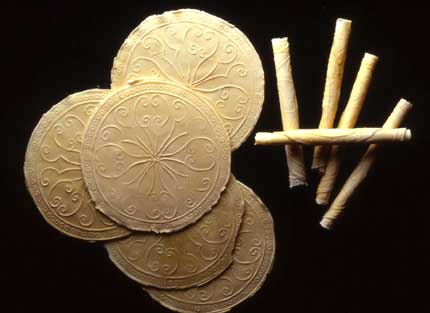
The ancient Greeks cooked flat cakes, called obelios, between hot metal plates. As they spread throughout medieval Europe, the cakes – made from a mixture of flour, water or milk, and sometimes eggs – became known as wafers and were also cooked over an open fire between iron plates with long handles. At some point, perhaps in the 13th century, these began to be stamped with various designs ranging from family crests and landscape scenes to the characteristic grid pattern.
During the Middle Ages and Renaissance, wafers were eaten by all segments of society, from peasants to kings. Often consumed in connection with religious occasions and saints' days, they were sold by street vendors (called waferers in England and gaufriers in France) who congregated outside churches.
During the late medieval period and into the early renaissance, wafers were an important constituent of the void, or issue de table , the court ceremony at the end of a state meal. Wafers, comfits and hippocras were consumed by the sovereign in this semi-religious ritual linked with the final grace and the washing of hands. The hippocras and wafers may originally have had a quasi-eucharistic significance in that they echoed the Holy Communion. The spicy comfits were intended as ‘stomach settlers' to calm the royal digestion, though like both hippocras and wafers they later became luxurious treats consumed at all manner of celebratory occasions by those who could afford them.
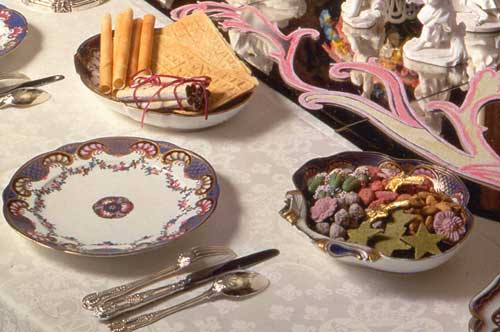
Wafers, comfits and hippocras were consumed at the end of a state meal.
The 1766 French dessert above has both curled and flat wafers and cannelons
(a type of wafer tube) filled with chocolate and fruit pastes. The cannelons
are tied together with ribbon.
Wafers continued to be an important element of the dessert course in later centuries. The 1766 French dessert in the picture has both curled and flat wafers and cannelons (a type of wafer tube) filled with chocolate and fruit pastes. The cannelons are tied together with ribbon.
Though some have speculated that waffle irons first appear in the 13th–14th centuries, it is not until the 15th century that a true physical distinction between the oublie and the waffle (wafel / gaufre) begins to evolve. Notably, while recipes like the fourth in Le Ménagier de Paris is only flour, salt and wine – indistinguishable from common oublies recipes of the time – what does emerge is a new shape to many of the irons being produced. Not only are the newly fashioned ones rectangular, taking the form of the fer à hosties, but some circular oublie irons are cut down to create rectangles. It is also in this period that the waffle's classic grid motif appears clearly in a French fer à oublie and a Belgian wafelijzer – albeit in a more shallowly engraved fashion – setting the stage for the more deeply gridded irons that were about to become commonplace throughout Belgium.
Alternately attributed to the 16th and 17th centuries, Groote Wafelen from the Belgian Een Antwerps kookboek is published as the first recipe to use leavening (beer yeast): 'Take white flour, warm cream, fresh melted butter, yeast, and mix together until the flour is no longer visible. Then add ten or twelve egg yolks. Those who do not want them to be too expensive may also add the egg white and just milk. Put the resulting dough at the fireplace for four hours to let it rise better before baking it. Until this time, no recipes contain leavening and can therefore be easily cooked in the thin moule à oublies. Groote Wafelen, in its use of leavening, is the genesis of contemporary waffles and validates the use of deeper irons (wafelijzers).
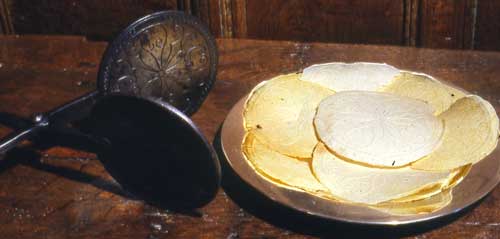
Wafers with wafer irons
Waffles from Le Menagier de Paris, 1393:
Waffles [or wafers] are made in four ways. In the first, beat eggs in a bowl, then salt and wine, and add flour, and moisten the one with the other, and then put in two irons little by little, each time using as much batter as a slice of cheese is wide, and clap between two irons, and cook one side and then the other; and if the iron does not easily release the batter, anoint with a little cloth soaked in oil or fat.
- The second way is like the first, but add cheese, that is, spread the batter as though making a tart or pie, then put slices of cheese in the middle, and cover the edges (with batter: JH); thus the cheese stays within the batter and thus you put it between two irons.
- The third method, is for dropped waffles, called dropped only because the batter is thinner like clear soup, made as above; and throw in with it fine cheese grated; and mix it all together.
- The fourth method is with flour mixed with water, salt and wine, without eggs or cheese.
Item, waffles can be used when one speaks of the "large sticks" which are made of flour mixed with eggs and powdered ginger beaten together, and made as big as and shaped like sausages; cook between two irons.
This was translated from the French edition of Jerome Pichon published in 1846. Translator, Janet Hinson
To make Wafers (17th century recipe)
Take Rose-water or other water, the whites of two eggs and beat them and your water, then put in flower, and make them thick as you would do butter for fritters, then season them with salt, and put in so much sugar as will make them sweet, and so cast them upon your irons being hot, and roule them up upon a little pin of wood; if they cleave to your irons, put in more sugar to your butter, for that will make them turn.
From Archimagirus Anglo-Gallicus; Or, Excellent & Approved Receipts and Experiments in Cookery (London: 1658)
For on wafers, including early ice cream cones, see http://www.historicfood.com/Wafer.htm.
