Medieval Desserts: Issue de Table
from http://languageoffood.blogspot.com/
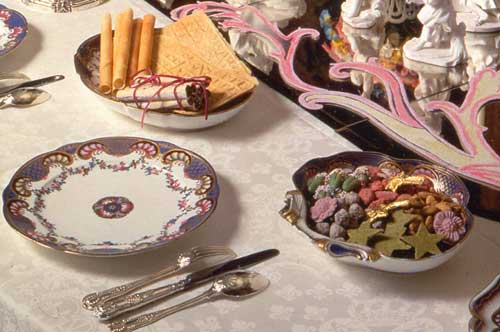
Wafers continued to be an important element of the dessert course in later centuries.
The 1766 French dessert above has both curled and flat wafers and cannelons (a type of
wafer tube) filled with chocolate and fruit pastes. The cannelons are tied together with ribbon.
Picture from http://www.historicfood.com/
In today's common American English usage, the dessert is a final sweet course. The Online Etymology Dictionary gives this definition:
c.1600, from M.Fr. dessert (mid-16c.) "last course," lit. "removal of what has been served," from desservir "clear the table," lit. "un-serve," from des- "remove, undo" (see dis-) + O.Fr. servir "to serve" (see serve)
The word comes from French, where dessert is the participle of desservir, to de-serve, that is, to "remove what has been served". According to Le Grand Robert de la Langue Francaise the term was first used in France in 1539. In its original usage, dessert meant what you ate after the meal had been cleared away; fresh fruit or the kind of dried fruits and candied nuts that used to be called 'sweetmeats'.
[From wikipedia: The term "dessert" comes from the Old French desservir, "to clear a table", literally "to un-serve", and originated during the Middle Ages. It would typically consist of dragées and mulled wine accompanied by aged cheese, and by the Late Middle Ages (c. 1301 – c. 1500) could also include fresh fruit covered in sugar, honey or syrup and boiled-down fruit pastes.]
The oubloyer (maker of oublies, or wafers) provided the waffles and thin wafers which along with cheese, candied fruits, hippacras, or sweet malmsey (imported sweet wine), formed a course the French called issue de table, or "departure from the table." The épicier delivered the épices de chambre or "parlor spices." They included dragées, candied aniseed or coriander seed, and gingerroot. Aside from aiding digestion, they were intended to freshen the breath, much like the mints served at the end of a restaurant meal today.
In 1633 dessert was still considered a foreign word in English, as we see in the following passage:
"Such eating, which the French call desert, is unnaturall."
But by a hundred years later, in the 18th century, it was borrowed into both British and American English. The word shifted here by the end of the 18th century to include more substantial sweet fare like cakes, pies and ice cream. In British English, on the other hand, the word retained this meaning of a light after-course longer than American. We can see this from the definition in the Oxford English Dictionary:
a. A course of fruit, sweetmeats, etc. served after a dinner or supper; 'the last course at an entertainment'
b. 'In the United States often used to include pies, puddings, and other sweet dishes'. Now also in British usage.
This idea of reserving sweet dishes for the end of a meal is thus a recent development. In the Middle Ages, a main course in England or France might include a dish like rabbits or beef tongue in gravy covered in sugar, or sweet meat puddings like blancmange (sweetened boiled rice and almond milk with capon or fish), and it was quite common to have custards or sweet cheesecakes in the middle of the meal. Meats and vegetables were often seasoned with ginger, rose water, and dried fruits.
Even as late as the 16th century, savory and sweet were intermingled, and a leg of mutton might be simmered with lemons, currants, and sugar, or chicken might be cooked served with sorrel, cinnamon, and sugar, as in the following recipe for "Chekyns upon soppes" (Chicken on bread with sauce) from the 1545 early Tudor cookbook, A Propre new booke of Cokery:
Chekyns upon soppes. [Chickens upon sops.]
Take sorel sauce a good quantitie / and put in Sinamon and suger / and lette it boyle / and poure it upon the soppes / then laie on the chekyns.
[Take sorrel sauce a good quantity / and put in Cinnamon and sugar / and let it boil / and pour it upon the sops / then lay on the chickens.]
Cinnamon toast with chicken and sorrel! It may be time to revive this recipe, which is reminiscent of Morrocan bastilla, the flaky pastry dish of squab or chicken with saffron, almonds, cinnamon, and sugar. In general this use of sugar and fruits with meats, while it died out in Western Europe after medieval and Renaissance times, still exists in Moroccan cuisine as well as in Persian, Central Asian, and even parts of Eastern European cuisine.
Not only could medieval or Renaissance meat and dish dishes be sweet, but last-course dishes could also be savory. A medieval final course often included dishes like venison, turtledove and lark pie, or crayfish. As late as the 16th century in France, capon pies or venison could be served with the flans, fruits, and pastries of the final course.
How, then, did dessert develop its modern sense of purely sweet dishes? An answer comes from culinary historian Jean-Louis Flandrin's analysis of French cookbooks over time, Arranging the Meal: A history of Table Service in France. Flandrin carefully annotated the presence of sugar in each recipe, and found that as French cuisine develops from the 14th and to the 18th century, main courses become more and more savory rather than sweet, and sweet dishes slowly shift toward the end of the meal. After a preliminary rise in the 15th century as sugar became more widely available, we see a sharp drop in the use of sugar in meat and fish dishes, and a corresponding rise in sweet desserts.
In modern France, this segregation of sugar has become absolute. The rules of French cuisine incorporate a strict constraint on the structure of a meal: sweet foods can only be served for dessert. By contrast, in American cuisine, maple syrup can be served with bacon for breakfast, and sweet foods like cranberry sauce, apple sauce, and even candied yams are eaten for dinner, particularly for old-fashioned meals like Thanksgiving. In other words, candied yams could not be a dish in French cuisine, not because they aren't delicious but because sweet foods are only served as dessert.
Yet while American meals are a bit more flexible in the placement of sugar, we clearly have constraints on the ordering of dishes. We still mainly save sweet things for dessert. And other constraints are implicit in the typical ordering of an American dinner which might be represented as a sequence of dishes as follows (with parentheses indicating optional dishes):
(salad or appetizer)
main/entree
(dessert)
That is, an American dinner might consists of a main course, preceded by an optional salad or appetizer (or both), and possibly followed by dessert.
By contrast, French cuisine makes use of a cheese course before dessert, and a light green salad is often eaten after the main rather than before:
(entrée)
plat
(salade)
(fromage)
(dessert)
While Italian cuisine has a distinct course ('primo') that often consists of pasta or risotto:
(antipasto)
primo
secondo
...
Just as the structure of the French meal changed over time, the ordering of the American meal has also shifted. Americans used to eat salad later in the meal, much as the French still do. The late writer M.F.K. Fisher suggests that the modern custom of eating salad before the main course arose in California in the early 20th century. Fisher grew up in Whittier around the first World War, eating fresh lettuce salad before the meal, and writes that her "Western" custom of starting a meal with salad shocked her friends from the East Coast who all ate salad after.
Anyhow, these differences between American, French, and Italian meals, and between each cuisine at different times, illustrate that part of what defines a particular cuisine is a set of constraints on how, and in what order, a meal is made of dishes. From a structural perspective, a cuisine defines a kind of grammar or script of what makes up a meal. This grammar can vary enormously from cuisine to cuisine. To summarize, these implicit constraints on meals form a "grammar of cuisine", telling us how individual dishes are allowed to combine in a grammatical meal in Chinese or French or American cuisine. This grammar imposes structure on individual dishes as well.
Issue de Table
In the 14th century, the first courses of a repast were mets (dishes) or assiettes (platters); the last, "entremets, dorures, issue de table, desserte, and boute-hors."
The dessert consisted primarily of baked pears, medlars, pealed walnuts, figs, dates, peaches, grapes, filberts, spices, and white or red sugar-plums.
At the issue de table wafers or some other light pastry were introduced, which were eaten with the hypocras wine. The boute-hors (wine and spices), which was served when the guests had passed into the drawing-room, consisted of spices, different from those that had appeared at dessert, and intended specially to assist the digestion. Whilst eating these spices they drank Grenache, Malmsey, or aromatic wines. (similar to our after-meals coffees and liquers).
It was only at the banquets and great repeats that sweet dishes and dorures appeared, and they seemed to be introduced for the purpose of imagination and the talent in execution of the master-cook. The dorures consisted of jellies of all sorts and colours; swans, peacocks, bitterns, and herons, on gala feasts, were served in full feather on a raised platform in the middle of the table, and hence the name of "raised dishes."
There was a firm pastry called bean cake, or king's cake, which, from the earliest days of the monarchy, appeared on all the tables, not only at the feast of Epiphany, but also on every festive occasion.
Amongst the dry and sweet pastries from the small oven which appeared at the issue de table, the first to be noticed were those made of almonds, nuts, etc. and such choice morsels; then came the cream or cheesecakes, the petits chour, made of butter and eggs; the echaudes, of which people were very fond; wafers, which are older than the 13th century; and lastly the oublies (wafers), which under the names of nieules, esterets, and supplications, gave rise in Paris to the oublayeurs.
Le Menagier de Paris Final Courses, 1393
"Hereafter follow some dinners and suppers for great lords and others, with notes on those you might choose, to collect and learn about those dishes which please you, according to the seasons and the foods available in the country where you will be, whether you have to serve dinner or supper."
Dinners - all Meat Days
These are the final courses in Le Menagier's menus. Note that not all end with a sweet course. Also note how often Frumenty and venison is mentioned.
- Pears and~sugared almonds, medlars and shelled nuts. Hippocras and wafers. (6 courses)
- Little sugared tarts and sugared milk, medlars, shelled nuts, cooked pears and sugared almond. Hippocras and wafers. (6 courses)
- Hippocras and wafers to finish. (4 courses)
- Frumenty, venison, roast fish, cold sage soup, jellied eels, fish jellies, capon pies with thick broth. (4 courses)
- Frumenty, venison, lamprey in hot sauce 26, fried bread slices, bream roasted and meat tarts, sturgeon and jelly. (3 courses)
- Frumenty, venison, browned [vegetables], fish jellies, fat capons a la dodine, roast of fish, fried bread slices and meat tarts, jellied eels, crayfish, thin pancakes and little sausages. (3 courses)
-
Fourth dish. Frumenty, venison, browned vegetables, bream and gurnard pies, jellied eels, fat capons a la dodine. (4th course)
The end is Hippocras and wafers.--Extra drink; wine and spices. (5 courses) - Frumenty, venison, browned [vegetables], lampreys in a hot sauce, fried bread slices and meat tarts, roast bream, gruel with verjuice, sturgeon and jelly. (3 courses)
- Frumenty, venison, browned apples and Spanish peas and young lampreys, roast of fish, jelly, lampreys, congers and turbot with green sauce, bream in verjuice, fried bread slices, meat tarts and a large side-dish. (3 courses)
- Frumenty, venison, browned [vegetables], roast fish, cold sage soup, jellied eels, fish jelly, capon pies. (4 courses)
- Frumenty, venison, browned [vegetables], fish jelly, fat capons a la dodine, fish roast, fried bread slices and meat tarts, jellied eels, crayfish, thin pancakes and little sausages. (3 courses)
- Frumenty, venison, browned [vegetables], jellied eels, a roast of bream. Boar's head as the side-dish. (4 courses)
- The end. Venison, smothered rice, capon pies, cream flans, meat tarts, jellied eels, fruit, wafers, waffles and claret. (3 courses with Raised side-dish. Swan, peacock, bittern, heron and other things. Swan, etc. would have been a swan roasted then covered with original skin and feathers so it looks like a live swan.)
- Roast of bream, galantine, swan, caponized falcon, jelly, portioned fricassee, plaice in water, turbot with cypress [herb], cream tarts, lampreys in hot sauce, browned [vegetables], smothered rice, etc, (3 courses)
Suppers - Meat Day unless noted
- Jelly, crayfish, plaice in water, various small freshwater fish in cold sage soup, numbles in hot sauce, tailemouse and cow pies.--Soup to finish, known as jelly. (4 courses (3 courses)
- Capon pies, cold sage soup, stuffed shoulders of mutton, pike in broth, venison with boar's tail, crayfish. (3 courses)
- Venison with frumenty, pies of turtle-doves and larks, tarts, crayfish, fresh herrings, fruit, claret, small pastries, wafers, pears, shelled nuts. (4 courses)
- Carp, loach, sole, mullet, salmon, eels. (2 courses - Fish for Lent)
- Roast pompano, fried whiting, porpoise sprinkled with water and frumenty, thin pancakes and rich pasties. To end: figs and grapes, hippocras and wafers, as is told above. (3 courses - Fish for Lent)
- The finest and best roast that you can get, white pies, "larras"[?][19], loach with "waymel"[20], crayfish, perch in parsley and vinegar, tench in soup, jelly. (3 courses - Fish)
- Chopped [vegetables], thin pancakes, little sausages, endive, fried loach, browned [vegetables], congers and turbot with sugar [or cypress, depending on which version of the manuscript you like]; Lombardy tarts, jellied eels. (4 courses - Fish)
- Frumenty with porpoise, rich pasties and roast mackerel, pompano in a roast and thin pancakes, oysters, fried dried fish with a crisp pastry of pike. (3 courses - Fish)
- Frumenty with porpoise, browned apples and Spanish peas and young lampreys, a roast of fish, jelly, lampreys, congers and turbot in green sauce, bream in verjuice, fried bread slices, meat tarts and the side-dishes: then Dessert, the Final Service and the Extras. (3 courses - Fish)
Sweets mentioned in Le Menagier de Paris, 14th century: walnut and almond comfits, parsley and fennel roots in honey, condoignac (or cotignac, quince paste preserved in honey), orengeat in honey (sucket, or crystallised orange peel), comfits of anise, rose sugar, hazelnuts and coriander seed (dipped in egg white, rolled in sugar, then left to harden).
Medieval Sweets and Desserts
from http://en.wikipedia.org/
Sugar, from its first appearance in Europe, was viewed as much as a medicine as a sweetener; its long-lived medieval reputation as an exotic luxury encouraged its appearance in elite contexts accompanying meats and other dishes that to modern taste are more naturally savoury.
There was a wide variety of fritters, crêpes with sugar, sweet custards and darioles, almond milk and eggs in a pastry shell that could also include fruit and sometimes even bone marrow or fish. German-speaking areas had a particular fondness for krapfen: fried pastries and dough with various sweet and savory fillings.
Marzipan in many forms was well known in Italy and southern France by the 1340s and is assumed to be of Arab origin. Anglo-Norman cookbooks are full of recipes for sweet and savory custards, potages, sauces and tarts with strawberries, cherries, apples and plums. The English chefs also had a penchant for using flower petals such as roses, violets, and elder flowers. An early form of quiche can be found in Forme of Cury, a 14th-century recipe collection, as a Torte de Bry with a cheese and egg yolk filling. These dishes, though, were served along with savory dishes.
In northern France, a wide assortment of waffles and wafers was eaten with cheese and hypocras or a sweet malmsey as issue de table ("departure from the table"). The ever-present candied ginger, coriander, aniseed and other spices were referred to as épices de chambre ("parlor spices") and were taken as digestibles at the end of a meal to "close" the stomach, more like medicinal aids to digestion than dessert. As sugar became more widely available, dessert as we know it today began to develop.
Like their Muslim counterparts in Spain, the Arab conquerors of Sicily introduced a wide variety of new sweets and desserts that eventually found their way to the rest of Europe. Just like Montpellier, Sicily was once famous for its comfits, nougat candy (torrone, or turrón in Spanish) and almond clusters (confetti). From the south, the Arabs also brought the art of ice cream making that produced sorbet and several examples of sweet cakes and pastries; cassata alla Siciliana (from Arabic qas'ah, the term for the terra cotta bowl with which it was shaped), made from marzipan, sponge cake and sweetened ricotta and cannoli alla Siciliana, originally cappelli di turchi ("Turkish hats"), fried, chilled pastry tubes with a sweet cheese filling.
