What are Ice Creams, Gelato, Sherbets, Sorbets, Granitas...
Ice cream, ice milk, gelato, sherbet, sorbet, granita.... There are a lot of names for frozen desserts. But what are the difference between them?
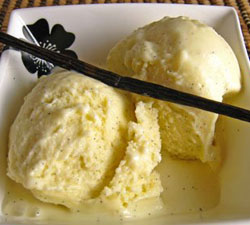
Ice Cream
Like the name suggests, ice cream is a frozen product made from cream. Milk is often adding to the mixture as well as other flavorings and sweeteners. Did you know that up to 60% of the volume of ice cream is air? This is introduced in the whipping process and gives ice cream a light and fluffy texture. This mixture is stirred slowly while cooling to prevent large ice crystals from forming; the result is a smoothly textured ice cream. Ice creams are further divided into categories based on the amount of butterfat they contain.
Premium Ice Cream has between 11% and 15% butterfat. While this ice cream is richer and denser you pay for it in the calorie count. Usually these premium ice creams come in small containers and have "gourmet" style flavorings.
Regular ice cream is somewhat less dense and contains 10% to 11% butterfat. This type of ice cream is sold in the standard larger containers, and contains the standard flavorings. This style is perfect for milkshakes.
Light Ice Cream means that there is EITHER 50% less fat OR 33% fewer calories than the regular ice cream produced by that particular company. But if you are calorie conscious look at the label. Light versions of the premium brands can have more fat and calories than the regular version of other brands. Light ice creams are made in a number of ways. Until recently this was what we called "ice milk" when I was growing up and simply made with milk instead of cream (often with the addition of gelatin).
Reduced Fat Ice Cream is required by law to have 25% less fat than that particular company's regular version.
Ice Milk is not a name you see too much anymore. This now-archaic term still holds nostalgic appeal for many long-time ice cream lovers. Ice milk is basically hard ice cream with less than 10% butterfat, but unlike sherbet, it's mostly dairy-based and often less sweet. Sold as a budget ice cream offering, superlative flavor and creamy texture aren't ice milk's strong points, but its slightly flaky, milky snow-cone qualities have their own unique appeal. In 1994, the FDA gave manufacturers permission to label ice milk as "low-fat ice cream," which not only meant the end of the ice milk name, but also that unique texture. Low-fat ice cream is pumped full of stabilizers to imitate full-fat ice cream's creamier body, which means old-fashioned ice milk is now decidedly a thing of the past.
Frozen Yogurt is a dessert is made of lowfat or nonfat yogurt plus sweetener, gelatin, corn syrup, flavoring and sometimes, coloring. It is churned in an ice cream machine. Frozen yogurt is available soft-serve and hard-packed. It both freezes and melts much more slowly than ice cream, since yogurt has a much higher freezing and melting point than milk. The beneficial bacteria Lactobacillus bulgaricus and Streptococcus thermophilus are believed to be killed when the yogurt is frozen. If you are making frozen yogurt at home, you can use nonfat yogurt and milk in place of regular milk and yogurt in the recipes. We recommend that you use a high quality ice cream maker to freeze these mixes as yogurts require a longer freezing time than ice cream.
If you are in the mood for esperimenting, some alternative milks for making homemade ice cream are oat milk and coconut milk.
+Jane's
Ice Cream in a Can
Easy Chocolate Ice Cream
New England Ice Cream
New England is the ice cream capital of the US, both for the density of its small-town ice cream shops and the generally excellent quality of ice cream you'll find there. Less well-known is that these shops are serving a style of ice cream all their own, which for lack of a better term I'm calling New England-style.
What does New England-style mean? Ice cream so chewy you have to bite it off the cone, not just lick. It's made with less air than other commercial ice creams, so it's dense and barely melts even in direct sun. Replicating New England ice cream at home is tricky, since home cooks can't adjust the amount of air that gets added to ice cream as it churns.
Philadelphia Ice Cream
Philadelphia ice cream—sometimes called New York ice cream, and other times American ice cream—has very little to do with the city of Philadelphia. (Or New York. Or America for that matter.) All it really means is an ice cream made without eggs, to distinguish it from "French" or "European"-style custard-based ice creams. Why the Philly name? James Beard theorized it was simply a way to class up the ice cream, as Philadelphia was an ice cream hot spot back in the 19th century.
Compared to egg-based ice creams, Philadelphia ice creams are lighter, fluffier, and melt more milky on the tongue. They tend to incorporate more air than custard ice creams, and because they lack egg yolks' stabilizing power, can turn icy fast. But if you're looking for a lightning-fast ice cream that tastes resoundingly of fresh milk and cream, one that doesn't have any fatty yolks to get in the way of your added flavorings, Philly is the way to go.
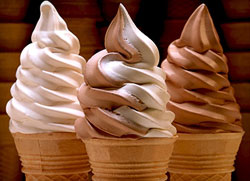
Soft Serve Ice Cream
As you might imagine, the defining characteristic of soft serve ice cream is that it is soft. It is often served in the form of a swirl, with servers twirling a cone or cup under the soft serve machine to create a tower of soft serve with a soft curl on top. It is mixed in a machine and dispensed on demand. The machine mixing includes a step which integrates a great deal of air into the ice cream, resulting in a product which is much lighter in texture and flavor than regular ice cream, and the result is characteristically soft and creamy, rather than hard, like traditional ice cream. The air content, called overrun, can vary from cone to cone, but at its highest can reach up to 60%.
Soft serve is also much lower in fat than conventional ice cream, because of the increased air content, and it has a lighter flavor. Soft serve ice cream is served at a much warmer temperature than conventional ice cream, and this can enhance the flavor. With both regular and soft serve ice cream, the ingredients are mixed at 21°F. Regular ice cream then goes into a hardening room where it becomes rock-solid at -40°F. Soft ice cream leaves off this last step and is perceived as tastier because it is warmer and doesn’t numb the taste buds.
Soft serve ice cream is especially common at burger joints and diners, and it can be found in many regions of the world, with a variety of toppings and in an assortment of flavors. One of the more charming aspects of soft serve ice cream, in the eyes of many fans, is that it is ephemeral. It generally tastes best right out of the machine, and it does not take well to being refrozen, forcing people to enjoy it on the spot. It also cannot be made at home, unless one happens to have a pressurized soft serve machine, so some people view it as a special treat eaten only when dining out.
Frozen yogurt is also available in soft-serve form.
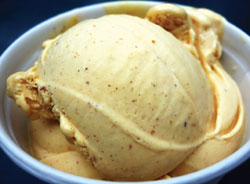
Frozen Custard - French Style Ice Cream or Glacée
An unknown food critic once said a frozen custard stand is 'where God gets His ice cream'. For thousands of frozen custard fans, this is probably not an exaggeration. Frozen custard is to regular ice cream what cream is to milk. Frozen custard is richer and creamier than standard ice cream, having an almost silky texture, because of a higher butterfat content, slower production time and less air blended into the mix.
There are two key types of ice cream: custard-based, or French-style ice creams, and Philadelphia-style ice creams (sometimes called New York- or American-style ice cream). Philadelphia-style ice cream is what we know as "regular" ice cream. The latter does not use egg yolks as an emulsifier. Instead - they're made by simply mixing cream, milk, sugar and the desired flavorings together. In the United States the Food and Drug Administration requires products marketed as frozen custard to contain at least 10 percent milkfat and 1.4 percent egg yolk solids. If it has fewer egg yolk solids, it is considered ice cream.
Custards are typically churned with less air and served at a slightly higher temperature - so the result is denser, smoother and less icy. All ice cream products must have air incorporated into the mix. Without the addition of air, eating ice cream would be like gnawing on a creamy ice cube. The amount of air introduced into the finished product is called overrun. While the introduction of air is necessary, too much becomes the enemy of both texture and flavor. Significantly less air is blended into a Custard mixture. Frozen Custard has 18%-20% overrun by volume as compared to 50%-70% overrun for ice cream and 60%-80% overrun for soft serve.
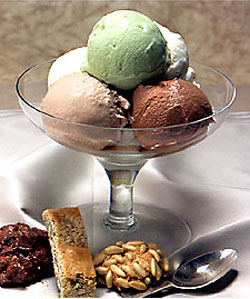
Gelato
Gelato (plural: gelati) is an old Italian frozen dessert (gelato traces its roots as far back as Renaissance Italy), a far more recent variant of which is ice cream. As such, gelato is made with some of the same ingredients as most other frozen dairy desserts. Milk, cream, various sugars, flavoring including fruit and nut purees are the main ingredients.
Gelato is different from ice cream, though, in that it has a lower butterfat content. Gelato typically contains 4–8% butterfat, versus 14% for ice cream in the United States. Gelato has a higher sugar content than ice cream. Dairy based gelato contains 16–24% sugar, whereas most ice cream in the United States contains 12-16% sugar. The sugar content in gelato is precisely balanced with the water content to act as an anti-freeze to prevent the gelato from freezing solid. Typically, gelato and Italian sorbet contain a stabilizing base. Egg yolks are used in yellow custard-based gelato flavors, including zabaione and creme caramel. Non-fat milk solids are also added to gelato.
Italian gelatos differ from French ice creams in having a more powerful flavor and denser texture, thanks to the inclusion of more solids and less air. Although they're usually made with milk instead of cream, they often contain more eggs than French ice creams and thus taste equally rich, if not richer. The result is a denser and more intensely flavored dessert. Unlike most commercial ice creams in the United States, which are frozen with a continuous assembly line freezer, gelato is frozen very quickly in individual small batches in a batch freezer. Churning during the freezing process incorporates air into the mix. The added air is called overrun. Unlike most commercial ice cream, which contains up to 60% overrun, the overrun in gelato is low, generally 20–35%. Lower overrun results in a denser product with more intense flavors.
In Italy, the mixture for gelato is typically prepared using a hot process, which includes pasteurization. White base is heated to 85 °C (185 °F). Heating the mix to 90 °C (194 °F) is essential for chocolate gelato, which is traditionally flavored with cocoa powder. Yellow custard base, which contains egg yolks, is heated to 65 °C (149 °F). The gelato mix must age for several hours after pasteurization is complete for the milk proteins to hydrate, or bind, with water in the mix. This hydration reduces the size of the ice crystals, making a smoother texture in the final product. A non-traditional cold mix process is popular among some gelato makers in the United States.
U.S. ice cream, with a higher fat content, can be stored in a freezer for months. High-quality artisan gelato holds its peak flavor and smooth texture only for several days. That is only when it is stored carefully at consistent, low temperatures.
Gelato is typically flavored with fresh fruit purees, cocoa and/or nut pastes. The best known gelato flavors are vanilla, a very rich vanilla called crema, and chocolate, often combined with hazelnuts (gianduia). Liqueur flavors are also popular, and so is espresso coffee. If other ingredients such as chocolate flakes, nuts, small confections, cookies, or biscuits are added, they are added after the gelato is frozen.
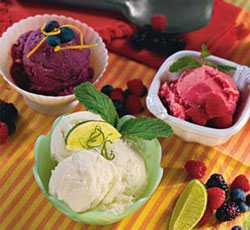
Sherbet
Like a sorbet (see below) sherbet (although it's spelled 'sherbet,' it is widely pronounced 'sherbert') is a fruit based product, but milk, unlike sorbet, is added for creaminess. By United States law it can contain no more than 2% butterfat. Sorbet, on the other hand, is considered by Americans to be a fruity frozen product with no dairy content, similar to Italian ice. Traditional flavors are lemon, lime, orange, and raspberry.
Sherbet in the United States must include dairy ingredients such as milk or cream to reach a milkfat content between 1% and 2%. In contrast, products with higher milkfat content of 10% or more are defined as ice cream, while those between 2% and 10% milkfat are termed "frozen dairy dessert"; products with lower milkfat content and not using any milk or cream ingredients, and no egg ingredients other than the egg white, are defined as water ice. The use of the term "sorbet" is unregulated and is most commonly used with non-dairy, fruit juice "italian ice" products.
Although some people may interchange the terms "sorbet" and "sherbet", usual usage by Americans and the manufacturers of these products bears a clear distinction. Sorbets are icier and more refreshing with flavor that hits you immediately, while sherbets will generally have a smoother, richer texture with slightly more subtle and lingering flavor due to the added dairy "slowing down" the flavors across your palate.
Orange Sherbet
Lemon Sherbet
Raspberry Sherbet
Lemon Pineapple Sherbet
Pineapple Coconut Sherbet
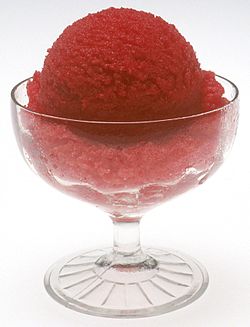
Sorbet
Sorbet is a frozen dessert made from sweetened water flavored with fruit (typically juice or puree), wine, and/or liqueur. The origin of sorbet is variously explained as either an ancient Roman invention, or a Middle Eastern drink charbet, made of sweetened fruit juice and water. In the first century C.E., Emperor Nero, who had a hankering for the cold, sweet stuff, had runners along the Appian Way pass buckets of snow from the mountains, hand over hand, until it reached his banquet hall, where it was mixed with honey and wine. Pre-dating Nero, the Chinese have made concoctions from snow, juice and fruit pulp for several thousand years. Sorbets are technically ices. These were probably the first iced dessert having been invented by the Asians and then introduced to the Middle East and Italy.
While sorbet and sherbet are both fruit-based desserts, the difference between them is that sherbets contain milk or another fat making it similar to ice cream whereas sorbets lack dairy. Because of the icy nature of the recipe sorbets are generally granular in texture where sherbets are creamy as a result of the added fat. Sorbets are a dense and extremely flavorful product and is served as a non-fat or low-fat alternative to ice cream. Sorbets contains 24–30% sugar.
Although sorbets are generally made with fruit, they can be made with any ingredient. For instance, there are chocolate sorbets as well as one made with champagne. Alcohol in sorbets lowers the freezing temperature, resulting in softer texture.
The smoothness of a sorbet is dependent on the secondary ingredients because of how they can change the structure of the frozen recipe. More or less sugar or alcohol or even the amount of water will make a big difference in the texture of the recipe.
Sorbet is often served as dessert, but can also be served as a palate cleanser between courses or, as with vegetable- or herb-flavored varieties, as a savory complement to a dish.
In Italy a similar though crunchier textured dish called granita is made. As the liquid in granita freezes it forms noticeably large-size crystals, which are left unstirred. Granita is also often sharded with a fork to give an even crunchier texture when served. Sorbets are often whipped to lighten its texture.
Easy Frozen Fruit Dessert (frozen concentrated juice mixed w/ a little sugar & ice, then blended)
2 Ingredient Healthy Mango Sorbet
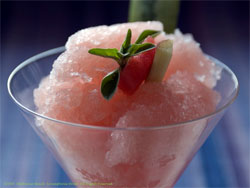
Granita
Granita, meaning granular in Italian, is a semi-frozen dessert made from sugar, water and various flavorings, usually in a 4:1 ratio of liquid to sugar. Originally from Sicily, although available all over Italy, it is related to sorbet and Italian ice but granita is not whipped and ice crystals are allowed to form giving it a more granular appearance, and a crunchy texture. Granita is made without an ice cream machine (not churned); instead, the sugar-syrup base, flavored with fruit purée, coffee, herbs and/or wine, is frozen in a pan. As the crystals on the top of the pan freeze, they are periodically scraped into a grainy sorbet. This scraping action prevents the formation of large ice crystals and creates the distinctive granular texture of granita.
In most of Sicily, it has a coarser, more crystalline texture than on other parts of Italy. This is largely the result of different freezing techniques: the smoother types are produced in a gelato machine, while the coarser varieties are frozen with only occasional agitation, then scraped or shaved to produce separated crystals.
Common and traditional flavoring ingredients include lemon juice, mandarin oranges, jasmine, coffee, almonds, mint, and when in season wild strawberries and black mulberries. Chocolate granitas have a tradition in the city of Catania. Granita is often found served as a slush-type drink rather than a dessert, in a paper or plastic cup with a plastic lid and a straw (often a spoon straw). Granitas are almost always fat-free, contain minimal additives and are the lowest in calories of all frozen desserts.
Mango-Lime Granita
Watermelon Granita
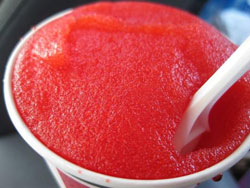
Italian Ice or Water Ice
Italian ice, also known as water ice, is a sweetened frozen dessert made with fruit (often from concentrates, juices or purées) or other natural or artificial food flavorings, similar to sorbet. Italian ice is not shaved ice that is flavored as are Snow Cones (see below); rather, it is made by the same process by which ice cream is made: freezing the ingredients while mixing them to achieve a smooth, icy texture. Italian ice differs from sherbet, another fruit-based frozen product, in that it does not contain dairy or egg ingredients, other than egg white.
Italian water ice is a smooth product, and although similar to a sorbet, it is generally sweeter and viewed more of a snack-type product than a refined dessert product.
A basic Italian ice recipe often starts with a simple syrup, made by dissolving sugar in hot water until it's fully dissolved. Some recipes also incorporate lemon juice or other flavorings at this stage. The simple syrup and flavor base are combined and then frozen. During the freezing process, the mixture is regularly mixed or churned to prevent large ice crystals from forming, resulting in a smooth, slushy consistency. Some methods utilize a batch freezer or ice cream machine for a finer, smoother texture.
Water ices like these are some of the world's oldest frozen desserts, but these days the New World (especially the Northeastern US) is their biggest home. The perfect companion to boardwalk fare or pizza from a slice joint, they're an essential part of Italian-American fast food culture, and the most famous brands command impressive loyalty even for sub-par, artificially flavored products.
It is served in Italian ice shops, as well as by street vendors. Common flavors include blue raspberry, cherry, lemon, mango, orange, strawberry, and watermelon, with numerous other flavors available. "Rainbow" ice, consisting of three different flavors/colors is also popular.
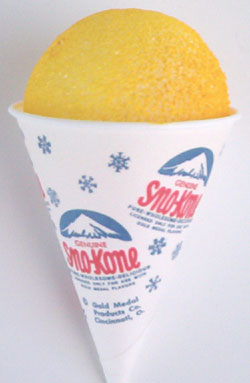
Snow Cones
The snow cone is said to have been invented in 1919; one year later, a man named Samuel Bert devised the first snow cone machine and began selling the treats at the State Fair of Texas. Snow cones, made from balls of crushed ice topped with bright-colored sweet syrup and served in a paper cone or cup, are consumed in many parts of the world. The most common places to find snow cones in the United States are at amusement parks and fairs.
The syrups are usually fruit-flavored (apple, banana, cantaloupe, cherry, colada, grape, kiwi, lemon, lime, mango, orange, peach, pineapple, raspberry, strawberry) but can also be spice (e.g. cinnamon) and pop flavors like bubblegum and cola. Snow cones served in a cup are eaten with a spoon; those in a paper cone are eaten like an ice cream cone. They are different from water ice in that water ice is flavored at the time of factory production, while snow cones are shaved and flavored "to order." Interestingly, snow cones are the descendents of the original "ice cream," which was snow flavored with fruit juice, created 4,000 years ago by the Chinese and learned through trade routes by the Persians 2,500 years ago.
Shaved Ice and Hawaiian Shave Ice - Originating in Japan in the 12th century or earlier, where it is known as kakigori, shave ice is simply that: ice shaved from a block of ice, flavored with syrup, which absorbs into the fine texture. The ice shavings appears snow-like and some people may call it a snow cone; but snow cones are made from crushed ice. The product is popular throughout Asia and Hawaii. Flavors will vary by country: from traditional American flavors (berry, citrus) to tropical flavors (guava, kiwi fruit, mango and passion fruit. Hawaiian shave ice is traditionally served with three flavors ("rainbow ice") atop a scoop of vanilla ice cream.
Shaved ice is similar to granita, but not as hard. The ice, frozen in a bowl or pan, is scraped up and served as required. By contrast, granita is flaked as it freezes, so the flaked ice is ready to scoop and serve.
*How to Convert Baume to Brix
Degrees Baume and degrees Brix both indicate the sugar content of a substance. Producers of wine, beer, juice, maple syrup, corn syrup and honey use these measurements, according to David Ball in the "Journal of Chemical Education." Measurements in degrees Baume use a scale of specific gravity -- the density of a substance in relation to the density of water -- and are used when there is a known relationship between the sugar concentration and the specific gravity of the substance. The Baumé of distilled water would be 0.
Measurements in degrees Brix indicate the number of grams of sucrose per 100 grams of the substance; 10 degrees Brix means 10 grams of sugar per 100 grams. The Brix scale is simplicity itself: Each degree is equivalent to 1 percent of sugar in the juice. For example, grape juice which measures 15.5 degrees on the Brix scale contains about 15.5% sugar.
Baume is a system for measuring the sugar content of a substance by its density. It is not easy to use though because the numbers aren't easy to handle: Each degree Baume is equal to approximately 1.75% sugar in the juice. Baume is the more scientific scale, since its based on the specific gravity of a substance.
To Convert Baume to Brix:
- Check to ensure that the specific gravity of the substance characterized using degrees Baume is greater than that of water. The Baume scale uses a different scale for substances with a specific gravity less than that of water, but for grapes and syrups the density should be greater.
- Multiply the degrees Baume by 1.905.
- Subtract 1.6 from this number to obtain degrees Brix.
