Beef Oven Roasts
When it comes to roast beef, the most common cuts are very different. The one that's best for you at any given meal is the one that meets your needs. The roast that's best for a special-occasion meal won't necessarily make the best sandwiches or the tenderest pot roast. Knowing which roast to pick for which purpose is the surest way to always choose the best. An oven roast is usually a minimum of 2 inches thick. The dry heat of oven roasting enhances the flavor and tenderness of the beef if it is not overcooked.
Best for Special Occasions
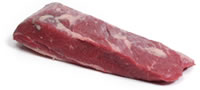
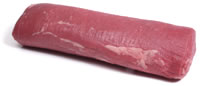
When you're looking for a premium roast for special occasions, three cuts stand out. The most visually impressive is the prime rib, with its massive, curving rib bones. It's the most richly marbled of beef roasts, and very tender. The strip loin -- the cut that's used for New York strip steaks -- is its closest rival in flavor and tenderness. It's a relatively flat, oblong cut, so it lacks the imposing visual appeal of a prime rib. For health-conscious diners who want a tender roast with less fat than those other options, the clear choice is a tenderloin. It's the tenderest cut on the steer, but much leaner than rib or strip.
Best Value for Family Meals
Premium roasts are out of place at ordinary meals, where they'd put a severe dent in your grocery budget. The ideal roast for a sit-down weekend meal is still tender, but rather less costly. Some are cut from the sirloin, a section between the loin and the tougher round. Look for top sirloin and the triangular tri-tip, both of which are excellent. Eye of round is another good option, a compact and lean roast that cooks evenly because of its nearly cylindrical shape. It's not as tender as the sirloin cuts, so it should be sliced more thinly.
Best for Sandwiches
The rich marbling that makes rib roasts or strip roasts so tasty becomes a flaw when you want roast beef for sandwiches. Here, leanness and a dense, even texture is the combination you're looking for. Cuts from the round are perfect for sandwich beef. They have the right texture, and they're large muscles that provide big, even slices to cover your bread or wraps. Pick a big bottom round roast for large slices or eye of round for neat, round slices.
Best for Pot Roast
Paradoxically, all the things that make for a bad oven roast -- tough muscles, gristle and connective tissue -- are advantages in a pot roast. The long, slow cooking required for a good pot roast breaks down the muscle fibers and transforms stringy connective tissue into tasty, gelatin-rich juices. Chuck roasts from the shoulder make especially rich and flavorful post roasts, perfect for a weekend meal. Leaner tough cuts including the brisket and bottom round are less flavorful, but slice more neatly and make a better appearance. They tend not to be as moist as chuck roasts, so be generous with the sauce or gravy.
Loin, Sirloin and Rib Roasts
Tenderloin Roast
|
The tenderloin is the inside muscle of the short loin. It is the most expensive cut of beef and can be roasted whole or it can be cut into tender, boneless steaks. The tenderloin roast is also known as:
Trimming a Beef Tenderloin |
Rib-Eye Roast (boneless)
|
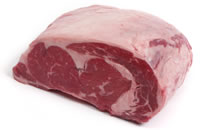
Rib Eye Roast is a rib roast that has been carved off the bone. It is the same piece of meat as a standing rib roast minus the bones. Beef has thirteen ribs, and usually seven of those are contained in the "rib" cut. The chuck contains the first five ribs, while the thirteenth rib is usually left on the short rib at the packing plant. Those ribs closest in proximity to the short loin are the most tender, while the ones nearest the chuck are less so. Thus, the primal rib cut (rib-eye roast) normally contains the sixth through the twelfth rib, leaving just the rib-eye muscle to comprise the roast. It is tender, flavorful, and expensive. The rib-eye roast is also known as a Delmonico roast. What is called the "cap" is the muscle that forms a crescent-shaped outer portion of many, but not all, rib steaks. It's acknowledged by many to be the single best part of the beef there is. The largest part of the cap muscle spans ribs 8 to 10, which means that it's the middle of the rib primal. |
Standing Rib Roast (Prime Rib)
|
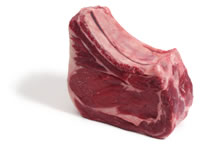
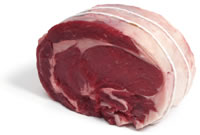
A rib roast that includes the bones is also known as a standing rib roast. Because of its size, a full rib roast (ribs 6 through 12) is often cut and sold as two separate roasts known as the first cut rib roast and the second cut rib roast. The first cut is also called a small end rib roast and includes ribs 9 or 10 through 12, which is next to the loin primal. The second cut, also known as the large end rib roast, includes ribs 6 through 8 or 9 and is next to the chuck primal. Although it is very tender, its proximity to the chuck means that it is slightly less desirable than a first cut rib roast. Prime Rib: Do not confuse "Prime" rib with the USDA beef grade called Prime. The beef roast known as "Prime Rib" refers to a rib roast, but it doesn't necessarily refer to a rib roast that is graded USDA "Prime". Prime grade rib roast may be available to some restaurants, but is rarely available to the generally public unless it is specially ordered. Most rib roasts sold in food stores are graded USDA "Choice". Standing Rib Roast (Prime Rib) |
Rolled Rib Roast
|
A rib roast that is boned, rolled, and tied is known as a rolled rib roast. |
Top Loin Roast
|
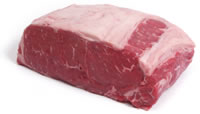
The top loin is the largest muscle of the short loin. The top loin roast is cut from the top loin and it is also known by the following names:
|
Top Sirloin Butt Roast
|
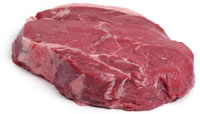
The top butt is one of the two main muscles of the sirloin. The top butt is a bit better in quality than the bottom butt and is very suitable for oven roasting if it is not overcooked. *Beef Kebabs in Pita (Souvlaki) |
Tri-Tip Roast (also known as Triangle Roast)
|
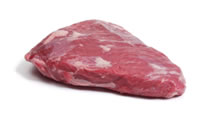
The tri-tip is a triangular shaped cut at the tip of the sirloin and is surrounded by the remainder of the sirloin and the round and flank primals. It can be used as an oven roast or it can be cut into steaks. The tri-tip is excellent when barbecued or grilled, but it can easily become very tough if cooked improperly. The fat should not be trimmed until after cooking because it helps to seal in the juices, keeping the meat tender. The tri-tip roast is also known as the triangle roast. |
Round and Rump Roasts
Bottom Round Roast
|
The bottom round is a section of the round separated from the top round and the eye of round by thin layers of fatty membrane which we call seams. The bottom round makes a decent to very good oven roast depending on one's ability. It can be quite dry if overcooked. Cook medium rare to medium for best results and cut thin slices against the grain. It also can be cooked as a pot roast with good results or cut into steaks for Swissing. Also makes outstanding stew meat or ground round. |
Boneless Rump Roast
|
A boneless rump roast is sometimes sold as is or it may be rolled and tied before it is packaged and sold. |
Standing Rump Roast |
A standing rump roast is a rump roast that has not had the bone removed. It can be very flavorful and tender when pot-roasted. |
Eye Round Roast
|
The eye of round is a dandy little boneless roast cut from the full cut round and is the eye muscle of the bottom round. It is lean and makes a great oven roast if not overcooked. Because of its solid structure it is great for slicing thin for French dip sandwiches. Cook medium rare to medium for best results and cut thin slices against the grain. The eye round roast can be a bit tough, so it is also often cooked using a moist heat process such as pot-roasting. |
Top Round Roast
|
The top round roast is obtained from the top round muscle. It is one of the better cuts from the round primal in terms of flavor and is a nice solid piece of meat that makes a very nice oven roast. The top round is also used to make London broils which are great on the grill if not overcooked and sliced thin against the grain. Pot-roasting is the recommended cooking method for a top round roast by many, because it can be a bit chewy if cooked with dry heat methods. The key when dry roasting is to slice it thin against the grain. |
Round Tip Roast
|
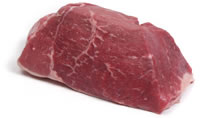
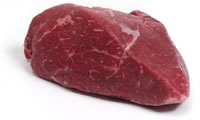
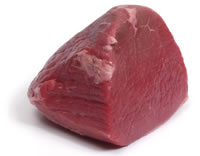
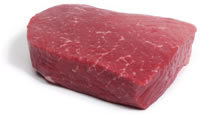
The round tip is next to the sirloin tri-tip so it is a bit more tender than other round roasts. It may be oven roasted if it is of top quality and it is often cut into pieces for use as kabob meat. |
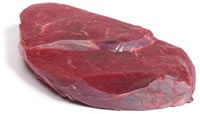
Beef Pot Roasts
Cuts from the chuck are among the most popular cuts for pot-roasting (braising). They have plenty of connective tissues that melt when the meat is pot-roasted making it tender and flavorful. Beef cuts from the round and brisket are also used. Cuts used for pot roast benefit from the moist heat of pot-roasting, which helps to tenderize the meat.
Boneless Chuck Eye Roast
|
The chuck eye is a continuation of the rib-eye meat. It is similar to the rib-eye meat of the rib primal (ribs 6-12) except that it is located in the chuck primal (ribs 1-5). The chuck eye is also not as tender as the rib-eye meat, but it is still one of the most tender of the chuck roasts. The chuck eye roast is usually braised, but it can also be oven roasted if it is not overcooked. Alternate names for the chuck eye roast include:
|
Top Blade Roast
|
The top blade is located above the shoulder blade and is known as the top blade roast. Although it is usually braised, it is tender enough to be oven roasted if it is not overcooked. Other names for the top blade roast include:
|
Mock Tender Roast
|
The mock tender is often sold as a roast and is a cone shaped muscle next to the top blade in the chuck primal. The name "mock tender" is misleading because the meat isn't very tender and is best when it is braised. Alternate names for the mock tender roast include:
|
Under Blade Roast
|
The under blade is directly below the shoulder blade and is sold as the boneless under blade roast or under blade steaks. It is also known by the following names:
|
7-Bone Roast
|
The 7-bone roast is a cross cut roast of the shoulder blade. It gets its name from the cross cut of bone that is shaped like a "7". The 7-bone roast is one of the most popular for pot-roasting because it is the leaner section of the chuck. It is also known by the following names:
|
Arm Roast
|
The arm roast is one of the most popular pot roasts. It can be reduced to a smaller cut known as an arm steak, which is also known as Swiss steak. The arm roast is also called:
|
Boneless Shoulder Roast
|
The boneless shoulder roast is also know as the English roast and is located behind the arm roast. |
Cross-rib Roast
|
A cross-rib roast contains the meaty portions on the top of ribs 3 through 5. The best results occur when it is pot-roasted. The cross-rib roast is also known by the following names:
|
Neck Pot Roast
|
The meat is obtained from the seven neck vertebrae. Stew meat is also cut from this area. |
Brisket
|
The brisket is located between the fore shank and the plate. It is usually sold boneless and it is flavorful, but tough. Pot-roasting helps to make the meat more tender. A full brisket may weigh 10 pounds or more, so it is usually cut into two sections. The front half is known as the point cut or thick cut. The back half is known as the flat cut or thin cut and is more commonly found in food stores than the front half. It is also a common practice for food stores to cut both halves of the brisket into several portions and offer them as smaller roasts. The flat cut is lean, but it has a layer of fat on the surface while the point cut contains more internal fat than the flat cut. The fat in both of these cuts helps to moisten the meat when it is pot roasted. Smoked Beef Brisket w/ Beer Mop |